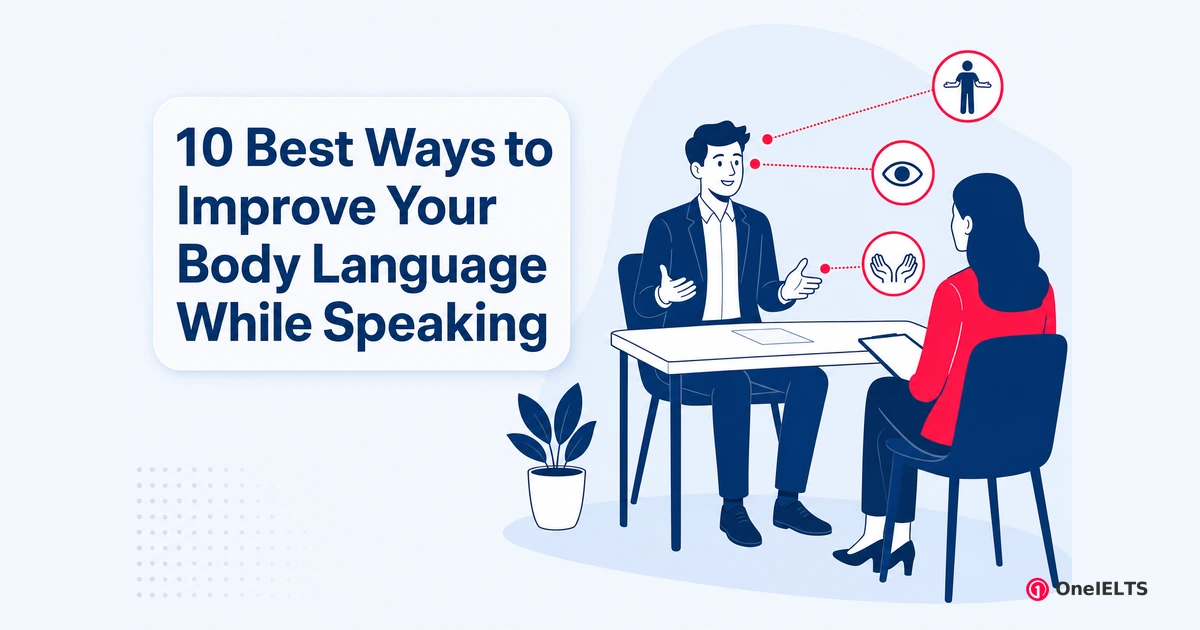
To improve your body language while speaking, start with an open posture, steady eye contact and intentional hand gestures. Your posture, face, hands and breath carry nonverbal communication that tells a listener how confident you are. Next come its definition, importance and seven types, then ten ways, the warning signs and a scoring answer for IELTS Speaking test candidates. The ten ways run from stance to video review.
- Keep an open posture and stance, limbs uncrossed.
- Use natural eye contact and a relaxed face.
- Use open hand gestures with palms in view.
- Match hand gestures to your words, on time.
- Control nervous hand movement with a resting place.
- Steady your breathing to relax shoulders and voice.
- Mirror positive body language without copying every move.
- Build confidence in speaking so movements stay calm.
- Study body language examples and pictures in pairs.
- Record yourself while speaking, then review the video.
What Is Body Language?
Body language is the nonverbal communication that travels with your words: posture, eye contact, facial expressions, gestures, movement, use of space and the voice qualities around speech. A listener reads it alongside what you say.
Most of it runs without conscious control, which is why nerves leak into it before you notice. These nonverbal cues can support your verbal message, add to it or contradict it. A nod with “yes” supports the word, while a shrug with “I’m sure” undercuts it.
Improving body language means making those signals deliberate and consistent with your message. It doesn’t mean performing a set of poses.
Why Is Body Language Important When You Speak?
Body language decides how confident, honest and engaged a listener thinks you are, and it changes how your words land. Mixed signals, such as a confident sentence said with crossed arms and a lowered gaze, make a listener trust the body over the words.
Open palms and a light smile shape a warm first impression. Eye contact keeps a listener with you, and a well-timed gesture marks your key point. The effect runs inward too, since an upright posture and slower breathing make it easier to keep talking.
The 7-38-55 rule needs a correction. Albert Mehrabian’s figures came from experiments on single words expressing feelings, and his own site says the equations don’t apply unless you’re talking about feelings or attitudes. Your credibility rests on signals and words agreeing.
What Are the 7 Types of Body Language?
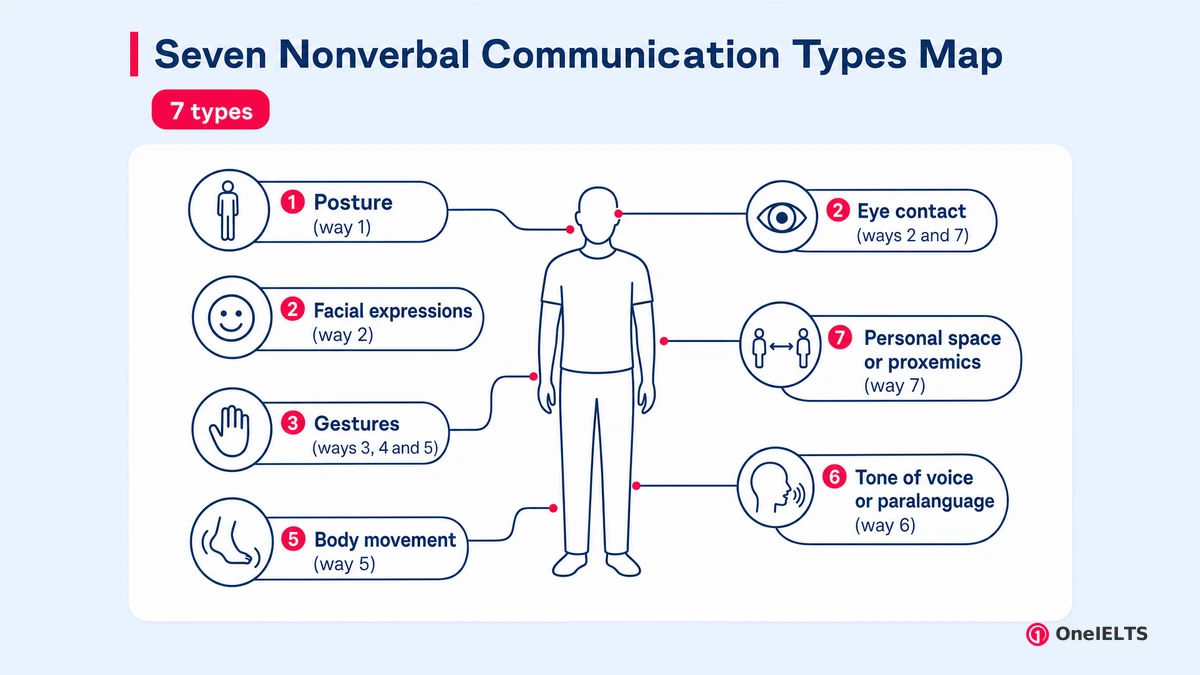
The seven types usually listed are posture, eye contact, facial expressions, gestures, body movement, personal space and tone of voice. Textbook lists vary, and some add touch or appearance, so the seven here follow a speaking-focused grouping. Each type maps to the numbered way that trains it.
- Posture: how you sit or stand, trained by way 1 on open stance.
- Eye contact: where your gaze rests, trained by way 2 and by way 7.
- Facial expressions: the smile and reactions on your face, covered in way 2.
- Gestures: what your hands do, trained across ways 3, 4 and 5.
- Body movement: rocking, swaying and foot tapping, handled by way 5 on nervous habits.
- Personal space (proxemics): the distance you keep, matched to your listener in way 7.
- Tone of voice (paralanguage): pitch, volume and pace, steadied by the breathing in way 6.
1. Keep an Open Posture and Stance
An open posture means sitting or standing tall with your shoulders back, chest open, feet planted, and arms and legs uncrossed. Crossed arms read as defensive even when you’re only cold, and slouching reads as low energy. Five quick checks keep your stance open.
- Shoulders rolled back, chest open. Roll your shoulders up and back, then let them drop.
- Feet flat and shoulder-width apart. Plant both feet so your weight stays even and you stop shifting.
- Arms and legs uncrossed. Crossed limbs close your chest, and listeners read that shape as defensive.
- Sitting upright, leaning slightly forward. A small forward lean shows interest, while sinking back into the chair shows the opposite.
- Head level, chin neither raised nor tucked. A raised chin looks arrogant and a tucked one looks unsure.
For a seated speaking test, sit back in the chair with both feet on the floor and your hands resting loosely on the desk or your lap. That’s the seated posture worth rehearsing at home.
2. Use Natural Eye Contact and a Relaxed Face
Hold warm, steady eye contact for roughly half to 60% of the time you’re talking, and look away briefly while you think. A light, genuine smile and facial expressions that respond to the topic show you’re engaged. The 50-60% figure is a coaching rule of thumb, not a research result. These five habits cover your eyes and face.
- Aim for 50-60% eye contact. Look at your listener for roughly half your speaking time, then glance away.
- Break gaze while thinking, then return. Glancing aside to find a word is natural, so come back when you resume.
- Avoid staring or darting eyes. Staring feels like pressure and darting eyes look nervous, so keep your gaze soft.
- Light, genuine smile. A small smile that reaches the eyes relaxes both you and the listener.
- Expressions that match the topic. Look serious about a problem and brighter about a happy memory.
Comfortable eye contact follows cultural norms that differ between countries and even within India, so steady and friendly beats intense.
3. Use Open Hand Gestures
Keep your gestures moderate and visible in the gesture zone, between chest and waist level, with your palms open. Exposed palms signal openness and trust, while hidden hands leave a listener guessing. Four open gestures do most of the work in conversation.
- Open palms when explaining. Turn your palms up or toward the listener as you give a reason.
- Counting points on your fingers. Raise one finger for your first point and two for your second.
- Showing size or comparison with your hands. Spread your hands for “huge” or hold them apart to compare.
- Hands resting loosely between points. Let your hands settle together after each gesture so the next one stands out.
Avoid pointing at the listener, hands in pockets and gestures above the shoulders, which pull attention away from your face.
4. Match Hand Gestures to Your Words
A gesture works when it lands on the word it supports, like a count on “first” and “second” or a widening hand on “huge”. Synchronized gestures add emphasis to the word they land on. Random or late ones distract.
Gesturing can also help you find words. Rauscher, Krauss and Chen (1996, Psychological Science) found that stopping speakers from gesturing made their speech less fluent on spatial content, which links gesture to word retrieval. Matched gestures also set your pacing in a long answer, since each movement marks one point.
Here’s one sentence with the gestures marked: “My hometown has [two fingers] two things worth seeing, a [wide sweep] huge river and a [small pinch] tiny old fort.”
5. Control Nervous Hand Movement
Fidgeting, touching your hair or face, clicking a pen and tapping your feet leak nerves and pull the listener’s eyes away from your face. Suppressing nervous habits rarely lasts, but replacing them does. A fixed resting position gives your hands a job, and each habit loses the job it was doing.
Each common habit maps to a replacement you can practice this week.
| Nervous habit | What to do instead |
|---|---|
| Fidgeting with a pen or ring while you think of the next point | Rest your hands loosely together on the desk or in your lap |
| Touching hair or face, the most visible form of self-touching | Keep your hands in the gesture zone between chest and waist |
| Tapping feet or bouncing a knee under the desk while you talk | Plant both feet flat on the floor, shoulder-width apart, and stay still |
| Rocking or swaying in the chair as your answer gets longer | Settle your weight evenly across both hips and keep your back upright |
| Crossing arms when you’re unsure of an answer or a word | Open your palms on the desk and let the short pause be visible |
6. Steady Your Breathing and Body Language
Shallow, fast breathing tightens your shoulders and throat and speeds up your speech. Slow diaphragmatic breathing relaxes your posture, steadies your voice and gives you natural pauses between ideas. A four-step routine trains this until it runs without counting.
- Breathe in through the nose for four counts, keeping your mouth closed and shoulders still.
- Let the stomach, not the shoulders, rise, with one hand on your stomach to check.
- Breathe out slowly for six counts, letting your shoulders drop a little further each time.
- Pause at sentence ends to take the next breath, so each pause sounds planned.
A steady breath sets your volume and pitch at an even level, and that tone of voice is the vocal side of body language.
7. Mirror Positive Body Language
Subtle mirroring, matching a listener’s open posture, pace and energy, builds rapport. Copying every move signals mimicry, so mirror the overall mood and leave the details alone. The list covers five positive signals worth picking up from the person you’re talking to.
- Nodding while the other person speaks. A slow nod shows active listening and invites them to keep going.
- Leaning slightly forward. A small lean toward the speaker signals interest without crowding their space.
- Matching a calm speaking pace. Slow down when your listener speaks slowly, so the conversation keeps one rhythm.
- Returning a smile. Smile back when someone smiles at you, because ignoring it reads as cold.
- Keeping an open, relaxed posture. Keep your arms and shoulders as open as theirs when your listener sits relaxed.
Mirror the listener’s openness, never their nervous habits.
8. Build Confidence in Speaking to Improve Body Language
Much “bad” body language is a symptom of not knowing what to say next. The more fluent and prepared you are, the less your body has to compensate.
A learner speaking a second language often freezes, looks down or over-gestures during a word search, and the listener sees the struggle before hearing it. Speaking confidence grows from preparation you can repeat. Practice answers to common question types, learn a small set of linking phrases, and build topic vocabulary for subjects such as work, study and your hometown.
Each step lowers the load, and fluency frees your eyes and hands for the listener. Start with our guide on how to speak English.
9. Study Body Language Examples and Pictures
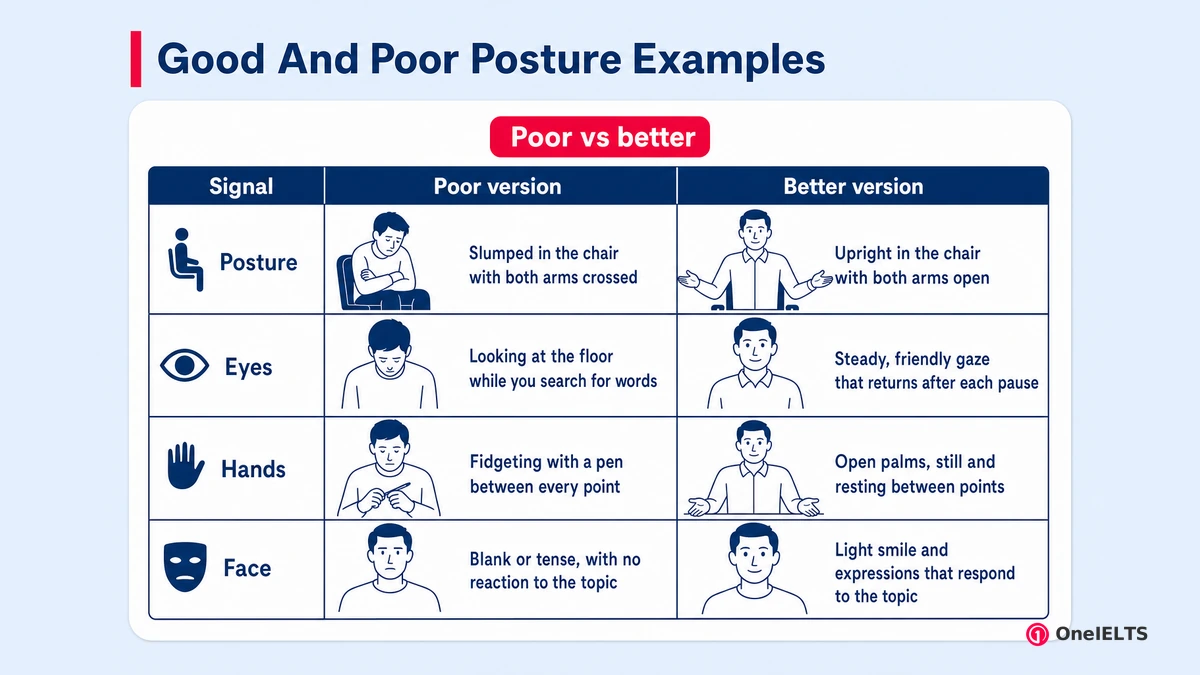
Seeing body language speeds up learning it, so compare good and poor versions side by side before you try them. Treat these body language examples as a visual comparison: picture or sketch each pair, then copy the better one in a mirror.
The table maps the gap between good and poor posture, gaze, hands and face across four signals.
| Signal | Poor version | Better version |
|---|---|---|
| Posture | Slumped in the chair with both arms crossed | Upright in the chair with both arms open |
| Eyes | Looking at the floor while you search for words | Steady, friendly gaze that returns after each pause |
| Hands | Fidgeting with a pen between every point | Open palms, still and resting between points |
| Face | Blank or tense, with no reaction to the topic | Light smile and expressions that respond to the topic |
10. Record Yourself to Improve Body Language While Speaking
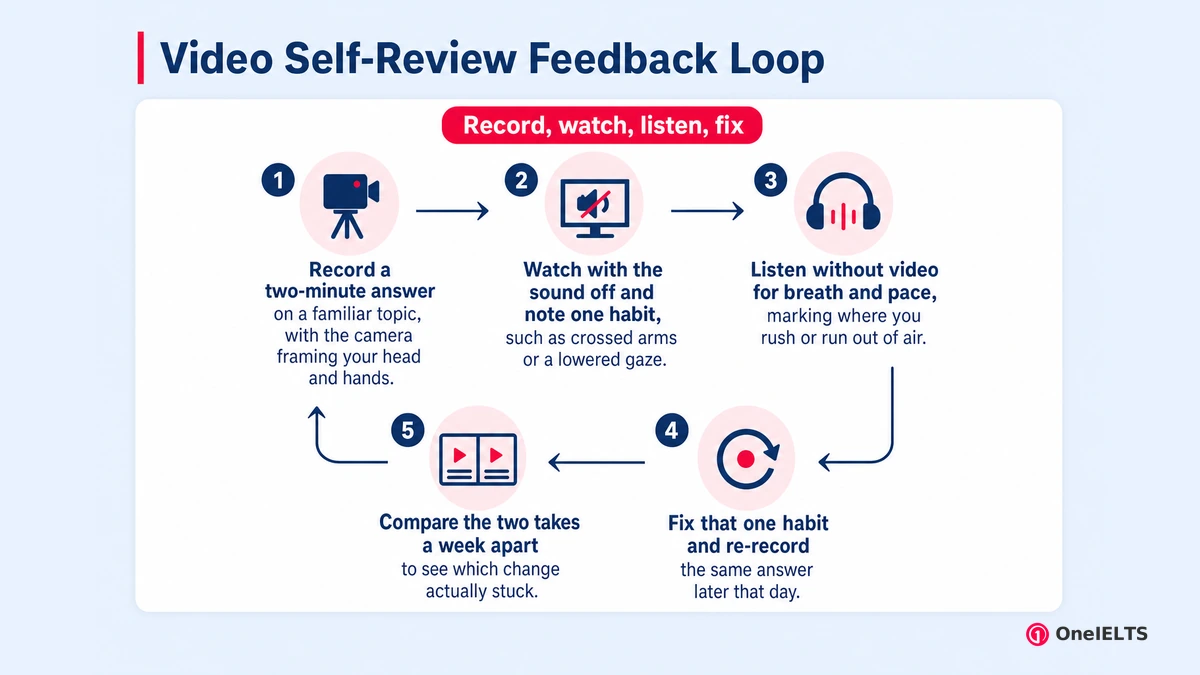
Video recording is the only honest mirror you have. Record a two-minute answer, watch it once with the sound off for posture, eyes and hands, and once listening only for breath and pace. The silent viewing is usually the uncomfortable one, because habits you never feel, like touching your face mid-sentence, are obvious on screen. That self-review becomes a feedback loop when you repeat it.
Five review steps make one full cycle.
- Record a two-minute answer on a familiar topic, with the camera framing your head and hands.
- Watch with the sound off and note one habit, such as crossed arms or a lowered gaze.
- Listen without video for breath and pace, marking where you rush or run out of air.
- Fix that one habit and re-record the same answer later that day.
- Compare the two takes a week apart to see which change actually stuck.
For a timed prompt to record against, use the free IELTS Speaking mock test.
What Are the Signs of Poor Body Language?
The clearest signs of poor body language are crossed arms, slouching, avoiding eye contact, fidgeting, a tense or blank face, and gestures that don’t match what’s being said. Together they form a closed posture that listeners read as distance or disengagement. Each sign below comes with the reading a listener usually takes from it.
- Crossed arms: listeners read you as defensive or closed to their point.
- Slouching: suggests low energy or disinterest, even when you’re simply tired.
- Avoiding eye contact: looks nervous or evasive, as if you’re hiding something.
- Fidgeting: signals anxiety or impatience and pulls attention from your words.
- Blank or tense face: reads as disengaged, bored or lost in the conversation.
- Mismatched gestures: suggest you’re unsure of your own message or reciting it.
The ten numbered ways above cover a fix for each of these signs.
Does Body Language Affect Your IELTS Speaking Score?
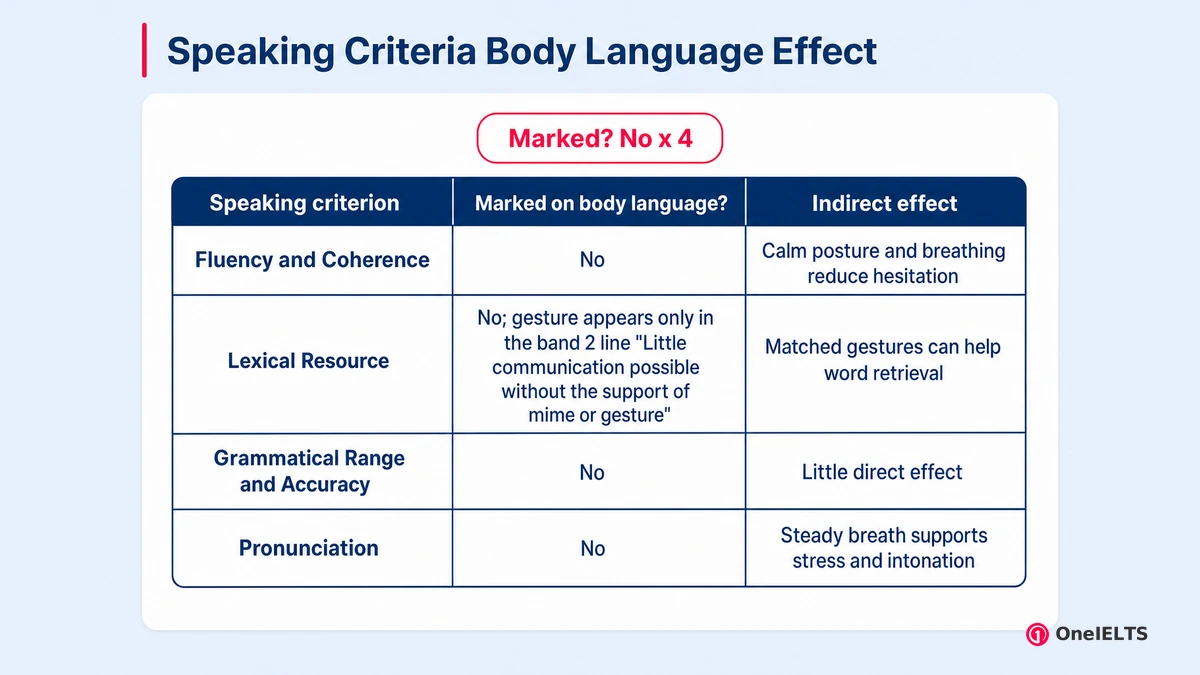
No, not directly. Body language is not one of the four IELTS Speaking criteria, so the examiner awards no band for posture, gestures or eye contact. It can still help indirectly, because a calm, open posture and steady breathing make it easier to keep talking fluently and to pronounce clearly.
The IELTS Speaking band descriptors score four criteria, each touched only indirectly.
| Speaking criterion | Marked on body language? | Indirect effect |
|---|---|---|
| Fluency and Coherence | No | Calm posture and breathing reduce hesitation |
| Lexical Resource | No; gesture appears only in the band 2 line “Little communication possible without the support of mime or gesture” | Matched gestures can help word retrieval |
| Grammatical Range and Accuracy | No | Little direct effect |
| Pronunciation | No | Steady breath supports stress and intonation |
The Speaking test is recorded, per ielts.org. IDP describes an audio recording for the face-to-face test and a video recording for video-call Speaking, so any re-mark judges your language. Checked on 7 October 2026. Forced power poses help nobody; just get comfortable enough to talk.
Can the Examiner See Your Body Language in IELTS Speaking?
Yes, the examiner sees you, because the Speaking test is a live face-to-face conversation, or a live video call at some test centers. But the band is awarded on what you say and how it sounds.
In video-call Speaking, upright posture and eye contact with the screen help you feel present, while hand gestures matter less. The face-to-face test is recorded too, and re-marking judges language alone. The IELTS Speaking test format page explains both modes.
What Body Language Should You Use With the IELTS Examiner?
Use the calm, open habits from the ten ways above, scaled down for a desk and one listener. Five of them carry straight into the test room.
- Sit upright with feet flat and hands relaxed on the desk or resting in your lap.
- Look at the examiner as you would a friendly interviewer, steady but never fixed.
- Use small, natural gestures in the Part 2 long turn to mark each new point.
- Glance at your Part 2 notes, then look back up, using your cue card notes as a quick prompt.
- Smile on arrival and when you finish, which costs nothing and settles your nerves.
The examiner follows an examiner script and may look down at papers or a timer. That’s normal and isn’t a reaction to you. More test-room advice sits in our IELTS Speaking tips.
How Can You Stop Nervous Body Language Before IELTS Speaking?
The way to stop nervous body language before IELTS Speaking is to calm the body first — slow breathing, relaxed shoulders, still hands — and let the words follow.
In the waiting area, run the four-in, six-out breathing routine from way 6. Then say a short warm-up answer quietly in English, such as two sentences about your hometown. Some test-day nerves are normal, examiners expect them, and they aren’t scored. For longer-term fixes, see how to overcome IELTS test anxiety.
Does Better Body Language Improve Your English Communication Skills?
Yes, better body language improves your English communication skills, because listeners follow and trust a speaker whose signals match the message. Nonverbal signals support communication, but they don’t replace vocabulary, grammar or pronunciation, which is why body language carries no IELTS band of its own. Listener trust grows when both layers agree. For listening, clear sentences and feedback, see how to improve English communication skills.
Written by Rifah Binte Faruk, reviewed 7 October 2026.
Last verified: 7 October 2026