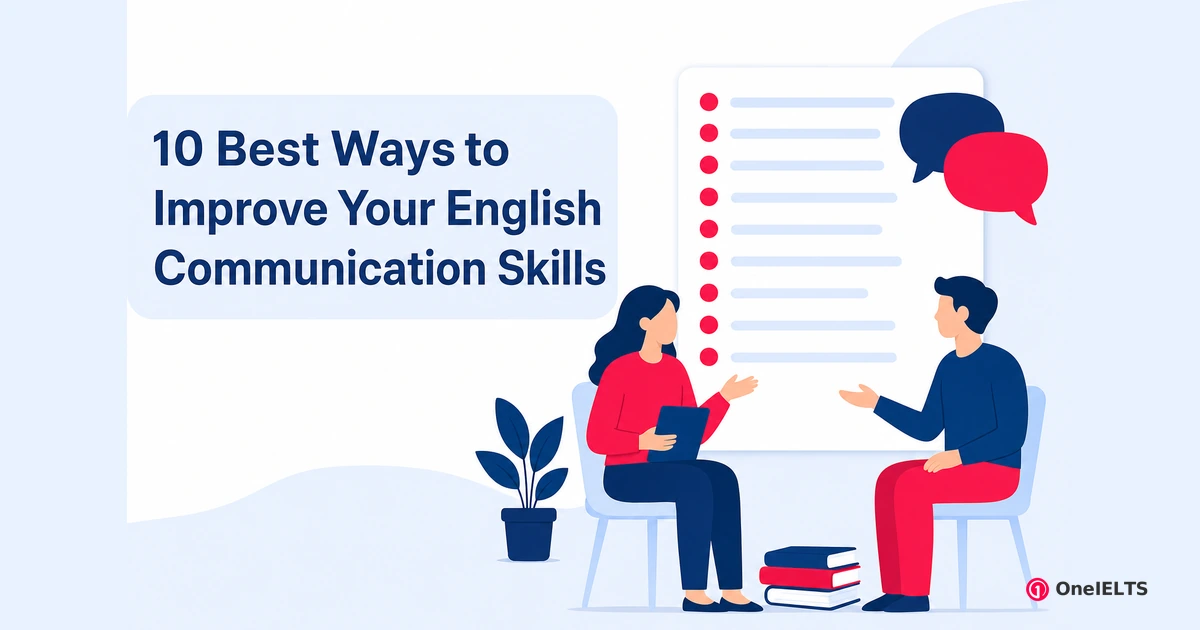
English communication skills carry your message out and bring the reply back. Most advice: speak daily, hear native audio and keep sentences clear. The IELTS Speaking test also scores four speaking criteria, mapped tip by tip at the end. Fluency drills live at speak English fluently, examiner tactics at communicating effectively. Ten habits follow.
- Practice speaking English every day, even for 10 minutes.
- Listen more than you speak, using active listening.
- Keep sentences clear and concise, one idea each.
- Expand your vocabulary in context, phrase by phrase.
- Prepare ahead of time before you speak.
- Watch your tone of voice and adapt to listeners.
- Have real conversations in English with people.
- Immerse yourself in English movies, news and podcasts.
- Read aloud and write in English every day.
- Record yourself and use feedback to keep improving.
What Are the 5 Good Communication Skills?
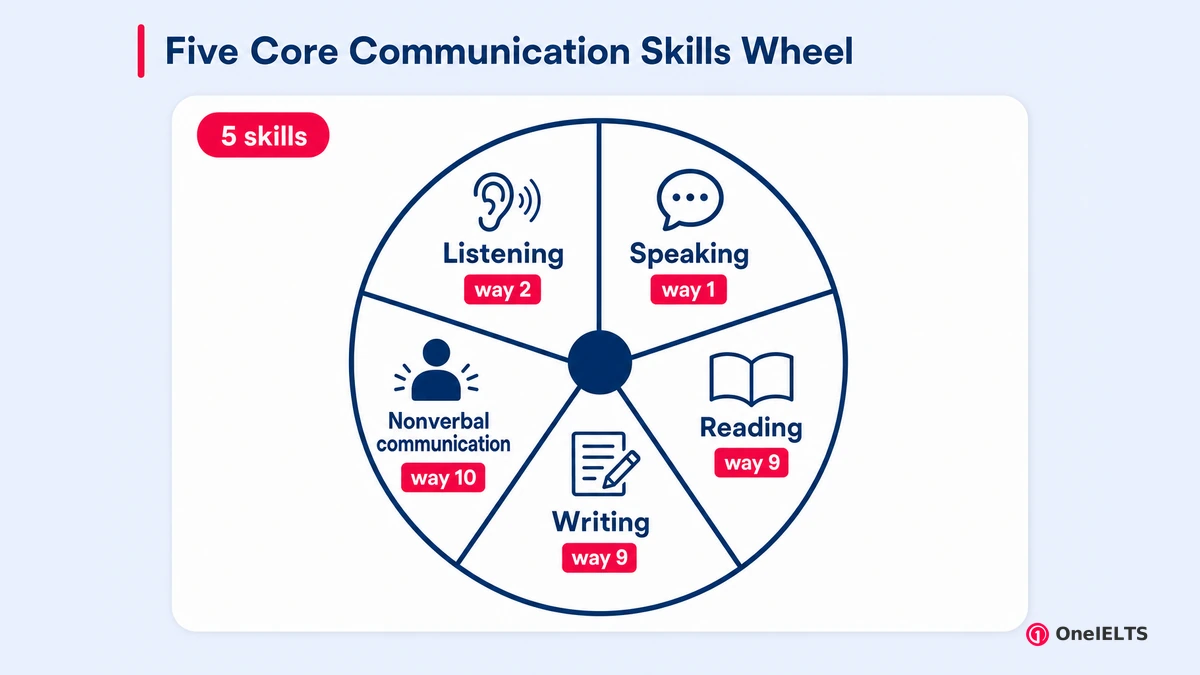
The five skills behind good communication in English are listening, speaking, reading, writing and nonverbal communication. Workplace lists from Harvard DCE and myenglishhouse add clarity, tone and empathy, but those are ways of using the five, not extra skills. Communication skills are the abilities you use to send a message and understand the reply.
Each skill has a numbered way on this page that trains it.
- Listening: trained by way 2, which turns hearing into active, two-way attention.
- Speaking: trained by way 1, a short daily habit of talking aloud.
- Reading: trained by way 9, where reading aloud links print to sound.
- Writing: trained by way 9 too, through a short daily journal.
- Nonverbal communication: checked in way 10, by watching your recording with the sound off.
The same list answers two related questions: the 5 ways to improve your communication skills, and 10 ways to improve communication. The ten numbered ways below cover both, and the first five are the ones most learners skip.
1. Practice Speaking English Every Day, Even for 10 Minutes
Ten minutes of speaking practice every day does more than one long session a week. Producing English aloud daily is what turns words you recognize into words you can use. Making mistakes is part of that process, so treat each slip as data, not as a reason to stop.
Five short slots fit into an ordinary day without a teacher or a timetable.
- Talk through your day aloud for two minutes, saying what you did, what went wrong and what’s next.
- Describe what you see on a walk or commute, naming colors, people and actions in full sentences.
- Answer one everyday question aloud without stopping, such as “What did you eat today and why?”
- Explain a news story to a friend or family member in your own words, in under two minutes.
- Join one online English conversation room a week to hear new accents and answer strangers’ questions on the spot.
Speaking aloud when you’re alone counts, and fear of mistakes fades once the daily habit is fixed. Techniques for smoother speech, such as thinking in English, belong to the fluency page linked in the introduction.
2. Listen More Than You Speak
Communication runs both ways. A reply that answers what was actually said does more for clarity than any advanced word, and active listening means attending, checking and responding to the speaker’s point. You earn your turn by showing you heard the last one, which makes turn-taking feel natural.
These five habits happen during the conversation itself, while the other person is still talking.
- Paraphrase the main point back before replying, so paraphrasing proves you understood rather than guessed the meaning.
- Ask a clarifying question such as “Do you mean…?” whenever a word or idea isn’t clear to you.
- Notice the speaker’s stressed key words, because English speakers put stress on the words that carry meaning.
- Stop planning your answer while they’re still talking; half-listening shows in replies that miss the actual point.
- Reply to the point that was made, not the one you prepared, even if your planned answer was better.
Listening practice at native speed, with podcasts and news, belongs to way 8. This section stays on live conversation.
3. Keep Your Sentences Clear and Concise
Listeners follow short, complete sentences more easily than long ones built while you speak. Clear and concise speech leads with the main point, then adds the reason. Speaking in short chunks gives the listener time to process each idea before the next one arrives.
You can make each of these edits in real time, mid-conversation, without stopping to think.
- Put one idea in each sentence, then start a new sentence for the next idea instead of chaining clauses.
- State the main point first, then the reason, so the listener knows where the sentence is heading.
- Replace filler words such as “basically” and “like” with a short pause that sounds calm and deliberate.
- Join ideas with simple linking words: because, so, but, for example, which mark how two ideas relate.
- Stop once the point is made, instead of repeating it in different words while you search for an ending.
Pace matters as much as length, since rushing blurs even clear sentences; the page on speaking speed covers the right rate. Concise means no padding, not short answers. The IELTS section at the end explains why candidates still extend every answer.
4. Expand Your Vocabulary in Context
Words you learn inside a phrase or sentence come back when you speak. Isolated word lists rarely do, because memory stores a word together with the words around it. That’s how passive words become active vocabulary.
Each of these habits keeps a new word attached to a real context.
- Learn whole phrases and collocations, not single words, such as “make a decision” rather than “decision” alone.
- Keep a vocabulary notebook with one example sentence per entry, written by you about your own life.
- Use each new word three times in the same day, once in speech, once in writing and once aloud.
- Build topic vocabulary sets for work, study, travel and family, the four areas everyday conversation keeps returning to.
- Look up how a word is said, not only what it means, so you can say it with confidence.
The full method, with spaced review, sits on the page about how to improve your English vocabulary.
5. Prepare Ahead of Time Before You Speak
A few seconds of planning removes most hesitation in meetings, interviews and a presentation. Preparing ahead means deciding what the listener must know and in what order. It doesn’t mean a script, only a key message and a route to it.
Follow these steps in the order a speaker uses them, from the core idea outward.
- Decide the one thing the listener must remember, and say that key message in a single sentence.
- Pick two or three supporting points that back the key message, and drop anything that doesn’t serve it.
- Have one example ready for each point, a number, a name or a short story from real life.
- Rehearse your first sentence aloud, because a confident opening carries you through the next thirty seconds.
- Expect one or two likely questions and plan short answers so a follow-up question doesn’t throw you off.
A simple structure holds it together: point-reason-example. The 3:2:1 drill later on this page trains that structure under time pressure.
6. Watch Your Tone and Adapt to Your Listener
The same words can sound polite, rude, bored or certain depending on tone of voice. Good communicators change register and pace for the person in front of them. A thank-you to a manager and a thank-you to a friend use different words and a different melody.
Here’s how each habit changes the way your message lands.
- Match formality to the listener: a friend, a teacher, an interviewer, since each expects a different register.
- Let your voice rise and fall instead of speaking flat; varied intonation signals interest and keeps listeners engaged.
- Stress the key word in each sentence, so “I said Tuesday” can correct a wrong day clearly.
- Soften disagreement with “I see your point, but…”, which keeps the conversation open rather than defensive.
- Check understanding with “Does that make sense?” to invite questions before a misunderstanding grows into a problem.
Empathy belongs here too: noticing how the listener feels and adjusting is part of communication, the emotional intelligence and adaptability Harvard DCE lists separately. Practice intonation and word stress on their own, and your tone follows.
7. Have Real Conversations in English
Practice with real people adds what solo practice can’t. Unexpected questions, interruptions and the need to answer on the spot only appear when someone else is talking. A regular conversation partner turns daily speaking into actual exchange.
These five options run from the lowest pressure to the highest.
- An AI conversation partner for low-pressure starts, available any hour, with no one watching you make mistakes.
- A language exchange partner online, where you teach your language for half the session and practice English.
- Set English-only times with classmates or colleagues, such as lunch on Fridays or the first ten minutes of meetings.
- An English speaking club or Toastmasters group, where you speak to a room and get structured feedback afterward.
- Short paid sessions with an online tutor, who pushes back, corrects you and asks harder follow-up questions.
An AI partner is useful for volume, since you can answer 50 questions in an evening, but a human listener is still the better test of whether you’re understood.
8. Immerse Yourself in English Movies, News and Podcasts
Everyday listening to natural English trains your ear for rhythm and intonation and for common phrases. Native speakers in films, news and podcasts give you real models to copy, at real speed and with real accents.
Each source tests your ear in a slightly different way.
- English movies and series: English subtitles first, then none, once you can follow most of the dialogue.
- One short news bulletin a day, which trains clear, formal speech and the vocabulary of current events.
- Podcasts for learners, such as 6 Minute English, which explain key phrases right after you hear them.
- YouTube talks on topics you already like, so interest keeps you listening longer than a textbook would.
- Repeat one useful phrase aloud from each session, copying the speaker’s stress and melody as closely as possible.
Shadowing, repeating audio as you hear it, is taught step by step on the fluency page linked at the top. Searches for the best English movies to improve communication skills are common; pick everyday-dialogue genres such as sitcoms and dramas over action films.
9. Read Aloud and Write in English Every Day
Reading aloud requires you to link written words to their sound, and builds the mouth habits of fluent speech. Daily writing organizes your thoughts and moves passive words into active vocabulary. Together they take about fifteen minutes.
Each reading habit below pairs with a writing habit that follows it.
- Read one short article aloud each day, at a steady pace, marking any word you stumble over.
- Summarize it in three written sentences, using two words from the article you hadn’t used before.
- Keep a five-minute English journal about your day, your plans or one opinion you hold.
- Write your messages and emails in English, even short ones, so daily writing becomes routine.
- Check grammar with a tool, then correct it yourself, because a grammar check only teaches when you fix the error.
Grammar errors that block meaning matter more than small slips, so fix those first; the English grammar guide sorts errors by impact.
10. Record Yourself and Use Feedback for Continuous Improvement
You can’t hear your own speech while you’re producing it. A recording shows the fillers, flat tone and unclear sounds that a listener notices, and outside feedback tells you which one to fix first. That loop of self-review and correction is what continuous improvement means here.
Run these steps as a weekly review loop.
- Record a one-minute answer to an everyday question, such as “Describe your favorite place in your city.”
- Listen with the screen off to check tone and clarity, noting every filler and every flat sentence.
- Watch with the sound off to check posture and gestures, since body language shapes how you come across.
- Ask a partner or teacher for one correction only, because one fix you act on beats ten you forget.
- Re-record the same answer a week later and compare the two recordings side by side for change.
Eye contact, posture and gestures shape how you come across, and the guide to body language while speaking covers them.
What Is the 3:2:1 Rule in Speaking?
The 3:2:1 rule is a fluency drill where you give the same short talk three times, usually to a new listener each time, first in three minutes, then in two, then in one. Each round forces you to drop fillers and keep only the main points.
Pick a topic and talk for three minutes, then retell it in two and in one, alone or with a partner. It adapts the 4/3/2 technique linguist Paul Nation described in 1989. Some coaches use “3:2:1” for a structure instead: three points, two examples, one conclusion.
Repetition under time pressure pushes you toward the delivery of ways 3 and 5. The last round mirrors the Part 2 long turn in IELTS Speaking Part 2: one minute to prepare, up to two minutes to talk.
How Can You Improve English Communication Skills at Home in 30 Days?
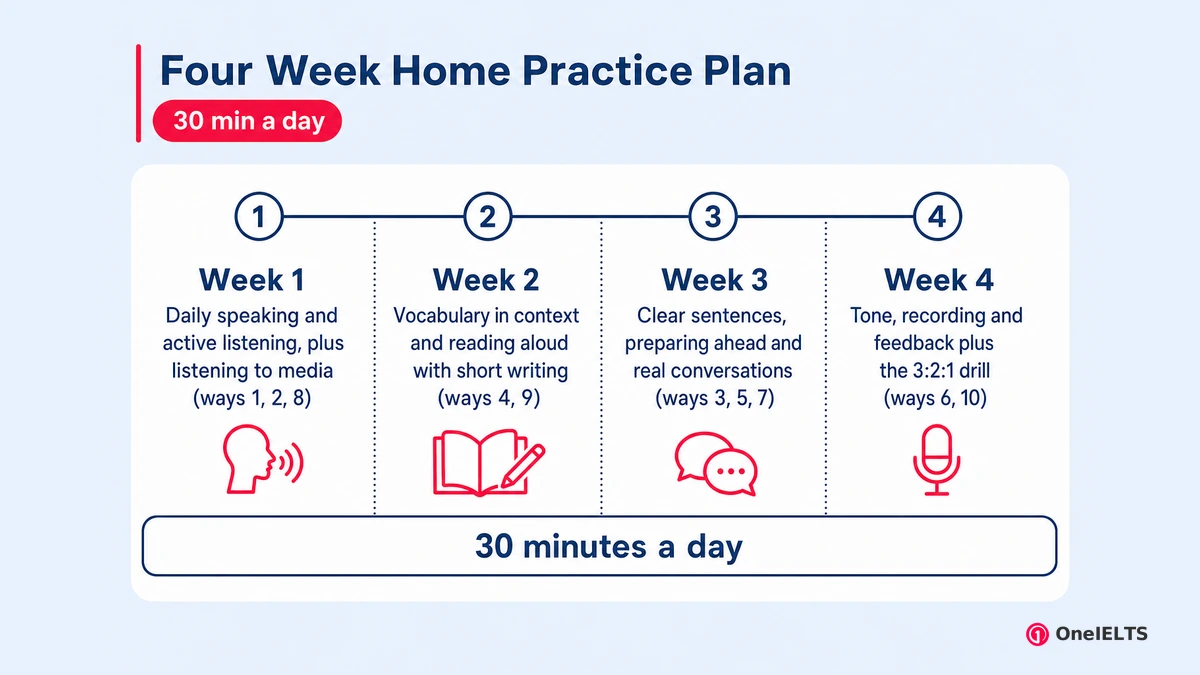
About 30 minutes a day at home is enough to notice a change in a month, if each week adds one group of the ten ways rather than all at once.
This 30-day plan is self-study with a weekly check.
| Week | Focus (ways from this page) | Daily routine (about 30 minutes) | End-of-week check |
|---|---|---|---|
| Week 1 | Daily speaking and active listening, plus listening to media (ways 1, 2, 8) | Ten minutes speaking aloud, ten on a podcast, ten paraphrasing what you heard | Can you retell one podcast episode for two minutes without stopping? |
| Week 2 | Vocabulary in context and reading aloud with short writing (ways 4, 9) | Read one article aloud, log five collocations, write a three-sentence summary | Use ten notebook phrases correctly in one recorded two-minute talk. |
| Week 3 | Clear sentences, preparing ahead and real conversations (ways 3, 5, 7) | Plan one point-reason-example answer, then use it in a live conversation | Hold a fifteen-minute conversation with a partner or AI without switching languages. |
| Week 4 | Tone, recording and feedback, plus the 3:2:1 drill (ways 6, 10) | Record one answer, review it, run one 3:2:1 round on a topic | Compare your day-one and day-thirty recordings and list three clear changes. |
This home practice uses free materials only, and you can print the table as a PDF.
Which Free Resources and Books Help Improve English Communication Skills?
Free courses, learner podcasts and a small set of well-known books cover everything on this page. The part that usually costs money is personal feedback on your speaking.
They fall into courses, free listening and reference sites, and books.
| Resource | Type | Cost | Best for (way number) |
|---|---|---|---|
| Improve Your English Communication Skills Specialization (Georgia Tech on Coursera) | Four-course online program built around workplace speaking and writing | Paid enrollment; Coursera offers financial aid on application | Preparing ahead and clear, concise workplace messages (ways 3, 5) |
| BBC Learning English, including 6 Minute English | Free podcast and video lessons for learners | Free, no account needed for most lessons | Daily listening and copying natural phrases (ways 2, 8) |
| British Council LearnEnglish | Free website with listening, speaking and grammar practice | Free lessons; some premium courses cost extra | Grammar fixes and structured daily reading and writing (way 9) |
| YouGlish | Search tool that plays a word in real video clips | Free to use in a browser | Hearing how a word is actually said (ways 4, 6) |
| Word Power Made Easy by Norman Lewis | Self-study vocabulary book built on word roots | Paid book; often in libraries | Learning words in families and in context (way 4) |
| English Vocabulary in Use (Cambridge) | Graded vocabulary workbook series with exercises | Paid book, one volume per level | Topic sets and collocations with example sentences (way 4) |
| How to Talk to Anyone by Leil Lowndes | Popular book of conversation and rapport techniques | Paid book; widely available | Tone, empathy and real conversations (ways 6, 7) |
| AI speaking apps with free tiers | Apps that chat back and correct speech | Free tier with daily limits; paid upgrades | Low-pressure conversation volume and recorded review (ways 7, 10) |
Pick one course or podcast and one book, not five of each.
How Do English Communication Skills Affect Your IELTS Speaking Score?
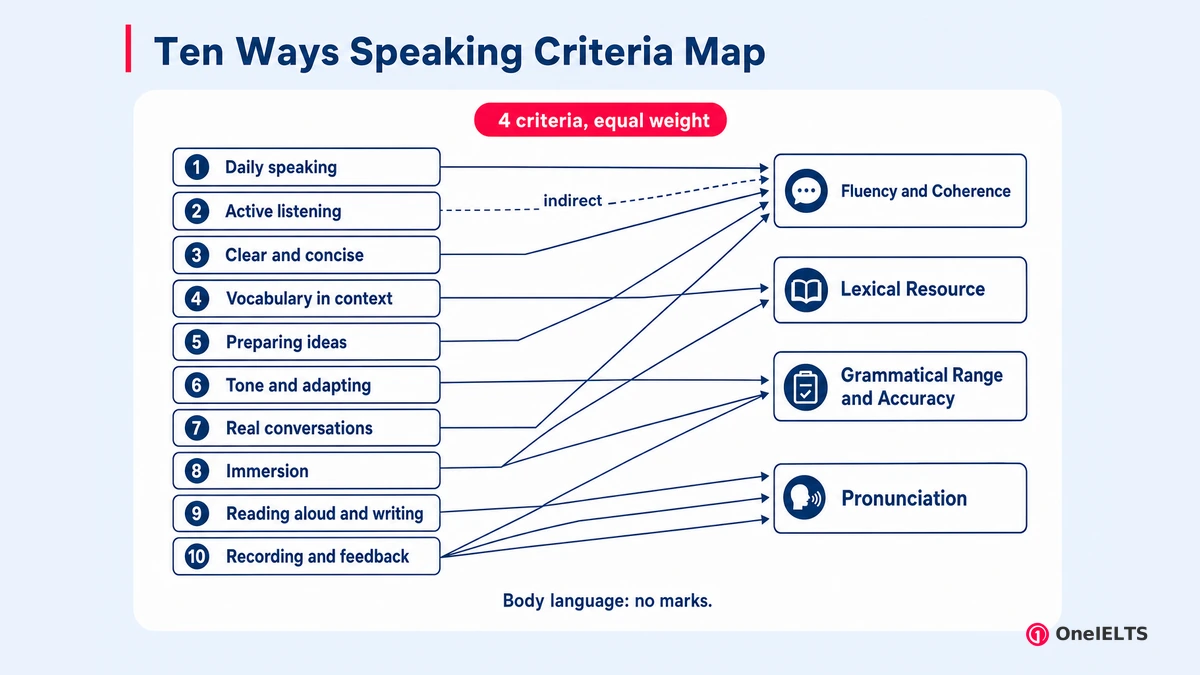
The IELTS Speaking test examiner doesn’t give a mark for “communication.” You get a band from 0 to 9 on four equally weighted criteria: Fluency and Coherence, Lexical Resource, Grammatical Range and Accuracy, and Pronunciation. Their average is your Speaking band.
Here is the criterion each way moves.
| Way (number) | IELTS Speaking criterion it moves | What changes in the test |
|---|---|---|
| 1. Daily speaking practice, even for 10 minutes | Fluency and Coherence, through steadier speech rate and continuity | You keep going in every part without long searches for words. |
| 2. Active listening during live conversation | Indirect: keeps every answer on the question asked | Your answers stay relevant instead of drifting to a prepared topic. |
| 3. Clear and concise sentences with the main point first | Coherence, but you still extend answers in Parts 1 and 3 | Ideas arrive in a logical order, then get a reason and example. |
| 4. Vocabulary learned in context, phrase by phrase | Lexical Resource, through collocation and successful paraphrase | You get round a missing word with other words instead of stopping. |
| 5. Preparing ideas ahead of time before speaking | Fluency and Coherence, through the one-minute Part 2 plan | Your long turn follows a plan rather than repeating the first point. |
| 6. Tone of voice and adapting to the listener | Pronunciation, through intonation, word stress and rhythm | Stress and intonation carry meaning instead of a flat, even delivery. |
| 7. Real conversations in English with real people | Fluency and Coherence in the Part 3 discussion | You answer unexpected follow-up questions without long pauses or panic. |
| 8. Immersion in movies, news and podcasts | Pronunciation and Lexical Resource, through natural models | You use natural chunking and phrases native speakers actually say. |
| 9. Reading aloud and writing in English daily | Grammatical Range and Accuracy, through more error-free sentences | Complex sentences come out with fewer errors and fewer restarts. |
| 10. Recording yourself and using feedback weekly | All four criteria, because you hear what the examiner hears | You fix the one weakness that is actually holding your band down. |
Everyday advice backfires twice. “Keep it short” produces under-extended answers, but the Speaking band descriptors want “long turns” at band 7. Body language earns no marks. Gesture appears only at band 2: “Little communication possible without the support of mime or gesture.” Checked on 7 October 2026.
Does Speaking English Fluently Improve Your IELTS Speaking Score?
Yes, but only partly: fluency is half of one criterion, Fluency and Coherence, which is one of four equal criteria in the IELTS Speaking score. Smooth speech with a narrow vocabulary, repeated grammar errors or unclear sounds still caps your speaking band through the other three of the four criteria. Techniques for how to speak English fluently are covered separately.
How Can You Improve English Communication With the IELTS Examiner?
The habits that help most with the examiner are answering the exact question, extending each answer with a reason or example, and asking for a repeat when you genuinely haven’t understood. In Part 1 the IELTS examiner can repeat a question, and in the Part 3 discussion can rephrase it, so asking for repetition beats a guess. Communicating effectively in IELTS Speaking covers extended answers.
Which Communication Mistakes in English Speaking Lower Your IELTS Band?
Five habits that work in casual talk cost the most in the test.
- One-line answers in Parts 1 and 3, since short answers can’t show long turns.
- Memorized answers that don’t fit the question, which examiners spot and descriptors penalize.
- Translating from your first language mid-sentence, causing hesitation and broken grammar at once.
- Flat, monotone delivery, which hides stress and intonation that Pronunciation rewards.
- Long silences instead of a short filler phrase, which pull your speaking band down quickly.
Every one of these appears in the list of common IELTS Speaking mistakes with a fix.
Where Can You Practice English Communication for the IELTS Speaking Test?
The best place to practice is a timed IELTS-style speaking session that gives feedback on all four criteria, so the 10 ways on this page are tested under exam conditions. The IELTS AI speaking coach lets you answer real Part 1, Part 2 and Part 3 questions aloud and provides criterion feedback, closing the speaking practice loop from way 10.
Written by Fahimur Rahman, reviewed 7 October 2026.
Last verified: 7 October 2026