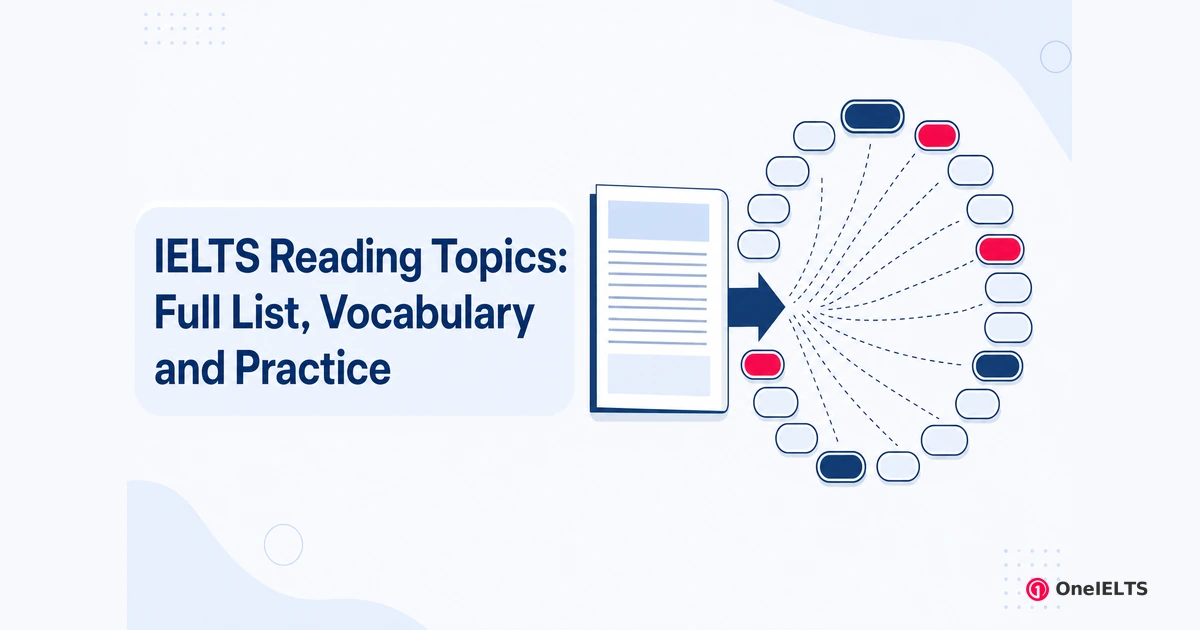
No IELTS Reading topic is off-limits, and none of them needs prior knowledge, because every answer sits somewhere in the passage in front of you. IELTS Reading topics are not a syllabus you can revise like a school subject. Every list you find, including this one, is an inventory of past passage titles.
This guide defines a reading topic, tables the full cluster list, then separates the Academic topics from the General Training ones. It covers where the texts come from, whether topics can be predicted, and how topic clusters differ from question types. Then comes the academic vocabulary each cluster needs, a four-week plan, where to practise, and the strategies that hold on any topic.
What Are IELTS Reading Topics?
An IELTS Reading topic is the subject area a passage is drawn from, such as the environment, science and technology, history and culture, or workplace information. The test owners publish no topic syllabus, so every list in circulation has been compiled from past papers.
Passages are chosen for readability by a non-specialist reader rather than for subject difficulty. That is why the exam assumes no prior knowledge, since the passage states every answer and a specialist gains nothing from knowing the field. You lose marks to unknown words, not to unknown subjects.
Academic passages and General Training texts draw on different pools, which is why the two lists further down are separate.
One distinction matters before the lists. A reading topic is what a passage is about. An IELTS Reading question type is what you are asked to do with it, and the Reading format page owns that inventory.
What Is the Full List of IELTS Reading Topics?
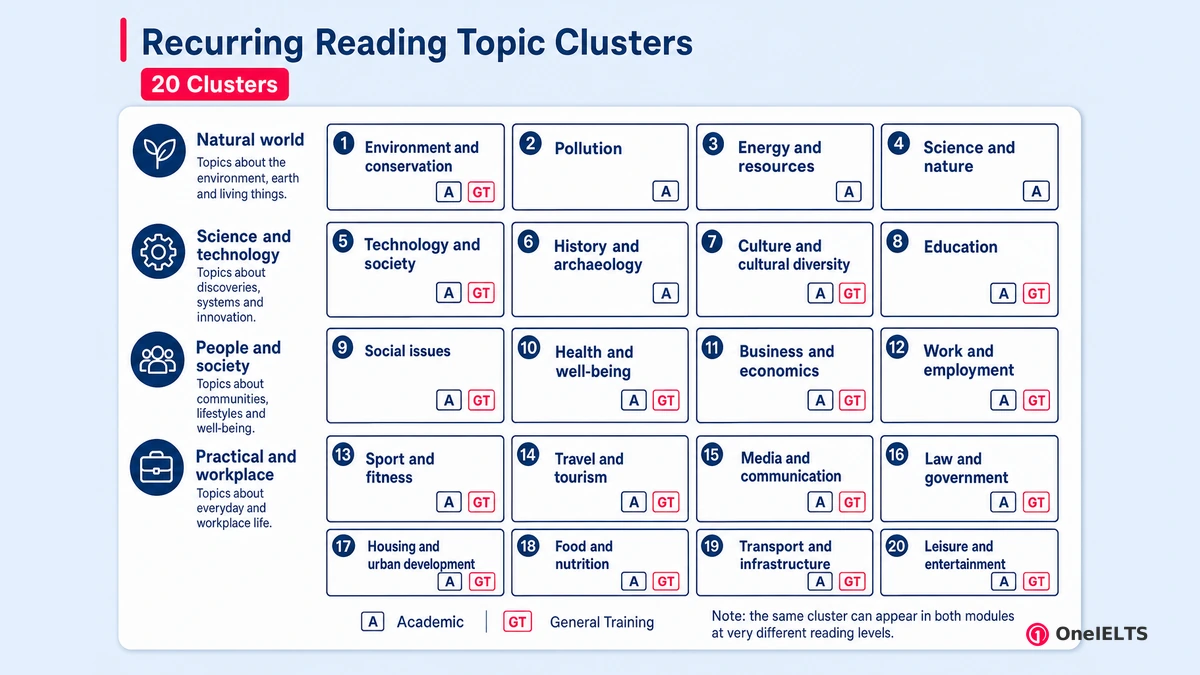
IELTS Reading draws on about twenty recurring topic clusters, and once they are grouped the range stops looking endless. The same cluster can appear in both modules at very different reading levels, which is what the fourth column records.
Each cluster below is paired with the shape of a typical passage, the vocabulary set worth pre-loading, and the module it belongs to.
| Topic cluster | What a passage on it looks like | Vocabulary to pre-load | Academic or General Training |
|---|---|---|---|
| Environment and conservation | A research-led case study on habitat loss or a conservation programme, usually with named species and dates. | Habitat, biodiversity, degradation, sustainable, restore, deplete, offset, ecosystem, endangered, and the verbs decline and recover. | Both, harder in Academic |
| Pollution | An argued piece on air or plastic waste, often pairing one cause with two proposed remedies. | Emissions, contaminant, runoff, particulate, landfill, discharge, curb, regulate, plus everyday words like dumping and cleanup. | Mostly Academic |
| Energy and resources | A survey of renewable or fossil supply, comparing two sources on cost, output and long-term availability. | Renewable, grid, turbine, yield, extraction, reserve, subsidy, consumption, efficiency, and the paraphrase pair supply and demand. | Mostly Academic |
| Science and nature | An explanation of one experiment or natural process, written for a reader with no background in the field. | Hypothesis, trial, sample, findings, replicate, correlation, evidence, and the hedging words suggest, indicate and imply. | Mostly Academic |
| Technology and society | A piece on automation or artificial intelligence weighing a benefit against a social cost, rarely technical. | Automation, adoption, displace, obsolete, algorithm, connectivity, surveillance, plus the common paraphrase pair convenience and dependence. | Both |
| History and archaeology | A dig or a period study, moving from discovery to interpretation, with dates and place names throughout. | Excavation, artefact, settlement, date back, era, remains, decline, plus everyday verbs uncover, abandon and preserve. | Academic |
| Culture and cultural diversity | A comparison of customs, festivals or language use across two communities, often with a migration angle. | Custom, ritual, heritage, assimilate, identity, generation, decline, revive, plus the common pair tradition and modernity. | Both |
| Education | A study of schooling methods or literacy outcomes, usually reporting one intervention and the results it produced. | Curriculum, attainment, enrolment, literacy, tuition, dropout, vocational, streaming, plus the paraphrase pair achievement and performance. | Both |
| Social issues | An argued passage on inequality, ageing or crime, with statistics and at least one contested claim. | Inequality, welfare, deprivation, cohesion, demographic, marginalise, household, plus the frequent paraphrase pair poverty and disadvantage. | Both |
| Health and well-being | A report on diet, sleep or public health policy, linking one behaviour to a measured outcome. | Symptom, chronic, immunity, nutrient, longevity, screening, prevalence, wellbeing, plus the frequent pair treatment and prevention. | Both |
| Business and economics | A case study of one firm or market, tracking a decision through to its commercial result. | Revenue, margin, incentive, competitor, expansion, forecast, stake, outsourcing, plus the frequent pair profit and turnover. | Both |
| Work and employment | In Academic a study of workplace behaviour; in General Training a staff handbook, contract or rights leaflet. | Entitlement, probation, shift, appraisal, redundancy, overtime, grievance, notice, plus the pair employee and staff member. | Both |
| Sport and fitness | Either a physiology study of performance or a club notice about fixtures, fees and membership rules. | Endurance, stamina, injury, recovery, training load, amateur, fixture, coaching, plus the pair fitness and conditioning. | Both |
| Literature and language | A passage on how a language spreads, dies or is written down, sometimes on reading itself. | Dialect, script, fluency, extinct, borrowing, literacy, translation, vocabulary, plus the frequent pair spoken and oral. | Academic |
| Art, film and entertainment | A history of one art form or a review of how audiences and funding have changed. | Exhibition, patron, audience, medium, restore, commission, critic, screening, plus the frequent pair popular and mainstream. | Both |
| Urbanisation and infrastructure | A study of city growth, housing or transport networks, often contrasting a past plan with today. | Congestion, sprawl, density, commuter, zoning, regeneration, tunnel, resident, plus the pair infrastructure and public works. | Both |
| Travel and geography | In Academic an exploration or mapping history; in General Training a tour brochure, timetable or booking page. | Itinerary, terrain, expedition, altitude, departure, fare, guided, remote, plus the frequent pair trip and excursion. | Both |
| Government and politics | A passage on policy, voting or public administration, usually explaining a system rather than taking sides. | Legislation, mandate, referendum, constituency, reform, enforce, authority, plus the frequent pair policy and measure. | Mostly Academic |
| Food | Food production, preservation or supply chains in Academic; menus, catering notices and safety rules in General Training. | Harvest, perishable, additive, yield, refrigeration, staple, hygiene, storage, plus the frequent pair crop and produce. | Both |
| Animal behaviour | A field study of one species, describing an observed behaviour and the explanation researchers currently prefer. | Migration, forage, predator, mating, colony, instinct, adapt, captivity, plus the frequent pair territory and range. | Academic |
What Are the Common IELTS Academic Reading Topics?
The Academic pool is drawn from books, journals, magazines and newspapers, and it leans hard on science, environment, history and social research. Every Academic passage starts life somewhere real, mostly in journals and newspapers written for a general readership. The clusters here are real past passage subjects rather than a syllabus, so treat them as a sample of the pool.
Academic Reading passages are often historical or research-led, and a research-led text feels harder than its vocabulary actually is. One of the three passages usually presents an argument rather than information, which changes the question types attached to it.
Fourteen clusters account for most Academic passages you will meet.
- Environment and climate. Real subjects here include ‘Climate Change and the Inuit’ and ‘Environmental Medicine’, both research-led rather than campaigning in tone.
- Pollution and industry. Passages such as ‘Tea and the Industrial Revolution’ trace an industrial process forward to the waste and regulation it eventually produced.
- Archaeology and ancient civilisations. ‘Stonehenge’ and ‘The Vikings’ are the classic examples, moving from what was dug up to what it means.
- Transport and infrastructure history. ‘A Brief History of London Underground’ sets the template, tracking one network through a century of engineering decisions and dates.
- Science as a discipline and its funding. Passages on peer review, research grants and why basic research struggles for money, rather than on any single experiment.
- Technology and automation. Robotics, artificial intelligence and workplace machines, usually weighing productivity gains against jobs displaced, with almost no technical detail to decode.
- Language and literacy. How writing systems spread, how children learn to read, and how a minority language declines or gets revived.
- Education and economic growth. Schooling reforms, vocational training and the returns a country gets from teaching more of its population for longer.
- Business innovation and marketing. How one company changed a product or a market, told through decisions, figures and the competitor response that followed.
- Health, ageing and public health. Diet, sleep, ageing populations and screening programmes, normally reporting one study and the policy argument built on it.
- Society, class and fashion. Social change told through clothing, housing or leisure, with a historical span and a contested explanation at the end.
- Food production and preservation. Farming methods, refrigeration, crop yields and supply chains, usually with a technology date line running through the passage.
- Sport and physical performance. Physiology, training loads and record-breaking, written as science rather than as sports journalism, so the vocabulary is clinical.
- Humour and human behaviour. ‘The Origins Of Laughter’ is the best known, and this cluster reliably carries an argument passage rather than a description.
What Are the Common IELTS General Reading Topics?
General Training reading uses everyday and workplace material, meaning notices, advice leaflets, staff information and one longer general-interest article. Section 1 carries the social survival texts, Section 2 the workplace ones, and Section 3 the single long article.
General Training texts are mostly practical documents, so the vocabulary that pays is administrative and workplace English rather than academic. The one long text in Section 3 behaves much more like an Academic passage.
Fourteen clusters cover almost everything the General Training paper sets.
- Travel and transport services. Timetables, fare rules and service notices, including past texts such as ‘The Role of the Swiss Postbus’ in Section 1.
- Tours, treks and holidays. Brochure copy and trip descriptions, ‘Himalayan Treks’ among them, where the questions test dates, prices and what each package excludes.
- Hotels and accommodation. Booking terms, room descriptions and house rules, with cancellation windows and deposit conditions carrying most of the answers.
- Consumer advice and product instructions. Texts like ‘Consumer Advice & Rice Cookers’ explain how to use or return a product, and every step matters.
- Business and marketing advice. Short guides for small firms on pricing, promotion and customer service, written as practical instruction rather than as analysis.
- Employment rights and working time. ‘Rights in the Workplace’ is the standard example, covering contracts, notice periods, leave entitlement and overtime rules.
- Recruitment, interviews and presentations. Job adverts, application guidance and staff training material on presenting, all sitting in Section 2 of the paper.
- Workplace health and catering services. Canteen notices, hygiene rules and occupational health leaflets, where a single qualifying word decides a True or False answer.
- Safety and emergency procedures. ‘Emergency Procedures’ texts list what to do in order, so flow-chart and note completion questions follow them closely.
- Community clubs and sport. Membership leaflets and class timetables from libraries, leisure centres and local clubs, with fees, ages and eligibility as the tested details.
- Wildlife and conservation stories. Human-interest pieces about a species or a reserve, sitting in Section 3 and reading much like an Academic passage.
- Reading, writing and study groups. Course descriptions and adult-learning notices, where the questions ask which class suits which learner and on what day.
- Official forms and applications. ‘Passport Application’ style texts set out eligibility, documents and deadlines, and they punish anyone who reads only half a condition.
- Popular science or human-interest articles. The one long Section 3 text, on sleep, memory or a social trend, written for a general magazine reader.
Where Do IELTS Reading Topics Come From?
Every passage comes from authentic sources that were published for real readers, meaning current books and journals, magazines and newspapers for Academic, and genuine notices, handbooks and leaflets for General Training. Nothing is written for the exam.
That is why passages read like edited real articles and occasionally feel dated. Test owners select for readability by a non-specialist reader, then the text is edited for length and difficulty. Where a technical term survives the edit, the passage either explains it in the next clause or supplies a short glossary.
Authenticity is also why no topic syllabus can exist. The pool is whatever happens to get published, so nobody can fix a list in advance.
The consequence for preparation is narrow. Reading widely inside the recurring clusters builds vocabulary, and reading to learn the subject does not.
Can You Predict IELTS Reading Topics?
No. Every topic list in circulation is a past passage inventory, including the one Google’s AI Overview leans on, so it tells you what the pool looks like and never what you will sit.
A page that promises a band from a topic list is selling the wrong thing. A repeated topic does not mean a repeated passage, and a passage you have already read will not come back. There is no published syllabus behind any of it.
The pool’s usefulness is real but different. It predicts vocabulary, not content.
What genuinely transfers between two passages on the same cluster is narrow and worth naming. The recurring word families come across. So does the typical text structure, problem then solution or history then present day. So does the kind of claim that the paper tests.
The honest exception matters too. Within a cluster the same handful of concepts really do recur, so pre-loading vocabulary at twenty words per cluster is a measurable gain.
How Do IELTS Reading Topics Relate to the Question Types?
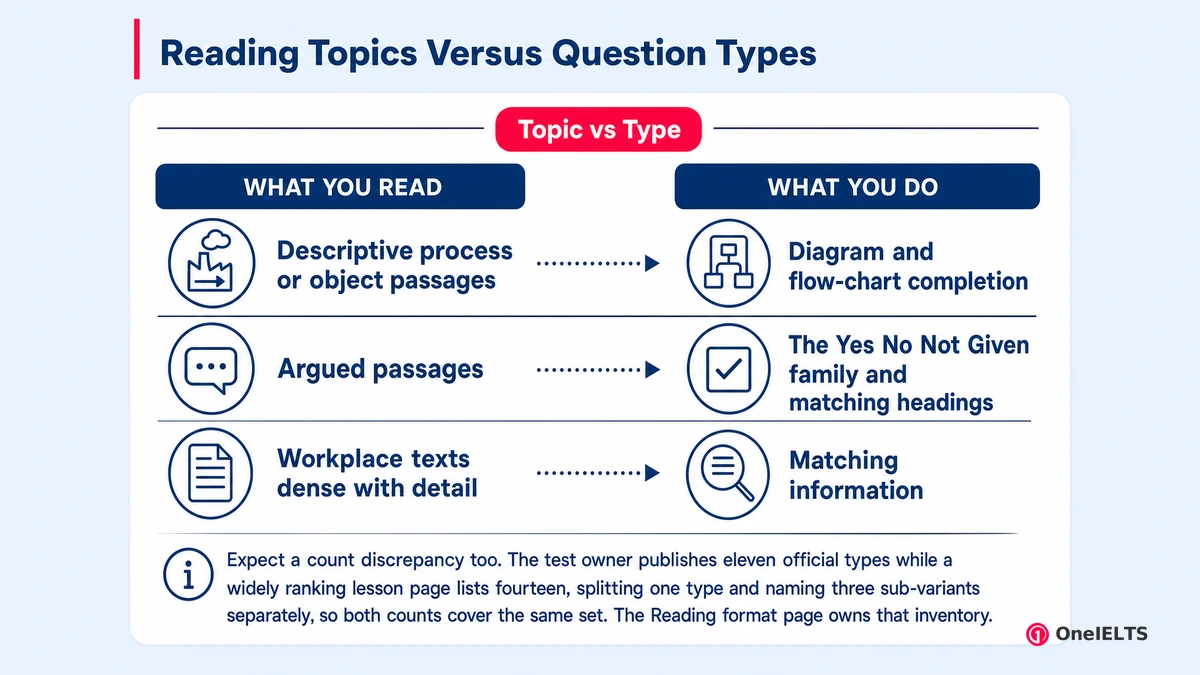
Not at all in one sense and completely in another. The topic decides what you read, the question type decides what you do, and no type belongs to any topic.
Readers arrive here confused. Google’s second organic result on this query is a question-types page that never mentions a topic, and two of eight related searches ask about types rather than topic clusters.
Descriptive process or object passages attract diagram and flow-chart completion. Argued passages attract the Yes No Not Given family and matching headings. Workplace texts dense with detail attract matching information. So a topic hints at the question types without ever fixing them.
Expect a count discrepancy too. The test owner publishes eleven official types while a widely ranking lesson page lists fourteen, splitting one type and naming three sub-variants separately, so both counts cover the same set. The Reading format page owns that inventory.
What Vocabulary Should You Learn for Each IELTS Reading Topic?
Learn about twenty words per cluster, as paraphrase pairs rather than definitions, because the question will use one word and the passage the other. Learning a subject’s technical terms is wasted effort, since the passage explains or glosses them anyway. Learning the everyday word a question uses for a technical idea is the whole game.
The table covers the six highest-frequency clusters rather than all twenty, because these carry the most passages and the widest paraphrase range.
Each row gives one core word family, the paraphrase the question is likely to use, and where the cluster tends to appear.
| Topic cluster | Core word family | Likely paraphrase in the question | Where it usually appears |
|---|---|---|---|
| Environment | Conserve, conservation, conservationist, conserved, plus the near neighbours preserve, protect, safeguard, sustain and maintain. | The question says protect the area while the passage says the habitat was left undisturbed. | Mostly Academic Passages 2 and 3, plus the occasional General Training Section 3 feature about a nature reserve. |
| Science and technology | Automate, automation, automated, automating, alongside the academic collocations labour saving, mass production and rapid technological change. | The question asks about machines replacing workers where the passage writes of labour being displaced. | Academic Passage 3 most often, because the argued technology text is usually placed last in the paper. |
| Health | Prevent, prevention, preventive, preventable, with the near synonym reduce the risk and the noun screening. | The question offers cut the chances while the passage prints lowered incidence or reduced prevalence. | Academic Passages 1 and 2, and in the General Training workplace health notices that sit in Section 2. |
| Education | Attain, attainment, attained, attaining, plus the everyday equivalents do better, results improve and grades rise. | The question says pupils performed better where the passage reports a rise in measured attainment. | Academic Passages 1 and 2, and in General Training course leaflets, study group adverts and adult learning notices. |
| Work and employment | Employ, employment, employer, employee, unemployed, with entitlement, probation and notice period as the paperwork words. | The question says staff may take time off while the contract text says leave is granted. | General Training Section 2 above all, plus Academic passages on changing workplace behaviour and labour markets. |
| History and archaeology | Excavate, excavation, excavated, plus date back to, remains, site, settlement and the glossed term stratigraphy. | The question asks when the site was abandoned where the passage says occupation ceased around 1200. | Academic Passage 1 or 2, and almost never in General Training outside an occasional museum or heritage leaflet. |
How Do You Use an IELTS Reading Topic List to Prepare?
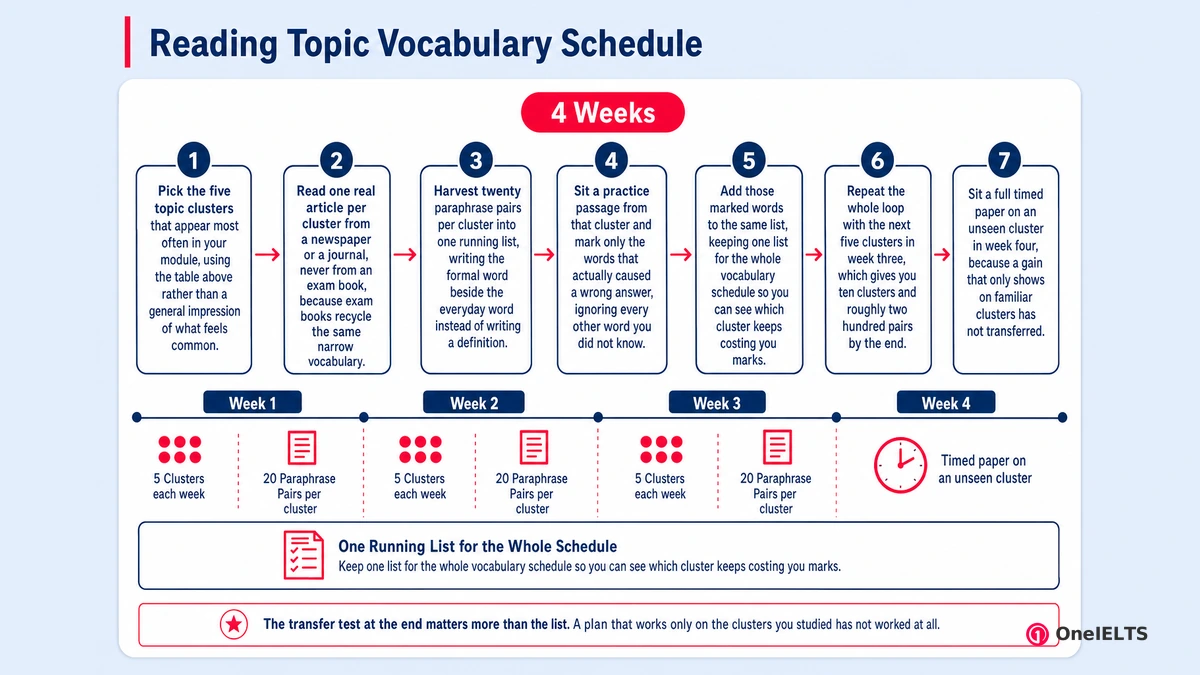
Use the list as a vocabulary schedule rather than a revision list, spread over four weeks, five clusters a week, twenty paraphrase pairs each. The plan works because it turns an inventory into a fixed weekly quota, and it ends with a test on a cluster you did not study.
Seven steps take you from the topic table to a timed paper on an unseen cluster.
- Pick the five topic clusters that appear most often in your module, using the table above rather than a general impression of what feels common.
- Read one real article per cluster from a newspaper or a journal, never from an exam book, because exam books recycle the same narrow vocabulary.
- Harvest twenty paraphrase pairs per cluster into one running list, writing the formal word beside the everyday word instead of writing a definition.
- Sit a practice passage from that cluster and mark only the words that actually caused a wrong answer, ignoring every other word you did not know.
- Add those marked words to the same list, keeping one list for the whole vocabulary schedule so you can see which cluster keeps costing you marks.
- Repeat the whole loop with the next five clusters in week three, which gives you ten clusters and roughly two hundred pairs by the end.
- Sit a full timed paper on an unseen cluster in week four, because a gain that only shows on familiar clusters has not transferred.
The transfer test at the end matters more than the list. A plan that works only on the clusters you studied has not worked at all.
Where Can You Practise IELTS Reading Topics With Answers?
Sit full OneIELTS Reading papers grouped by cluster, so you meet a topic under the clock, then check the answer key by cause rather than by count.
Three of eight related searches on this query ask for a PDF or an answer key, so most readers arrive wanting a download. A downloaded topic list with answers is a vocabulary source, not a rehearsal. Only a full paper rehearses the test.
The official sample tasks and the test partners’ free practice tests are your authenticity check. Cluster-grouped papers sit on the IELTS Reading practice hub, which a free account opens. Practising the same cluster twice tests memory rather than reading, so build cluster rotation into the schedule.
Then run the review by cause. Mark whether each wrong answer was an unknown word, a missed paraphrase, a word-limit slip or the clock.
What Are the Best Strategies for IELTS Reading Topics?
The strategies that survive an unfamiliar topic are all about ignoring the subject and working the text. Everything above this point describes the topics themselves. What follows is what a candidate does when the passage covers something they have never read.
In marked practice papers the pattern holds. On an unfamiliar cluster most lost marks trace back to four or five unknown content words, not to the subject. So these habits are mechanical, and none of them depends on knowing anything.
Six habits carry a candidate through a cluster they have never met.
- Read the title and any subheading first, and place the cluster within ten seconds before touching a question.
- Accept that some words will be unknown, mark them in the margin, and keep reading rather than stopping.
- Hunt the question’s proper nouns, numbers and dates in the passage, because those are never paraphrased away.
- Use the passage’s own text structure, problem then solution or past then present, to predict where an answer sits.
- Never let subject knowledge override the passage evidence, even when the text states something you believe is wrong.
- Treat an unfamiliar cluster as a local vocabulary problem to solve in the margin, not a reason to panic.
How Do You Get Band 8 or Above on an Unfamiliar IELTS Reading Topic?
At band 8 and above the topic stops mattering, because the method does not change with the subject and only three or four wrong answers are allowed. Two habits separate band 8 from band 7 on an unfamiliar cluster: you read around an unknown word instead of stopping, and you refuse any plausible answer the passage evidence does not state. Our ielts band 8 guide gives the raw scores.
How Can I Get 7 in IELTS Reading?
Band 7 in Reading is usually three or four answers away from band 6.5, and on a topic-driven diagnosis those answers are almost always lost to unknown vocabulary in one or two clusters. Fix it in order. Pre-load the cluster vocabulary for the two clusters where your error concentration sits, then re-test on an unseen passage from a third cluster. Our ielts band 7 guide covers the raw score.
Is a 7.5 IELTS Score Easy?
No, but 7.5 is easier to reach in Reading than in any other component, because every answer is in the text and no examiner judges it. An overall band of 7.5 usually depends on Reading and Listening carrying the component average, so cluster vocabulary work has an outsized effect. Objective marking is why, because a Reading answer is either in the text or not. Our ielts band 7.5 guide explains the rounding.
Does Knowing the Topic in Advance Help Your IELTS Reading Score?
Only a little, and not the way candidates expect. A familiar cluster gives you a vocabulary advantage, because you already hold its words, not because you know its content. Familiarity also carries the biggest risk in Reading: on a topic you know well, you start answering from your own prior knowledge instead of the passage evidence. Our how to improve ielts reading skills guide drills that habit.
Written by Fahimur Rahman, reviewed 14 August 2026.
Last verified: 14 August 2026
Practice for the Real IELTS Exam
Apply what you’ve learned with free, exam-style practice:
- Take a free IELTS mock test — all four skills, real exam timing, AI band scoring
- Sit a Reading section mock — one full timed paper with an instant band score
- Practise by question type — self-paced passages with answer explanations