What you do next depends on your current band and on the question types that lose you marks. So this page starts with a diagnosis. Improvement means a measurable change in marks out of forty, not a feeling of reading better. Your IELTS Reading score moves when skill building is aimed at your own error profile.
The sections run in order: what improvement takes, how to diagnose the loss, the core skills, speed habits and vocabulary. Then the reading diet, official practice, the band ladder from 5 to 8, a realistic timeline, a one-month plan and target bands. Technique inside the exam hour sits on our IELTS Reading tips page; the plan across weeks sits here.
What Does It Take to Improve Your IELTS Reading Score?
Three things move the score, in order: a diagnosis of where your marks go, skill work aimed at that specific loss, and timed papers that prove the gain transfers. Technique alone moves nobody who has not diagnosed first.
Reading is the component where improvement shows up most clearly. Objective marking means every mark is counted rather than judged, so progress is visible the week it happens. The ceiling is rarely raw reading ability. It is the interaction of paraphrase recognition, vocabulary and the clock.
Most candidates plateau because they keep sitting whole papers without changing anything between them. A timed paper measures; it does not teach. The same score can be lost for four completely different reasons, which is why the next section exists.
Skimming and scanning are real skills, and every page recommends them. On their own they never explain the gap between a 6 and a 7.
How Do You Diagnose Which IELTS Reading Skill Is Costing You Marks?
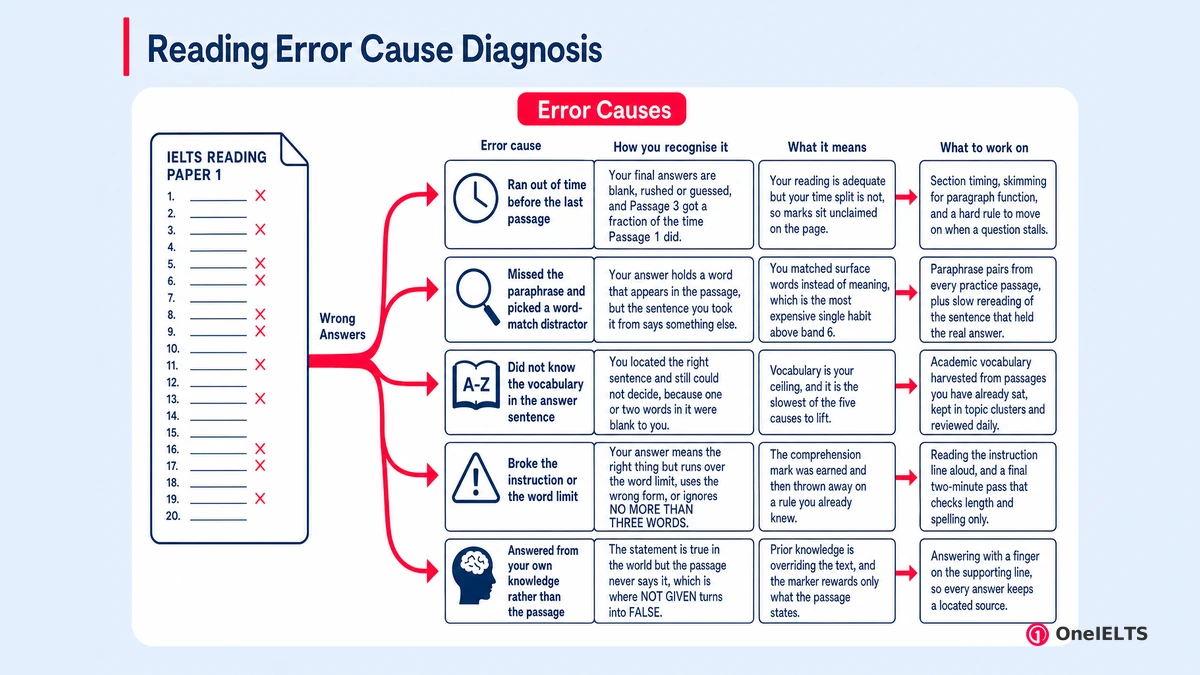
Sit one full timed paper, then sort every wrong answer into one of five error causes. The fix follows from the cause, not from the score.
Mark the paper first. Then go back to every wrong answer and find the sentence that carried the right one. If you can see the answer once it is pointed out, the cause is time or paraphrase, not comprehension.
Google’s own AI Overview closes its answer to this query by asking you for your current score and your weakest question types, because it cannot advise without them. No ranking page supplies it.
Five causes account for nearly every wrong answer, and each one sends you to a different week of work.
| Error cause | How you recognise it | What it means | What to work on |
|---|---|---|---|
| Ran out of time before the last passage | Your final answers are blank, rushed or guessed, and Passage 3 got a fraction of the time Passage 1 did. | Your reading is adequate but your time split is not, so marks sit unclaimed on the page. | Section timing, skimming for paragraph function, and a hard rule to move on when a question stalls. |
| Missed the paraphrase and picked a word-match distractor | Your answer holds a word that appears in the passage, but the sentence you took it from says something else. | You matched surface words instead of meaning, which is the most expensive single habit above band 6. | Paraphrase pairs from every practice passage, plus slow rereading of the sentence that held the real answer. |
| Did not know the vocabulary in the answer sentence | You located the right sentence and still could not decide, because one or two words in it were blank to you. | Vocabulary is your ceiling, and it is the slowest of the five causes to lift. | Academic vocabulary harvested from passages you have already sat, kept in topic clusters and reviewed daily. |
| Broke the instruction or the word limit | Your answer means the right thing but runs over the word limit, uses the wrong form, or ignores NO MORE THAN THREE WORDS. | The comprehension mark was earned and then thrown away on a rule you already knew. | Reading the instruction line aloud, and a final two-minute pass that checks length and spelling only. |
| Answered from your own knowledge rather than the passage | The statement is true in the world but the passage never says it, which is where NOT GIVEN turns into FALSE. | Prior knowledge is overriding the text, and the marker rewards only what the passage states. | Answering with a finger on the supporting line, so every answer keeps a located source. |
What Are the Core IELTS Reading Skills You Need to Build?
Four skills carry a Reading paper: skimming, scanning, close reading and paraphrase recognition, and only the fourth one decides bands. The first three are ways of moving through a text at different speeds. The fourth earns the mark, because the question and the passage almost never use the same words.
Each skill here comes with the moment in the hour it belongs to and a way to drill it alone.
- Skimming. Read the first and last sentence of each paragraph in two minutes to fix the shape of the text and the paragraph function of every block. Drill it on news features.
- Scanning. Hunt one specific name, number, date or term without reading the sentences around it, then stop. Practise on a page with ten targets and a timer running.
- Close reading. Slow right down for the two or three sentences around a located answer, because that is where the qualifier deciding true from not given hides.
- Paraphrase recognition. Hold the question’s wording and the passage’s wording as one idea. Drill it by rewriting five question stems in the passage’s words before you answer.
The first three are trainable in days. Paraphrase recognition takes weeks, which is why a candidate who only drills skimming stalls at the same score. All four are trained on real passages, never on speed-reading exercises.
How Do You Build the Habits That Improve IELTS Reading Speed?
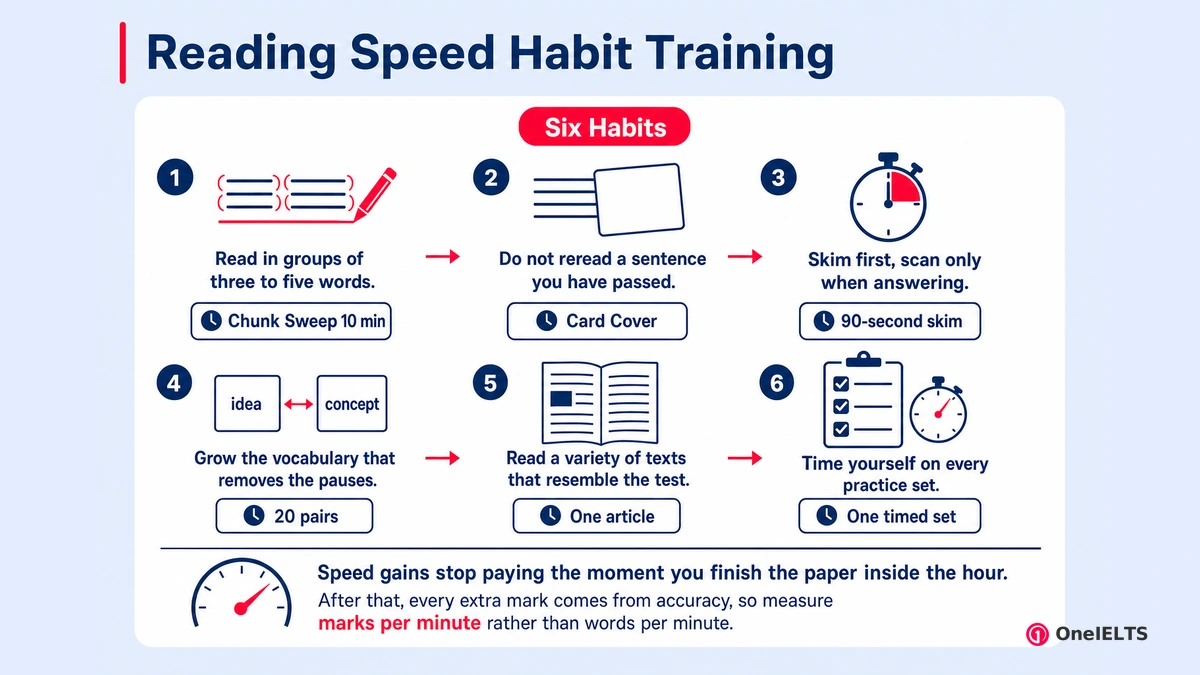
Six habits raise reading speed, and the two that pay most are word chunking and refusing to reread. Speed comes from changing what your eyes do, so every reading habit here is a physical change rather than an intention.
Each habit carries a drill, a length of time, and the signal that tells you it is working.
- Read in groups of three to five words. Practise word chunking for ten minutes a day with a pencil sweeping under each group. It works when your lips stop moving.
- Do not reread a sentence you have passed. Cover each line with a card as you leave it, for one week. Rereading has gone when your eyes stop jumping backwards.
- Skim first, scan only when answering. Give ninety seconds to the shape of a passage before you look at any question. The signal is fewer returns to the same paragraph.
- Grow the vocabulary that removes the pauses. Twenty new paraphrase pairs a day, taken from passages you have sat. It works when a passage stops producing full stops in your head.
- Read a variety of texts that resemble the test. One long article a day, read for structure. The signal is that an unfamiliar topic no longer slows the first two paragraphs.
- Time yourself on every practice set. Run one timed set of a single passage and log the clock beside the score. Improvement shows as the same accuracy in less time.
Speed gains stop paying the moment you finish the paper inside the hour. After that, every extra mark comes from accuracy, so measure marks per minute rather than words per minute.
How Do You Improve Your Vocabulary to Speed Up Comprehension?
Collect paraphrase pairs, not definitions. The question uses one word, the passage uses the other, and that pair is the mark. Vocabulary is the slowest-moving part of the plan and the highest-return one, because it lifts every question type at once.
The method runs in five steps, from harvesting a word to proving you can produce it under the clock.
- Harvest from passages, not word lists. Pull every unknown word out of a practice passage you have already sat, so each word arrives with its context attached.
- Record it as a pair. Write the passage word beside the word the question used for it, because that substitution is what the test actually examines.
- Keep the pairs in topic clusters. Twenty pairs per cluster, on themes such as environment, education or transport, so related academic vocabulary reinforces itself.
- Review by covering one side. Produce the other side from memory, in both directions, in short daily sittings rather than one long weekly one.
- Re-test on an unseen passage. Take a new passage from the same cluster and answer it timed, which confirms recall under time rather than recognition.
A technical term inside a passage is usually explained or glossed where it appears, so learning that glossed term is wasted effort. The everyday word a question substitutes for it is exactly what to learn. Our IELTS Reading topics page owns the cluster-by-cluster vocabulary plan, so this page keeps no long word list.
Which Texts Should You Read to Get Familiar With IELTS Reading?
Read the kind of thing the test is cut from: quality journalism, popular science and long features, one a day rather than one a week.
The reading diet here pairs each source type with the way to read it and how often it earns a slot.
| Source type | Why it resembles the test | How to read it | How often |
|---|---|---|---|
| Broadsheet features and long-read journalism | Argument runs across paragraphs, with the writer’s view signalled rather than stated, exactly as Passage 3 does. | Read for paragraph function first, one line of notes per paragraph, then harvest three paraphrase pairs. | Daily, one article of roughly a thousand words, which fits the time a single passage takes. |
| Popular-science and nature writing | Matches the Academic passages drawn from journals and books, with process description and cautious claims. | Track what each paragraph adds to the process, then note every hedge such as may, tends or suggests. | Four times a week, alternated with journalism so the topics keep rotating rather than repeating. |
| Magazine profiles and social-trend pieces | Carry opinion, attribution and comparison between groups, which is where matching-features questions come from. | Mark who says what, because the test asks you to attach a stated view to a named person. | Twice a week, read to the end without stopping, so stamina builds alongside speed. |
| Workplace and consumer documents for General Training candidates | General Training texts are drawn from notices, handbooks, contracts and adverts rather than from academic journals. | Hunt the condition and the exception, since most General Training marks turn on a qualifying clause. | Daily for General Training candidates, weekly for Academic candidates who want instruction practice. |
| Academic summaries and review articles | The densest prose you will meet, heavier than the real passages, which makes the real ones feel slower. | Read one section only, and stop to restate each paragraph in a single plain sentence. | Once a week, and only once your daily reading no longer tires you by the third page. |
Read for the shape first, then harvest three paraphrase pairs, and set yourself no questions on it. This is skill work rather than practice, and invented questions teach nothing. A General Training candidate runs the same diet weighted towards notices, handbooks and consumer material.
How Should You Use Official IELTS Reading Practice Tests to Improve?
Use them sparingly and deliberately. Official papers are finite, so spend them on measurement and spend third-party material on drill.
Practising and measuring are different jobs. A drill can be repeated, paused and marked halfway. An official practice test measures reliably only once, because it matches the real paper’s length and difficulty and you only meet it fresh a single time.
Six rules keep the official supply useful right up to test week.
- Keep at least two official papers unseen. Save them for the final fortnight, when you need a number you can trust rather than more practice material.
- Drill one weak type with per-type sample tasks. An official per-type sample task lets you work a single question type repeatedly without burning a whole paper.
- Sit every measurement paper to the full sixty minutes. No pauses, no dictionary and no restarting a passage, because a paused paper measures nothing at all.
- Log the error causes, not just the score. An error log that records why each mark went tells you what to do on Monday; a bare score does not.
- Never reuse a seen paper for measurement. Once you remember an answer you are testing memory, so seen papers go back into the drill pile.
- Use third-party banks for volume. Once your method is fixed, quantity matters more than provenance, and third-party sets give you enough passages to drill on.
Time yourself passage by passage as well as end to end. A whole-paper score hides which passage ate the hour, and section timing is what exposes it.
How Do You Improve Your IELTS Reading Score From Band 5 to Band 8?
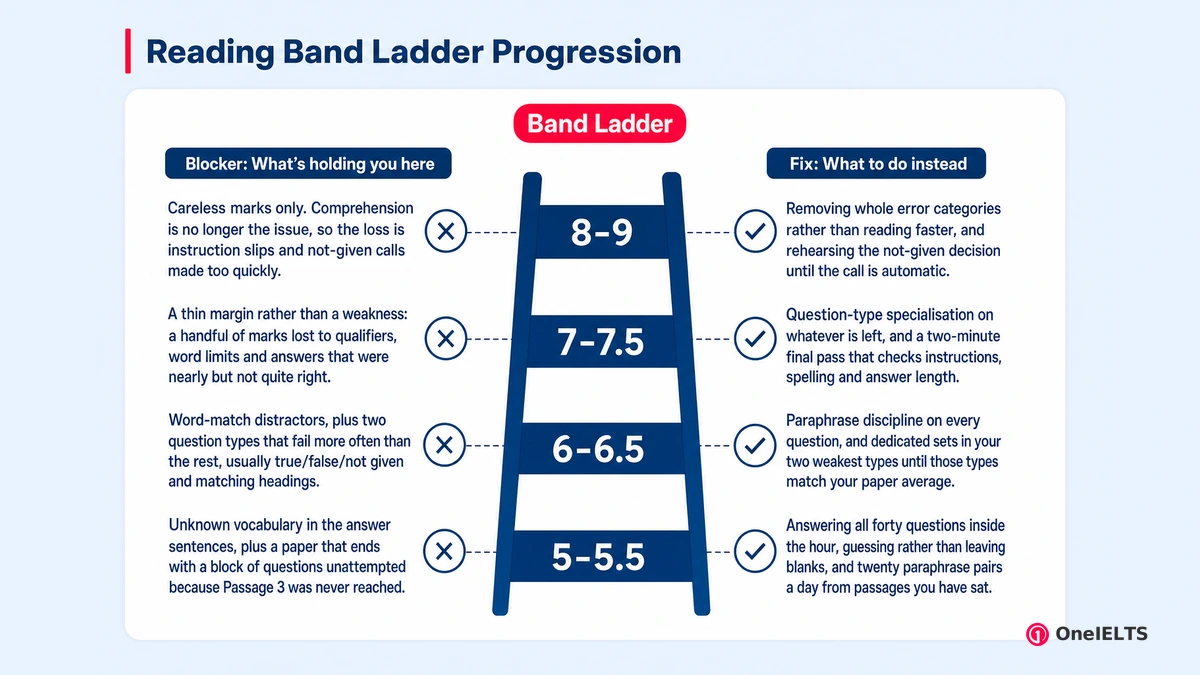
The work changes at every step. Below 6 the barrier is vocabulary and unfinished papers; at 6.5 to 7 it is paraphrase and two weak question types; above 7.5 it is only the last few careless marks.
The band ladder here sets out what holds candidates at each step and the evidence that the step has been cleared.
| Current band | What is usually holding you there | What to work on | How to know it worked |
|---|---|---|---|
| Band 5 to 5.5 | Unknown vocabulary in the answer sentences, plus a paper that ends with a block of questions unattempted because Passage 3 was never reached. | Answering all forty questions inside the hour, guessing rather than leaving blanks, and twenty paraphrase pairs a day from passages you have sat. | No blank answers on a timed paper, and the raw score climbing before your reading feels any different at all. |
| Band 6 to 6.5 | Word-match distractors, plus two question types that fail more often than the rest, usually true/false/not given and matching headings. | Paraphrase discipline on every question, and dedicated sets in your two weakest types until those types match your paper average. | The two weak types stop appearing at the top of your error log across two consecutive measurement papers. |
| Band 7 to 7.5 | A thin margin rather than a weakness: a handful of marks lost to qualifiers, word limits and answers that were nearly but not quite right. | Question-type specialisation on whatever is left, and a two-minute final pass that checks instructions, spelling and answer length. | Errors cluster in one identifiable category instead of scattering, and that category shrinks from paper to paper. |
| Band 8 to 9 | Careless marks only. Comprehension is no longer the issue, so the loss is instruction slips and not-given calls made too quickly. | Removing whole error categories rather than reading faster, and rehearsing the not-given decision until the call is automatic. | Two consecutive unseen papers at the same near-perfect raw score, which the official conversion maps to your target. |
Each step up costs roughly three to four extra correct answers. That is a smaller change than most candidates imagine and a far more specific one. The raw score each band needs comes from the official conversion for that paper.
The 5-to-7 journey is mostly vocabulary and finishing the paper. The 6.5-to-8 journey is almost entirely paraphrase discipline plus question-type specialisation. Generic tip lists treat those as one project, which is why the same list helps one reader and does nothing for another.
How Long Does It Take to Improve Your IELTS Reading Score?
A half band is realistic in two to four weeks of daily work, and a full band in six to eight. More than that inside a month happens only when the loss was time management rather than language. Treat these ranges as our editorial estimate, not published data.
The spread is wide because the diagnosis decides the timeline, not the target. A candidate losing marks to the clock takes a time management gain in days by changing the split between passages. A candidate losing marks to vocabulary sits on a multi-week vocabulary curve, and urgency does not shorten it.
Short daily sessions beat weekend marathons for paraphrase and vocabulary. Keep whole timed papers to one weekly paper, because each needs a review longer than the paper itself. Three things speed nothing up: repeating seen papers, speed-reading apps, and vocabulary lists detached from passages.
How Do You Improve Your IELTS Reading in a Month?
Four weeks, four jobs: diagnose in week one, fix the largest error cause in week two, specialise on your two weakest question types in week three, and rehearse under full time in week four.
The four-week plan here gives each week a focus, the daily work that serves it, and the checkpoint that closes it.
| Week | Focus | Daily work | Weekly checkpoint |
|---|---|---|---|
| Week 1 | Diagnosis and baseline, so the rest of the month aims at your own losses rather than at a generic tip list. | One long article a day read for paragraph shape, with a single line of notes per paragraph. | A baseline paper sat to the full hour, then every wrong answer sorted into its error cause. |
| Week 2 | The single largest error cause from week one, whichever of the five it turned out to be. | Twenty paraphrase pairs plus one passage drilled slowly and without a clock, in one daily session. | A second full paper, compared with the baseline paper on cause rather than on score alone. |
| Week 3 | The two question types that still fail most often, drilled one at a time rather than together. | One question-type set each day plus the running paraphrase pairs, timed but not yet rushed. | The same two types on an unseen passage, to prove the gain is not passage-specific. |
| Week 4 | Full-length rehearsal under exam conditions, with the method now fixed and no new technique added. | One timed section a day, alternating passages so all three positions in the hour get rehearsed. | An unseen official paper as a full-hour rehearsal, marked and sorted one last time. |
Week one sets what the other three weeks do, so the plan holds its shape at every band. Only the week-two content changes with your diagnosis, because that week aims at your largest single loss. With less than a month, compress weeks two and three rather than skipping week one, since a plan pointed at the wrong cause wastes the whole period.
How Do You Improve Your IELTS Reading Score for Your Target Band?
The plan keeps its shape whatever you are chasing, but the week-two content and the allowable errors change with the target band. The higher the target, the fewer causes you are allowed to leave unfixed.
Allowable errors at each target come from the official raw-score conversion, which shifts slightly between papers. The direction of travel does not shift. A band 6 target tolerates two shaky question types. A band 7 target needs question-type coverage across everything but one. A band 8 or 9 target needs every type safe and every instruction obeyed.
The hardest passage gets the same treatment at every level. Passage 3 takes more than a third of the hour only when Passages 1 and 2 come in under it, and above band 7 that budget is decided before the paper starts.
Set the next half band as your working target. A target below your diagnosis is weeks of work. A target two bands above it is a term’s work, and planning for it as though it were four weeks is why candidates repeat the test.
How Do You Get 7.0 in IELTS Reading?
Band 7 needs the paper finished and two question types made safe, which is usually three extra answers on top of a 6.5. The most common single fix is the uneven time split. Candidates who reach Passage 3 with a third of the hour intact pick up marks without any new language. Question-type safety comes second. Our IELTS band 7 guide covers what the band means overall.
How Do You Get 9.0 in IELTS Reading?
A 9 in Reading allows almost no wrong answers, so it is reached by removing whole error categories rather than by reading faster. Three slips survive at the top: word limit breaches, not given treated as false, and a spelling error on a copied answer. Reading is where a 9 is most attainable, because objective marking judges nothing. Our IELTS band 9 guide sets the same standard for every component.
How Can You Get 5.5 in IELTS Reading?
At this level the marks are lost to unfinished papers and unknown vocabulary, so the first goal is answering all forty questions rather than answering them well. Two changes move you off the floor fastest: leaving no unanswered questions, and dropping the habit of reading every word. Paper completion delivers Band 5.5 well before better English does. Sitting timed sets on our IELTS reading practice hub needs a free account.
How Do You Improve From 6.5 to 8 in IELTS Reading?
This jump is almost entirely paraphrase discipline plus specialising on the two question types that still cost you marks, and it is a slower project than the climb to 6.5. Time management is usually solved by 6.5, so the remaining marks come from language and from refusing the plausible unstated answer. Band 8 rewards question-type specialisation over general practice. Our IELTS band 8 guide covers the standard in each component.
Written by Fahimur Rahman, reviewed 14 August 2026.
Last verified: 14 August 2026
Practice for the Real IELTS Exam
Apply what you’ve learned with free, exam-style practice:
- Take a free IELTS mock test — all four skills, real exam timing, AI band scoring
- Sit a Reading section mock — one full timed paper with an instant band score
- Practise by question type — self-paced passages with answer explanations