IELTS Academic Reading gives you three long texts from current books, journals, magazines and newspapers, plus forty questions and one hour. Subject knowledge earns nothing here. Paraphrase and academic vocabulary decide the band.
This page covers the paper’s structure, its recurring topics, its real difficulty, and the question types that dominate it. It then works through the official sample tasks, the books and PDFs worth using, and the order to use them in. The closing sections handle score conversion, where to sit a full paper, and the tips that move a band.
Five of the eleven official question types have no Academic sample task on the test owner’s site. Format numbers live on the Reading format page, and the module comparison on the General Training page.
What Is Academic Reading in IELTS?
Academic Reading in IELTS is the Reading paper sat by candidates taking IELTS Academic, built from three long authentic texts written for a general readership rather than for specialists. University applicants sit it, and so do candidates seeking professional registration with a body such as a nursing or engineering council.
The receiving institution decides which module you take, not you. Check the offer letter or the regulator’s page before you book, because the two modules are not interchangeable once the result is issued.
Reading is one of four timed components on test day, and it runs for sixty minutes. The paper is identical whichever test partner you book with, and identical whether you sit it on paper or on screen. Its texts come from published sources rather than from writing produced for an exam.
Two things sit on other pages. The full format walkthrough belongs on the IELTS Reading format page. The module-by-module comparison belongs on the General Training Reading page.
How Is the IELTS Academic Reading Test Structured?
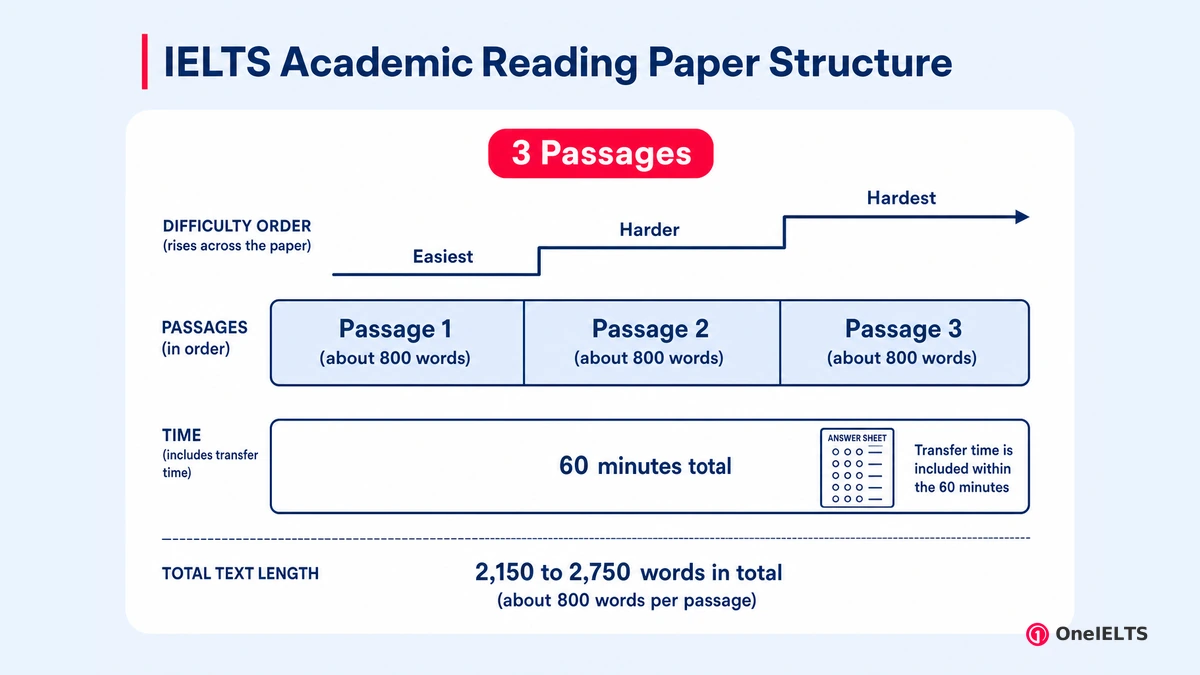
Three passages, forty questions and sixty minutes, with a total text length of 2,150 to 2,750 words. That hour already includes transfer time, because nothing is added at the end for copying answers across. The three passages rise in difficulty, so the third one is the hardest by design. The paper’s fixed figures, from passage count to marking, are set out in this table.
| Feature | Detail |
|---|---|
| Passages | Three long passages in sequence, each with its own question sets and its own instruction lines. |
| Total questions | Forty questions across the three passages, numbered straight through from 1 to 40 without restarting. |
| Time allowed | Sixty minutes in total, and that clock covers writing your answers onto the answer sheet. |
| Total text length | Between 2,150 and 2,750 words across the whole paper, so roughly 800 words per passage. |
| Difficulty order | Passage 1 is the most approachable and Passage 3 the hardest, because difficulty rises on purpose. |
| Marks per question | One mark for each correct answer, which gives a raw score out of 40 for the paper. |
| Penalty for a wrong answer | None at all, so a guess costs nothing and every answer box should carry something. |
The section-by-section IELTS Reading format walkthrough lives on the Reading format page, so this page does not repeat it.
What Topics Come Up in IELTS Academic Reading?
A narrow and recognisable set of academic fields. The passages look endless in variety, but the subject areas repeat from paper to paper.
The texts come from current books, journals, magazines and newspapers on topics of general academic interest, which is a much tighter range than the phrase suggests. These are authentic sources written for educated non-specialists, so the writing style repeats as much as the subject does. Treat the grouping here as observed across published papers, not as a published syllabus.
Ten subject areas account for most Academic passages, each paired with the kind of text it tends to produce.
- Natural science and biology. Animal behaviour studies, plant adaptation, and laboratory research written up for a reader with no specialism.
- Environment and climate. Ocean plastic, water scarcity, rewilding schemes, and the argument over how anyone measures them.
- History and archaeology. Excavation reports, ancient trade routes, and how a new dating method overturned an older account.
- Technology and engineering. Bridge design, battery chemistry, or a manufacturing process explained from the problem through to the solution.
- Psychology and human behaviour. Memory experiments, decision-making studies, and the sampling problems that leave their results contested.
- Business, work and economics. Company case studies, labour market shifts, and the economics of one commodity such as coffee.
- Education and language. Bilingualism research, classroom studies, and the history of writing systems or endangered languages.
- Health and medicine. Public health programmes, sleep research, and the trials behind a treatment that later proved disappointing.
- Urban life and transport. City planning experiments, congestion pricing, and how a transport network changed the place it served.
- Art, design and architecture. Museum conservation, the design of an everyday object, and building materials chosen for a climate.
No prior knowledge is assumed or rewarded, and every answer sits somewhere in the passage. What pays is the academic vocabulary a field reuses, meaning its words for change, cause, measurement and doubt. The full cluster list and the vocabulary plan behind IELTS Reading topics sit on the Reading topics page.
Is IELTS Academic Reading Hard?
Academic Reading is the component most candidates under-estimate, and the difficulty is almost never the subject matter. Ranked by the marks each one costs, five things make it hard.
Paraphrase comes first, because the question almost never reuses the passage’s words. Text density comes second, since 2,150 to 2,750 words in an hour leaves no room to read everything properly. Third is the third passage itself, hardest by design and usually the one that meets the least time.
Fourth is vocabulary in context, where a familiar word carries an unfamiliar sense and the obvious reading is the wrong one. Fifth are distractors, which are statements true in the world but never actually stated in the passage.
One honest comparison belongs here. General Training texts are easier to read, but its conversion asks for more correct answers at the same band. So “harder” depends on whether you mean the reading or the band.
What Question Types Dominate IELTS Academic Reading?
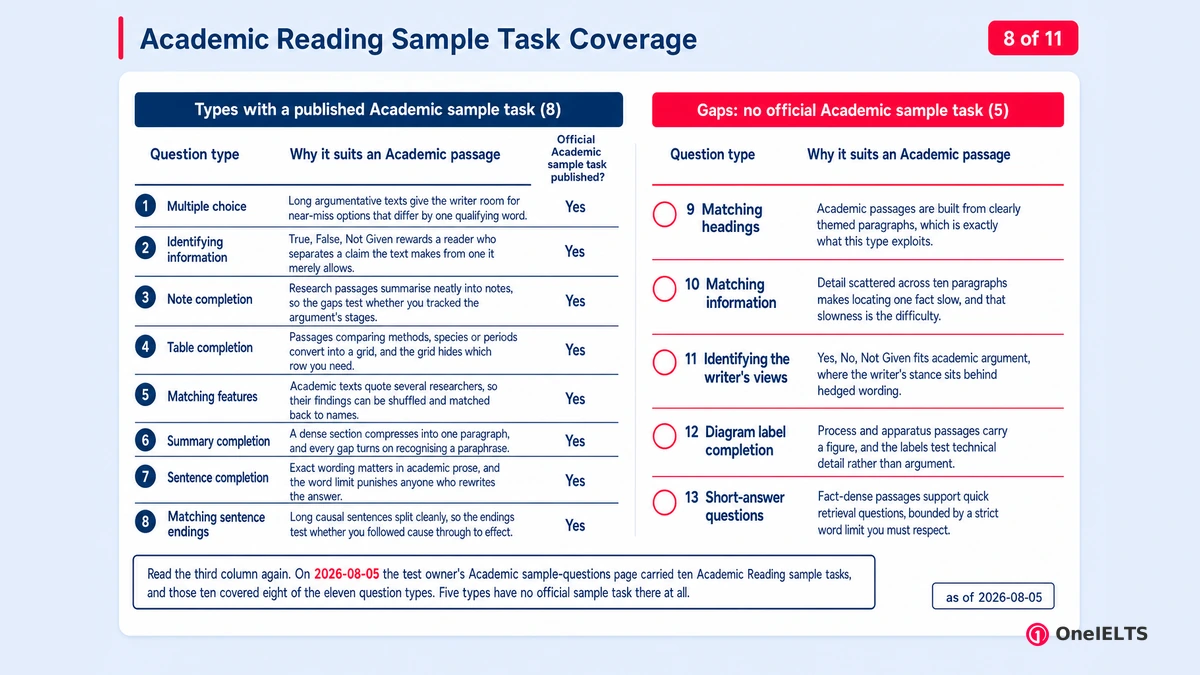
All eleven question types can appear on an Academic paper, but the paraphrase-heavy ones do the damage: matching headings, identifying information and summary completion. The table pairs each type with the reason it suits an Academic passage, and records whether the test owner publishes an Academic sample task for it.
| Question type | Why it suits an Academic passage | Official Academic sample task published? |
|---|---|---|
| Multiple choice | Long argumentative texts give the writer room for near-miss options that differ by one qualifying word. | Yes |
| Identifying information | True, False, Not Given rewards a reader who separates a claim the text makes from one it merely allows. | Yes |
| Note completion | Research passages summarise neatly into notes, so the gaps test whether you tracked the argument’s stages. | Yes |
| Table completion | Passages comparing methods, species or periods convert into a grid, and the grid hides which row you need. | Yes |
| Matching features | Academic texts quote several researchers, so their findings can be shuffled and matched back to names. | Yes |
| Summary completion | A dense section compresses into one paragraph, and every gap turns on recognising a paraphrase. | Yes |
| Sentence completion | Exact wording matters in academic prose, and the word limit punishes anyone who rewrites the answer. | Yes |
| Matching sentence endings | Long causal sentences split cleanly, so the endings test whether you followed cause through to effect. | Yes |
| Matching headings | Academic passages are built from clearly themed paragraphs, which is exactly what this type exploits. | No |
| Matching information | Detail scattered across ten paragraphs makes locating one fact slow, and that slowness is the difficulty. | No |
| Identifying the writer’s views | Yes, No, Not Given fits academic argument, where the writer’s stance sits behind hedged wording. | No |
| Diagram label completion | Process and apparatus passages carry a figure, and the labels test technical detail rather than argument. | No |
| Short-answer questions | Fact-dense passages support quick retrieval questions, bounded by a strict word limit you must respect. | No |
Read the third column again. On 2026-08-05 the test owner’s Academic sample-questions page carried ten Academic Reading sample tasks, and those ten covered eight of the eleven question types. Five types have no official sample task there at all.
The consequence is blunt. A candidate who prepares only from official samples arrives never having met matching headings, matching information, identifying the writer’s views, diagram label completion or short-answer questions. Two of those five are the hardest on an Academic paper.
Each method is unpacked in the IELTS Reading question types inventory on the Reading format page.
What Are the Official IELTS Academic Reading Sample Tests?
Three official things sit behind that question, and candidates routinely confuse them: the Familiarisation test, the paper sample tests, and the computer sample tests with the on-computer practice experience alongside them.
The Familiarisation test walks you through the whole exam once. The paper sample tests are full question sets with an answer key. The computer sample tests reproduce the on-screen version, and the practice experience adds the live timer around it.
Six free official materials cover Academic Reading, and each one does a different job.
- The official Familiarisation test. Meet the paper cold with no clock running, so you learn the instruction lines and the answer sheet before speed ever matters.
- The Academic paper sample tests. Full question sets in authentic wording, each with an answer key, which makes them the closest free thing to a real paper.
- The per-type Academic Reading sample tasks. Short sets that isolate one question type, so you can drill matching or completion until the method runs automatically.
- The computer sample tests. The on-screen paper with its split screen, passage on one side and questions on the other, which reads very differently from paper.
- The on-computer practice experience. The live timer, the highlight tool and the review panel, so nothing about the interface is new to you on test day.
- The test partners’ free full practice tests. A timed rehearsal from British Council or IDP, most useful once you can already handle every question type.
These are free and authentic, which no third-party bank can claim. They are also finite, and most motivated candidates exhaust them inside a fortnight. That is why the order you use them in matters more than the quantity.
Which IELTS Academic Reading Books and PDFs Are Worth Using?
The Cambridge IELTS practice test series is the one third-party material that behaves like the real paper, and most free PDFs circulating online are re-typed copies of it. Six kinds of material turn up in every recommendation thread, so the table gives what each is good for and where each one fails.
| Material | What it is | Best for | Watch out for |
|---|---|---|---|
| Cambridge IELTS practice test series | Past papers published by the exam’s academic partner, each volume holding four full tests with an answer key. | Timed full-paper rehearsal that matches the real paper’s length and difficulty more closely than anything else. | Volumes are finite, so plan which of them you keep unseen for your final rehearsal. |
| Official guide from the test owners | A single volume pairing an explanation of every question type with practice sets and a marked answer key. | Learning the method behind each type before you start sitting whole papers against a clock. | It teaches more than it drills, so it cannot carry your practice on its own. |
| Test-partner preparation courses | Structured lesson courses from British Council or IDP, mixing video teaching, per-type drills and progress checks. | Candidates who want a syllabus rather than a pile of papers to work through alone. | Course practice sets run shorter than a full paper, so your pacing stays largely untested. |
| Free PDF collections online | Scanned or re-typed question sets, usually of Cambridge material, with no stated source or edition. | Extra drilling volume, once you already know what a correct answer key ought to look like. | Wrong keys and invented question types, because a wrong key quietly teaches a wrong habit. |
| Question-type lesson sites | Free teaching pages explaining one question type at a time, each with worked examples and commentary. | Covering the five types that have no official Academic sample task to practise from. | Quality varies, and some sites invent type names the exam board has never published. |
| Full online mock platforms | Timed on-screen papers that reproduce the computer-delivered interface and mark themselves the moment you finish. | Rehearsing the split screen, the review panel and the pressure of a live countdown. | Passage quality varies widely, so check the source before you trust a band estimate. |
One check separates a usable PDF from a harmful one. Does the material state which official type each question set belongs to? Materials carrying accurate question type labels were built from the published inventory, and materials without them were assembled by someone guessing.
Older Cambridge IELTS volumes remain valid practice, because the Academic Reading format has not changed. “Latest edition” matters far less than candidates assume, and an older volume you have not seen beats a new one you already worked through. Nothing here points you to a pirated PDF.
How Should You Use IELTS Academic Reading Materials to Improve?
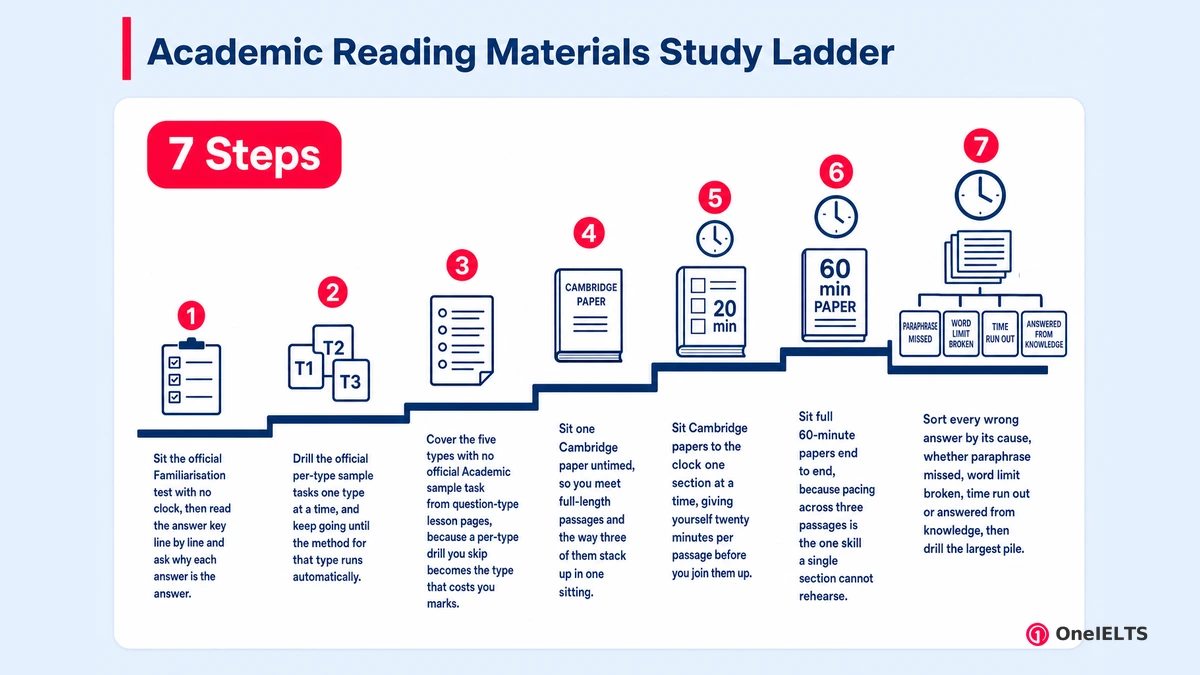
In an order. Meet the paper untimed, drill single question types, then sit whole timed papers. Most candidates do only the third of those and stall.
This ladder is the part no ranking page supplies. Every guide names the materials, and almost none says which to open first, yet the order decides whether the materials teach you anything. The last step, review by cause, is what turns practice into improvement.
Seven steps take you from a first untimed look to a full rehearsal, in the order that works.
- Sit the official Familiarisation test with no clock, then read the answer key line by line and ask why each answer is the answer.
- Drill the official per-type sample tasks one type at a time, and keep going until the method for that type runs automatically.
- Cover the five types with no official Academic sample task from question-type lesson pages, because a per-type drill you skip becomes the type that costs you marks.
- Sit one Cambridge paper untimed, so you meet full-length passages and the way three of them stack up in one sitting.
- Sit Cambridge papers to the clock one section at a time, giving yourself twenty minutes per passage before you join them up.
- Sit full 60-minute papers end to end, because pacing across three passages is the one skill a single section cannot rehearse.
- Sort every wrong answer by its cause, whether paraphrase missed, word limit broken, time run out or answered from knowledge, then drill the largest pile.
Repeating a paper you have already seen tests memory rather than reading. Keep one clean Cambridge paper unopened for a final timed paper in the week before test day.
How Is the IELTS Academic Reading Score Calculated?
One mark per correct answer out of 40, with no negative marking, and that raw score is converted onto the nine-band scale using the Academic conversion.
Half bands exist in Reading, so one or two marks decide a boundary. A copied answer also has to be spelled correctly to score, which means a word lifted straight from the passage still loses the mark when you mis-transcribe it.
The Academic conversion is fixed rather than adjusted to the day’s candidates. It is more forgiving than the General Training conversion at the same raw score, because the Academic texts are harder to read.
Candidates always want the raw totals behind each band, and that is where care matters. Treat the exact raw score for each band as version-specific and check the current official table, rather than a figure repeated on a forum.
Two things hold regardless. General Training needs a higher raw total for the same band, and one extra correct answer can be worth a half band near a boundary. The full conversion table sits on the IELTS Reading band score page.
Where Can You Take a Full IELTS Academic Reading Practice Test?
Sit a full three-passage Academic paper under the real sixty minutes on OneIELTS, and keep the official free tests as your authenticity check. Practice needs a free account.
Loose passages cannot rehearse what the paper actually tests. A full-length mock test is the only way to feel how an hour runs out across three passages of rising difficulty. A computer-delivered mock is also the only rehearsal for the split screen, the highlight tool and the review panel.
Five of the eight related searches on this query ask for a PDF or an answer key, which tells you candidates want the key more than the paper. A key on its own teaches very little. Mark the paper, then apply the review by cause step from the ladder above and drill the largest pile of errors.
What Are the Best Tips for IELTS Academic Reading?
The tips that move an Academic Reading band are about where you spend the hour and how you handle paraphrase, not about reading faster.
Everything above describes the Academic paper and the materials behind it. What follows is what a candidate does with them on the day, plus the four questions that decide whether a band actually moves. Seven habits separate candidates who finish the paper from candidates who run out of time.
- Read the instruction line and its word limit before the passage, because a three-word answer written in four scores nothing.
- Give the third passage more than a third of the hour, since it is the hardest section by design.
- Treat every question as paraphrase matching rather than comprehension, because the answer is a reworded version of the text.
- Scan for the question’s proper nouns, numbers and dates first, since those are the words never paraphrased.
- Keep your answers moving down the page as you finish each one, instead of transferring them all at the end.
- Never let a statement that is true in the world pass as a statement made in the passage.
- Answer every question, even a pure guess, because a wrong answer costs you nothing on this paper.
How Do You Get Band 6.5 or 7 in IELTS Academic Reading?
The gap between band 6.5 and 7 is usually three or four extra correct answers, and they sit in one or two question types rather than spread across the paper.
Diagnose it with an error by question type count across three papers, then drill only the worst two. At this level, time management and one weak type explain nearly all of the loss. Our how to improve IELTS Reading skills guide covers those drills.
Is 7.5 a Good Score in IELTS Academic Reading?
Yes, 7.5 in Reading clears almost every university and visa component requirement, and Reading is the component where a high band is most reachable because nothing is judged. Reading and Listening award half bands straight off the raw conversion, so a band 7.5 is a counted number of correct answers rather than an examiner’s decision. Check it against what a good IELTS score means for your destination.
How Fast Do You Need to Read for IELTS Academic Reading?
Fast enough to cover roughly 2,150 to 2,750 words plus 40 questions in 60 minutes, which works out at about a page every three to four minutes if you read every word. Nobody scoring well reads every word: your working reading speed comes from scanning for the question’s anchor words, then close reading only the sentences around them. Below band 8, paraphrase recognition pays more than any speed drill. Our IELTS Reading tips page has both.
Should You Read the Passage or the Questions First in IELTS Academic Reading?
It depends on the question type, which is why a single blanket answer is wrong: read the questions first for locating tasks, and skim the passage first for matching headings.
Types that send you hunting for one fact, such as locating information, reward reading the questions first, since question order usually follows the passage. Types needing the shape of the whole text reward a fast skim first. Test both orders in our IELTS Reading practice sets, which need a free account.
Does Vocabulary Decide Your IELTS Academic Reading Score?
Largely yes, not because the passages test vocabulary directly, but because almost every question is a paraphrase, and a paraphrase you cannot recognise is a mark you cannot score.
The vocabulary that pays is synonym families and academic collocation, not long word lists, since technical terms are either explained in the passage or irrelevant. Build vocabulary in context from papers you have already sat, and our IELTS synonyms page groups the families worth learning.
Written by Fahimur Rahman, reviewed 14 August 2026.
Last verified: 14 August 2026
Practice for the Real IELTS Exam
Apply what you’ve learned with free, exam-style practice:
- Take a free IELTS mock test — all four skills, real exam timing, AI band scoring
- Sit a Reading section mock — one full timed paper with an instant band score
- Practise by question type — self-paced passages with answer explanations