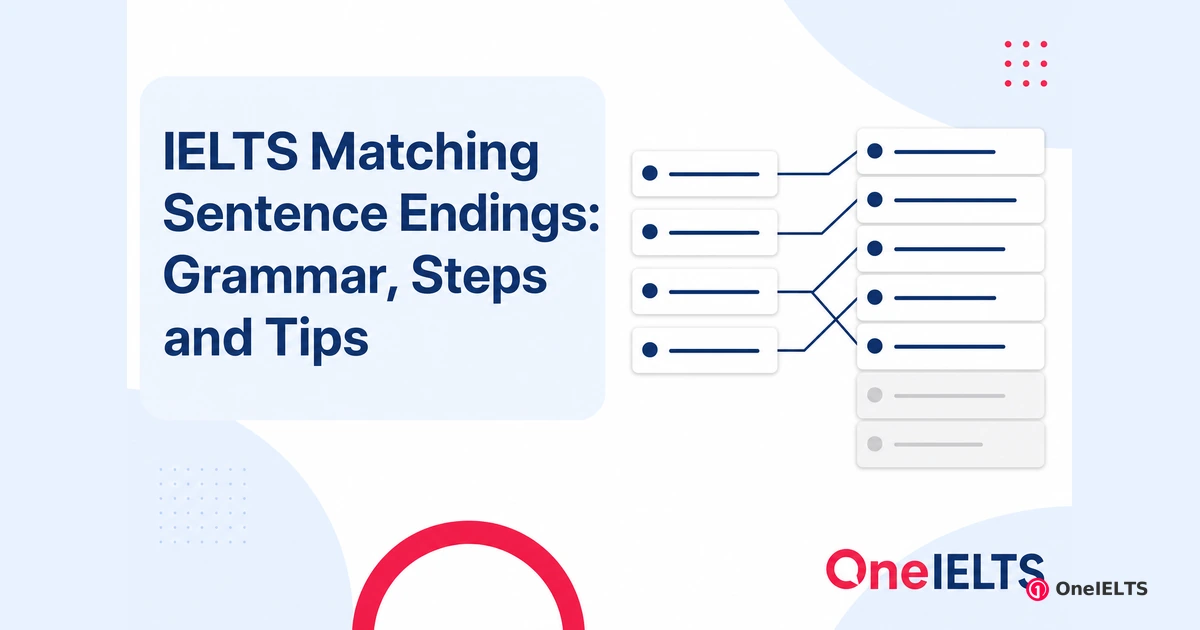
Matching sentence endings gives you a set of sentence beginnings and a longer list of lettered endings, and you pick the letter that finishes each one the way the passage does. The list is longer on purpose. Half of it can be crossed off on grammar alone, before you read a word of the passage.
The beginnings also run in passage order, which matching features does not.
This guide covers what the task is, the skills it tests, how grammar narrows the endings, and whether the answers follow the passage. It then gives the step-by-step method, the common mistakes, a worked example, where to practise, the best tips, and how the type sits beside the other Reading question types.
What Is Matching Sentence Endings in IELTS Reading?
You get the first halves of several sentences plus a longer lettered list of possible endings, and you choose the ending that completes each one the way the passage does. The answer you write is a letter, not copied words.
A sentence ending is the second half of a statement about the passage, printed for you and ready made. The sentence beginnings are numbered, and the lettered endings run A, B, C and on. You write letters in the answer boxes, so spelling costs you nothing on this task.
Two rules govern every set. The list always holds more endings than beginnings, so some endings go unused. The ending you pick also needs to make the joined sentence both true to the passage and grammatically correct, because one without the other scores zero.
IELTS lists it as Academic Reading Question Type 7 – Matching sentence endings, and it turns up in General Training papers too.
What Skills Does IELTS Reading Matching Sentence Endings Test?
It tests reading grammar accurately, recognising a paraphrase, and holding a half-sentence in mind while you scan for the rest of it. The task works at the level of one specific detail rather than the drift of a paragraph, which puts it with the scanning question types rather than the main-idea ones.
The matching happens through synonyms. A beginning that says “researchers underestimated” may sit above a passage line that reads “the team had not expected”, so shared vocabulary is a weak signal and often a planted one.
Grammar reading is what separates this type from every other matching task. No other Reading question makes the shape of the sentence part of the answer.
Why Does Grammar Narrow the Options in IELTS Reading Matching Sentence Endings?
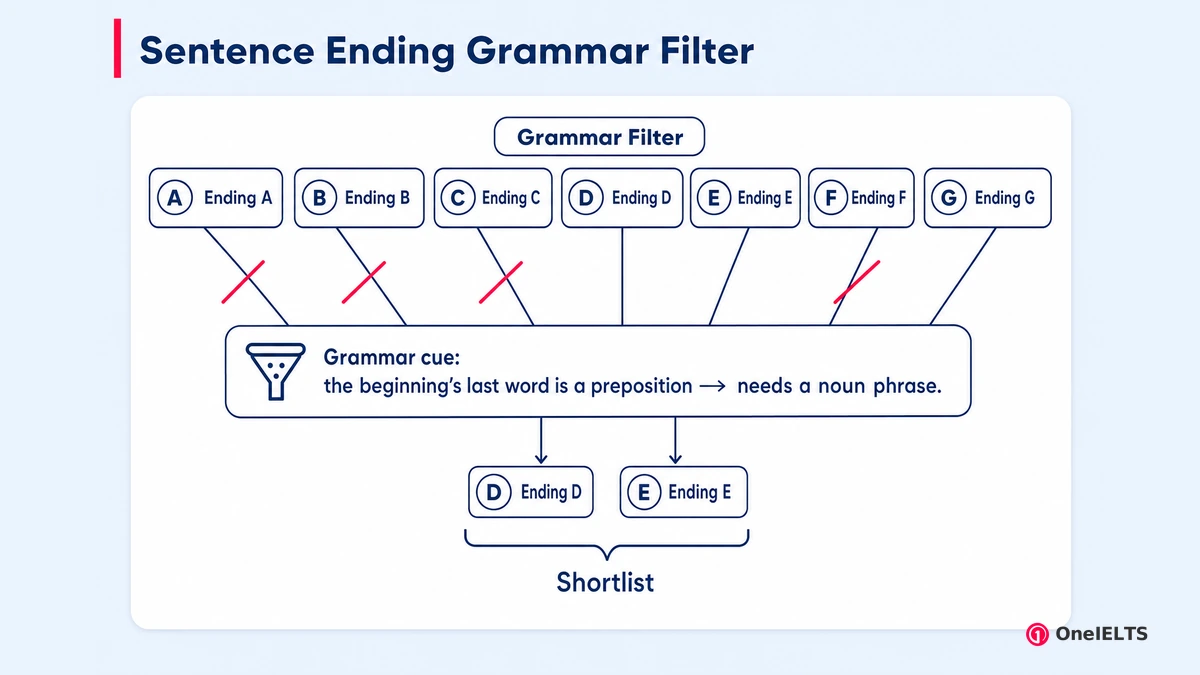
Because a beginning and an ending have to join into one grammatical sentence. An ending that starts with a finite verb cannot follow a beginning that already has one, so you can strike out endings before you read the passage at all.
Read the last two or three words of each beginning and ask what has to come next. “The researchers concluded that” needs a clause. “The scheme was funded by” needs a noun phrase. “Rainfall fell sharply after” needs a date or an event.
The spare options are distractor endings, and plenty of them are made ungrammatical on purpose, because a set with more endings than beginnings needs endings that can be thrown out. Others read perfectly well yet contradict the passage, so grammar shortens the list without finishing the job.
Shortlist two or three endings per beginning, then let the passage choose between them.
Do IELTS Reading Matching Sentence Endings Answers Follow the Passage Order?
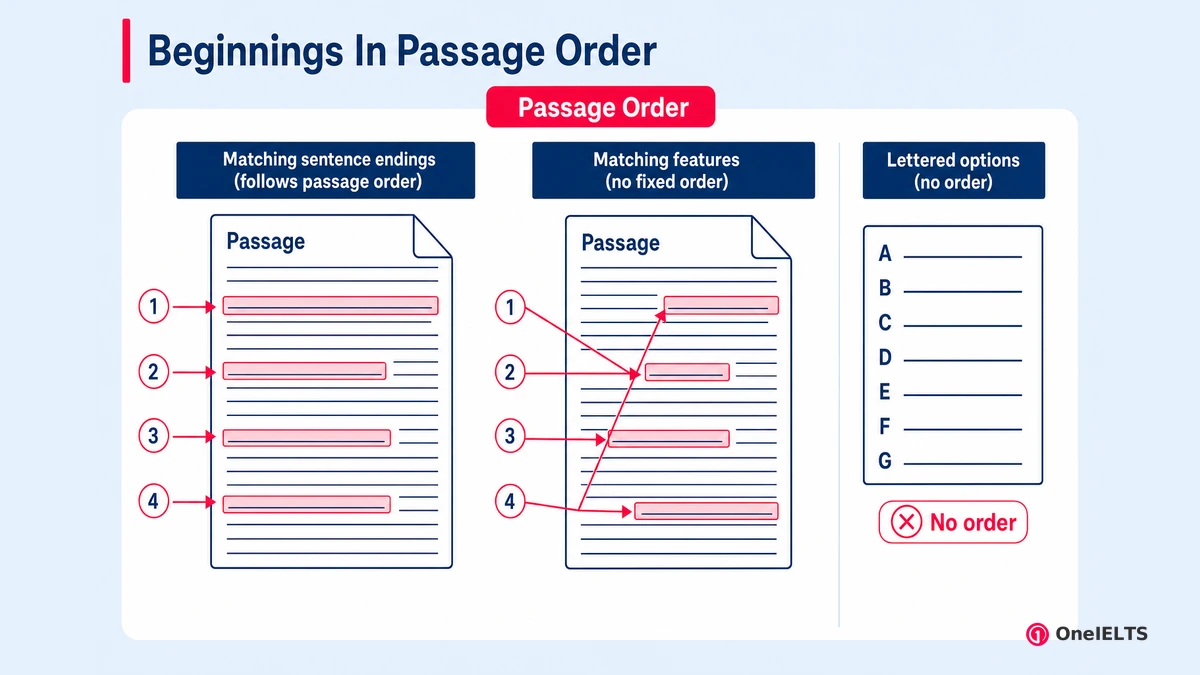
Yes. The sentence beginnings run in passage order, so once you have settled beginning 3 you only look forward for beginning 4. Everything above your last answer can be left alone.
That allows one pass through the text instead of four, which on a 60-minute paper is worth several minutes.
Matching features is the exception inside the matching family, and its answers arrive in no fixed order. That matching features contrast is the reason one method cannot serve both types.
The lettered options behave differently again. They are printed with the endings in no order at all, so never work down the list from A hoping the sequence will help you.
How Do You Answer IELTS Reading Matching Sentence Endings Questions?
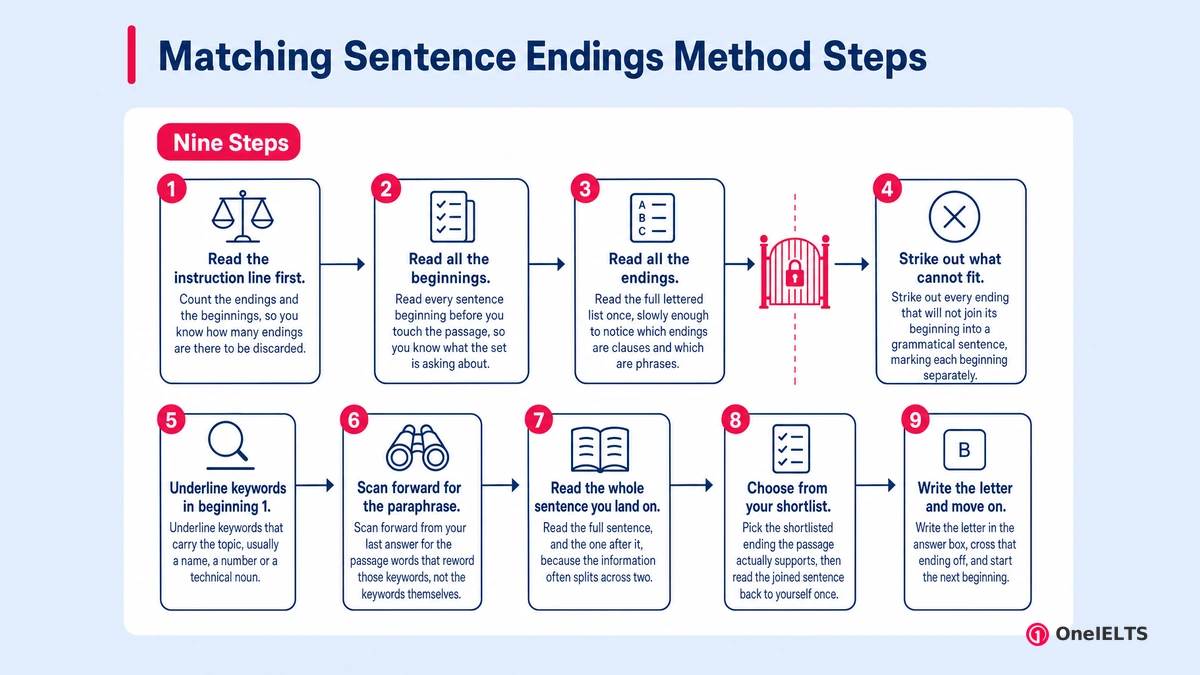
The method has one unusual feature. The grammar pass comes before the passage, so you thin the options first and read only to decide between what survives. The instruction line asks for letters, and everything below is built around getting the right letter into the right box.
Here is the nine-step loop, from the instruction line to the last letter written.
- Read the instruction line first. Count the endings and the beginnings, so you know how many endings are there to be discarded.
- Read all the beginnings. Read every sentence beginning before you touch the passage, so you know what the set is asking about.
- Read all the endings. Read the full lettered list once, slowly enough to notice which endings are clauses and which are phrases.
- Strike out what cannot fit. Strike out every ending that will not join its beginning into a grammatical sentence, marking each beginning separately.
- Underline keywords in beginning 1. Underline keywords that carry the topic, usually a name, a number or a technical noun.
- Scan forward for the paraphrase. Scan forward from your last answer for the passage words that reword those keywords, not the keywords themselves.
- Read the whole sentence you land on. Read the full sentence, and the one after it, because the information often splits across two.
- Choose from your shortlist. Pick the shortlisted ending the passage actually supports, then read the joined sentence back to yourself once.
- Write the letter and move on. Write the letter in the answer box, cross that ending off, and start the next beginning.
What Are the Common Mistakes in IELTS Reading Matching Sentence Endings?
Marks disappear on this type before the passage is even consulted. The costliest error is picking the ending that sounds right rather than the one the passage supports, and the second costliest is skipping the grammar work that would have removed it.
Seven errors account for most of the lost marks here.
- Picking the ending that fits your ear. An ending can be fluent, plausible and still wrong, the classic “reads well but untrue” trap.
- Working down the endings list. Answers come from the beginnings, so working through the endings list from A wastes time and invites guesses.
- Re-scanning the whole passage each time. The beginnings run in order, so starting again at paragraph one for every item burns minutes.
- Skipping the grammar check. Without a grammar check you leave impossible endings in play and choose between five options instead of two.
- Reusing an ending. Each lettered ending may be used once only, so a repeated letter means one of the two is wrong.
- Writing words instead of a letter. Write the letter the ending carries, because copying the ending’s wording scores nothing on this task.
- Leaving a beginning blank. A blank scores zero, while a letter taken from a shortlist of two lands about half the time.
What Does an IELTS Reading Matching Sentence Endings Question Look Like?
A set prints a short instruction line, a numbered column of sentence beginnings, and a longer lettered column of endings underneath. Here is a worked example built on an original passage written for this page.
Since 2019, marine biologists at the Rosgill Institute have recorded the sound of a damaged reef off Sula Bay. Healthy reefs are noisy places, full of the clicks of snapping shrimp, and young fish use that noise to find somewhere to settle. The team suspended underwater speakers over four bare patches of rubble and played recordings of a healthy reef for six weeks.
Fish settled on the treated patches at roughly twice the rate seen on untreated patches nearby. Coral growth itself did not improve during the trial, and the researchers were careful to say so. The equipment was funded by a regional fisheries levy, not by the institute’s own research budget.
Four sentence beginnings come with the passage.
- Young fish locate a place to settle by
- The speakers were placed above
- The trial produced no measurable change in
- The recording equipment was paid for by
Seven lettered endings sit below them, so three will go unused.
- A. listening to the sounds a healthy reef makes.
- B. four patches of bare rubble.
- C. the growth of the coral itself.
- D. a levy charged on regional fisheries.
- E. increased twice as fast as elsewhere.
- F. the number of shrimp recorded on the reef.
- G. the institute’s own research budget.
Each beginning requires a particular grammatical shape, and the passage settles the rest.
- 1 = A. “by” requires a gerund, and A is the only ending that starts with one; the passage has young fish using “that noise to find somewhere to settle”.
- 2 = B. “above” requires a noun phrase of place; the passage puts the speakers over “four bare patches of rubble”.
- 3 = C. “change in” requires a noun phrase, which keeps B, C, F and G alive, and only C matches “Coral growth itself did not improve”.
- 4 = D. “paid for by” requires a payer, so D and G both fit the slot, and the passage kills G with “not by the institute’s own research budget”.
Ending E is grammatically impossible after all four beginnings, because every one of them ends in a preposition. F and G join up perfectly well and are simply untrue, which is why the grammar pass alone never finishes the job. In each case the passage-supported ending came from a shortlist of two, and an unused ending is a sign the set is working rather than a sign you missed something.
Where Can You Practise IELTS Reading Matching Sentence Endings?
Practise this type on OneIELTS instead of hunting down worksheet PDFs. Our IELTS Reading matching sentence endings practice filter narrows the Reading bank to practice questions of this single type. Opening them requires a free OneIELTS account.
Short sets suit this task better than long ones. The grammar pass is a habit, and habits form on repetition, so ten items worked properly on a Tuesday beat forty rushed on a Sunday.
A question type drill isolates the one decision you are training, which a full paper cannot do while a clock is running. Across our marked Reading practice, wrong answers on this type cluster on the grammatical-but-untrue endings rather than on the impossible ones.
Review your errors with three questions. Did the grammar pass fail, did the paraphrase slip past you, or did a distractor simply read well?
What Are the Best Tips for IELTS Reading Matching Sentence Endings?
Most matching sentence endings tips come down to sequence. Accuracy rises when the grammar pass happens before the passage, and it falls when the lettered list drives the search instead of the beginnings.
These eight habits are worth building one at a time.
- Read every ending first. Read the full lettered list before the passage, so you know what you are choosing between.
- Run the grammar pass first. Do the grammar pass before you read, and cut every ending that cannot join grammatically.
- Expect the beginnings in passage order. The beginnings follow passage order, so search forward from your last answer, never backward.
- Never work down the endings list. Take the beginnings in turn; the lettered list has no order to follow.
- Read the whole sentence around your match. Read the sentence before and after your hit, because qualifiers often sit nearby.
- Read the joined sentence back. Check the beginning and ending together make one true, correct sentence before committing.
- Write letters, never words. Write letters in the answer boxes; copied wording from the ending earns nothing here.
- Leave nothing blank. Guess from your shortlist rather than leaving an empty box, because blanks score zero every time.
How Does Matching Sentence Endings Fit With the Other IELTS Reading Question Types?
Among the official Academic Reading question types, this one belongs to two families at once. By answer format it is a matching task, because it uses letters from a list. By what it asks you to do it is a completion task, because you finish a sentence.
That double membership explains the confusion. Candidates who file it under the matching family import the matching features method and lose the passage-order advantage. Candidates who file it under the completion family start hunting for words to copy and forget the words are already printed.
Everything above this line treats matching sentence endings on its own. What follows sets it beside its two nearest neighbours and beside the way a real paper mixes them.
Is Matching Sentence Endings the Same as Sentence Completion in IELTS Reading?
No. Sentence completion makes you find the words in the passage and copy them inside a word limit, while matching sentence endings gives you the words already written and makes you choose a letter. No word limit applies here, because you never write a word. Even IDP’s own page blurs the line, labelling a matching task “Sentence Completion” in its samples. Our IELTS Reading sentence completion guide covers the copying rules.
Do IELTS Reading Matching Sentence Endings and Matching Features Use the Same Method?
No, and treating them alike costs marks. Matching sentence endings runs in passage order and can be narrowed by grammar, while matching features runs out of order and lets you reuse an option. The grammar filter does not exist on matching features, because the options there are names rather than sentence halves. The one shared step is recognising the paraphrase. Our IELTS Reading matching features guide sets out that method.
Do Cambridge IELTS Reading Tests Use Matching Sentence Endings?
Yes, it is an official task type in Academic Reading and appears across the Cambridge IELTS papers. Meeting it inside a full passage matters, because a full passage mixes it with True/False/Not Given and completion tasks, so the switch between methods is part of the training. A free IELTS Reading mock test covers those mixed question types.
Written by Fahimur Rahman, reviewed 14 August 2026.
Last verified: 14 August 2026
Practice for the Real IELTS Exam
Apply what you’ve learned with free, exam-style practice:
- Take a free IELTS mock test — all four skills, real exam timing, AI band scoring
- Sit a Reading section mock — one full timed paper with an instant band score
- Practise by question type — self-paced passages with answer explanations