IELTS General Reading runs sixty minutes and forty questions across three sections, and what you read is notices, timetables, staff handbooks, contracts and one longer general-interest text. Nothing on the paper looks like a journal article. The official name is IELTS General Training Reading, while candidates and search boxes say IELTS General Reading and IELTS GT Reading.
This guide covers the test, its format, and what sits in Section 1, Section 2 and Section 3. It then takes the question types, the timing, the score conversion, the common mistakes, practice, and the Academic comparison. Two facts run underneath all of it: the marks are front-loaded against the clock, and the General Training conversion asks for more correct answers than the Academic one for the same band.
What Is the IELTS General Reading Test?
The IELTS General Reading test is the Reading paper sat by candidates taking IELTS General Training, built from social and workplace English rather than academic prose. It is one of the four timed components, and it shares its Listening, Writing and Speaking neighbours with the Academic version.
Migration applicants sit it, along with candidates applying for secondary education or for work and training below degree level. University applicants usually do not, because their institutions ask for IELTS Academic Reading instead. Reading and Writing are the only two components where the two versions genuinely differ, and IELTS Liz states the reason plainly: the difference is mainly due to the language and difficulty level of the texts.
The paper is identical whichever test partner you book with. This page owns the General Training Reading paper itself. The whole-Reading format and the practice sets have their own pages, linked further down.
What Is the Format of the IELTS General Training Reading Test?
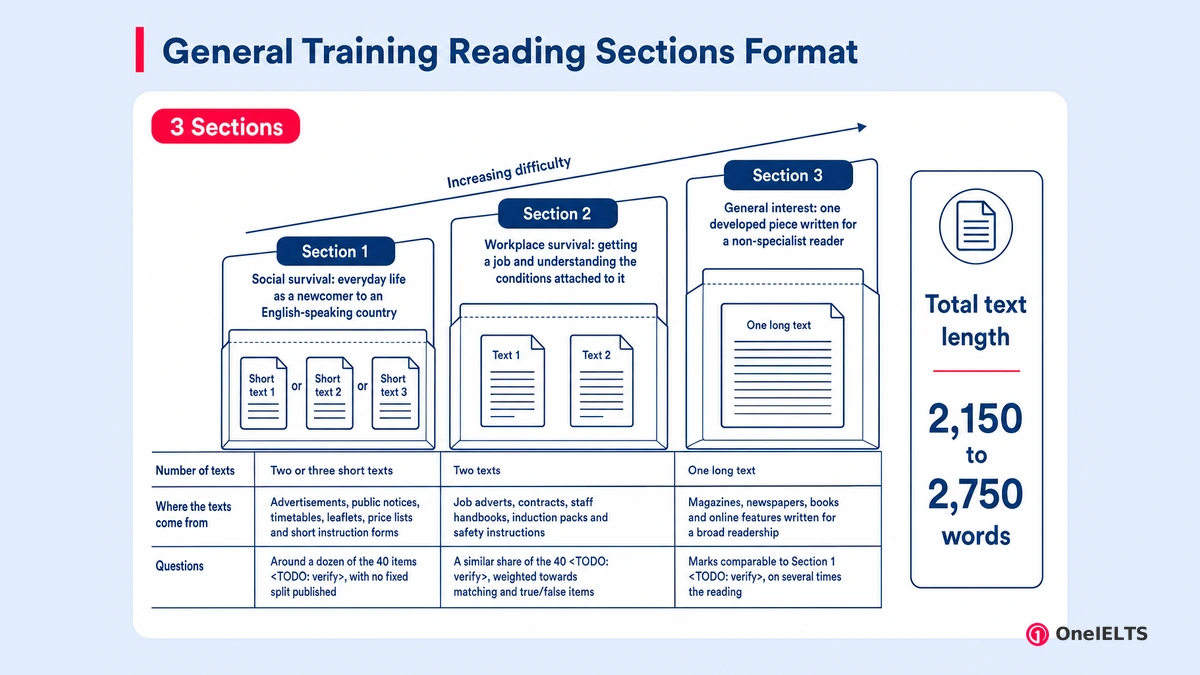
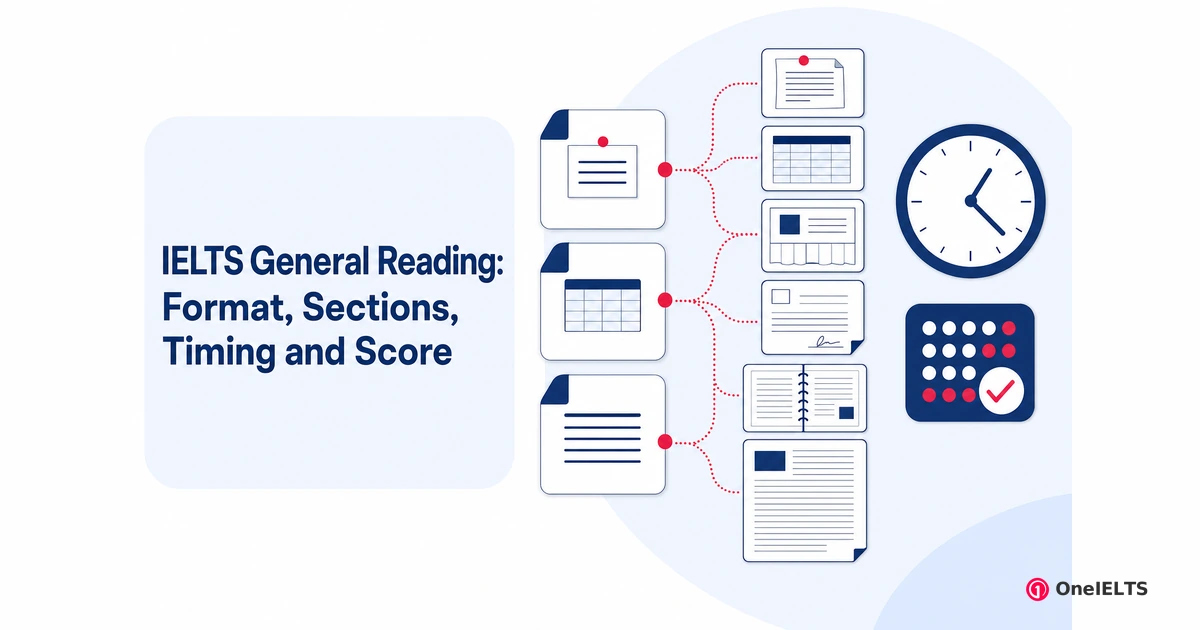
Three sections of increasing difficulty carry up to six texts, 40 questions and 60 minutes including transfer time. The total text length runs from 2,150 to 2,750 words, exactly as the test owner’s General Training format page states.
The number of sections and the number of texts are different counts, and that gap is what catches people. Section 1 can carry two or three separate short texts, Section 2 carries two, and Section 3 carries one. A single paper therefore holds as many as six texts inside three sections.
The total text length matches the Academic range, so General Training is not a shorter paper. The texts are simpler while the word count stays the same.
Each section’s theme, text count, sources and question load sit in the table.
| Section | Theme | Number of texts | Where the texts come from | Questions |
|---|---|---|---|---|
| Section 1 | Social survival: everyday life as a newcomer to an English-speaking country | Two or three short texts | Advertisements, public notices, timetables, leaflets, price lists and short instruction forms | No fixed split is published |
| Section 2 | Workplace survival: getting a job and understanding the conditions attached to it | Two texts | Job adverts, contracts, staff handbooks, induction packs and safety instructions | A comparable share of the 40, weighted towards matching and true/false items |
| Section 3 | General interest: one developed piece written for a non-specialist reader | One long text | Magazines, newspapers, books and online features written for a broad readership | Marks comparable to Section 1, on several times the reading |
What Is in Section 1 of the IELTS General Reading Test?
Section 1 is social survival English, two or three very short factual texts of the kind you meet as a newcomer to an English-speaking country. Everything here is information you would need in your first week abroad, such as opening times, prices, rules and booking steps. Advertisements and notices dominate, and no text runs longer than a page.
Six text types account for almost everything Section 1 sets.
- Advertisements. Short commercial texts for courses, rentals or services, where the answer is usually a price or a condition.
- Public notices. Rules and announcements posted in libraries, stations and community centres, often carrying one exception that gets tested.
- Timetables and schedules. Bus, train and class timetables where you read across a row and down a column.
- Leaflets and brochures. Tourist, council or college leaflets split into small headed blocks that reward scanning by heading.
- Opening hours and price lists. Numeric blocks where a single day or category differs from the rest of the list.
- Short instructions and forms. Application steps, membership forms and how-to notices, tested by sequence and by who qualifies.
Four mechanics apply here and nowhere else. The texts are too short to skim, so scanning beats skimming outright. The questions usually follow the order of the text. The answers are literal answers lifted from the text rather than paraphrases. Marks per minute peak here, so finishing Section 1 inside seventeen minutes is what funds Section 3.
Here is an original Section 1 style notice, written for this page rather than lifted from a past paper.
Riverside Community Pool: summer opening hours Monday to Friday, 6:30 am to 9:00 pm Saturday, 7:00 am to 6:00 pm Sunday, closed for maintenance until 12 noon Adult swim £4.20, under-16s £2.10, family ticket £11 Lockers take a £1 coin, refunded on return
Two questions in Section 1 style. When does the pool open latest? Sunday, 12 noon. What do you get back after using a locker? Your £1 coin. Neither answer needs a synonym, and both need you to find the right line.
What Is in Section 2 of the IELTS General Reading Test?
Section 2 is workplace survival English, two work-related texts about applying for a job, conditions of employment, pay, training and staff facilities. The reader it imagines has arrived, found work, and now has to understand the paperwork around it: the contract, the handbook, the training material and the notice on the wall.
Section 2 draws its material from six recurring text types.
- Job descriptions and advertisements. Vacancy texts listing duties, hours and essential requirements, tested on who qualifies and who does not.
- Contracts and conditions of employment. Formal terms covering notice, probation, overtime and leave, where one clause carries the tested exception.
- Staff handbooks and company policies. Internal rulebooks on conduct, absence and dress, written in fixed phrasing that repeats across papers.
- Training and induction material. Course outlines and induction packs telling a new starter what is compulsory and what is optional.
- Equipment manuals and safety instructions. Procedures for machinery or premises, tested on sequence and on the one prohibited action.
- Workplace notices about pay or leave. Payroll dates, holiday entitlement and sick-pay rules, usually tested with a number or a date.
Three habits pay off here. The register is fixed workplace vocabulary that repeats from paper to paper, so this is the one section where learning a wordlist genuinely earns marks. The question usually asks about a condition or an exception buried in a clause rather than about the main statement. Matching information and true/false/not-given both cluster here, and both punish a reader who answers from the general sense of a paragraph.
What Is in Section 3 of the IELTS General Reading Test?
Section 3 is one long text of general interest, more descriptive and more argued than anything earlier in the paper, and the hardest section by design. This is the part of General Training that comes closest to Academic Reading: one writer, one topic, and a view developed over several paragraphs.
Six features mark this section out from the two before it.
- A single continuous text. One piece of writing rather than several short ones, so there is no easy re-entry point once you lose the thread.
- A general interest text for a non-specialist. The subject can be anything from urban beekeeping to workplace sleep, and no background knowledge is assumed.
- A developed argument. The writer takes a position and then qualifies it, so the tested meaning often sits inside the qualification rather than the claim.
- Paraphrase instead of word-matching. The question rewords the text, and the word you scan for has usually been replaced by a synonym.
- Matching headings and summary completion. Both appear here more often than earlier, because both need a whole paragraph rather than a single line.
- Marks roughly level with Section 1. The reading takes several times longer while the mark total stays comparable.
That last feature is the one nobody tells you. Section three carries marks comparable to Section 1 on many times the reading, so an even 20/20/20 split hands your slowest section the same hour-share as your fastest. Section 3 needs the remainder of the hour, not a third of it.
What Question Types Appear in the IELTS General Reading Test?
General Training uses the same eleven question types as Academic Reading. The test owner publishes one identical inventory for both papers, so no question type is exclusive to General Training.
The table names each type, what it asks you to do, and the part of the General Training paper it tends to land in.
| Question type | What you do | Where it usually appears in the GT paper |
|---|---|---|
| Multiple choice | Pick one answer from four options, or several from a longer list, using one located part of the text | All three sections |
| Identifying information (true/false/not given) | Judge whether a statement agrees with the text, contradicts it, or is simply absent from it | Heaviest in the Section 2 workplace texts |
| Identifying the writer’s views or claims (yes/no/not given) | Judge a statement against the writer’s opinion rather than against the plain facts of the text | Section 3, where a writer argues a case |
| Matching information | Find which paragraph holds a given detail, working backwards from the question into the text | Section 2 and Section 3 |
| Matching headings | Choose the heading that captures a paragraph’s main idea rather than one detail inside it | Section 3, on the multi-paragraph text |
| Matching features | Link statements to a list of people, places or categories named somewhere in the text | Section 2 and Section 3 |
| Matching sentence endings | Complete a half sentence with the ending the text supports, working in text order | Section 2 and Section 3 |
| Sentence completion | Fill a gap with words copied from the text, staying inside the stated word limit | All three sections |
| Summary, note, table and flow-chart completion | Complete a condensed version of part of the text, from the text or from a word box | Section 3 most often, Section 2 sometimes |
| Diagram label completion | Label the parts of a picture or plan using words taken directly from the text | Rare on General Training |
| Short-answer questions | Answer a direct question in a few words taken straight from the text | Section 1 and Section 2 |
The third column is what the test owner’s own page does not give you. Per-type frequency is unpublished, so read those entries as tendencies rather than counts. Diagram label completion is the clearest case, because General Training texts seldom describe an object. Splitting drill time equally across all eleven types wastes the hours you have.
Is the IELTS General Reading Test 60 Minutes or 40 Minutes?
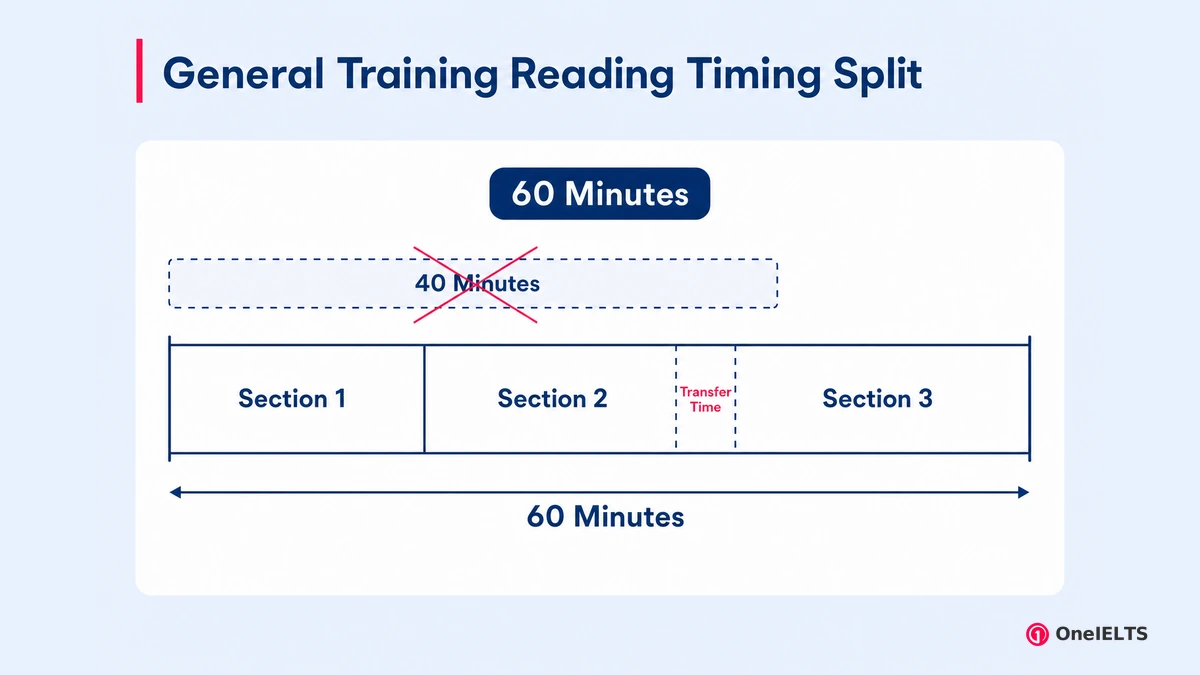
Sixty minutes. The 40 is the number of questions, not the number of minutes, and the two get confused often enough that Google surfaces the question in its People-also-ask block. Forty questions in sixty minutes is the real shape of the paper.
Those sixty minutes include transfer time on the paper-based test, so nothing is added at the end for copying answers across. Listening is the component that grants a separate transfer window, and that is where the expectation comes from. The computer-delivered version runs to the same sixty minutes and simply removes the copying step.
The time split for this paper is uneven on purpose. Give Section 1 about fifteen to seventeen minutes, Section 2 about twenty, and Section 3 everything left. Section three is one long text carrying marks comparable to Section 1’s short ones, so it needs the largest share.
How Is the IELTS General Reading Score Calculated?
One mark per correct answer, no penalty for a wrong one, and the raw total out of 40 converted onto the nine-band scale using the General Training conversion, which is not the Academic one.
There is no negative marking, so a blank answer and a wrong answer score the same nothing. Half bands exist in Reading, which means one or two marks decide a boundary. Spelling must be correct for a copied answer to score, and the conversion is fixed in advance rather than adjusted to the day’s candidates.
The reader’s real question is what a raw score buys. Thirty out of forty is a solid band on the Academic conversion and a lower one on General Training, which is why a candidate who checks an Academic chart over-estimates their band.
The table sets the two conversions side by side so the direction of the gap is visible.
| Band | Correct answers needed (General Training) | Correct answers needed (Academic) |
|---|---|---|
| 7 | 35 | 30 |
| 6 | 30 | 23 |
| 5 | 23 | 15 |
| 4 | 15 | not published |
Those four rows are the only figures the exam board publishes, and it gives them as average marks that “will vary slightly from test version to test version”. Bands above 7 and every half band are unpublished, so a chart showing them is an estimate rather than the conversion.
The direction is what this page stands behind. Thirty correct answers is a band 6 on General Training and a band 7 on Academic, one full band apart on the same raw score.
What Are the Most Common Mistakes in the IELTS General Reading Test?
General Training candidates lose marks on easy texts, which is what makes the losses hard to see. Nothing in Section 1 is difficult English. The marks go on the time split, on the word limit, on spelling, and on answering from what you already know instead of from what the page says. The pattern that repeats in marked practice papers is a clean Section 1 and a half-finished Section 3.
Nine recurring errors account for most of the marks that go missing on this paper.
- Splitting the hour evenly. Twenty minutes each hands Section 3’s single long text the same time as Section 1’s short ones.
- Reading Section 1 like a passage. These are notices and timetables, so scanning for the line beats reading from the top down.
- Missing the second text in a section. Section 1 can hold three separate texts, and the questions move on before you notice.
- Treating a workplace exception as the rule. The clause beginning “unless” or “except” is usually the one the question tests.
- Breaking the word limit. A three-word answer in a two-word gap scores zero even when the meaning is exactly right.
- Mis-spelling a copied word. The word is printed in front of you, so a spelling slip loses a mark you had already earned.
- Answering true false not given from knowledge. The question asks what this text says, not what happens to be true in the world.
- Benchmarking against an Academic raw score chart. The General Training conversion asks for more, so the band you calculate comes out too high.
- Leaving answers blank. Nothing is deducted for a wrong answer, so an unanswered question is a mark thrown away.
The last two are General Training specific. The other seven are shared with Academic Reading, so you can tell whether your error belongs to this paper or to reading under a clock in general.
Where Can You Find IELTS General Reading Practice Tests With Answers?
Sit a full-length mock test of all three General Training sections under the real sixty minutes, rather than working through loose PDFs, and use the answer key to diagnose rather than to score.
Six of the eight related searches on this query ask for a PDF, a sample or an answer key, so most readers arrive wanting a download. A download cannot rehearse the one thing that decides this paper, which is the clock across three unequal sections. The test owner publishes official sample questions, and those are the right first stop for authentic wording.
A computer-delivered mock is the only rehearsal for the split screen, if that is the sitting you have booked. OneIELTS practice opens with a free account.
Review by cause rather than by score. Sort every wrong answer into one of four piles, which are running out of time, missing a second text in a section, breaking the word limit, and answering from knowledge instead of from the text. Then drill the largest pile only.
How Does IELTS General Reading Differ From IELTS Academic Reading?
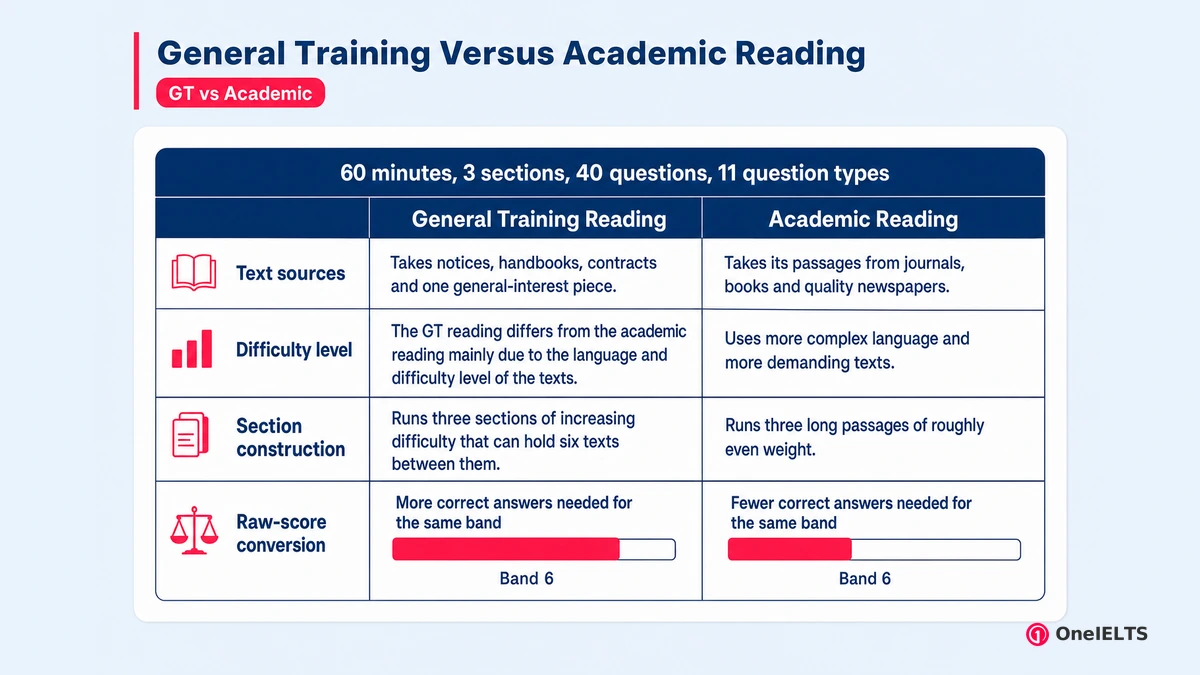
Same hour, same three sections, same forty questions, and the same question types on both papers. What changes is where the texts come from, how hard they are, and how many correct answers a band costs.
The two papers sit on one frame and carry different material. Four dimensions actually differ, and the fourth is the one that decides scores.
Text sources come first. IELTS Academic Reading takes its passages from journals, books and quality newspapers, while General Training takes notices, handbooks, contracts and one general-interest piece.
Difficulty level comes second. IELTS Liz puts it in one line: the GT reading differs from the academic reading mainly due to the language and difficulty level of the texts.
Section construction comes third. Academic runs three long passages of roughly even weight, while General Training runs three sections of increasing difficulty that can hold six texts between them.
The raw-score conversion comes fourth, and it is where the easier paper takes its payment. Easier texts do not buy an easier band. That is the single most misunderstood fact about the two papers, and the sections below start there.
Does IELTS General Reading Need More Correct Answers for the Same Band?
Yes, the General Training conversion asks for more correct answers out of forty than the Academic conversion does for the same band, because its texts are simpler. A candidate who benchmarks against an Academic raw score chart over-estimates their band, and that is the most common scoring error in the whole Reading cluster. The exact gap varies from one test version to the next. Our IELTS Academic vs General Training guide puts both papers side by side.
What Is 30 Out of 40 in IELTS General Reading?
Thirty out of forty sits in the Band 6 zone on the General Training conversion, a band lower than the same raw score would give on the Academic paper. This is the exact number the live People-also-ask block asks about, and the answer changes with the paper rather than with the day. Our IELTS band score guide sets out the full scale.
Are the Question Types the Same in General and Academic Reading?
Yes, the test owner publishes one inventory of eleven question types for both papers, so every type you drill for one counts for the other. Frequency is the caveat. Diagram label completion is rare on General Training, because its texts seldom describe an object, while matching information is common in the workplace section. The same inventory, weighted differently. Our IELTS Reading format guide lists all eleven.
Which IELTS Reading Test Should You Take for a Visa or a Course?
You do not choose the Reading paper on its own. You choose IELTS Academic or IELTS General Training, and the Reading paper follows from that. Migration, work, and study below degree level normally point to General Training, while university admission and professional registration point to IELTS Academic.
The receiving institution decides. Switching modules after booking is a re-booking rather than a change of paper. Our IELTS General Training guide covers the whole test.
Can You Practise With Academic Reading Passages for the General Test?
Yes, partly. Academic passages drill the question types and rehearse Section 3, but they cannot rehearse Section 1 or Section 2, because nothing in the Academic paper looks like a notice or a staff handbook. Mix the two. Use Academic passages for paraphrase and matching headings, and General Training short texts for the clock. Finish with a full practice paper. The IELTS Reading practice hub holds that self-paced work, and a free account opens it.
Written by Fahimur Rahman, reviewed 14 August 2026.
Last verified: 14 August 2026
Practice for the Real IELTS Exam
Apply what you’ve learned with free, exam-style practice:
- Take a free IELTS mock test — all four skills, real exam timing, AI band scoring
- Sit a Reading section mock — one full timed paper with an instant band score
- Practise by question type — self-paced passages with answer explanations