The fastest way to listen better is to stop listening to reply and start listening to understand. That single shift turns passive hearing into active listening, where you track meaning instead of waiting for your turn. The article closes with how each strategy transfers to IELTS Listening, which rewards the same focus on meaning and the same core-message tracking. Below are the seven strategies, in order, that build the habit.
- Minimize distractions
- Listen to understand, not to reply
- Focus on the core message
- Use non-verbal cues and clarifying questions
- Take structured notes
- Build concentration and stamina
- Practise with varied real audio
1. Minimize Distractions
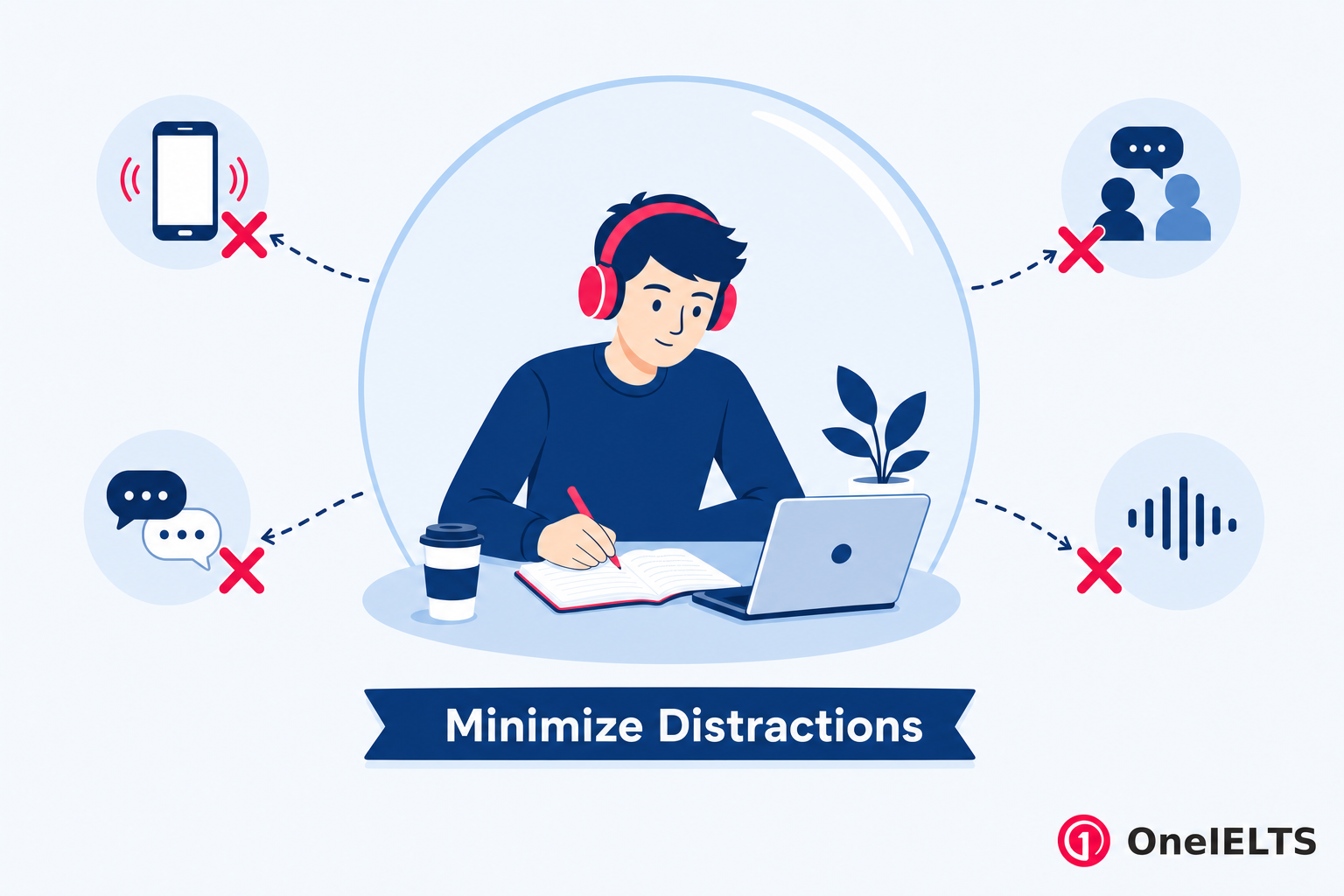
Active listening starts when you remove distractions and give the speaker your undivided attention. Put your phone face-down in another room and mute every notification, because one buzzing screen pulls your focus away mid-sentence. The goal is simple: one speaker, one channel, full attention. When the room competes for your focus, you catch the words but miss the meaning, and you end up asking people to repeat themselves.
2. Listen to Understand, Not to Reply
Most poor listening comes from rehearsing your answer while the other person is still talking. Stop rehearsing and let yourself understand first; hold your reply until the speaker finishes their thought. When you plan a comeback mid-sentence, your attention splits and you lose the speaker’s core message. Try a one-second pause before you respond — it proves you processed what they said rather than waiting for a gap to jump in.
3. Focus on the Core Message
Strong listeners follow the main idea instead of fixating on every word. Chase the gist — the point the speaker is building toward — and let minor details sit in the background until they matter. Tracking not every word but the through-line keeps you from freezing on one unfamiliar term while three more sentences fly past. Ask yourself, “What is this person actually trying to tell me?” and the structure of their message becomes far easier to hold.
4. Use Non-Verbal Cues and Clarifying Questions
Listening is visible, so signal engagement with non-verbal cues — eye contact, a nod, an open posture — that tell the speaker you are with them. When something is unclear, ask clarifying questions like “Do you mean the morning session or the afternoon one?” instead of guessing. These small moves confirm your understanding and invite the speaker to expand or correct you. A short paraphrase — “So you’re saying the deadline moved to Friday?” — checks comprehension without interrupting the flow.
5. Take Structured Notes
Capturing key points in a clear structure keeps long conversations from blurring together. Jot keywords, names, and numbers rather than full sentences, and group them under simple headings so the message’s shape stays visible. Structured notes — arrows for cause and effect, dashes for lists, stars for what matters most — let you rebuild the whole discussion later from a few anchors. Smart shorthand keeps your hand from ever falling behind the speaker.
6. Build Concentration and Stamina
Listening well for forty seconds is easy; holding sustained attention across a ten-minute talk is the real skill. Training your stamina works like distance running: start with shorter audio, then stretch each session until you can follow longer audio without your mind wandering. Concentration fades fastest in the final third of any recording, so practise pushing through that dip on purpose. Short daily reps beat one long weekly marathon for building durable focus.
7. Practise With Varied Real Audio
Real speech rarely sounds like a textbook, so expose yourself to varied accents, different speeds, and unfamiliar topics. Mixing British, Australian, North American, and Indian English alongside slow interviews and fast debates stretches your ear past one comfortable voice. Real audio — news, lectures, podcasts, and unscripted conversation — trains your ear for the messiness of how people actually speak. The wider your listening diet, the less any single accent or pace can throw you.
How Do Listening Strategies Help in IELTS?
Every active-listening habit maps directly onto the IELTS Listening test, because the exam rewards the same focus on meaning, the same note-taking, and the same sustained attention you build in daily practice. The recording plays once, so candidates who follow signposts and track the core message score higher than those chasing single words. The connections between each strategy and IELTS performance appear in the list that follows.
- Minimize distractions trains the exam focus you need when the audio plays only once and you cannot ask for a replay during the test.
- Listen to understand, not to reply keeps you on the speaker’s meaning, so you predict the answer instead of stalling on one word you missed.
- Focus on the core message helps you follow signposts like “however” and “finally” that flag where the answer is coming in the recording.
- Use non-verbal cues and clarifying questions transfers as reading the question wording closely, since you cannot ask the recording, so the prompt becomes your cue.
- Take structured notes matches the map and form-completion tasks, where quick keyword note-taking captures dates, names, and numbers before they pass.
- Build concentration and stamina carries you through all four sections without the late-recording focus dip that costs careless candidates easy marks.
- Practise with varied real audio prepares you for the mix of accents and speeds IELTS uses, so no examiner’s voice sounds unfamiliar on test day.
What Are the Barriers to Effective Listening?
Common barriers are distraction, prejudging, fatigue and unfamiliar accents, and each one quietly drains comprehension before you notice. Distraction splits your attention, while prejudging makes you hear what you expect instead of what is said. Fatigue erodes focus in long recordings, and an unfamiliar accent can mask words you actually know. Name your own barrier first, because once you label the habit you can target it directly in practice. Our IELTS Listening guide shows how these same barriers play out across the four test sections.
How Can You Practise Active Listening Daily?
Practise with podcasts and conversations, then summarise in your words what you just heard, because retelling forces your brain to process meaning rather than skim it. Pick a five-minute clip, listen once, then say or write a two-sentence summary; over a week you will notice how much more you retain. Pair this daily habit with IELTS audio so the skill transfers straight to the exam format. Try it alongside our IELTS Listening practice test to check whether your everyday gains show up under timed conditions.
Last verified: 30 June 2026
Practice IELTS Listening
Put this into practice with real, exam-style questions: