Flow chart completion gives you a diagram of ordered steps and asks you to fill gaps in the process boxes as the recording plays. The trick is to track the linking language, not the topic. The boxes follow a process in order, and the speaker signals each step with a connector, so the connectors keep you on the right box. This guide explains what these questions are and how to complete them step by step. It then covers the sequence words that signal the next stage, why following the order matters, what a real question looks like, how to master the format, and how to practise it with audio.
What Are IELTS Listening Flow Chart Completion Questions?
Flow chart completion asks you to fill gaps in a diagram of ordered steps that follow a process. Each gap sits inside one of the process boxes, and you write the missing word or words as you hear them. The IELTS Listening test plays the recording once, so you fill gaps in real time without a replay.
These questions appear most often in Sections 3 and 4 of the Listening test, where the audio describes a procedure, an experiment, or a stage-by-stage method. The format maps that spoken process onto ordered steps, and your job is to drop the right answer into each box before the speaker moves on.
How Do You Complete Flow Chart Questions?
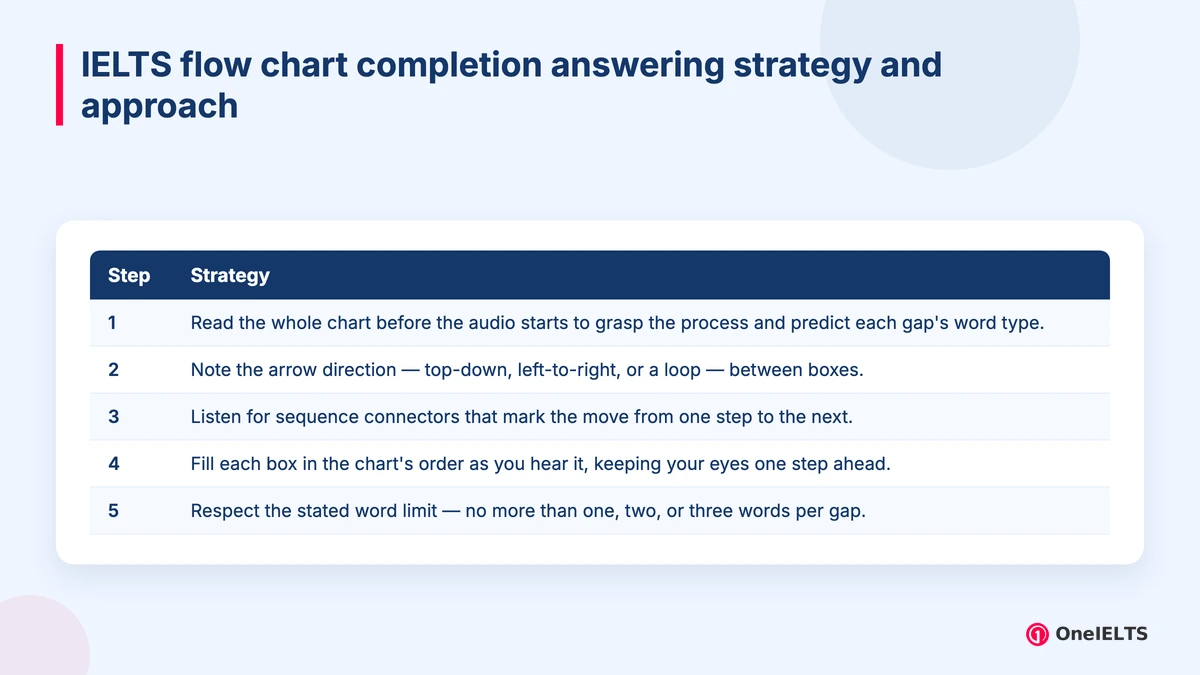
You complete a flow chart by reading the whole diagram first, then following the box order as the recording narrates each stage. The approach is mechanical once you see the chart as a sequence rather than a topic, so a fixed routine beats guessing.
These five steps walk through the routine from preview to final check.
- Read the chart in full before the audio starts so you grasp the whole process and predict what kind of word each gap needs.
- Note the arrow direction between boxes, because the arrows tell you whether the process runs top-down, left-to-right, or in a loop.
- Listen for sequence connectors, since these linking words mark the exact moment the speaker moves from one step to the next.
- Fill each box in the chart’s order as you hear it, keeping your eyes one step ahead so you are ready when the answer arrives.
- Respect the word limit stated in the instructions, writing no more than the permitted one, two, or three words per gap.
What Sequence Words Signal the Next Step?
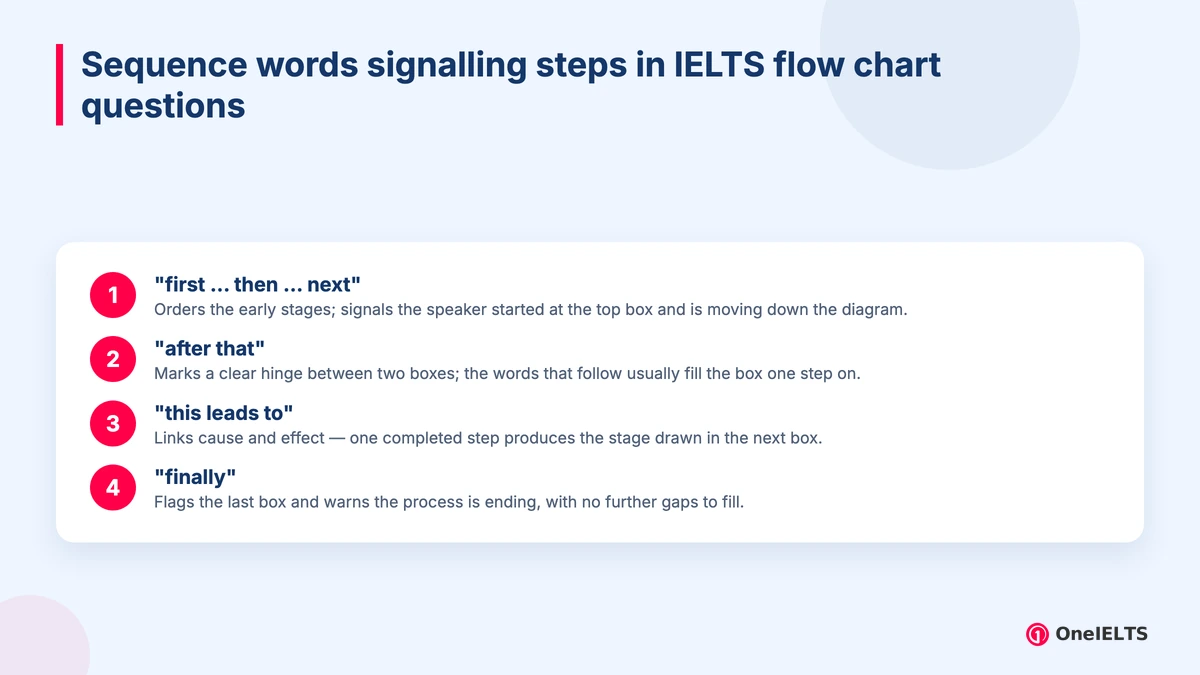
The linking language moves the process forward by marking each transition, so you learn to hear a connector as a cue that the next box is about to be answered. These connectors carry no content of their own, yet they pin down exactly where you are in the chart.
Listen for these recurring sequence signals as the recording steps through the process.
- The chain first then next orders the early stages and tells you the speaker has started at the top box and is moving down the diagram.
- The phrase after that marks a clear hinge between two boxes, so the words that follow it usually fill the box one step on.
- The marker finally flags the last box and warns you that the process is ending, with no further gaps left to fill.
- The connector this leads to links cause and effect, showing that one completed step produces the stage drawn in the next box.
Why Is Following the Order Critical in Flow Charts?
The boxes follow a fixed sequence, so missing one connector throws every later answer off. A flow chart sets its answers in order, and the recording matches that order exactly, so a single missed connector pushes you out of step with the audio.
When you slip one box behind, your answers land in the wrong gaps and trigger cascading errors down the rest of the chart. Recovering mid-recording is hard, so anchor on each connector and confirm which box you are filling before you write.
What Does a Flow Chart Completion Question Look Like?
A typical process flow chart shows a sequence of stages and arrows, with each stage drawn as a labelled box and a gap or two left blank for you to complete. The arrows run between the boxes to show the direction of the process, and the layout might flow downward, across, or around a loop.
Here is how a simple three-stage chart reads:
[ Collect samples ] --> [ ________ (1) the data ] --> [ Publish ________ (2) ]
The sequence connectors in the recording signal each next stage, so when the speaker says the team “then recorded the data” you fill gap (1), and at “finally published the results” you fill gap (2). You complete the gaps in order and stay inside the word limit set in the instructions, here no more than two words per blank.
How Can You Master Flow Chart Completion?
Mastering this format comes down to treating the chart as a tracked sequence: you follow the arrows, latch onto the connectors, and predict the part of speech each gap needs before the answer arrives. The candidates who score well in flow chart completion are not the ones with the widest vocabulary but the ones who never lose their place on the chart.
These five tactics turn that mindset into a repeatable method.
- Follow arrows strictly so your eye tracks the same path the recording takes, and never jump to a box the speaker has not yet reached.
- Listen for connectors as your primary cue, because the linking words flag a new box even when the surrounding wording is paraphrased.
- Expect process verbs and nouns in the gaps, since flow charts describe procedures and most answers name an action or the thing it produces.
- Do not skip a box even if you miss one answer; leave it blank, move on, and keep your place rather than guessing and falling behind.
- Mind your spelling and the word limit, because a correctly heard answer still scores zero if it is misspelled or runs over the permitted count.
How Can You Practise These Questions With Real Audio?
Drill this question type with timed practice tests and replay every miss until you can track a chart at full speed without pausing. Timed practice trains the real-time tracking the single play demands. Each time you replay misses against the transcript, you see which connector you lost and why the chart slipped out of step.
Isolate the type on its own before you attempt full tests, so you build the tracking habit in a focused block rather than mixing it with map or matching questions. You can run timed sets on the IELTS Listening practice test and review every error against the script.
Last verified: 30 June 2026
Practice IELTS Listening
Put this into practice with real, exam-style questions: