To improve listening score results fast, train your ear on paraphrase, because the answers you write are almost never the exact words you hear. Paraphrase recognition lifts your band more than any vocabulary list. The eight tips below cover reading questions ahead, predicting the answer type, paraphrase and synonyms, signposting words, accents, spelling and word limits, never getting stuck, and timed tests. After the eight tips, the guide names the common mistakes that quietly cost marks.
The eight tips that raise your IELTS Listening band are numbered here.
- Read the questions ahead.
- Predict the answer type.
- Train on paraphrase and synonyms.
- Follow signposting words.
- Practise different accents.
- Watch spelling and word limits.
- Never get stuck on one answer.
- Take full timed practice tests.
1. Read the Questions Ahead
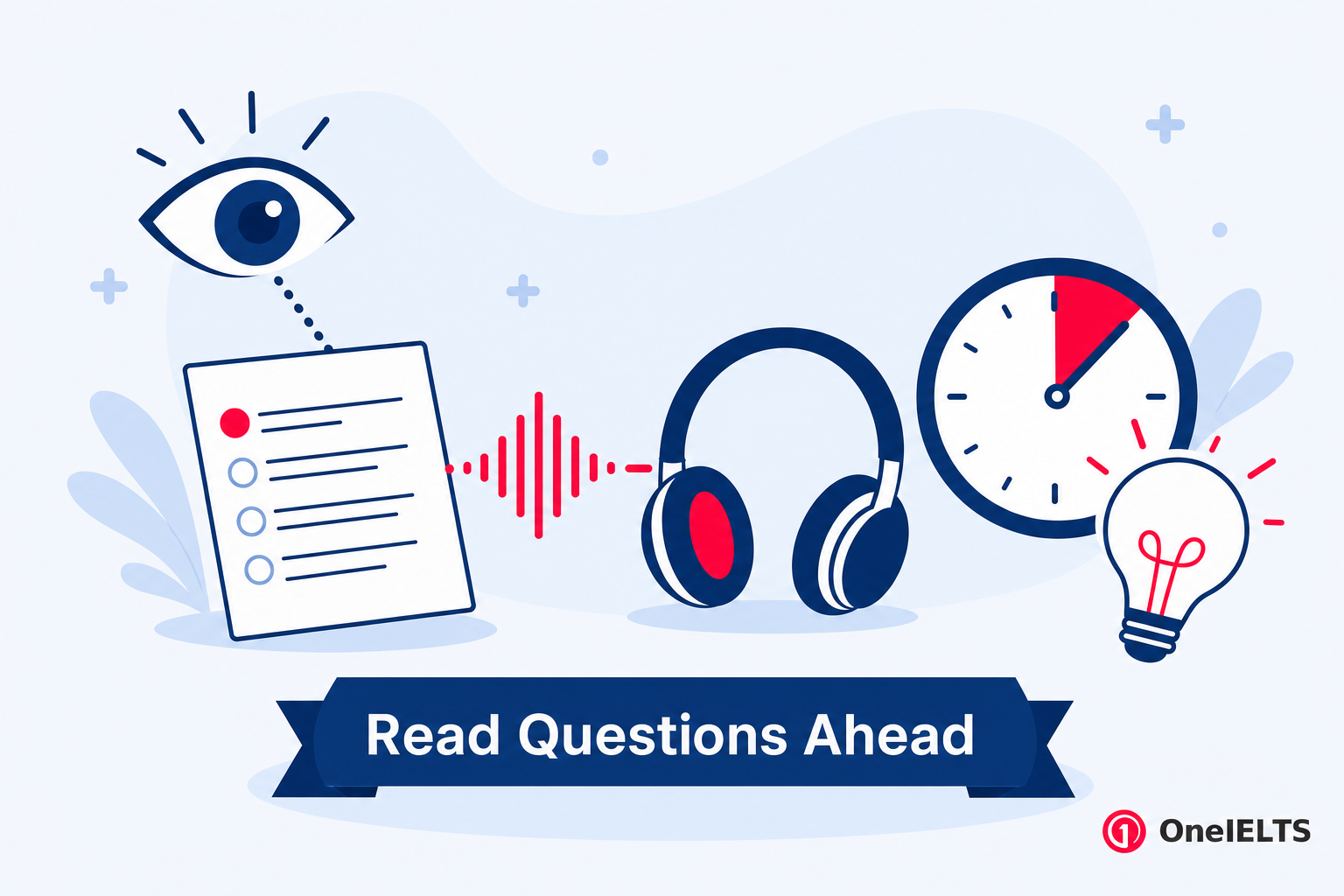
Use the reading time the recording gives you before each section to preview questions rather than sit idle. Read every question in the upcoming set, then underline keywords that tell you what to listen for, such as a name, a price, or a place.
When you preview questions this way, you already know the shape of each answer before the speaker starts. That head start turns passive listening into a targeted hunt, and it stops you reading and listening at once, which is where most marks leak.
2. Predict the Answer Type
Before the audio plays, predict answer type for each gap so your ear knows what to catch. Decide whether a blank wants a name number date or noun, and note that guess beside the question.
A gap after “on” usually expects a date; a gap after “costs” expects a number; a gap after “the” expects a noun or verb. Naming the category first lets you ignore everything that does not fit it, which sharpens your focus on the few words that score.
3. Train on Paraphrase and Synonyms
The highest-value habit is training on paraphrase, because the test rarely repeats the words printed in your question. The recording swaps the keyword for a synonym, so a question about “cheap accommodation” is answered by a speaker saying “budget housing”.
Practise spotting synonyms of every keyword you underline, and rehearse common swaps until keyword spotting becomes automatic. Candidates who listen only for the printed word miss the answer the moment it is paraphrased.
4. Follow Signposting Words
Track the signposting words a speaker uses to flag where the talk is heading and when an answer is near. The words however next finally each mark a turn, and the answer often lands in the clause right after them.
“However” signals a contrast that frequently overturns an earlier statement, so the correct option sits after it. Reading the direction of talk this way lets you brace for the answer a beat early instead of catching it after it has gone.
5. Practise Different Accents
Train on varied accents, because the examiners cast speakers from across the English-speaking world. A single test mixes British Australian and North American voices, and sometimes New Zealand or Irish ones too.
Spend your preparation listening to all of them rather than only the accent your textbook uses, so an unfamiliar vowel never throws you on test day. A learner raised on American media often stumbles on a British “schedule”, and that single stumble can cost a whole answer.
6. Watch Spelling and Word Limits
Spelling counts in Listening, so a correct word you misspell is marked wrong even when you clearly heard it. Respect the word limit on every gap, because an answer that breaks the “no more than X words” rule scores zero however accurate its meaning.
If the rubric says “no more than two words”, write two at most and drop the article. Check your transfer for British spellings like “colour” and “centre”, since the answer key follows them.
7. Never Get Stuck on One Answer
If you miss an answer, move on immediately, because the audio continues whether or not you are ready. The recording plays once and never waits, so a few seconds spent on one blank costs you the next two questions as well.
Mark the gap, leave it, and rejoin the speaker at the current question instead of the lost one. Do not dwell: the single recording allows no replay, so each second you linger feeds the next answers to the questions you abandon.
8. Take Full Timed Practice Tests
Sit full timed tests, because they build stamina that short clips never can. Rehearsing the whole thirty-minute paper in one go trains the concentration four back-to-back sections demand.
After each attempt, review errors one by one, find why each answer slipped, and log the pattern so the same trap does not catch you twice. Reviewing under timed conditions also shows how fast your focus fades, which tells you where to bank easy marks early.
What Common Mistakes Lower Your Listening Score?
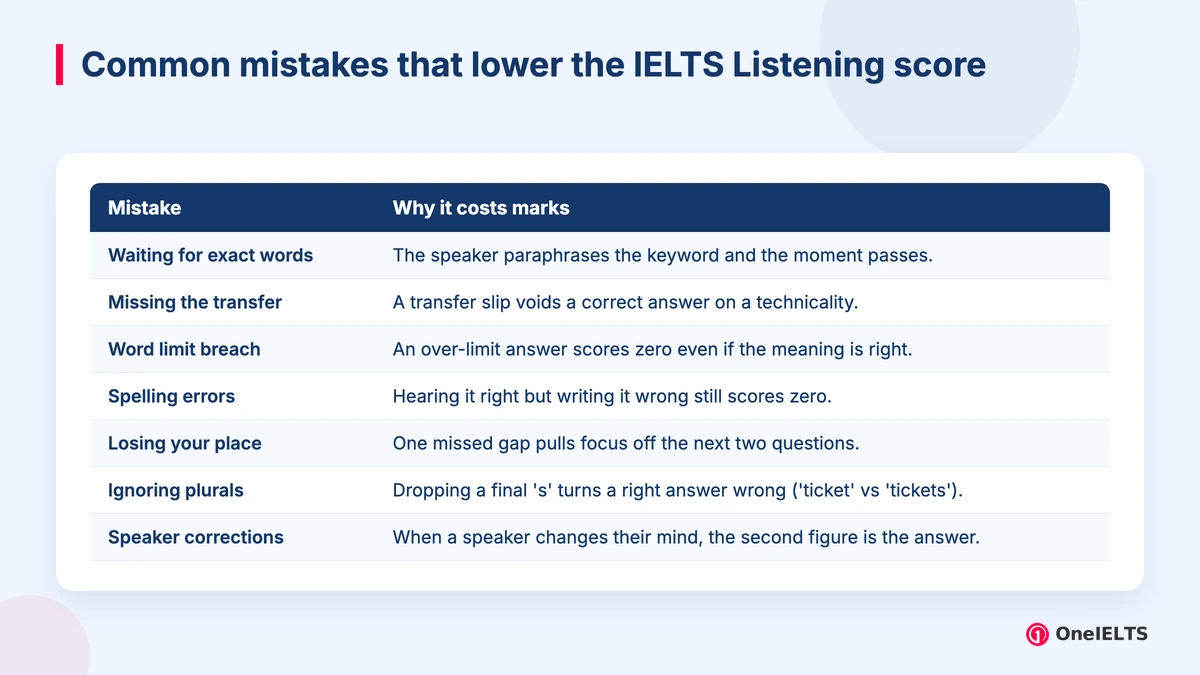
Most lost marks in Listening come from habits, not ability, and the same handful of mistakes recurs across thousands of answer sheets. Catching yourself before the recording starts protects your band. The mistakes that most often pull a Listening score down are set out here.
- Waiting for exact words. Sitting tight for the printed keyword fails, since the speaker paraphrases it and the moment passes before you react.
- Missing the transfer. Fluffing the answer-sheet transfer voids a correct answer on a technicality, even when you heard it right.
- Word limit breach. An answer that runs past the stated limit scores zero, so a word limit breach wastes a mark you had already earned.
- Spelling errors. Hearing the word right but writing it wrong still scores zero, because the marker checks the exact spelling.
- Losing your place. One missed gap drags your attention backward, and you drift off the speaker for the next two questions too.
- Ignoring plurals. Dropping a final “s” turns a right answer wrong, as “ticket” and “tickets” are graded as different responses.
- Speaker corrections. When speakers change their mind mid-sentence, the second figure is the answer, yet many candidates note the first.
How Long Does It Take to Improve Your Listening Band?
With daily practice that stays focused, many candidates lift one band in four to six weeks, provided the work is reviewed honestly. Consistency matters far more than total hours, so thirty minutes a day beats a single five-hour cram at the weekend. Our IELTS Listening preparation guide maps what to drill each week so the gains compound rather than plateau.
How Can You Practise Listening Every Day?
Mix full practice tests with daily English podcasts, news and shows so your ear meets natural speech as well as exam audio. Active listening beats passive listening, so take notes, pause to summarise, and predict what comes next. Run a full IELTS Listening practice test once a week. On the other days, podcasts and news give the everyday exposure that note-taking turns into real gains.
Last verified: 30 June 2026
Practice IELTS Listening
Put this into practice with real, exam-style questions: