The most reliable IELTS Listening gains come from a fixed method, not luck: the same routine on every section stops you missing answers you could hear. You start with a pre-listening routine, read and annotate questions, predict the answer type, follow signpost words, stay one question ahead, train all four accents, transfer answers carefully, and review with transcript. The eight strategies are mapped here, then expanded one per section below.
- Build a pre-listening routine.
- Read and annotate the questions.
- Predict the answer type and word form.
- Track signpost and transition words.
- Stay one question ahead.
- Train all four accents.
- Transfer answers carefully.
- Review every test with the transcript.
1. Build a Pre-Listening Routine
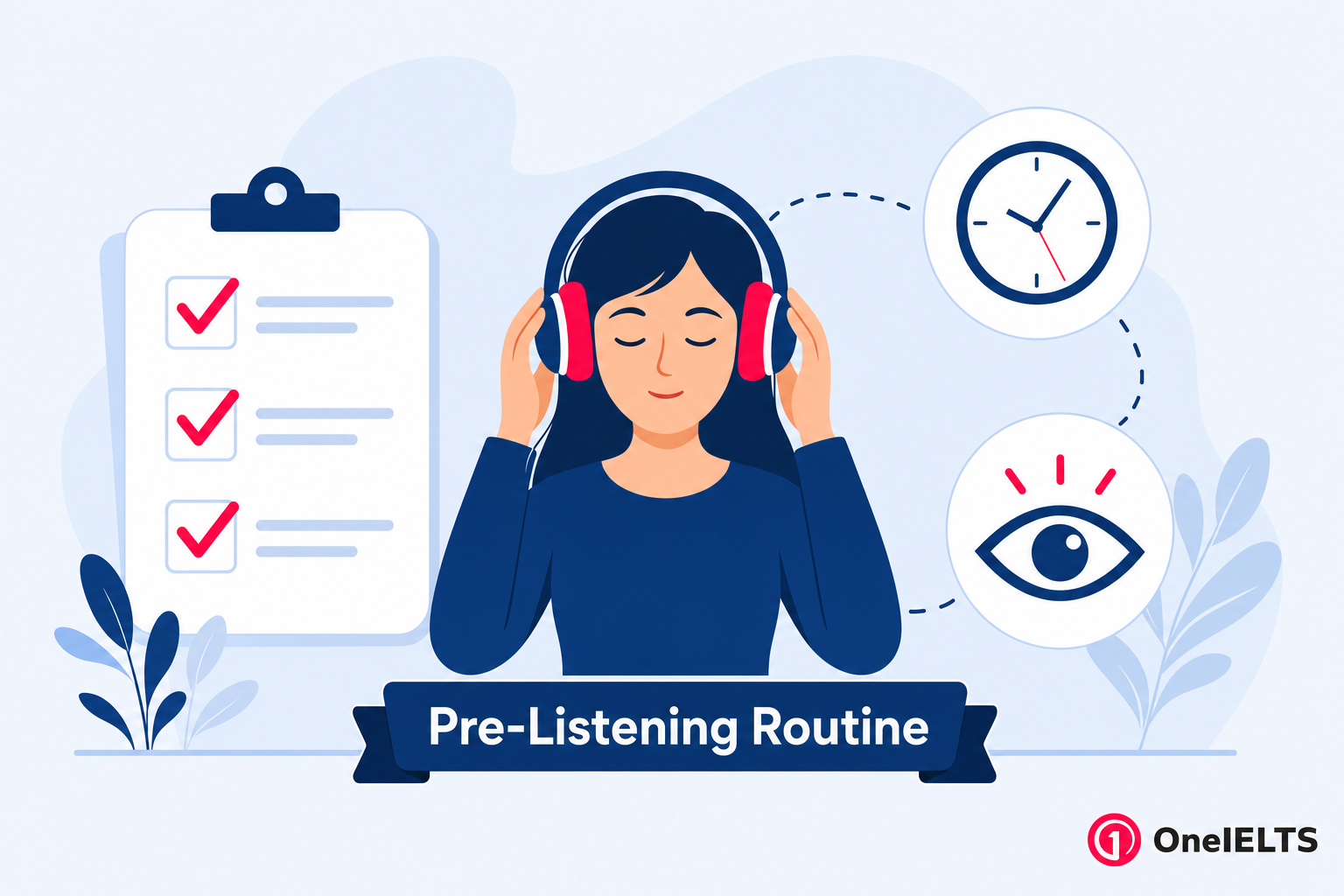
Use the few seconds before each recording starts to do the same three things every time. In that reading window you scan questions, mark how many words each gap allows, and settle your pen on the first blank.
A consistent setup removes panic, because you already know what the next ten questions ask and spend the audio listening for answers instead of decoding the page. The British Council gives you this preview time on purpose, so treat it as part of the test, not dead air.
2. Read and Annotate the Questions
Mark the page before the audio begins, not while it plays. Underline keywords in each question stem, then note question type in the margin so you know whether you are filling a gap, matching a label, or picking a multiple-choice option.
To annotate each stem this way forces your eye to the words a speaker is likely to paraphrase. A map question needs different marks from a form, so labelling the type first tells you what kind of answer to wait for.
3. Predict the Answer Type and Word Form
Decide what each gap wants before you hear it. Most answers are a noun number name, so ask whether the blank needs a plural noun, a digit, a date, or a proper name. Predicting the word form narrows your listening: if the sentence needs a singular noun, a verb you hear will not fit. Checking grammatical fit against the words around the gap catches careless errors, because a word that breaks the sentence grammar is almost never the right answer.
4. Track Signpost and Transition Words
Follow the speaker’s direction words to know when an answer is coming. Words such as “however next“, “but”, “finally”, and “on the other hand” mark a turn in the talk and usually sit right before the detail you need. These signposts reveal the direction of talk, so when a speaker says “actually” or “instead”, the first answer was often a distractor and a correction follows. Tracking these words keeps you anchored even when the topic shifts quickly.
5. Stay One Question Ahead
Read the next question while you finish writing the current one. Staying ahead requires that you split your attention, because this read ahead habit keeps you from falling behind when two answers come in quick succession, which is common in Section 3 discussions. The pace needs you to never fall behind the speaker.
Listeners who pause to admire a correct answer miss the following one. If you do lose your place, leave the gap and jump to the next question you can see, because that is how you keep pace with a recording that never waits.
6. Train All Four Accents
Practise with every accent the test uses, not just the one you find easy. The IELTS Listening recordings mix British Australian, North American, and New Zealand speakers, so a candidate who only trains on one variety meets unfamiliar vowels on test day. Listen to podcasts and news from each region for a few weeks before the exam. Your ear adapts faster than you expect once you stop avoiding the accents that trip you up.
7. Transfer Answers Carefully
Treat the answer sheet as its own task with its own errors. The transfer step requires ten minutes on paper, so check spelling plurals and confirm each answer obeys the stated word limit before you commit it. A “no more than two words” instruction turns a three-word answer wrong even when the meaning is right. On computer there is no transfer step, so spend that saved time on a final transfer check of spelling and obvious slips instead.
8. Review Every Test With the Transcript
Mark every practice test against its transcript, not just the answer key. Reading the script shows you the exact missed paraphrase that cost a mark, such as the moment “give up” became “abandon” in the audio. This is how you learn from errors rather than repeat them. Candidates who skip the transcript keep losing the same band, because they never see the synonym swap that fooled them the first time.
What Strategies Work for Each Listening Section?
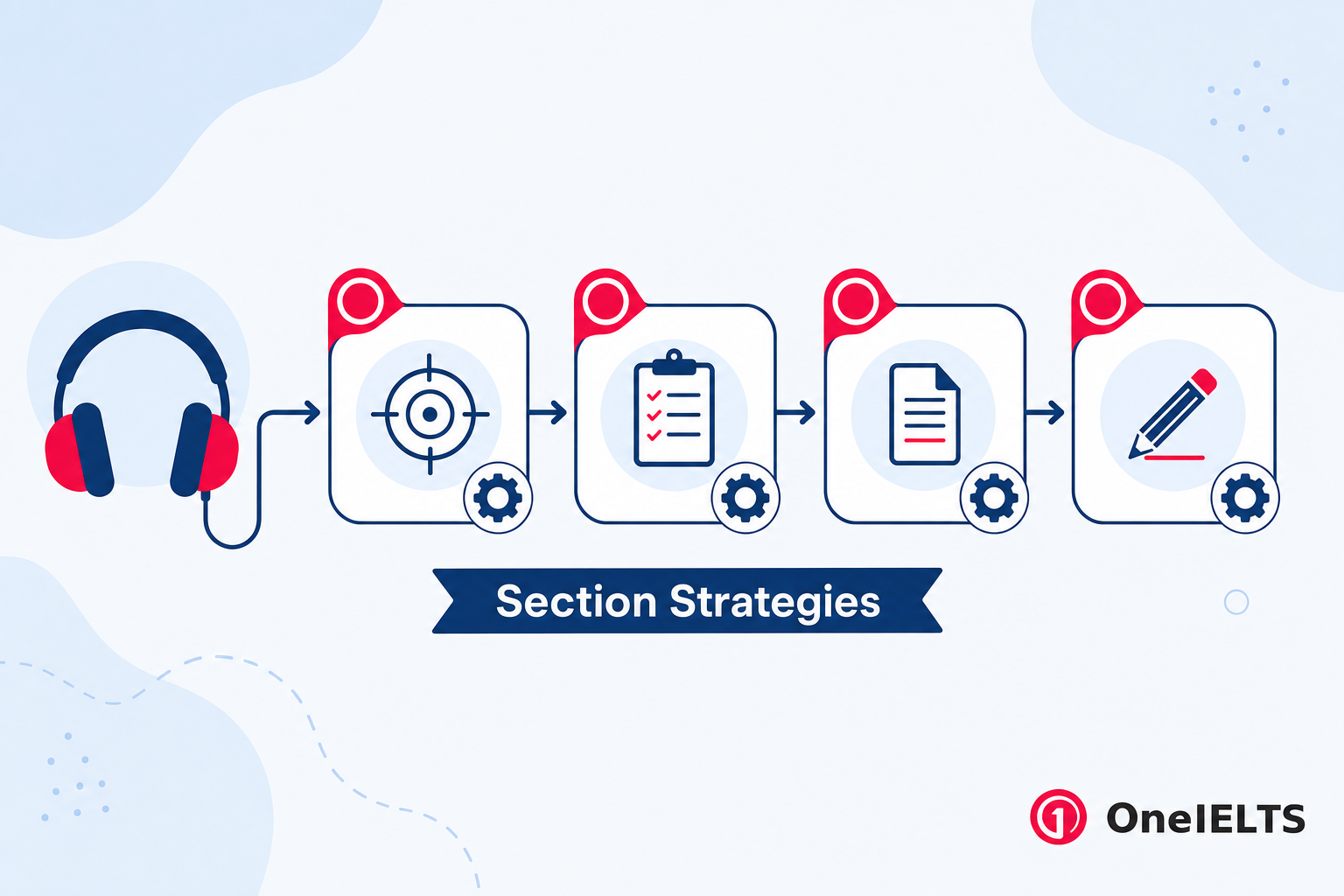
Each of the four sections rewards a slightly different focus, even though the core routine stays the same. Matching one habit to each section turns a general method into a section-by-section plan, so you know what to listen hardest for before the recording starts. The four section-specific strategies are set out one by one below.
- Section 1 details. A form-filling conversation about everyday arrangements, so chase the Section 1 details like names spelled out, phone numbers, and dates, and write digits exactly as you hear them.
- Section 2 monologue. A single speaker describes a place or service, so in this Section 2 monologue follow directions and map labels, and let signpost words mark each turn in the route.
- Section 3 discussion. Two to four speakers debate a task, so the Section 3 discussion demands you track who says what and catch the correction when one speaker overrules another.
- Section 4 lecture. An academic talk with no break, so the Section 4 lecture rewards prediction and note completion, because you only hear the answers once and cannot pause to reread.
Which Listening Strategy Helps the Most?
Using the reading window to predict gives the biggest, most consistent gain across every section. The preview seconds let you decide what each gap needs, so you listen for a target instead of trying to catch every word.
Pair this with paraphrase training for the largest jump: when you can predict the answer and recognise its synonym, you stop losing marks to reworded clues. Our IELTS Listening improvement guide shows how to drill both habits together.
How Can You Practise These Listening Strategies?
Apply the same routine on every timed practice test, then sit down for a transcript review afterwards to see what you missed. Working under real timing trains the read-ahead pace that an untimed drill never builds.
Once you spot a pattern in your mistakes, isolate weak sections and practise them alone. A candidate weak on Section 3 runs extra discussion drills rather than full timed tests every time. Use our IELTS Listening practice tests to rehearse the full method end to end.
Last verified: 30 June 2026
Practice IELTS Listening
Put this into practice with real, exam-style questions: