In IELTS Listening note completion you read a set of notes with blank gaps, then fill gaps with the exact words the speaker says as the recording plays. The headings and sub-headings above each block tell you what comes next and in what order, so you anticipate each answer instead of listening cold. This guide explains what these questions are and how to approach them. It then covers how notes differ from a summary or table, the word limit, a real sample, the best tips, and how to practise with audio.
What Are IELTS Listening Note Completion Questions?
Note completion asks you to fill gaps in a set of notes organised under headings as the speaker talks, copying the missing words straight from what you hear. The notes use headings and sub-headings to break the talk into labelled blocks, and each blank sits inside one of those blocks. This task type appears anywhere across the four parts of the Listening test.
How Do You Approach Note Completion Questions?
A reliable approach treats the printed notes as a map: you read the structure first, decide what each gap needs, then track the speaker through it in sequence. The five steps below turn that map into answers without losing the thread of the audio.
- Read the headings to map the talk. Before the audio starts, read headings to map the talk so you know each topic block and the order the speaker will move through them.
- Predict each gap’s word type. Predict word type for every blank, deciding whether it needs a noun, a number, a date, or a name, so your ear is primed for the right form.
- Follow the heading order. The speaker moves in heading order, so track the blocks top to bottom and never jump ahead, because the answers arrive in the printed sequence you already mapped.
- Write exact words within the limit. Copy the precise words you hear, spelled correctly and kept inside the stated word limit, since paraphrases and overlong answers both lose the mark.
- Keep pace with the speaker. Match the audio’s speed and move on the instant a gap passes, because pausing on one blank makes you miss the next two answers entirely.
How Do Notes Differ From a Summary or Table?
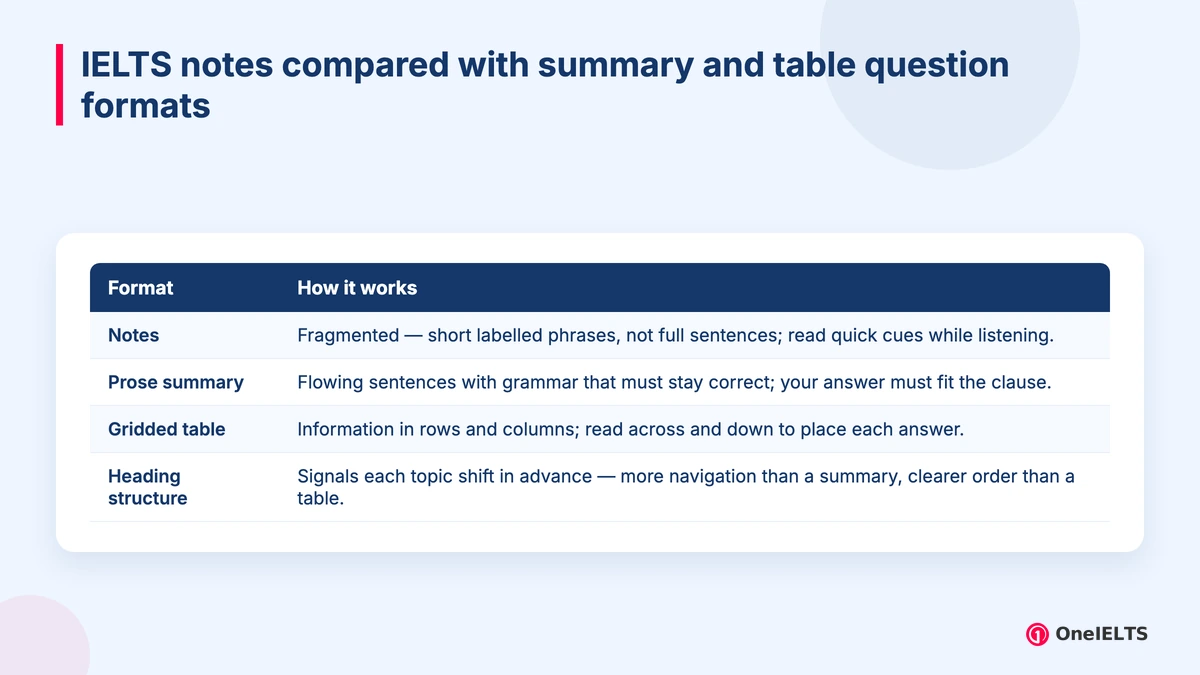
The note format sits between the other completion tasks: it gives you more scaffolding than a prose summary but less rigidity than a gridded table. The differences below show what each format demands of you.
- Fragmented notes. Note completion uses fragmented notes — short labelled phrases, not full sentences — so you read quick cues rather than connected text while you listen.
- Prose summary. A prose summary runs as flowing sentences with grammar that must stay correct, so your answer has to fit the surrounding clause, not just the topic.
- Gridded table. A gridded table arranges information in rows and columns, so you read across and down to place each answer, unlike the linear flow of notes.
- Heading structure. The heading structure of notes signals each topic shift in advance, giving you more navigation than a summary and a clearer reading order than a table.
What Word Limit Applies to Note Completion?
The instruction usually allows no more than words to a fixed cap of one, two, or three per gap, and a number where one is spoken. Read that line before you start. Writing a fourth word or spelling a number wrongly cancels an answer you actually heard correctly.
What Does a Note Completion Question Look Like?
A typical set of headed notes appears with gaps to fill, most often in Part 2 of the test, where one speaker describes a place, event, or facility. The title and headings give the structure, so you anticipate each gap and write what you hear within the word limit, as in the sample below.
City Museum Tour

Opening hours: weekdays until (1) ........

Ground floor: local (2) ........ collection

Cost of guidebook: £ (3) ........

Group bookings: email the (4) ........ office two weeks ahead
The headings (“Opening hours”, “Ground floor”) tell you the topic of each line before the speaker reaches it, so you wait for the matching detail and drop it into the gap.
What Are the Best Tips for Note Completion?
The strongest tactics all flow from one habit: let the printed structure do the heavy lifting so your attention stays free for the audio. The tips below sharpen each part of that habit.
- Use each headings signpost. Read every heading as a signpost that announces the next topic, so you know which detail to expect and roughly when the speaker is about to say it.
- Expect telegraphic notes. The notes are written in telegraphic notes style with articles and verbs stripped out, so don’t wait for a full sentence before you commit your answer.
- Watch the word limit. Keep the word limit in mind on every gap, counting your words as you write so a stray article never pushes a correct answer over the cap.
- Mind plurals and spelling. Listen for plurals and trailing sounds, because a missing “s” or a misspelled word marks a right answer wrong even when you heard it clearly.
- Never fall behind the audio. Stay level with the recording and skip any gap you miss, since chasing one lost answer costs you the next, and you cannot rewind.
How Can You Practise These Questions With Real Audio?
Drill this question type with timed practice tests and replay misses until the headings cue your answers automatically. Isolate the type first, working through note-completion sets on their own before you sit full papers. Our IELTS Listening practice test gives you timed practice with audio you can replay on each missed gap. Once you isolate the type and clear it cleanly, fold it back into complete Listening sections under exam timing.
How Do You Predict the Word Type for Each Gap?
Read the note headings and predict the word type for each gap before the audio starts. Predicting whether a gap needs a noun, number, or date narrows what you listen for. It also stops you writing a grammatically impossible answer that cannot be right.
Do Spelling and Grammar Errors Lose Marks?
Yes, a misspelled or grammatically wrong answer scores zero, even when you heard the word correctly. Spell exactly as the speaker says, and make the word fit the grammar of the note. Hyphenated words and numbers usually count as one word toward the limit.
How Is Note Completion Scored?
Each gap is worth one mark, with no penalty for a wrong guess, so never leave a gap blank. Transfer answers carefully, because a word the examiner cannot read costs the same as an empty gap.
Last verified: 30 June 2026
Practice IELTS Listening
Put this into practice with real, exam-style questions: