Every English word of two or more syllables carries one primary stress, and most two-syllable nouns stress the first syllable while most two-syllable verbs stress the second. Word stress makes that stressed syllable louder, longer and higher in pitch, and it lets each unstressed syllable relax toward a schwa. This page goes deep on stress inside single words; vowel sounds, consonants and intonation sit on the OneIELTS English pronunciation rules page.
The sections run from the definition, why stress matters, its levels and rules to two-syllable words, noun-verb pairs and exceptions. Then come each stress pattern by syllable count and suffix, vowel reduction, ten examples, dictionary marks and sentence stress, ending with practice and your IELTS pronunciation score.
What Is Word Stress?
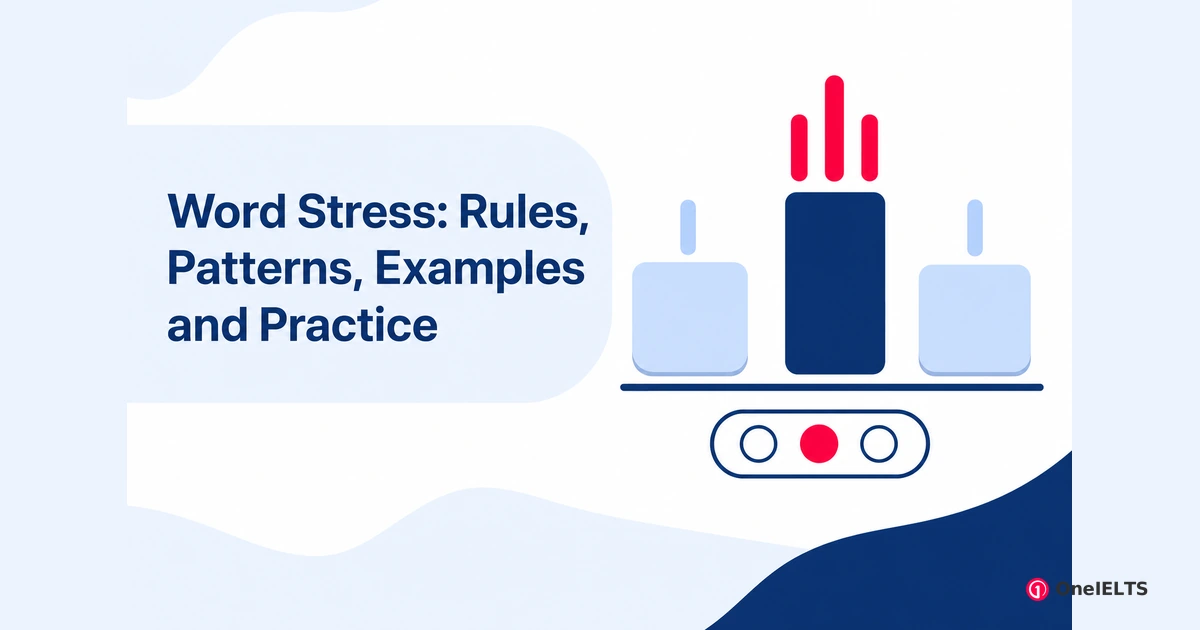
Word stress is the extra force placed on one syllable of a multi-syllable word, so that syllable sounds louder, longer and higher in pitch than the syllables around it. Three cues signal it at once: loudness, vowel length and pitch. In PHOtograph the stressed syllable is the first; add -y and phoTOgraphy moves it to the second.
Stress belongs to syllables, not letters, so split the word first. Ba-NA-na has three syllables and one stress. One-syllable words such as cat carry no word stress.
English doesn’t pin stress to one position the way Finnish does, so every new word needs its stress learned with it. Misplace it and a correctly spelled word turns into another: DEsert is dry land, deSERT means abandon.
Why Is Word Stress Important in English?
Listeners recognize English words by their stress pattern first, so a word with the right sounds but the wrong stress is often misheard or not understood at all. Stress separates word class (a REcord, to reCORD), decides which vowels stay full and which reduce to schwa, and sets the rhythm of the whole sentence.
Native listeners lean on stress more than on single sounds during word recognition. A slightly wrong vowel gets forgiven. ComFORtable for COMfortable stalls intelligibility, because the listener searches for a word that doesn’t exist. Each slip like that raises listener effort, for an examiner or for anyone else.
Stress shapes listening too. Expect the wrong beat and you’ll miss words you already know.
What Are the Types of Word Stress?
English words carry three levels of stress: primary stress, secondary stress, and no stress on unstressed syllables. Every multi-syllable word has a primary stress. Only longer words show a secondary stress, because English rhythm wants a beat every two or three syllables and a long word has room for a lighter one before the main beat.
Some linguists sort languages into fixed and free stress. English has free, or lexical stress, so the position changes from word to word.
The word education shows all the levels at once, each with the IPA stress mark a dictionary uses for it.
- Primary stress: the strongest beat, on CA in eduCAtion; Cambridge marks it with a raised line (ˈ) placed just before that syllable.
- Secondary stress: a lighter beat on the ED of education, shown with a lowered line (ˌ) before the syllable, as in /ˌedʒ.əˈkeɪ.ʃən/.
- Unstressed syllables: the reduced -u- and -tion in education, which carry no mark and shrink to a quick schwa /ə/ in normal speech.
What Are the Main Rules of Word Stress?
Every multi-syllable word has one main stress on a vowel, placed by its word class, its number of syllables and its suffix, with exceptions you learn one at a time. Two-syllable word patterns, noun-verb pairs, exceptions and suffix patterns each get their own section further down, so this list stays short.
Eight rules cover most everyday vocabulary, each shown with one example word.
- One main stress per word, always on a vowel sound: baNAna.
- Two-syllable nouns and adjectives stress the first syllable: TAble, HAPpy.
- Two-syllable verbs and prepositions stress the second syllable: beGIN, aBOVE.
- Words used as noun and verb shift stress with word class: PREsent, preSENT.
- A compound noun stresses its first part (BLACKboard); compound verbs stress the second (underSTAND).
- Suffixes such as -tion, -ic and -ity pull stress onto the syllable before: deCIsion.
- Suffixes such as -ee, -eer and -ese take the stress themselves: refeREE.
- A prefix and endings like -ness, -ment and -ful leave the stress alone: HAPpiness.
Where Does Stress Fall in Two-Syllable Words?
Most two-syllable nouns and adjectives stress the first syllable, and most two-syllable verbs and prepositions stress the second syllable. Treat both as tendencies, not laws. HoTEL breaks the noun default with second-syllable stress, and ANswer breaks the verb default by stressing the first.
The default covers most words, so learn it first and flag the outliers. Oo marks a strong-weak beat and oO a weak-strong one in this table of the four word classes.
| Word class | Usual stress | Pattern (Oo or oO) | Examples |
|---|---|---|---|
| Nouns | First syllable | Oo | TAble, DOCtor, LAWyer, DEADline |
| Adjectives | First syllable | Oo | HAPpy, CLEver, BUsy |
| Verbs | Second syllable | oO | beGIN, reLAX, aDOPT, deCIDE |
| Prepositions | Second syllable | oO | aBOVE, beTWEEN, beSIDE |
How Does Word Stress Change in Nouns and Verbs?
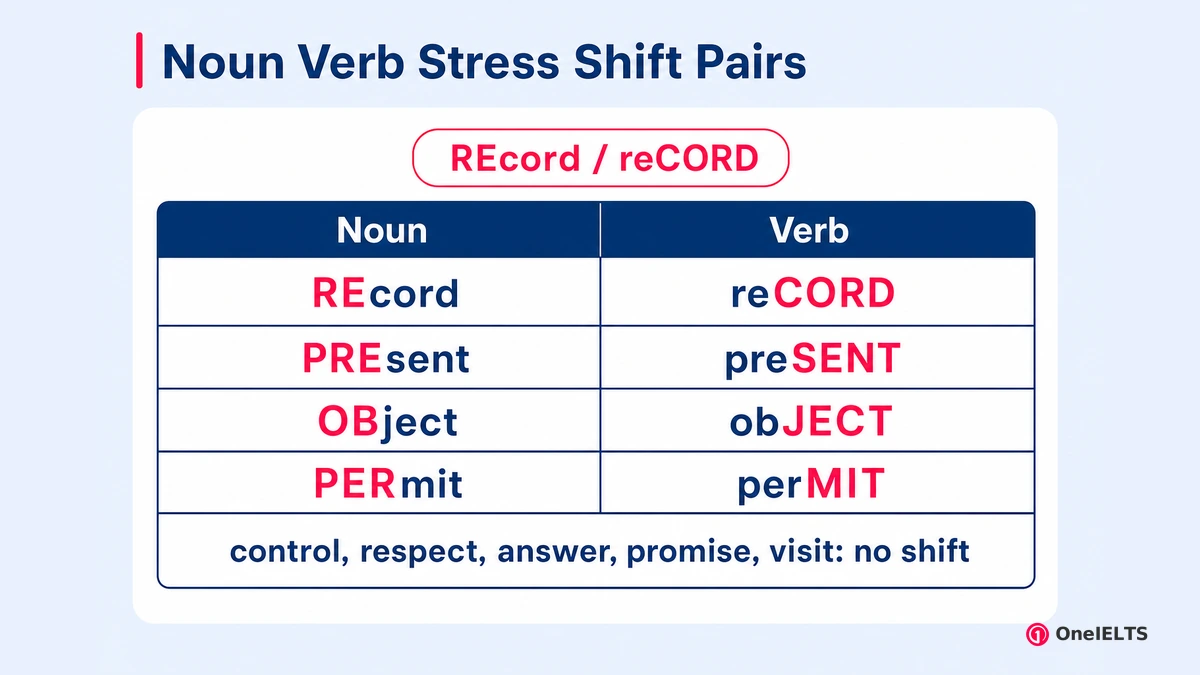
In many two-syllable words spelled the same way, the noun stresses the first syllable and the verb stresses the second: a PREsent is a gift, to preSENT is to show. Each noun-verb pair shares a spelling, but the listener hears two words of a different word class. Linguists call this phonemic stress, and each such pair is a heteronym.
Vowel reduction follows the beat. In American English the noun REcord is /ˈrek.ɚd/ and the verb reCORD is /rɪˈkɔːrd/, so the two forms differ in their vowels as well as their stress.
Ten common pairs appear here, each with one sentence for the noun and one for the verb.
| Word | Noun (stress) | Verb (stress) | Example sentence pair |
|---|---|---|---|
| record | REcord | reCORD | She broke the world REcord last year. / Please reCORD your answer before the timer ends. |
| present | PREsent | preSENT | My sister bought me a PREsent yesterday. / You preSENT your findings to the whole class. |
| object | OBject | obJECT | Describe an OBject you keep at home. / Several neighbors obJECT to the new road. |
| project | PROject | proJECT | Our group PROject took three whole weeks. / Economists proJECT slower growth for next year. |
| increase | INcrease | inCREASE | There was a sharp INcrease in fuel prices. / Cities inCREASE taxes when budgets run short. |
| contract | CONtract | conTRACT | He signed a two-year CONtract with the firm. / Metal will conTRACT as it cools down. |
| permit | PERmit | perMIT | You need a PERmit to park here. / The rules don’t perMIT phones in the exam. |
| conduct | CONduct | conDUCT | Students are judged on their CONduct in class. / Researchers conDUCT surveys across four cities. |
| export | EXport | exPORT | Tea is the region’s biggest EXport. / Farmers exPORT mangoes to the Gulf every summer. |
| rebel | REbel | reBEL | The REbel leader gave a short speech. / Teenagers often reBEL against strict rules. |
Not every noun-verb word shifts: control, respect, answer, promise and visit keep the same stress in both uses.
What Are the Exceptions to Word Stress Rules?
The rules describe the usual pattern, and a set of common words breaks them, so the safe habit is a dictionary check on the stress of every new word. Each exception comes from somewhere. A loanword often keeps the stress it had in its source language, which is why French-origin hoTEL and maCHINE end strong. Very frequent words also drift over centuries until they no longer fit the pattern.
Spelling rarely gives an exception away, so note any word whose stress surprises you. Regional variation adds a second layer, because British and American stress differs on a handful of everyday words.
Five groups of exception catch most learners.
- Second-syllable nouns: hoTEL, poLICE, maCHINE and guiTAR all break the first-syllable default for two-syllable nouns.
- First-syllable verbs: ANswer, OFfer, LISten, HAPpen and VISit ignore the second-syllable default for two-syllable verbs.
- Non-shifting pairs: conTROL, reSPECT and PROMise keep one stress whether you use them as a noun or verb.
- Regional pairs: Americans often say aDULT and gaRAGE, while British speakers usually say ADult and GARage.
- Borrowed final stress: balLOON and uNIQUE end strong, and cigaRETTE does too, though many Americans say CIGarette.
What Are the Common Word Stress Patterns?
Stress patterns use a large O for the stressed syllable and a small o for each unstressed one: Oo (HAPpy), oO (beGIN), Ooo (PHOtograph), oOo (baNAna), ooO (refeREE) and ooOo (eduCAtion) cover most everyday words. Grouping words by stress pattern beats memorizing them one by one, because the suffix usually predicts the pattern.
Seven patterns, each tied to a typical suffix, cover most everyday vocabulary.
| Pattern | Syllables | Typical suffix or word type | Examples |
|---|---|---|---|
| Oo | 2 | Two-syllable nouns and adjectives | TAble, LAWyer |
| oO | 2 | Two-syllable verbs | aDOPT, deCIDE |
| Ooo | 3 | Many three-syllable nouns, -ize verbs | PHOtograph, HUmanize |
| oOo | 3 | -ic, -tion, -sion endings | eLECtric, deCIsion |
| ooO | 3 | -ee, -eer, -ese endings | refeREE, engiNEER, JapaNESE |
| ooOo | 4 | -tion, -ic, -ical endings | eduCAtion, enerGETic |
| oOoo | 4 | -ity, -phy, -gy, -cy endings | aBILity, phoTOgraphy, deMOcracy |
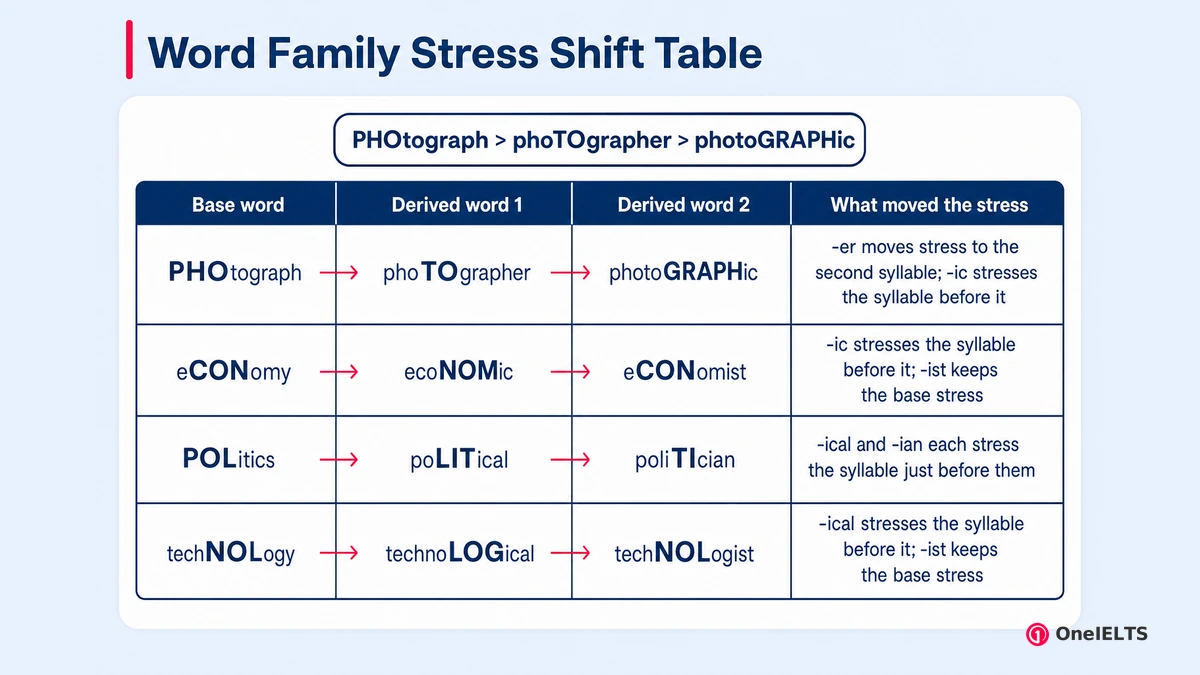
A stress shift happens inside a word family whenever a suffix is added. These topic words from IELTS Speaking vocabulary show the beat moving.
| Base word | Derived word 1 | Derived word 2 | What moved the stress |
|---|---|---|---|
| PHOtograph | phoTOgrapher | photoGRAPHic | -er moves stress to the second syllable; -ic stresses the syllable before it |
| eCONomy | ecoNOMic | eCONomist | -ic stresses the syllable before it; -ist keeps the base stress |
| POLitics | poLITical | poliTIcian | -ical and -ian each stress the syllable just before them |
| techNOLogy | technoLOGical | techNOLogist | -ical stresses the syllable before it; -ist keeps the base stress |
| enVIronment | environMENtal | (none) | -al stresses the syllable before it, here MEN |
| comMUnicate | communiCAtion | (none) | -tion stresses the syllable just before it |
A compound noun follows first-part stress (GREENhouse), while a compound adjective stresses the second part (old-FASHioned).
How Does Word Stress Cause Vowel Reduction?
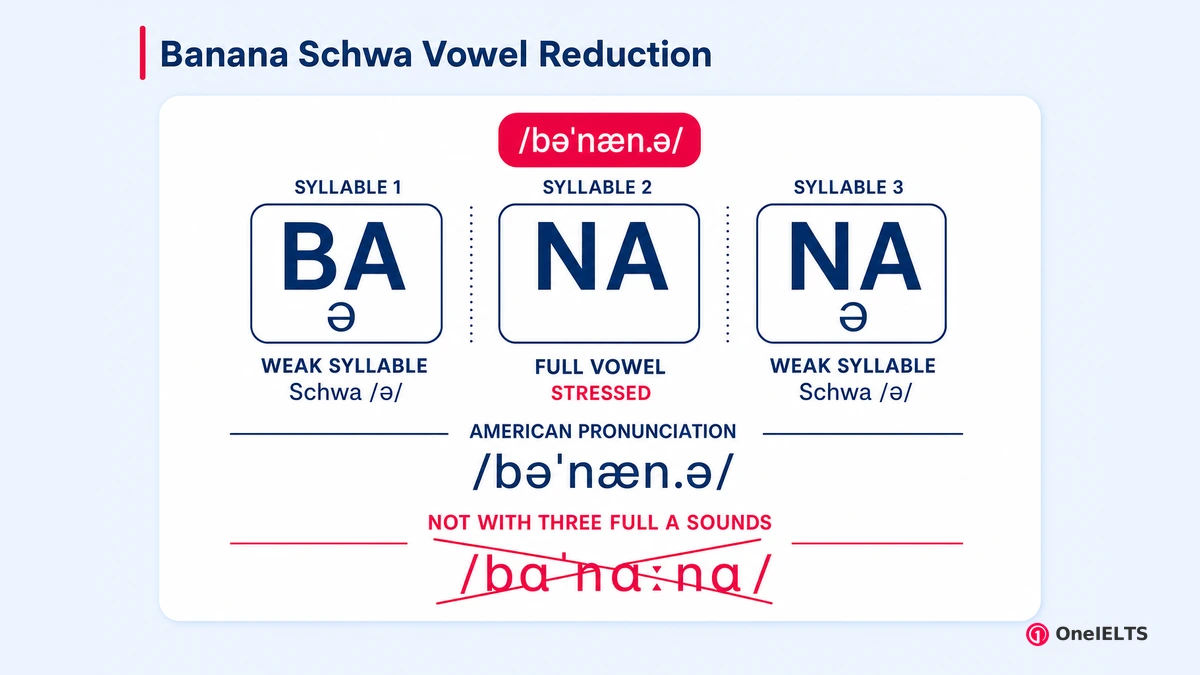
When one syllable takes the stress, the vowels in the unstressed syllables usually weaken to a short, relaxed schwa sound /ə/. So baNAna is said /bəˈnæn.ə/ in American English, not with three full A sounds. The stressed syllable uses a full vowel, long and clear. Each weak syllable shortens and drifts toward the center of the mouth.
The schwa hides behind any letter: the a in aBOUT, the middle o in PHOtograph, the o in comPUter. The first o in PHOtograph is full, but in phoTOgraphy it reduces while the second o turns full. That’s vowel reduction at work.
Speakers of a syllable-timed language such as Spanish or French often give every vowel its full value, which makes English sound flat and harder to follow. See the schwa sound in the American accent for the accent side.
What Are 10 Examples of Word Stress?
The ten words in this table put stress on the first syllable, the second or the third syllable, so you hear each pattern once. Rows cover syllables, the stressed syllable, the stress pattern and the Cambridge Dictionary’s American IPA transcription.
| Word | Syllables | Stressed syllable | Pattern | IPA |
|---|---|---|---|---|
| happy | 2 | 1st (HAP) | Oo | /ˈhæp.i/ |
| lawyer | 2 | 1st (LAW) | Oo | /ˈlɔɪ.jɚ/ |
| deadline | 2 | 1st (DEAD) | Oo | /ˈded.laɪn/ |
| adopt | 2 | 2nd (DOPT) | oO | /əˈdɑːpt/ |
| banana | 3 | 2nd (NA) | oOo | /bəˈnæn.ə/ |
| computer | 3 | 2nd (PU) | oOo | /kəmˈpjuː.t̬ɚ/ |
| photograph | 3 | 1st (PHO) | Ooo | /ˈfoʊ.t̬oʊ.ɡræf/ |
| referee | 3 | 3rd (REE) | ooO | /ˌref.əˈriː/ |
| education | 4 | 3rd (CA) | ooOo | /ˌedʒ.əˈkeɪ.ʃən/ |
| energetic | 4 | 3rd (GET) | ooOo | /ˌen.ɚˈdʒet̬.ɪk/ |
Ten common words stressed on the second syllable are about, begin, computer, decide, enough, hotel, instead, police, relax and adopt.
How Do You Mark Stress in a Word?
Dictionaries put a raised mark (ˈ) before the stressed syllable in the IPA transcription and a lowered mark (ˌ) before a secondary stress; teachers often use capitals (baNAna), bold, or the O/o pattern instead.
Five marking methods turn up across dictionaries, textbooks and class notes.
- IPA primary mark (ˈ): the primary stress mark that the Cambridge Dictionary places right before the main stressed syllable.
- IPA secondary mark (ˌ): the secondary stress mark appears in long words, as in /ˌedʒ.əˈkeɪ.ʃən/ for education.
- Capital letters: write the stressed syllable in capitals, as in baNAna or deCIsion, for fast reading aloud.
- O/o pattern notation: a big O for the stressed syllable and a small o for others, so banana is oOo.
- Underlining or a dot: in handwritten notes, underline the stressed vowel or put a small dot above it.
On a Cambridge Dictionary entry the mark sits before the syllable, not above the vowel, and the UK and US phonetic transcription lines can differ.
How Is Word Stress Different From Sentence Stress?
Word stress is fixed inside each word and found in the dictionary, while sentence stress is chosen by the speaker: content words carry the beat and the most important word gets the strongest stress. Word stress doesn’t change with meaning, apart from noun-verb pairs.
Sentence stress belongs to prosodic stress. It lands on nouns, main verbs, adjectives and adverbs, while function words (articles, auxiliaries, prepositions) weaken, and the focus moves with meaning. It always hits the stressed syllable of its chosen word, so sentence stress requires correct word stress first. In “I took a PHOtograph of the MOUNtains,” both beats hit dictionary stresses.
Intonation and stress-timed rhythm belong to the English pronunciation rules overview.
How Can You Practice Word Stress With Exercises?
Practice works best when you hear the pattern, mark it, and say it aloud against a model, clapping or humming the beat before saying the word. Seven exercises build the habit, moving from quick body drills to recorded checks.
- Clapping: clap or tap each syllable of a new word, hitting harder on the stressed one, so PHOtograph becomes one loud clap and two soft ones.
- Humming: hum the pattern first, da-DA-da for banana, then say the real word over the hum until both beats match.
- Sorting: sort new vocabulary into Oo, oO, Ooo and oOo columns in a notebook, adding each word under the pattern it follows.
- Marking: mark the stress in your own word lists by copying the raised mark from the dictionary before you practice saying anything.
- Minimal pairs: say noun-verb minimal pairs in short sentences, such as a REcord and to reCORD, until the two forms sound clearly different.
- Shadowing: play a short recording, pause after each sentence, and copy the speaker’s stressed syllables at the same speed and loudness.
- Self-recording: record yourself reading ten words, then compare each stressed syllable with the dictionary audio and redo any that sound wrong.
Use the examples table on this page as a printable answer key: cover the Pattern column, mark each word, then uncover it to check. When you play back a Part 2 recording, the misplaced beats usually sit in long topic words like environment or technology, not in short ones.
How Does Word Stress Affect Your IELTS Speaking Score?
Word stress is one of the pronunciation features assessed under the Pronunciation criterion, which carries 25% of your IELTS Speaking band. Frequent stress errors that make words hard to recognize keep you in the lower bands for that criterion. The examiner scores four equally weighted criteria: Fluency and Coherence, Lexical Resource, Grammatical Range and Accuracy, and Pronunciation. Word stress sits inside Pronunciation beside sentence stress, rhythm, intonation and chunking.
The public IELTS Speaking band descriptors show the step up. At band 6 the candidate “Uses a range of phonological features, but control is variable”. Band 8 shows “Flexible use of stress and intonation across long utterances, despite occasional lapses” and “Can be easily understood throughout”. Checked on 7 October 2026.
Your accent isn’t marked down; intelligibility is. A misplaced stress hurts more than an Indian or regional accent.
How Is Word Stress Assessed in IELTS Speaking Pronunciation?
The examiner judges word stress as part of how easy you are to understand across all three parts of the Speaking test, not through a separate stress task. There’s no read-aloud passage or isolated word list. Stress is heard in natural speech: Part 1 answers, the Part 2 long turn after one minute of preparation, and the Part 3 discussion.
Intelligibility across those answers sets your Pronunciation criterion band, and our IELTS Speaking pronunciation guide covers the full criterion.
How Does Word Stress Fit Into English Pronunciation Rules?
The word stress rules are one group within the wider English pronunciation rules, which also cover vowel sounds, consonants, linking and intonation. This page is the deep dive on stress alone. For the other rule groups, start with our overview of English pronunciation rules, then come back here when a word’s beat is the problem.
Which Word Stress Mistakes Do Indian Speakers Make in English?
Indian English has settled stress habits of its own, and four of them can slow down a listener from another background. They’re tendencies linked to a syllable-timed language background, not faults of an accent, and each example was checked against the Cambridge Dictionary.
Each habit appears here with the form a listener expects.
- Equal stress: giving every syllable equal weight instead of using vowel reduction, so baNAna loses its two schwas.
- Early stress: pulling stress to the first syllable, saying HOtel and DEvelop instead of hoTEL and deVELop.
- One stress for pairs: using a single stress for noun and verb, such as PREsent for both gift and action.
- Late stress: moving stress late in long words, saying comfor-TA-ble instead of COMfortable, which hides a familiar word.
Our guide to IELTS Speaking mistakes covers the grammar, fluency and vocabulary slips beyond stress.
Can a Word Stress Finder Check Your Speaking Pronunciation?
Partly – a word stress finder shows the dictionary stress of a word you type, but it cannot hear whether you actually put the stress there when you speak.
Checking spoken stress needs a speech recording compared with a model, or pronunciation feedback on a recorded speaking answer. The OneIELTS AI speaking coach is where you record IELTS-style answers.
Written by Rifah Binte Faruk, reviewed 7 October 2026.
Last verified: 7 October 2026