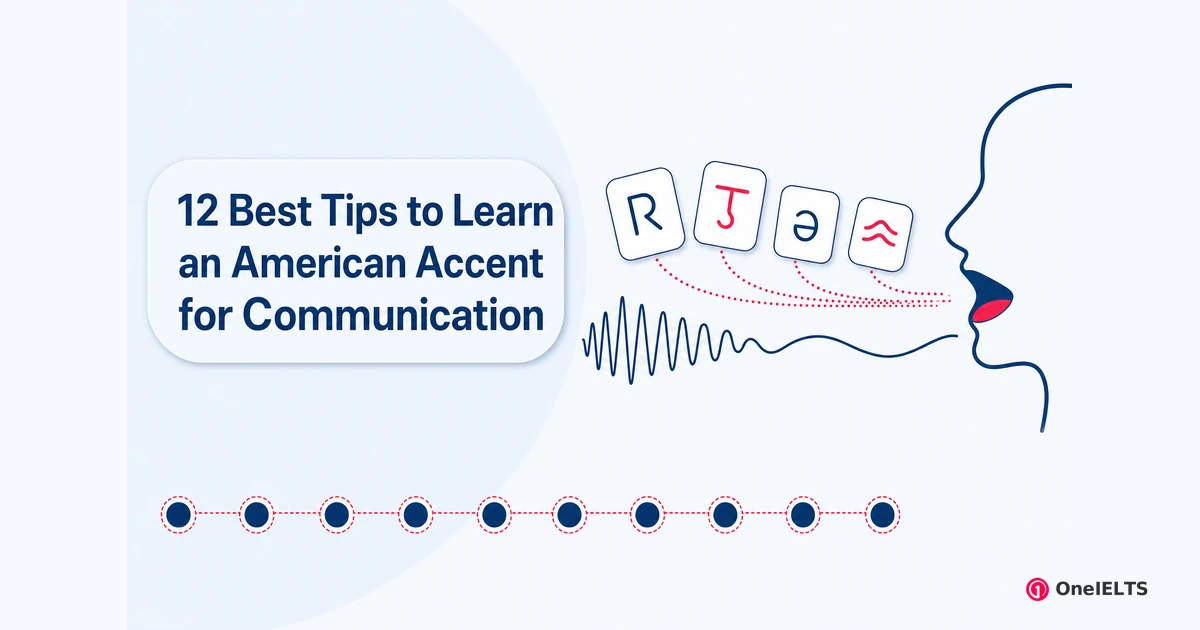
The General American accent shapes how listeners hear your R, T, vowels and rhythm. Daily drills change it, not vocabulary. The IELTS Speaking test scores intelligibility, not accent. American and British English spelling sits elsewhere.
Twelve tips follow, in practice order.
- Pick one standard American accent to copy first.
- Pronounce the American R as a rhotic R.
- Turn T into a flap between vowels (flap T).
- Master the schwa sound in unstressed syllables first.
- Learn the key vowel sounds of the American accent.
- Get the L, TH and W/V sounds right.
- Stress the right syllable in every long word.
- Link words together in connected speech, never rushing.
- Know American contractions and when to use them.
- Shadow native speakers a split second behind them.
- Record your accent and compare it to the original.
- Work with an accent coach or speaking partner.
1. Pick One Standard American Accent to Copy
The United States has dozens of regional accents, and you’ll progress faster by copying one model: General American. It’s the broadcast English most US newscasters, audiobook narrators and teaching channels use, so recordings are easy to find. It also carries no strong regional marker, which means listeners anywhere in the country hear it as neutral.
You’ll still meet other accents in films and podcasts, and each one has a feature that sets it apart from your model.
- General American: pronounces every R, flaps the T in “water”, and serves as the default teaching model.
- Southern American English: stretches vowels into glides, so “ride” can sound close to “rahd” in casual speech.
- New York City English: traditionally drops R after vowels and raises the vowel in “coffee” toward “caw-fee”.
- Boston (Eastern New England) English: drops the R in “car” and “park”, the opposite of General American.
- Inland Northern and Midwestern English: shifts short vowels, so “bag” can sound tense and “lot” close to “lat”.
Mixing models confuses listeners. Drop the R like a Bostonian in one sentence and stress it in the next, and you sound inconsistent rather than American.
2. Pronounce the American R (Rhoticity)
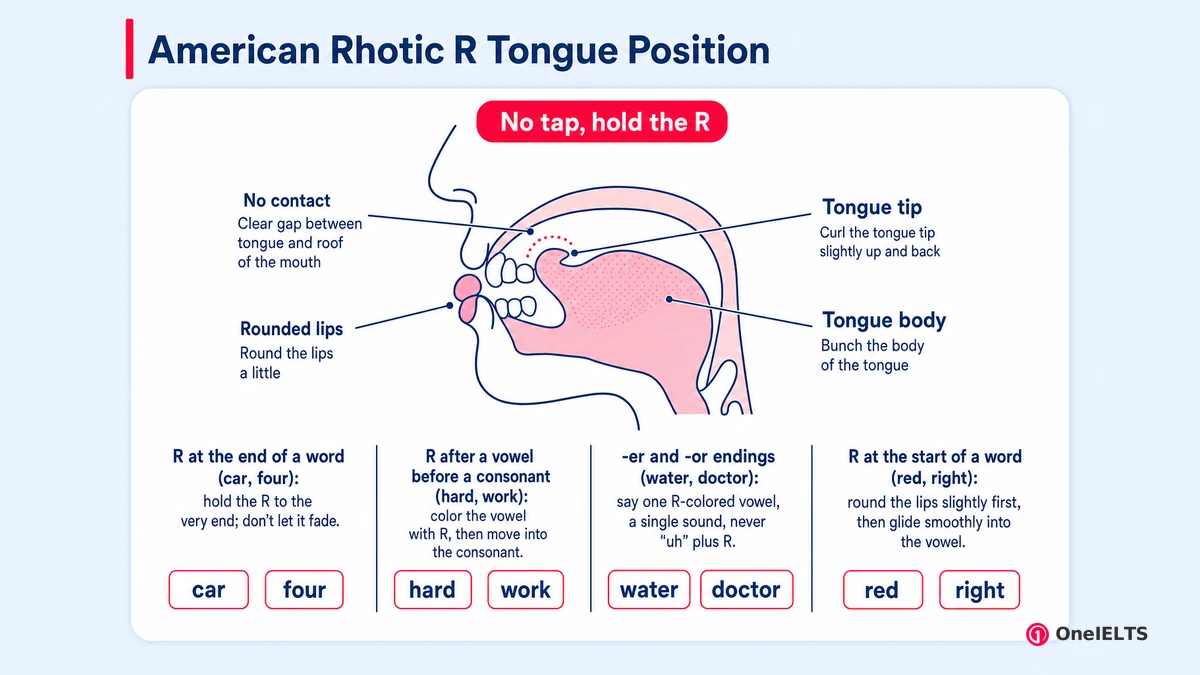
American English is rhotic, so the R is pronounced wherever it’s spelled, in “car”, “hard” and “water”, unlike non-rhotic British English, which drops it before a consonant or a pause. Rhoticity sets American speech apart from British speech more clearly than any vowel does.
The tongue position matters more than the lips. Curl the tongue tip slightly up and back, or bunch the body of the tongue, without touching the roof of the mouth, and round the lips a little. Hold the sound; don’t flick it.
The R behaves the same way in four positions, and each one is worth a separate drill.
- R at the end of a word (car, four): hold the R to the very end; don’t let it fade.
- R after a vowel before a consonant (hard, work): color the vowel with R, then move into the consonant.
- -er and -or endings (water, doctor): say one R-colored vowel, a single sound, never “uh” plus R.
- R at the start of a word (red, right): round the lips slightly first, then glide smoothly into the vowel.
Many Indian speakers tap or roll the R; the American R is a smooth, held sound with no tap at all.
3. Turn T Into a Flap Between Vowels
When a T sits between two vowel sounds and the next syllable is unstressed, Americans say it as a quick, soft D: “water” sounds like “wadder” and “city” like “cidy”. Phoneticians call that sound the alveolar tap, and learners call it the flap T.
The American T isn’t a single sound, though. It takes five forms, and each follows its own rule.
- Flap T between vowels (water, better, city): the tongue taps the ridge once, quickly, like a soft D.
- Flap T across two words (get it, a lot of): the T flaps before a word starting with a vowel.
- Held or stopped T at the end of a word (but, that): the tongue stops the air with no release.
- Dropped T after N (internet, twenty): the T disappears, so “twenty” sounds like “twenny” in relaxed speech.
- True T at the start of a stressed syllable (attack, return): keep a crisp T with a puff of air.
The last form matters most. A flap never replaces the T that starts a stressed syllable, so “attack” keeps its true T, while the T in “city” flaps because it starts an unstressed syllable. Over-flapping every T, or swapping the stop T for a flap, sounds as foreign as never flapping.
4. Master the Schwa Sound in Unstressed Syllables
The schwa (/ə/) is the relaxed “uh” sound that replaces most vowels in unstressed syllables, the first sound in “about” and the last in “sofa”, and it’s the most common vowel sound in American English.
It matters more than any single consonant. Reduced vowels give American English its stress-timed rhythm: stressed syllables stay long and clear, and everything between them shrinks. Pronounce every vowel fully and your speech comes out syllable by syllable, which listeners hear at once. Most of that shrinking happens in short function words.
Six function words reduce in almost every sentence, and their weak forms carry most of the rhythm.
- to: “go to work” becomes “go tuh work”, never a full “too”.
- for: “wait for me” becomes “wait fer me” in normal speed.
- and: “bread and butter” becomes “bread ‘n’ butter” with no D.
- can: “I can swim” becomes “I c’n swim”; stress moves to “swim”.
- of: “a cup of tea” becomes “a cup uh tea”.
- the: “the end of the day” uses “thee” before vowels, “thuh” elsewhere.
5. Learn the Key Vowel Sounds of the American Accent
American vowels come from a relaxed jaw and lips. The sounds learners most often miss are the open “a” in “bat”, the “ah” in “hot” and “cart”, the gliding “oh” in “go”, and the short-long pair in “sit” and “see”. Loosen your jaw and face for one minute before each session; a tight jaw position flattens every vowel.
The table uses IPA symbols because spelling hides the difference. Short vowels and long vowels form minimal pairs such as “sit” and “seat”, and two of the six rows are diphthongs that glide.
| Vowel (IPA) | Example words | What learners often say instead | Mouth cue |
|---|---|---|---|
| æ | bat, cat, man | An “e” as in “bet” | Drop the jaw wide, spread the lips |
| ɑ | hot, cart, father | A rounded British “o” in “hot” | Open the jaw, keep the lips unrounded |
| oʊ | go, home, phone | A flat single “o” with no glide | Start open, then round the lips into “w” |
| eɪ | day, late, name | A flat “e” held without movement | Glide from “e” up toward “ee” |
| ɪ versus i | sit versus seat | The same vowel for both words | Short and loose for “sit”, long and tense for “seat” |
| u | food, school | A short “u” as in “foot” | Round the lips tightly and hold the vowel longer |
6. Get the L, TH and W/V Sounds Right
Four consonant habits carry over from many first languages, and American listeners hear them at once. Each has a fixed mouth position and minimal pairs you can drill in a minute.
The four consonants below cause most mishearings, so drill them in this order.
- Dark L at the end of a word (feel, people): lift the back of the tongue toward the soft palate while the tip touches the ridge. Drill “fee” versus “feel”.
- Voiceless and voiced TH (think, this): put the tongue tip lightly between the teeth and blow. The voiceless TH has no buzz, the voiced TH does. Drill “tin” versus “thin”.
- W with rounded lips versus V with teeth on the lip (wine, vine): W rounds the lips. The labiodental V presses top teeth on the lower lip. Drill “wet” versus “vet”.
- Full -ing ending without an added G or K (going, singing): end on the back-of-tongue “ng” and stop the sound there. Don’t add a hard G. Drill “sing” versus “sink”.
7. Stress the Right Syllable in Every Word
American English puts strong stress on one syllable per word and on the content words in a sentence, and misplaced stress confuses listeners more than an imperfect vowel does. Our word stress guide covers the full rules.
Five stress patterns earn their place first, given here in one line each; the wider English pronunciation rules sit on their own page.
- Word stress in long words: stress moves with the suffix, so PHOtograph becomes phoTOgraphy and PHOtographer.
- Noun and verb pairs: a REcord and a PREsent are nouns; to reCORD and to preSENT are verbs.
- Sentence stress on content words: nouns, main verbs and adjectives carry sentence stress; function words stay weak.
- Falling intonation for statements, rising for yes/no questions: the voice drops on facts and rises on “Is it?”
- American stress and vowel in words like vitamin and schedule: Americans say VY-tuh-min and SKED-jool, unlike British VIT-uh-min.
8. Link Words Together in Connected Speech
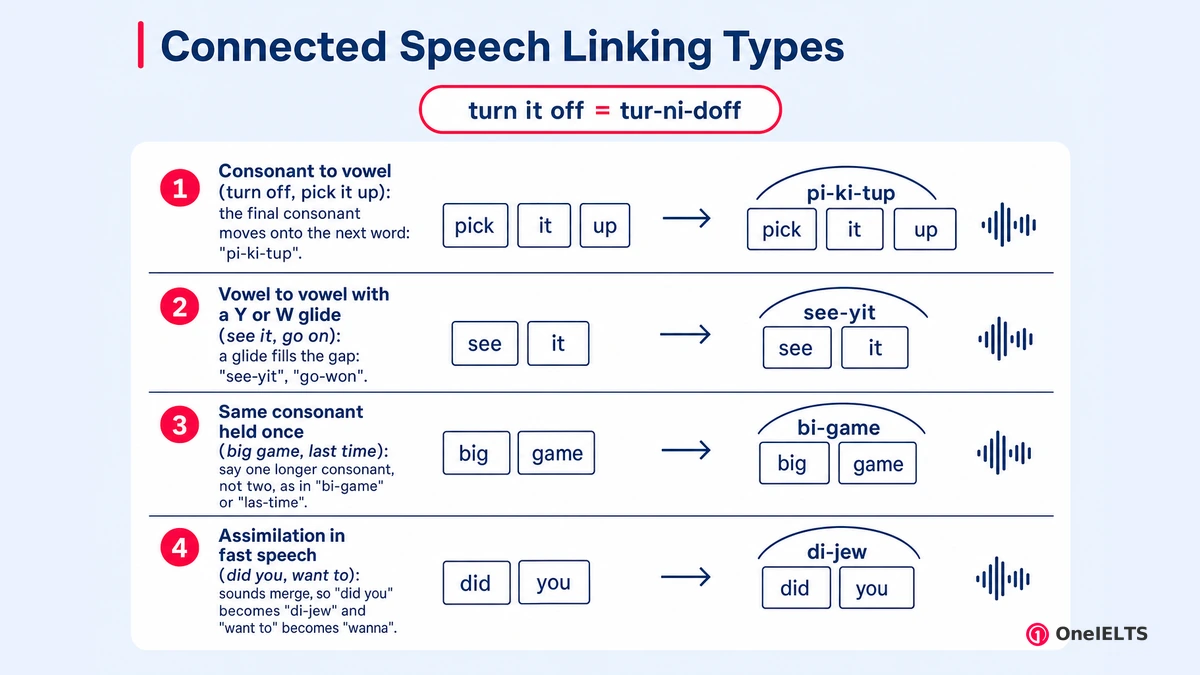
Americans join words inside a phrase so a sentence flows as one unit: “turn it off” sounds like “tur-ni-doff”. This connected speech happens inside thought groups, short phrases said on one breath, and it stops at the pause between them.
Four kinds of linking cover most of what you’ll hear in American conversation.
- Consonant to vowel (turn off, pick it up): the final consonant moves onto the next word: “pi-ki-tup”.
- Vowel to vowel with a Y or W glide (see it, go on): a glide fills the gap: “see-yit”, “go-won”.
- Same consonant held once (big game, last time): say one longer consonant, not two, as in “bi-game” or “las-time”.
- Assimilation in fast speech (did you, want to): sounds merge, so “did you” becomes “di-jew” and “want to” becomes “wanna”.
Linking works at a natural conversational pace, not by talking faster; speaking speed is a separate skill with its own page.
9. Know American Contractions and When to Use Them
Americans contract auxiliary verbs in almost all speech, so full forms like “I am going” sound stiff in conversation. Contractions also help rhythm, because they shrink unstressed words into one beat.
Some contractions suit any conversation, while two belong in informal speech only.
- I’m, you’re, it’s, we’re in everyday statements: use these by default whenever “be” is an auxiliary in speech.
- don’t, isn’t, won’t in negatives: negative contractions sound natural; “do not” adds emphasis you rarely want.
- can versus can’t, told apart by the vowel, not the T: “can” reduces to “c’n”; “can’t” keeps a full “a”.
- I’d, I’ll, would’ve in conditionals and plans: “I’d go” and “I’ll call” sound fluent; “would’ve” sounds like “would-uv”.
- gonna and wanna in casual speech only: use them with friends, but avoid them in formal talks or interviews.
10. Shadow Native Speakers
Shadowing, repeating a short American recording a split second behind the speaker, trains rhythm, linking and intonation together, which drilling single sounds can’t. It’s structured mimicry with a transcript as your map.
Six steps take one clip from first listen to a recording you can judge.
- Choose a 30-60 second clip of one American speaker: pick one clear General American voice with no music.
- Listen three times without speaking: notice where the voice rises, falls, pauses and links words together.
- Read along with a transcript, marking stress and linking: underline stressed syllables and draw arcs between linked words.
- Shadow with the transcript: speak a split second behind the speaker, matching pace and pitch, not just words.
- Shadow without the transcript: repeat until you can keep up with the speaker without reading a single word.
- Record your final attempt: save it, because tip 11 compares this recording with the original clip.
Good sources include TV series, podcasts, news broadcasts and teaching channels that use General American.
11. Record Your American Accent and Compare It to the Original
Your own ear is a poor judge while you’re speaking, so a voice recording compared with the original is the fastest free feedback loop you have. Record the same clip you shadowed. Play it beside the original, sentence by sentence, and note one or two sounds that differ. Fix only those, then re-record the next week.
For a quick intelligibility check, read a paragraph into your phone’s speech-to-text and see which words it mishears. Speech-to-text needs the same clear cues a human listener needs, so its errors flag the sounds to fix. In our experience, that check flags stress errors more often than R sounds, which surprises most learners. Keep each week’s file, and your self-assessment gets easier.
12. Work With an Accent Coach or Speaking Partner
A trained listener hears the errors you can’t, and gives you one correction at a time. That single focus is what self-study lacks, because you’d otherwise fix five things at once and keep none.
Four feedback options differ mainly in cost and in how deep the correction goes.
- Certified accent coach: gives precise, personal correction on the exact errors you make, but costs the most per hour of practice.
- Structured accent training course: an accent training course gives a logical sound-by-sound order, though its feedback on your own voice is limited.
- Language exchange partner: a language exchange is free, real conversation with an American, but partners rarely know how to correct sounds.
- AI pronunciation app: a pronunciation app scores every word instantly and cheaply, yet misses rhythm and the context of longer answers.
Is the American Accent Easy to Learn?
Yes and no. Most adult learners can learn the core features in a few months of daily practice. Losing every trace of a first-language accent is rare after the teenage years, and you don’t need to lose it to be understood.
Three things decide how hard it is for you. The first is distance: how far your first language’s sounds and rhythm sit from American English. The second is exposure, meaning how much American speech you hear each week. The third is practice time, the minutes a day you spend speaking aloud rather than listening.
For most learners the goal is accent reduction toward clear, comfortable intelligibility, not a native imitation.
How Can You Learn an American Accent Quickly?
Work on the few features with the biggest effect first: the R, the flap T, the schwa and word stress, for 15-20 minutes every day, and record yourself once a week. Those high-impact sounds change how listeners hear you faster than any vowel drill does.
A four-week starter plan sets that daily practice in order, with a weekly recording as the check.
| Week | Focus (tip number) | Daily drill | Check at the end of the week |
|---|---|---|---|
| Week 1 | The R and the flap T (tips 2 and 3) | Read 20 R words, then 20 flap T words aloud | Record “water, city, better, car” and compare |
| Week 2 | The schwa and weak forms (tip 4) | Say six weak-form phrases in short sentences | Speech-to-text catches “to”, “for” and “can” correctly |
| Week 3 | Word and sentence stress (tip 7) | Tap the stressed syllable in 15 long words | Record a paragraph and mark the stressed words |
| Week 4 | Linking and shadowing full clips (tips 8 and 10) | Shadow one 45-second clip five times | Compare the final shadow with the original clip |
A month builds habits, not a finished accent. Keep the week 4 routine running after the plan ends.
How Can Indian Speakers Change Their Accent to American?
Indian English speakers shift fastest by fixing a handful of predictable transfers. The usual five are W and V, the TH sounds, retroflex T and D, full vowels where Americans use the schwa, and an even syllable-by-syllable rhythm.
Indian English isn’t one accent. Mother tongue influence differs between Hindi, Bengali, Tamil, Telugu, Marathi, Punjabi and other first languages, so test which rows apply to you.
Six transfers from Indian English map back to tips already on this page, so the table points to the fix rather than re-teaching it.
| Common Indian English habit | American target | Practice words | Tip on this page |
|---|---|---|---|
| W and V said the same way | Rounded W, teeth-on-lip V | wine, vine, west, vest | Tip 6 |
| TH said as a soft T or D | Tongue tip between the teeth | think, three, this, those | Tip 6 |
| Retroflex T and D from retroflex consonants | Tongue tip on the ridge behind the teeth | today, ten, did, water | Tips 3 and 6 |
| Full vowels in unstressed syllables | The schwa in every weak syllable | about, banana, problem, today | Tip 4 |
| Syllable-timed rhythm, every syllable equal | Stress-timed rhythm, weak syllables shortened | photography, development, comfortable | Tips 7 and 8 |
| Tapped R | Smooth, held American R | car, rice, very, mirror | Tip 2 |
Where Can You Learn an American Accent Online for Free?
Free resources cover listening models, pronunciation lookups and self-checks, while feedback on your own speech is the part that usually costs money.
Six free resources split into models to copy, lookups for single words, and ways to check yourself.
- Rachel’s English: YouTube lessons on General American, best for mouth position and connected speech on video.
- Merriam-Webster and Cambridge Dictionary US audio: best for checking how one word sounds before you drill it.
- YouGlish: shows a word spoken in real American video clips, best for hearing it in context.
- Phone speech-to-text: best as a free intelligibility check; misheard words point to the sounds to fix.
- Free tiers of ELSA Speak and BoldVoice: best for instant word scores; free access and trials are limited.
- The r/EnglishLearning community: best for finding practice partners and asking native speakers about specific words.
Does an American Accent Improve Your IELTS Speaking Score?
No. IELTS doesn’t reward any accent, whether American, British, Australian or Indian. Pronunciation is one of four equally weighted Speaking criteria, alongside Fluency and Coherence, Lexical Resource, and Grammatical Range and Accuracy. The Pronunciation criterion measures how easily the examiner understands you and how well you use stress, rhythm, intonation and connected speech.
The public Speaking band descriptors on ielts.org settle it. At band 8, “Accent has minimal effect on intelligibility.” At band 9, “Accent has no effect on intelligibility.” Checked on 7 October 2026.
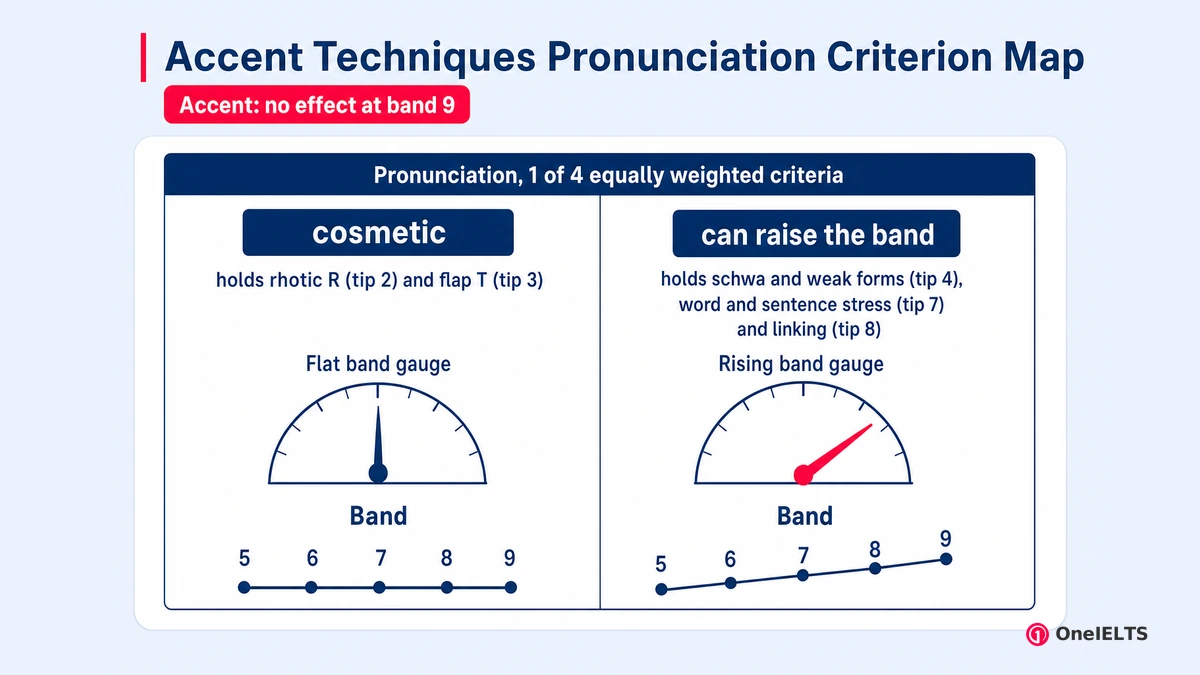
Tips 2 to 9 split into cosmetic features and ones that move a band, as the map shows.
| Accent technique (tip number) | Pronunciation feature it touches | Effect on an IELTS Speaking band |
|---|---|---|
| Rhotic R (tip 2) | A single consonant sound | None on its own; British non-rhotic speech scores the same |
| Flap T (tip 3) | A single consonant sound | None on its own; cosmetic |
| Schwa and weak forms (tip 4) | Rhythm and connected speech | Can raise the band |
| Key vowel sounds (tip 5) | Individual sounds | Helps where a vowel swap changes the word |
| L, TH and W/V (tip 6) | Individual sounds | Helps where a substitution causes misunderstanding |
| Word and sentence stress (tip 7) | Stress and intonation | Can raise the band |
| Linking (tip 8) | Connected speech | Can raise the band |
| Contractions (tip 9) | Naturalness | Supports fluency |
The R and flap T rows are worth learning for communication but buy no IELTS marks. Short of time, drill the schwa, stress and linking rows first.
How Does IELTS Speaking Score Accent and Pronunciation?
The IELTS Speaking test scores pronunciation, not accent: the examiner judges how easily you are understood and how well you control individual sounds, word and sentence stress, rhythm, intonation and connected speech. The Pronunciation criterion is 25% of the Speaking band, and examiners assess it throughout all three parts. Clear intelligibility lifts this criterion more than any accent feature. Our IELTS Speaking pronunciation guide covers the phonological features band by band.
Should You Use American or British English in IELTS?
The choice is yours. IELTS accepts American English and British English in speech and in spelling, as long as you’re understood. Spelling consistency is good practice rather than a rule, and it matters most in Writing: use “color” or “colour”, not both in one script. The full comparison of US vs UK English spelling and vocabulary sits on its own page.
Can a Forced American Accent Lower Your IELTS Speaking Band?
Yes, a forced accent can lower your band indirectly, when imitating it makes you hesitate, mix sound systems mid-answer or become harder to understand. Hesitation is marked under Fluency and Coherence and unclear sounds under Pronunciation, so a half-learned accent costs marks twice. On test day, use only the features your natural speech already produces in the IELTS Speaking test.
Where Can You Practice American Accent Pronunciation for IELTS Speaking?
The best places to practice are timed IELTS-style speaking tasks, where you answer real Part 1, Part 2 and Part 3 questions aloud and then review a recording for intelligibility. A free IELTS Speaking mock test puts tips 10 and 11 under timed practice, including the Part 2 long turn. Finish each speaking mock test with a recording review.
Written by Fahimur Rahman, reviewed 7 October 2026.
Last verified: 7 October 2026