If a band score sits one half-point below what you needed, an IELTS Enquiry on Results lets a senior examiner re-mark your test, with the fee refunded if band rises. An EOR is a re-mark with a conditional refund, not an appeal: you pay upfront, a senior examiner reviews the sections you choose, and your […]

Picking between IELTS and TOEFL comes down to where you’re applying and which test format suits you. The exam that’s “harder” doesn’t decide it. The IELTS vs TOEFL choice is really one of American vs UK English and destination choice. IELTS tests the same four skills favoured across the UK, Australia and Canada, with paper […]

The exam itself is the same, so your decision comes down to logistics, not difficulty. The British Council vs IDP choice is between two operators that co-own and deliver the identical IELTS test. Same questions, same band scale, same examiner standards. They differ only in the practical details: which test dates each releases and where […]

To live, work, or study in the United Kingdom you usually have to prove your English at a UK-government-approved centre. IELTS for UKVI is the version of the test that does exactly that. It is the same IELTS exam as the standard one in content and scoring; the difference is that you sit it at […]

An IELTS 7.5 puts you in the “Very Good User” band, meaning fully operational English with only occasional slips. It clears the cut-off at almost every university and visa stream you are likely to target. That is the real headline: a 7.5 already meets nearly every requirement, so the only open question is whether an […]

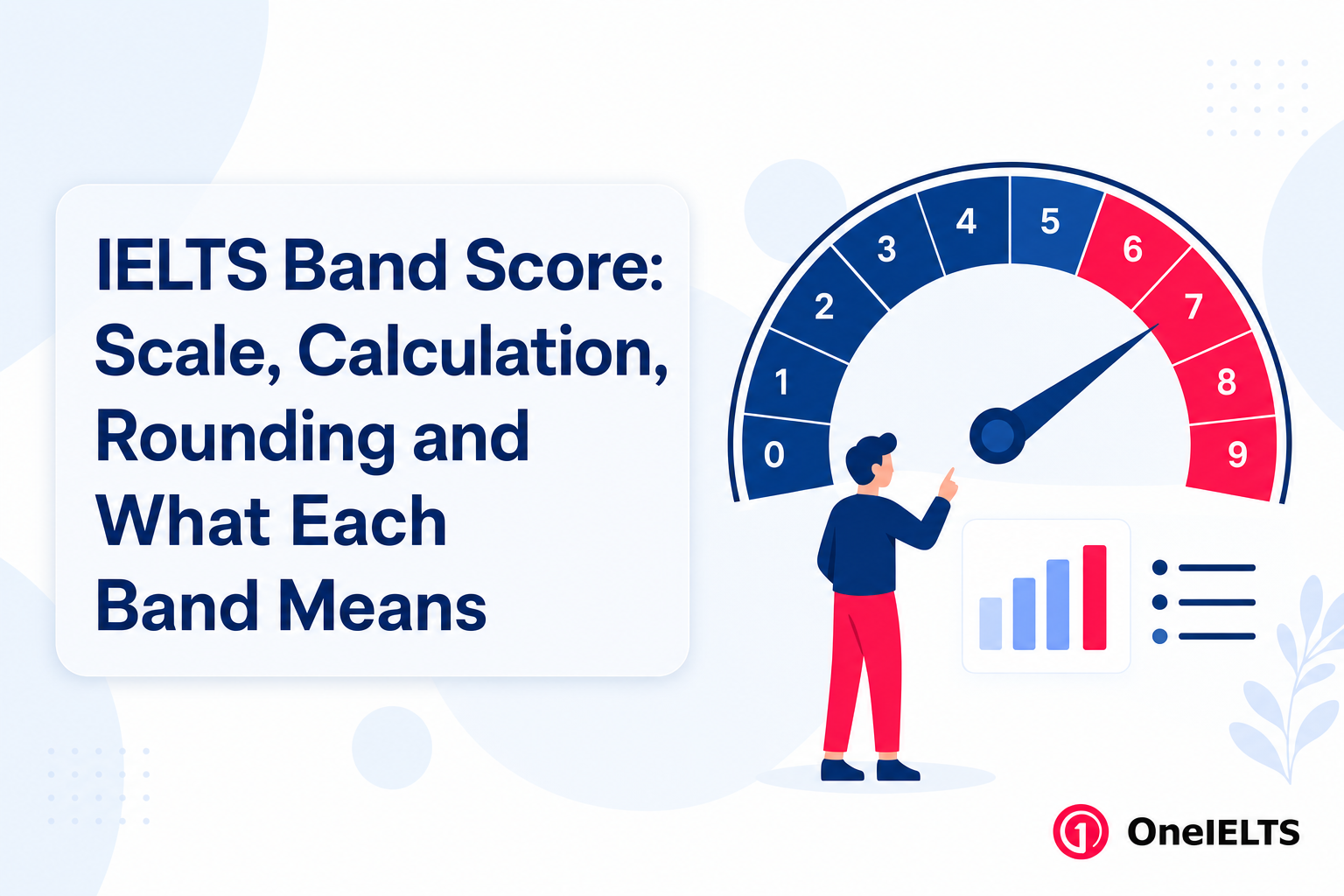
Your IELTS band score is a number between 0 and 9 on a fixed 0 to 9 scale, and it tells a university or visa office how well you use English. You get a band for each of the four sections plus an overall band, the average of those four rounded under a strict rounding […]

The fastest way to lift your IELTS Lexical Resource score is to swap a handful of overused words for the right synonym in the right place, judged by register and collocation rather than blind substitution. Strong paraphrasing earns marks only when the replacement word actually fits the sentence. The six high-value IELTS synonyms groups below […]

The British Council delivers the standard IELTS exam as one of the test’s three joint owners, so the questions you answer and the nine-band score you earn match any other IELTS sitting. Most candidates book with the British Council for its center network and support, not for a different or easier test. You handle booking […]

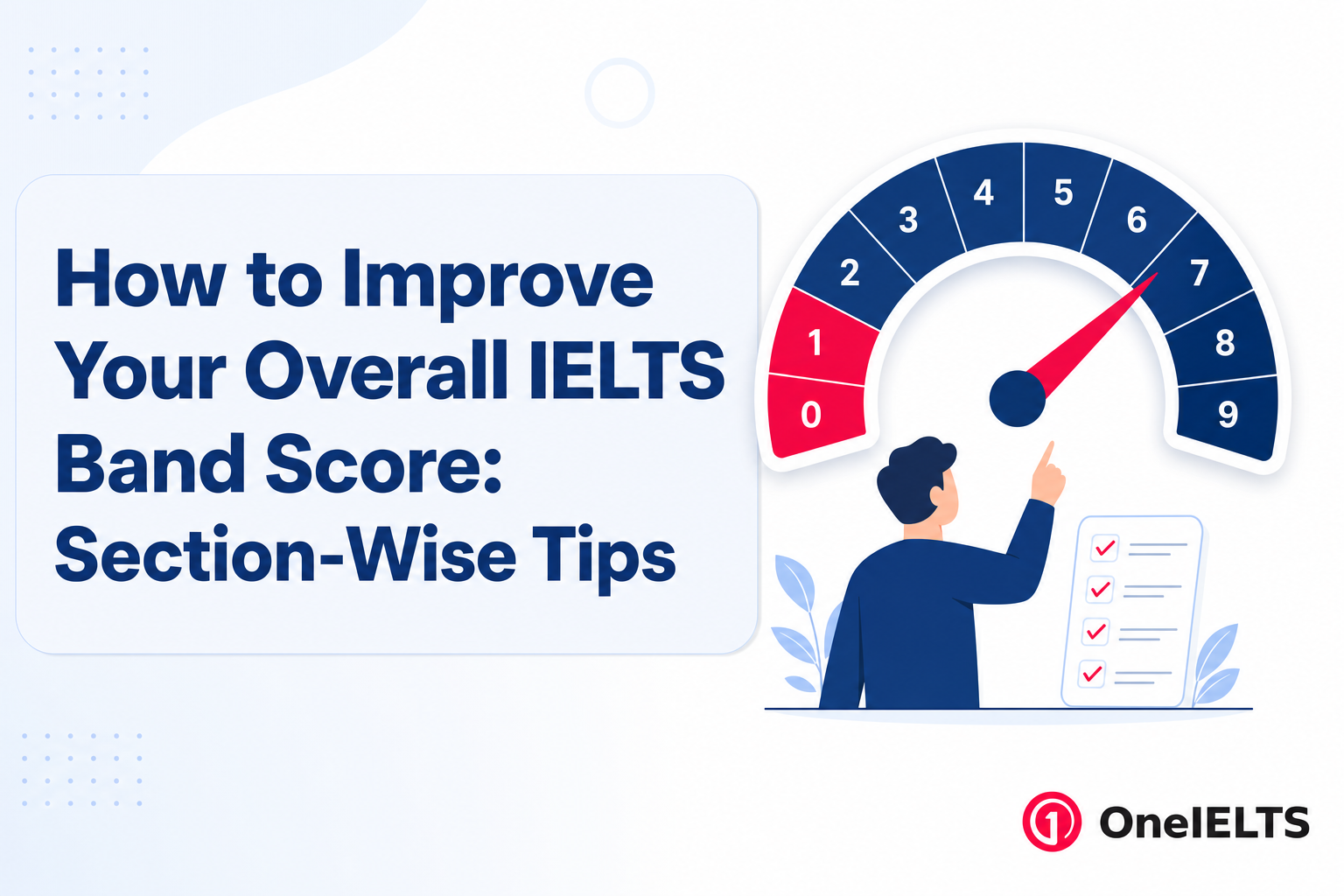
Your overall IELTS band is the average of four sections. The fastest way to raise it is to lift your weakest skill first — moving a 5.5 to 6.5 shifts the overall far more than pushing a 7 to 7.5. This guide gives examiner-approved, section-wise tips for Listening, Reading, Writing, and Speaking, shows how a […]

To reach an IELTS band 8 you do not need four flat 8s. The overall is the rounded average of Listening, Reading, Writing and Speaking, so two 8.5s can offset a 7.5. A band 8 marks you as a Very Good User of English. This guide walks through how to score band 8 in each […]

IELTS has no pass or fail, so a good IELTS score is simply one that clears your target’s cut-off rather than any global average. Read by goal, a 6.0 can pass a bachelor’s program yet fall short of a 7.0 immigration stream, which is why the score by goal matters more than the average. Most […]

Grammatical Range and Accuracy decides a full quarter of two of your IELTS bands, so IELTS grammar is the skill examiners read first when they score what you write and say. This guide explains why grammar matters, what grammar is tested in IELTS, how to improve it, and the common mistakes that cap your band. […]