The exam itself is the same, so your decision comes down to logistics, not difficulty. The British Council vs IDP choice is between two operators that co-own and deliver the identical IELTS test. Same questions, same band scale, same examiner standards. They differ only in the practical details: which test dates each releases and where their centre locations sit. This guide summarizes what each provider offers, walks through the four real differences, confirms the fees match, explains why the “one is easier” myth persists, and ends with a short rule for picking between them.
Last verified: 30 June 2026
What Is IELTS by the British Council?
British Council IELTS is the version of the test booked through the British Council, one of the three co-owners of IELTS alongside IDP and Cambridge. The British Council is a co-owner that delivers IELTS, handles your booking, and runs free preparation material. That single operator owns the whole booking and prep journey, from registration through to your free practice tests and webinars. When you sit IELTS through it, you take the same exam content scored on the same nine-band scale as every other candidate.
What Is IELTS by IDP?
IDP IELTS is the same test booked and run by IDP Education, another co-owner of IELTS. In India, IDP operates the largest network of IELTS test centres, with venues across more cities than any other operator. You book through IDP’s own portal and sit the exam at one of its India centres, but the test you take is the identical IELTS, marked to the identical standard.
What Are the Differences Between British Council and IDP IELTS?
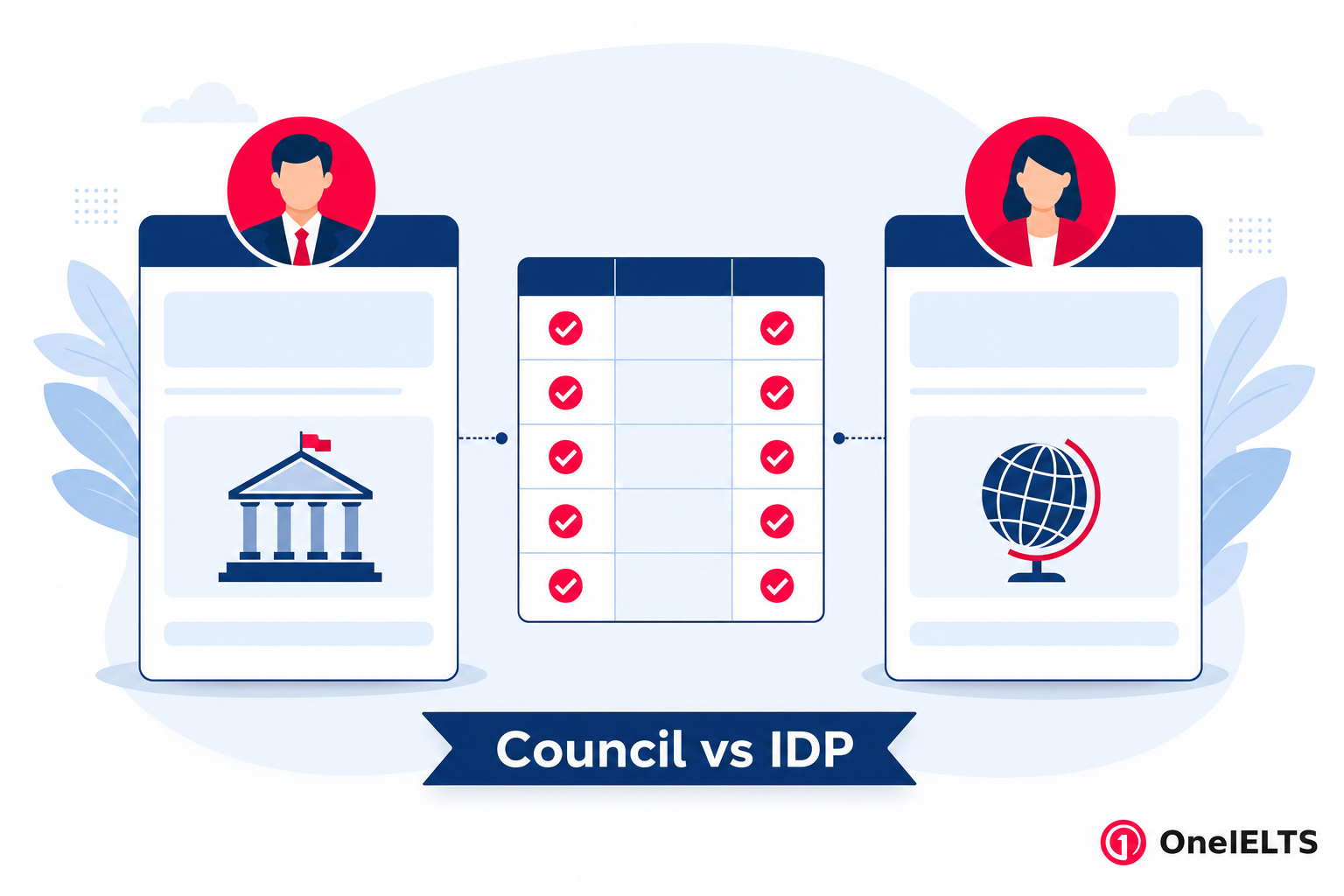
Four practical things separate the two operators, and none of them touches the exam itself. The differences sit in scheduling, geography, and service rather than in the identical content or the marking. Here are the four areas where your experience can actually vary between providers.
- Test content and scoring. Both providers use the identical content, the same band scale, and the same examiner standards, so nothing about the exam itself changes between them.
- Test dates and availability. Each operator releases its own slots, so date availability and slot frequency differ and one may have an earlier sitting in your city.
- Centre locations. Each runs its own centre network with different city coverage, so the nearest venue to your home or office may belong to one provider.
- Booking and support experience. The booking portals, customer support channels, and free prep resources differ, even though the test you book through either is the same.
1. Test Content and Scoring
Both providers deliver the identical content, the same band scale, and the same examiner standards. You answer the same Listening, Reading, Writing, and Speaking tasks, and examiners mark your work against the same band scale whether you book through the British Council or IDP. Both operators apply the same examiners standards to every script. There is no easier paper hiding behind one logo.
2. Test Dates and Availability
Date availability varies by provider and by city, so one operator may offer an earlier date than the other. Each releases its own slots, and slot frequency is city dependent. A metro centre might list weekly sittings while a smaller city sees them monthly. If you need a fast date, check both calendars and book whichever opens the sitting you need.
3. Test Centre Locations
Each provider runs its own centre network, so the nearest venue often differs between them. City coverage is not identical: one operator may have a centre fifteen minutes from you while the other’s closest venue sits in the next city. Compare both maps and weigh the travel, especially if you are sitting the paper-based test early in the morning.
4. Booking and Support Experience
The booking portals, customer support, and extras differ between the two. Each has its own website flow for paying and rescheduling, its own help channels when something goes wrong, and its own free prep resources such as sample tests and practice materials. None of this changes your score, but a smoother portal or richer prep library can make the run-up less stressful.
Do British Council and IDP Charge the Same IELTS Fees?
Yes — the British Council and IDP charge the same IELTS fee in India (₹19,000 as of July 2026), because the fee is set for the test, not the operator. The only fee difference comes from occasional promotions: one provider may run a discount at a given time, so it’s worth checking both for a current offer before you pay.
Last verified: 30 June 2026
Why Do People Think IDP and British Council IELTS Differ?
The ‘easier examiner’ myth holds that one provider gives a softer interviewer, and it usually starts with Speaking. Candidates swap anecdotes about a friendlier examiner at one centre, a more comfortable venue, or better date availability, and they read those stories as a scoring advantage. The reality is shared marking: both operators run the same standards, so your band is awarded the same way at either.
That leaves the perception vs reality gap. A nervous Speaking test or a long commute feels like a harder exam, yet those are venue, logistics and nerves, not a difference in how examiners score you.
Which Should You Choose, British Council or IDP?
The choice is about logistics, not the exam — pick whichever operator fits your dates, location, and preferences, because the test and your result are identical either way. Use the following rules to settle it quickly.
- Pick the earliest convenient date. If you have an application deadline, book whichever operator lists the earliest date that still leaves you time to prepare properly.
- Choose the nearest centre. A shorter trip means less travel stress on test day, so favour the operator whose nearest venue is closest to your home or work.
- Match your preferred format. If you prefer computer-delivered or paper-based IELTS, check which operator offers that format on a date that suits you in your city.
- Consider which prep resources you like. Both give free practice material, so if one provider’s sample tests, webinars, or apps suit how you study, let that tip the balance.
- Treat either as equally valid. Both are equally valid for any university, employer, or visa, so once dates and location are settled, the remaining choice carries no real consequence.
Is One Provider Easier to Score On Than the Other?
No — scoring is identical, so no easier provider exists for IELTS. Both operators use the same identical scoring, and examiners apply the same descriptors everywhere, marking your Writing and Speaking against the same public criteria. If you want to see how those bands are calculated, read our IELTS band score guide.
Do Universities Prefer British Council or IDP IELTS?
No — institutions accept IELTS from either provider equally, with no preference, so your score is equally accepted whichever operator you booked. The same official result reaches them either way, reported on the same Test Report Form, so an admissions or visa office cannot tell — and does not care — which operator ran your test.
Can You Book IELTS With Either Provider?
Yes — you can book either provider for the same IELTS, and the test you sit is identical. Choose whichever offers a better date or centre; if you prefer to register through IDP, start with our IELTS with IDP guide to compare its dates and venues.
Practice for the Real IELTS Exam
Apply what you’ve learned with free, exam-style practice:
- Take a full IELTS mock test
- Practice by section: Listening, Reading, Writing, Speaking
- Structure your essays with IELTS Writing templates