If you plan to study, work, or settle abroad, IELTS is the English test most destinations read, and the eleven countries below accept it the most often. This guide ranks the top eleven countries accepting IELTS, shows the score each one wants, and explains whether you need Academic vs General Training. As one of the […]

To study, work, or settle in Germany you may need to prove English, and for that proof you take IELTS Academic in its standard form. IELTS for Germany matters in one place only: admission to English-taught programmes at German universities, which set the score themselves. The German state does not centrally require IELTS for the […]

To study, work, or settle in Ireland you prove your English with IELTS for Ireland. It comes in two forms — IELTS Academic for university and the student visa, and General Training for some other routes. The International English Language Testing System (IELTS) sits at a common 6.5 Academic minimum for study. This guide covers […]

To study, work, or settle in Australia you must prove your English, and for most applicants that proof is IELTS for Australia, taken as either IELTS Academic or IELTS General Training. The International English Language Testing System (IELTS) is recognised by the Department of Home Affairs (DoHA), Australian universities, and employers. This guide covers which […]

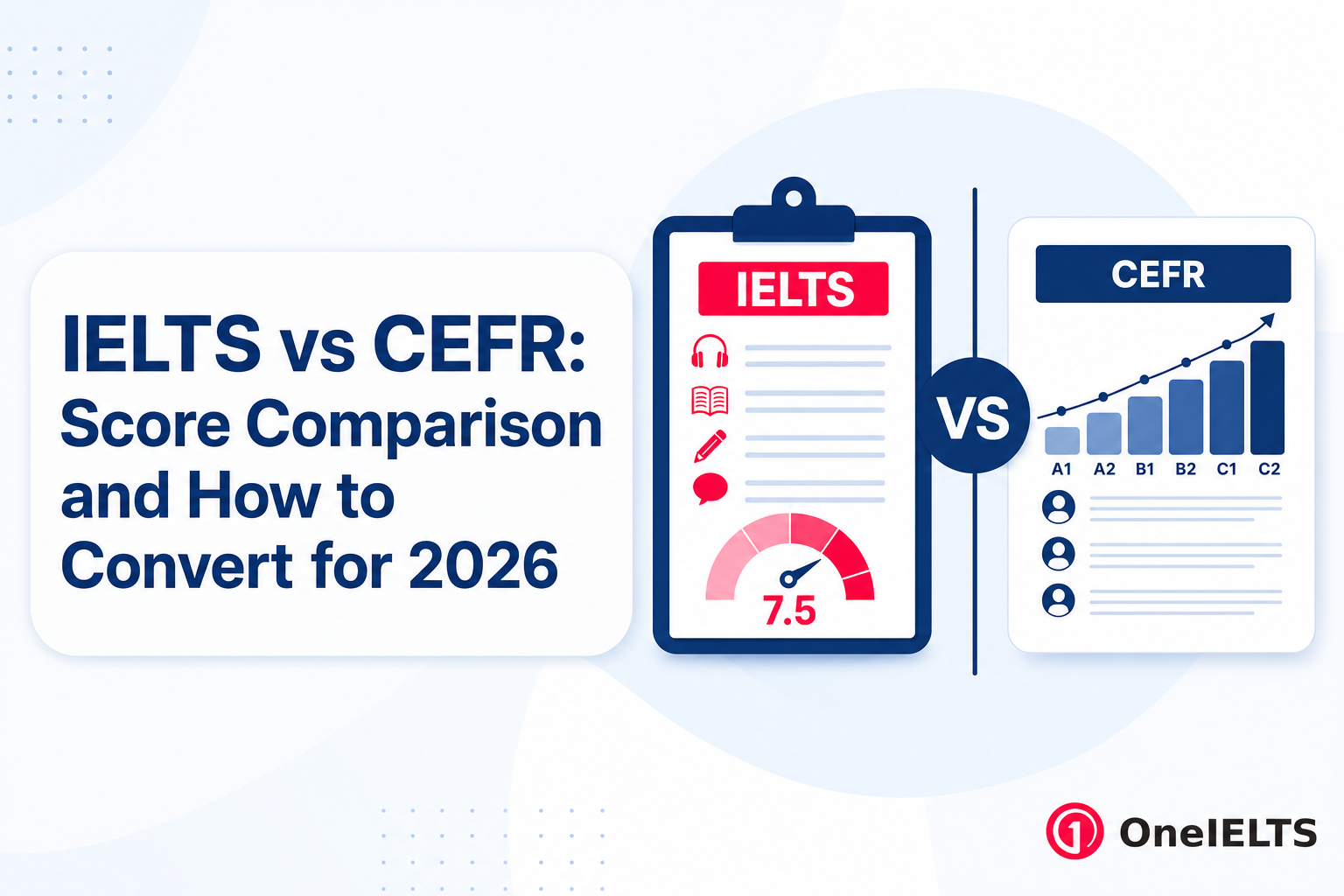
The CEFR levels sort language ability into six rising rungs, A1 to C2, and your IELTS band tells you where you sit on that ladder: a 6.5 reads as B2, a 7.5 as C1. Going from IELTS to CEFR gives you a level range, not a single conversion number, because each CEFR level covers a […]

If you are heading to university or registering with a professional body, IELTS Academic is the test you sit for university admission and registration. It scores you on a band scale from 0 to 9 across four skills. Only its Reading and Writing modules differ from General Training: you read academic passages drawn from journals, […]

Both PTE Academic and IELTS prove your English to the same universities and visa offices, but they sit on different scales. A PTE to IELTS score conversion reads across an equivalence band rather than a fixed sum. PTE runs 10-90 and IELTS runs 1-9, so the PTE 10-90 vs IELTS 1-9 gap is exactly why […]

For Canadian immigration, both CELPIP and IELTS prove your English and both feed the same Canadian Language Benchmark (CLB) score, so the CELPIP vs IELTS choice comes down to format and reach. CELPIP is a fully computer-based test built around Canadian English; IELTS offers paper or computer delivery and is accepted worldwide. This comparison covers […]

Choosing between IELTS Academic and IELTS General Training comes down to your destination, not which paper feels harder. IELTS Academic suits university admission and professional registration. IELTS General Training suits migration, work, and below-degree study. The two share an identical Listening and Speaking section and the same 1-9 band scale; only Reading and Writing Task […]

To immigrate to Canada you convert your four IELTS General Training band scores into a Canadian Language Benchmark level, and Express Entry then reads that level. Most economic routes want CLB 7, which is IELTS 6.0 in every skill. The Canadian Language Benchmark is Canada’s official yardstick for English, and the IELTS to CLB mapping […]

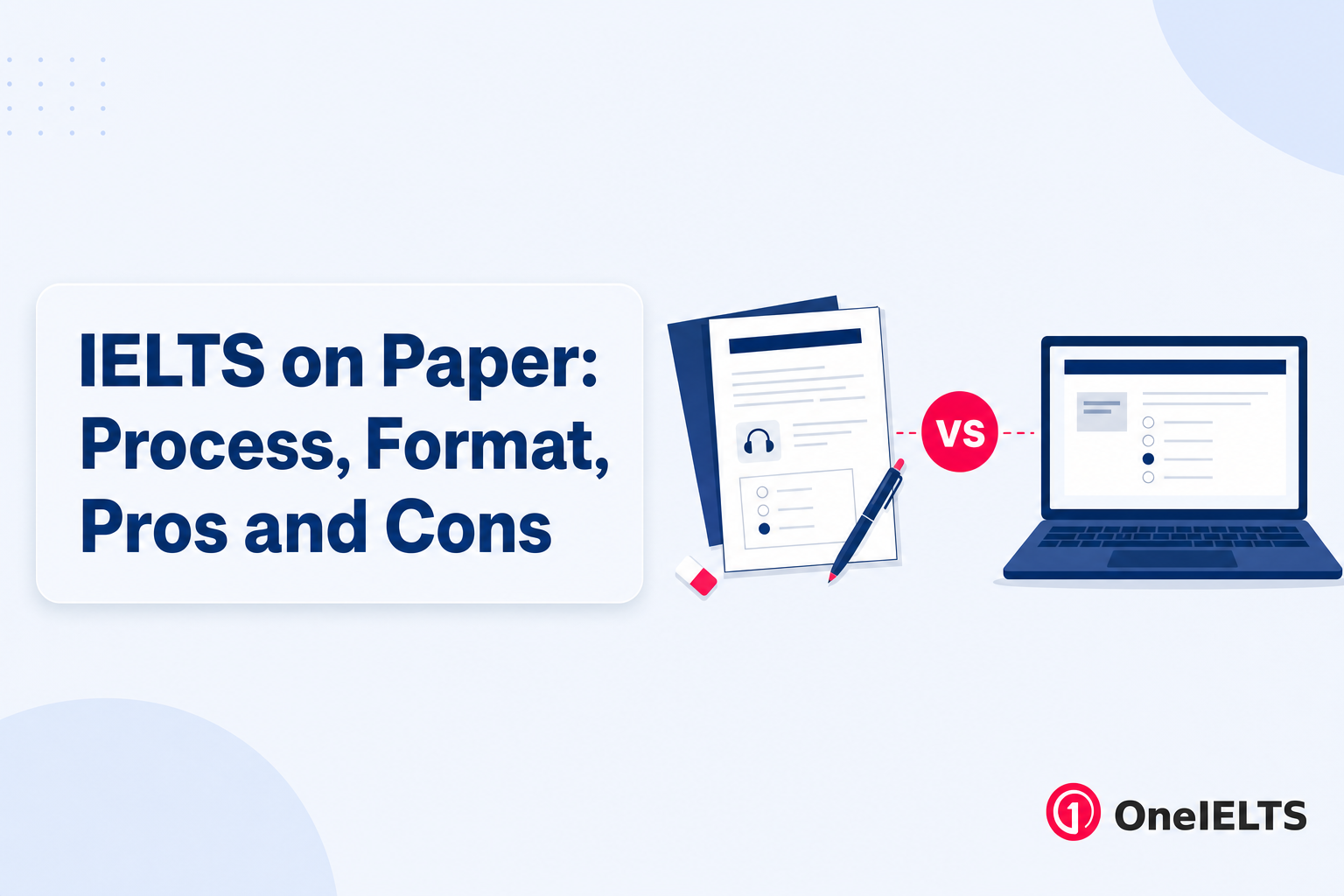
IELTS on Paper has been discontinued. All IELTS tests now run on computer, and in India the last paper-based dates were in August 2026. If you prefer to handwrite, the replacement is IELTS Writing on Paper: you take Listening and Reading on computer, write your Writing answers by hand on an answer sheet with the […]

If you are moving abroad for work or settlement, the test most immigration programmes ask for is IELTS General Training, not Academic. It measures the everyday and workplace texts you actually read and the practical English you use on the job. That focus on migration and work is the only real difference from Academic, because […]