To study, work, or settle in Germany you may need to prove English, and for that proof you take IELTS Academic in its standard form. IELTS for Germany matters in one place only: admission to English-taught programmes at German universities, which set the score themselves. The German state does not centrally require IELTS for the student visa, work visa, or settlement permit – those test German language and funds.
If your course is taught in German, you prove it through TestDaF / Goethe (German proof), and a Medium of Instruction (MOI) letter can waive IELTS. This guide covers which tests Germany accepts and the requirements by route. It then walks through how IELTS helps you study, the top German universities, working in Germany, the visa process, the cost, and why the EU Blue Card and the Niederlassungserlaubnis (settlement permit) rest on German.
Last verified: 30 June 2026
Which IELTS Tests Does Germany Accept?
German universities accept the standard IELTS Academic for English-taught programmes, IELTS General Training is rarely needed, and there is no special secure “IELTS for Germany” test. Unlike the UK, which mandates IELTS for UKVI from an approved centre, Germany uses standard IELTS taken at any IDP or British Council centre.
There is no central visa requirement here: the German government does not centrally require IELTS. Instead, universities and some visa officers ask for it as proof of English proficiency for English-taught programmes. Your results must show two-year validity – less than two years old on the day you apply.
What Are the IELTS Requirements for Germany?
The requirements come from the university, not the German state, and they apply only to English-taught programmes; there is no nationwide IELTS rule and no central visa band. The university-set minimum is the figure that actually gates your admission, whether you head toward study, an EU Blue Card, or a later settlement permit. The three IELTS requirements for Germany break down by route, mapped here before each is detailed below.
- The IELTS score for a German student visa, which applies to English-taught study.
- The IELTS score for German work routes, covering the Blue Card and Skilled Immigration.
- IELTS for German permanent residency, which covers settlement.
1. IELTS Score for a German Student Visa
The German student visa is a national D visa for study, and IELTS enters only for English-taught programmes, where the university sets the band. The minimum German universities commonly ask is IELTS Academic 6.0 to 6.5 overall, with sectional bands around 6.0 and no band below 6.0, per the live AI Overview and IDP IELTS India guidance.
The student visa itself asks for an admission letter, a blocked account (Sperrkonto) proving your funds, and, for German-taught courses, German proof rather than IELTS. Which type of IELTS test should you take for a German student visa? You take IELTS Academic, the version built for university admission.
2. IELTS Score for German Work Routes
German work routes include the EU Blue Card, the Skilled Immigration Act work visa, and the Job Seeker visa, and English proof sits at the edge of all three. These routes are built around recognised qualifications, salary thresholds, and a German language requirement, so IELTS is requested only when an employer or an English-taught role asks for it.
There is no German-government IELTS band for a work visa; any employer-specified English proof is route- or programme-specific. Which type of IELTS test should you take for German work routes? You usually take IELTS Academic, or General Training if an employer specifies it.
3. IELTS for German Permanent Residency (Settlement)
The German settlement permit, the Niederlassungserlaubnis, grants indefinite residence, and IELTS plays no role in earning it. Settlement requires several years of residence, pension contributions, and German B1 (Goethe / telc) language proof rather than any English test.
This is why IELTS not used for PR is the rule that matters: IELTS is irrelevant at the PR stage, even though it may have secured your original university admission. Which test does Germany use for permanent residency? Germany uses a German-language test, not IELTS.
How Does IELTS Help You Study in Germany?
IELTS helps you study in Germany mainly when you target English-taught Master’s and international programmes, where it proves you can cope with English-medium teaching. German universities trust IELTS Academic more than most other tests for English-taught programmes, so a valid score clears the university admission hurdle. The specific ways IELTS supports your study plans in Germany are set out in the list below.
- Admission to English-taught Bachelor’s and Master’s programmes. A qualifying IELTS Academic score lets German universities admit you onto degrees delivered in English, which is the main gate for international study in Germany.
- Meeting the university’s English-proficiency condition. Many offers are conditional, and your IELTS result is the document that satisfies the English-proficiency clause so the university can confirm your place.
- Stronger application for competitive international courses. A band above the minimum strengthens your file for selective English-medium Master’s programmes, where admissions teams weigh English ability alongside grades.
- Wider course and university choice. Holding IELTS Academic opens more English-taught options across Germany, since you are not limited to programmes that waive a test.
- Smoother enrolment without a separate MOI dispute. A clean IELTS score avoids back-and-forth over whether your prior Medium of Instruction qualifies, letting enrolment proceed without delay.
Can You Study in Germany Without IELTS?
Yes – many German universities admit international students without IELTS, depending on your background and the programme. To study in Germany without IELTS, common alternatives include a Medium of Instruction (MOI) letter confirming prior English-medium study, evidence of earlier English-taught education, or other accepted tests such as TOEFL / PTE / Duolingo.
German-taught programmes sidestep English entirely and instead need German proof through TestDaF or DSH. A conditional waiver still leaves the university in charge, though: it decides case by case, and some still ask for proof even when you expect a pass.
What Are the Top Universities in Germany That Accept IELTS?
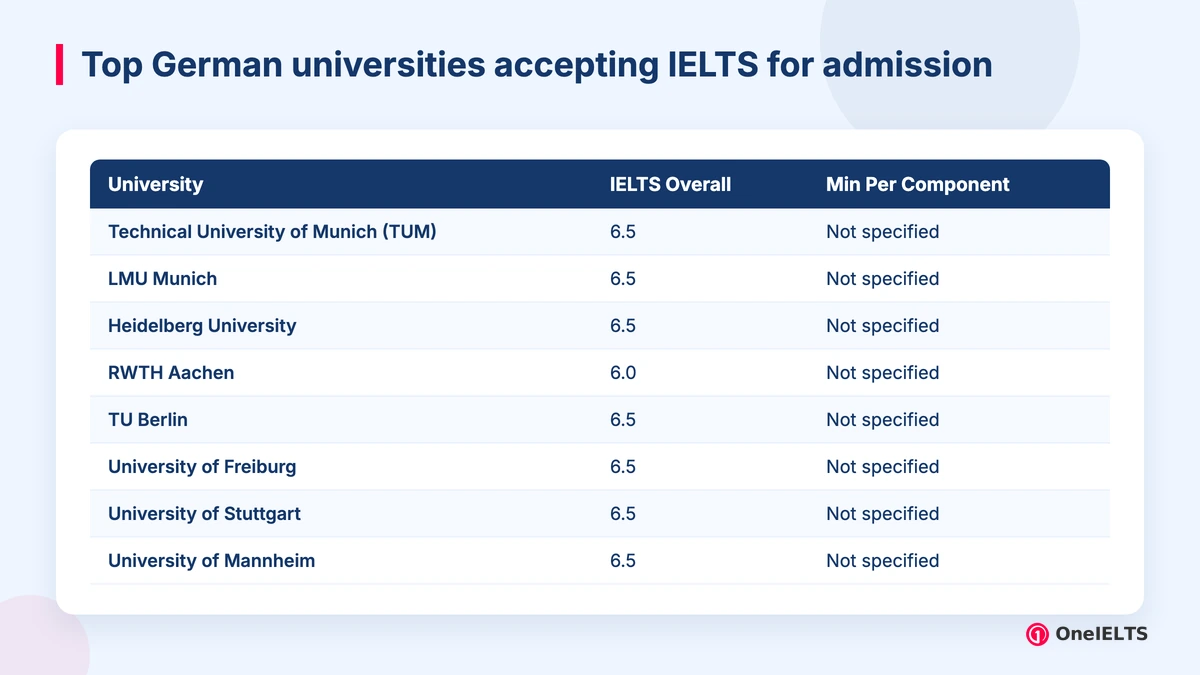
The top universities in Germany accept IELTS Academic for their English-taught Master’s, and competitive courses often ask for an IELTS 6.5 overall, rising toward 7.0. The typical minimum overall band score sits at 6.0 to 6.5, but you must always check the specific programme, because departments set their own bars. The IELTS scores that popular German universities ask of international applicants are mapped in the table below.
| University | IELTS Overall | Minimum Per Component |
|---|---|---|
| Technical University of Munich (TUM) | 6.5 | Not specified (overall only) |
| LMU Munich | 6.5 | Not specified (overall only) |
| Heidelberg University | 6.5 | Not specified (overall only) |
| RWTH Aachen | 6.0 | Not specified (overall only) |
| TU Berlin | 6.5 | Not specified (overall only) |
| University of Freiburg | 6.5 | Not specified (overall only) |
| University of Stuttgart | 6.5 | Not specified (overall only) |
| University of Mannheim | 6.5 | Not specified (overall only) |
| Technical University of Darmstadt | 7.0 | Not specified (overall only) |
| University of Bonn | 6.5 | Not specified (overall only) |
Several German universities set the IELTS band per programme (ranging from 5.5 to 7.0) and publish an overall band only – always confirm the exact requirement on your specific course page.
Exact minimums vary by programme, so confirm the figure on the course page before you apply. Last verified: 30 June 2026.
How Can You Work in Germany with IELTS?
Working in Germany means meeting German qualification, salary, and language rules, with IELTS supporting only English-mediated roles. IELTS is not a German-government work requirement; it surfaces when an English-taught degree or an international employer expects English proof. The IELTS test that applies is usually Academic, with General Training accepted if an employer asks. The German work routes and where IELTS may be requested are detailed in the list below.
- EU Blue Card (qualification + salary threshold). The EU Blue Card needs a recognised degree and a salary above a set threshold, and IELTS only appears if the employer or an English-language role asks you to prove your English separately.
- Skilled Immigration Act work visa. This route rests on recognised qualifications and German language often required alongside them, so IELTS is requested only when a specific English-mediated position calls for it rather than as a standard rule.
- Job Seeker Visa (six months to find a role). The Job Seeker Visa gives you six months in Germany to secure a job, and your qualifications and funds matter most, with IELTS relevant only where an English-speaking employer requests it during hiring.
- Study-to-work stay-back after an English-taught degree. After an English-taught German degree you can stay back to find graduate work, and the IELTS you used for admission already evidences the English ability some employers want.
- English-mediated multinational roles that request IELTS. Multinationals operating in English are the main source of employer-requested IELTS, asking candidates for a score directly while the German language otherwise takes priority across most jobs.
What Is the Germany Visa Process with IELTS?
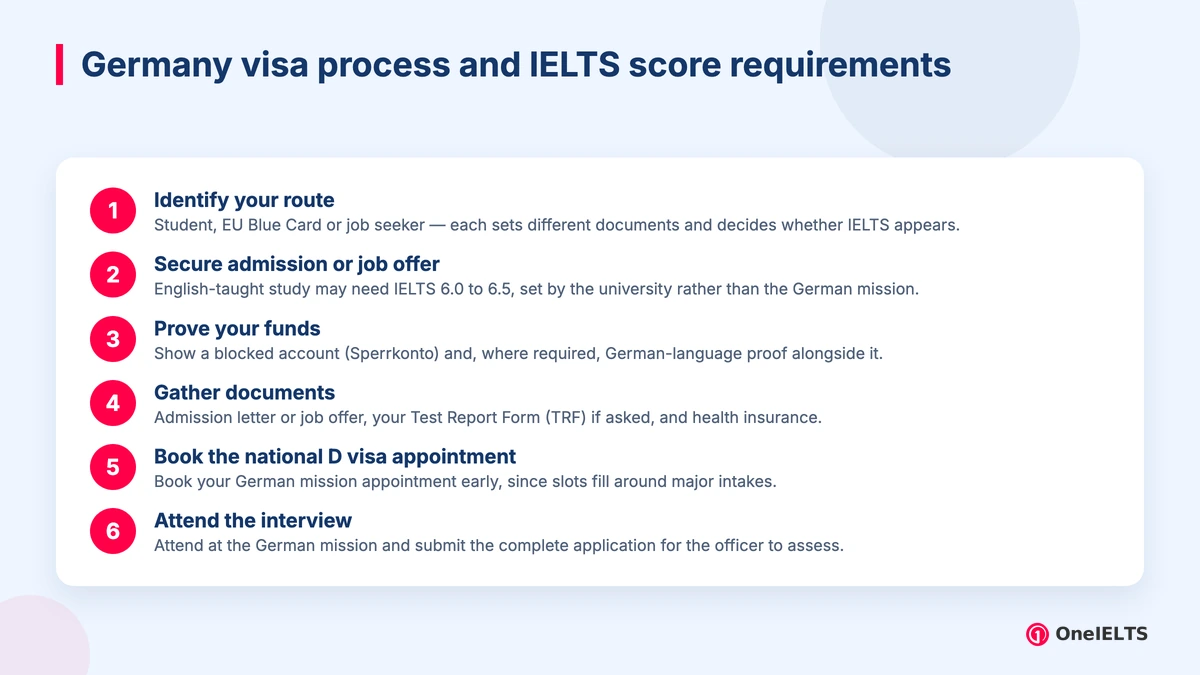
The Germany visa process runs from choosing a route to attending the interview, and IELTS, when needed, sits early, at the university-admission step for English-taught courses. The main German visa types are the student or national D visa, the EU Blue Card, and the Job Seeker visa. IELTS appears only inside university admission, never as a visa-office band. The steps of the Germany visa process are set out in order below.
- Identify your route – student, EU Blue Card, or job seeker – because each sets different documents and decides whether IELTS even appears.
- Secure admission or a job offer; English-taught study may need IELTS 6.0 to 6.5, set by the university rather than the German mission.
- Prove your funds through a blocked account (Sperrkonto) and, where the route requires it, show German-language proof alongside it.
- Gather your documents – the admission letter or job offer, your Test Report Form (TRF) if asked, and health insurance.
- Book the national D visa appointment, your German mission appointment, since slots fill early around major intakes.
- Attend the interview at the German mission and submit the complete application for the officer to assess.
How Much Does IELTS Cost for Germany?
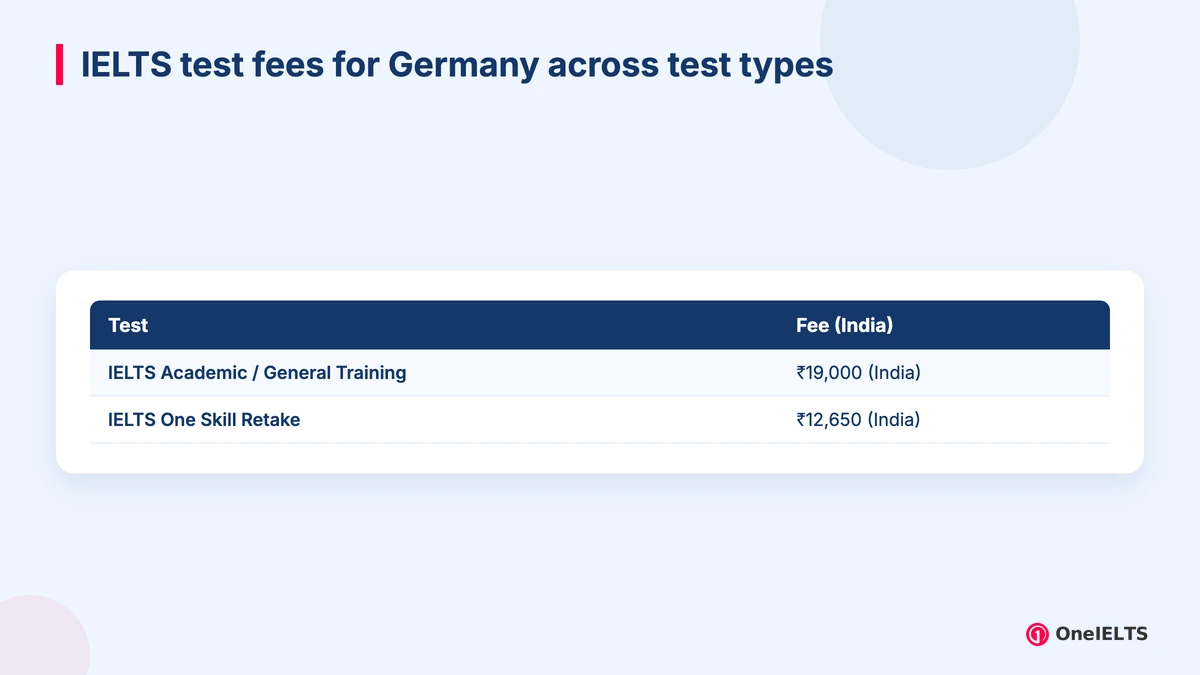
In India, IELTS Academic or General Training costs about ₹19,000, and the same fee applies whether you target Germany or any other country. The fee is identical for computer-delivered and paper-based formats, and Germany sets no separate IELTS fee of its own.
The IELTS One Skill Retake costs ₹12,650 (India), captured from the official providers. Fees are set by IDP and the British Council and change over time, so confirm the current figure before booking. The current IELTS fees relevant to a Germany application are listed in the table below.
| Test | Fee |
|---|---|
| IELTS Academic / General Training | ₹19,000 (India) |
| IELTS One Skill Retake | ₹12,650 (India) |
Last verified: 30 June 2026.
How Can You Get Permanent Residency (PR) in Germany with IELTS?
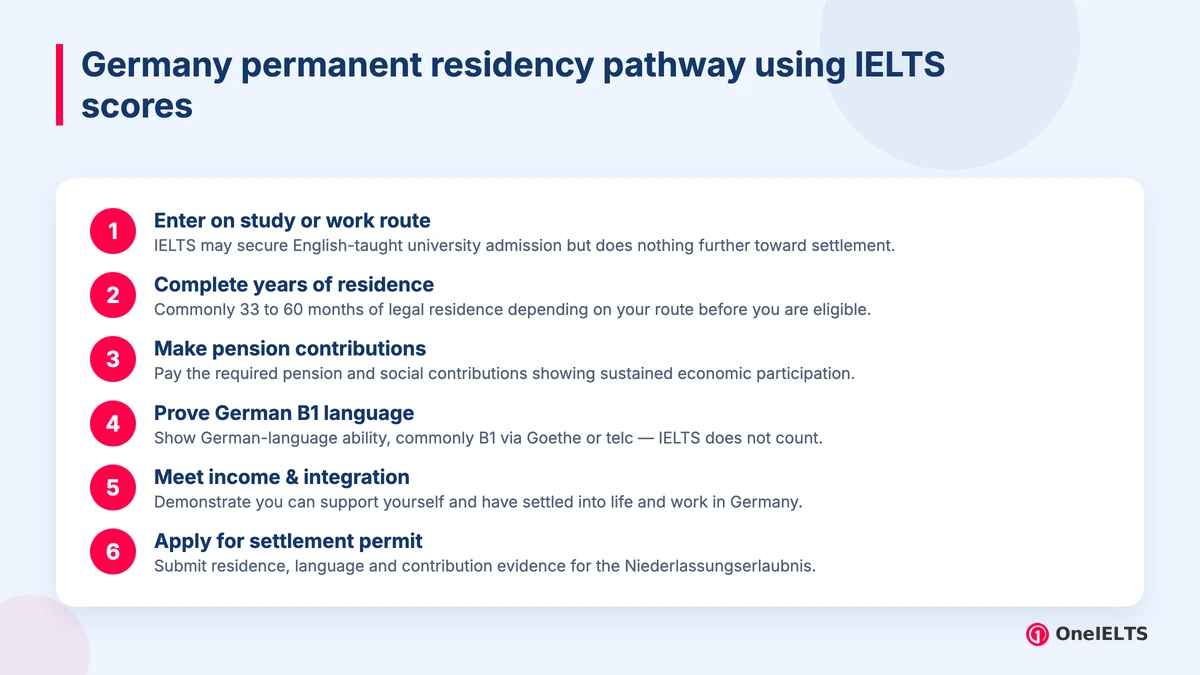
German permanent residency, the Niederlassungserlaubnis, is built on German language and years of residence, not on IELTS. The principle that IELTS not used for settlement holds throughout: the German B1 (Goethe / telc) proof and time-in-country requirements carry the weight, not English. The real steps to German settlement, and where IELTS does and does not apply, are set out in order below.
- Enter Germany on a study or work route, where IELTS may secure your English-taught university admission but does nothing further toward settlement.
- Complete the required years of legal residence, commonly 33 to 60 months depending on your route, before you become eligible to apply.
- Make the required pension contributions and other social contributions, since settlement rewards sustained, documented economic participation in Germany.
- Prove your German-language ability, commonly B1 through Goethe or telc, because settlement tests German rather than English – IELTS does not count.
- Meet the income and integration conditions, showing you can support yourself and have settled into life and work in Germany.
- Apply for the settlement permit, the Niederlassungserlaubnis, submitting your residence, language, and contribution evidence to the immigration office.
What IELTS Band Score Is Required for German Permanent Residency?
There is no IELTS band for PR – the settlement permit requires German B1 language proof, not an IELTS band, and the language requirement is set in German. IELTS may have secured your English-taught university admission years before, but it is not read at the PR stage. The relevant test is a German exam through Goethe / telc. Our IELTS band score guide explains what IELTS bands cover, so you can see why none of them applies to German settlement.
Is IELTS Academic or General Training Better for Germany?
For Germany you should take IELTS Academic – it is the version German universities accept for English-taught programmes. IELTS General Training is relevant only where employer-specified, when a particular employer or route asks for it, which is uncommon. Neither version is required by the German state for the visa or for settlement, so the choice is about university admission rather than immigration. Our IELTS Academic vs General Training comparison breaks down which one fits your goal.
When Does Your IELTS Score Expire for German Applications?
An IELTS score is valid for two years from the test date for German university and visa applications. This two-year validity period must still hold when both the university and the German mission assess your file, so a lapsed score forces a retake. An expired Test Report Form (TRF) is rejected, so time your test around your intake timeline. Our IELTS score validity guide shows how to plan that window.
Can IELTS One Skill Retake Help You Meet a German University’s Score?
Yes – if a German university requires a higher band in one skill, a One Skill Retake can lift that section without re-sitting the whole test. It resits a single section within 60 days of a computer-delivered IELTS Academic or General Training test, so you only repeat the skill that fell short. It is useful only for a university English condition, and it is not used for German visa or PR, which do not use IELTS. Our IELTS One Skill Retake guide sets out the rules in full.
In practice, the candidates I see most often trip up here assume the German embassy sets an IELTS band; it does not. The half-band that actually decides admission is the one a specific English-taught Master’s lists on its course page. That single line, not any visa rule, is where applicants who skip the programme check lose their place.
Practice for the Real IELTS Exam
Apply what you’ve learned with free, exam-style practice:
- Take a full IELTS mock test
- Practice by section: Listening, Reading, Writing, Speaking
- Structure your essays with IELTS Writing templates