For Canadian immigration, both CELPIP and IELTS prove your English and both feed the same Canadian Language Benchmark (CLB) score, so the CELPIP vs IELTS choice comes down to format and reach. CELPIP is a fully computer-based test built around Canadian English; IELTS offers paper or computer delivery and is accepted worldwide.
This comparison covers what CELPIP is and what IELTS is, and how the two differ. It also walks through whether CELPIP is easier, the CELPIP to IELTS score equivalent via CLB conversion, and which test to take for Canada.
Last verified: 30 June 2026
What Is CELPIP?
CELPIP, the Canadian English Language Proficiency Index Program, is a Canadian English test that measures your reading, writing, listening, and speaking for life in Canada. It is fully computer-based, so you complete every section on screen in a single sitting at a test centre. The test uses Canadian English throughout, from its accents to its everyday situations. It is IRCC designated, which means it is accepted for Canadian immigration and citizenship applications that ask for proof of English.
What Is IELTS and How Is It Different From CELPIP?
IELTS is the International English Language Testing System, an exam that assesses the same four skills of reading, writing, listening, and speaking on a nine-band scale. Where CELPIP serves Canada only, IELTS gives you worldwide acceptance across universities, employers, and immigration authorities in dozens of countries.
You can sit IELTS on paper or computer, depending on the test centre, rather than computer only. For Canadian permanent residence, IELTS General Training for PR is the version that counts, and the same result also opens doors well beyond Canada.
What Are the Differences Between CELPIP and IELTS?
CELPIP and IELTS test the same four skills, but they differ in their format delivery, the accepted countries that recognise them, their scoring scale, and how Speaking and Listening feel. Four practical differences separate the two tests, each explained in the sections below.
- Test format and delivery sets them apart first, since CELPIP runs entirely on a computer in one sitting while IELTS lets you choose paper or computer.
- Accepted countries divide them next, because CELPIP serves mainly Canada whereas IELTS carries acceptance across many nations worldwide.
- Scoring systems differ in their scoring scale, as CELPIP reports levels 1 to 12 and IELTS reports bands 1 to 9, both mapping onward to CLB.
- Speaking listening style finishes the list, with CELPIP recording your voice to a computer and IELTS using a face-to-face interview.
1. Test Format and Delivery
With computer only CELPIP testing, you finish all four sections in one sitting of roughly three hours without a separate appointment. Choosing paper or computer IELTS gives you flexibility for the written sections, and IELTS schedules Speaking as a separate slot, sometimes on a different day. That one sitting structure is why many Canada-bound candidates pick CELPIP when they want a single trip to the test centre and one result.
2. Accepted Countries
IRCC and Canadian institutions accept CELPIP for immigration, citizenship, and professional designation, which keeps CELPIP Canada only in practice. IELTS worldwide acceptance reaches more than 11,000 organisations across education, work, and migration. If your plans might extend past Canada, that global acceptance matters. For a Canada-only goal, CELPIP’s narrower reach rarely costs you anything.
3. Scoring Systems
CELPIP scores each skill from CELPIP 1 to 12, with each level aligned directly to a CLB level. IELTS reports each skill on the IELTS 1 to 9 band scale, which IRCC then converts to CLB using a published chart. Both map to CLB, so a Canadian immigration officer reads your CLB level rather than the raw CELPIP level or IELTS band. The two scales look different on paper, yet they meet at the same Canadian benchmark.
4. Speaking and Listening Style
CELPIP records your Speaking answers to a computer, with no examiner in the room, and its Listening uses North American audio and accents. IELTS uses a face-to-face IELTS interview, where you speak with a trained examiner in real time.
The recorded speaking format suits candidates who freeze in interviews, while the human conversation suits those who think better when talking to a person. North American audio in CELPIP also feels familiar to anyone already living in or studying toward Canada.
Is CELPIP Easier Than IELTS?
Many Canada-bound candidates find CELPIP comfortable because of its Canadian English and consistent computer format, but difficulty is strength dependent rather than fixed by the test itself. The computer format rewards confident typists and people who prefer recording answers over live conversation.
IELTS may suit those used to British English or those who perform better in a human interview than speaking to a screen. In practice, candidates who have lived in Canada often score half a level higher on CELPIP Listening because the North American accents sound normal to them.
What Is the CELPIP to IELTS Score Equivalent?
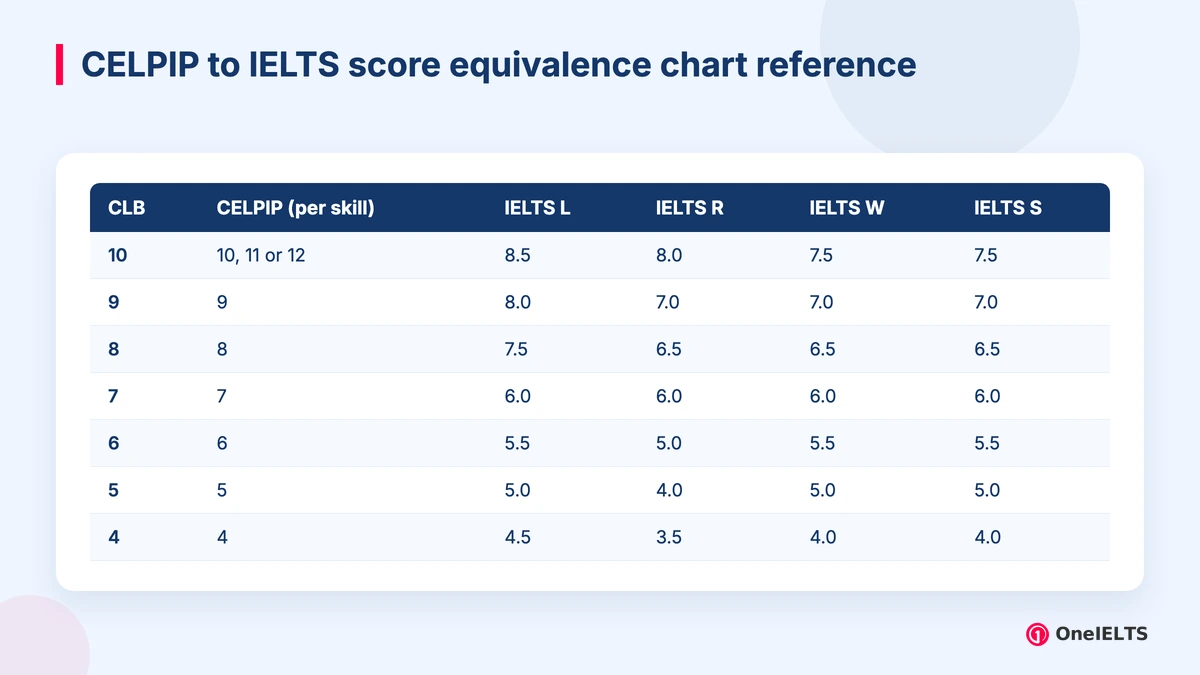
There is no direct CELPIP-to-IELTS conversion; instead each test maps to a shared CLB level, and you compare the two through that common benchmark. The table below pairs each CELPIP level with the IELTS General Training bands that sit at the same CLB level, per IRCC’s published equivalency charts.
| CLB Level | CELPIP Level (per skill) | IELTS Listening | IELTS Reading | IELTS Writing | IELTS Speaking |
|---|---|---|---|---|---|
| CLB 10 | 10, 11, or 12 | 8.5 | 8.0 | 7.5 | 7.5 |
| CLB 9 | 9 | 8.0 | 7.0 | 7.0 | 7.0 |
| CLB 8 | 8 | 7.5 | 6.5 | 6.5 | 6.5 |
| CLB 7 | 7 | 6.0 | 6.0 | 6.0 | 6.0 |
| CLB 6 | 6 | 5.5 | 5.0 | 5.5 | 5.5 |
| CLB 5 | 5 | 5.0 | 4.0 | 5.0 | 5.0 |
| CLB 4 | 4 | 4.5 | 3.5 | 4.0 | 4.0 |
Reading across the CLB 9 row shows the brief’s anchor point clearly: CELPIP 9 ~ IELTS 7.0 on the Reading, Writing, and Speaking skills, all sharing CLB 9. Because both convert through CLB rather than directly to each other, you compare across each row to the shared CLB level instead of matching a CELPIP level straight to one IELTS band.
Should You Take CELPIP or IELTS for Canada?
Both CELPIP and IELTS are accepted for Canadian immigration through the CLB system, so the right test is the one that fits your destination, your format preference, and your strengths. The decision rules below help you pick.
- Choose CELPIP for a Canada-only CELPIP goal. If Canada is your single destination and you prefer computer testing in Canadian English, CELPIP’s one-sitting format and familiar accents make it the simpler route to take.
- Choose IELTS for global options IELTS opens. If you want choices beyond Canada or you prefer paper testing, IELTS gives you worldwide acceptance plus a delivery format that suits exam-takers who write by hand.
- Both to CLB for Express Entry. Whichever test you sit, IRCC reads your CLB level for Express Entry, so both routes are equally valid for the points calculation that decides your profile.
- Pick the format fit that matches your strengths. Choose recorded speaking and typing if interviews unsettle you, or a face-to-face interview and handwriting if a live examiner brings out your best work.
Which Is Better for Canadian PR?
With both accepted PR routes running through the CLB system, neither test is universally better for permanent residence. The deciding factor is which test gets you the higher CLB, since the higher CLB wins more Express Entry points.
A candidate who speaks more fluently to a person may earn a higher CLB on IELTS, while one who freezes in interviews may do better on CELPIP. Test your strengths against both formats first, and read our IELTS for Canada guide for the full PR score requirements.
Do Both CELPIP and IELTS Convert to CLB?
Yes, both CELPIP and IELTS General Training convert to a CLB level for Express Entry, which is why either test satisfies the language requirement. Both convert to CLB, and IRCC uses your CLB level, not the raw CELPIP level or IELTS band, when it awards points.
You can see exactly how each band lines up in our IELTS to CLB conversion guide. That shared benchmark lets two very different tests count equally toward Canadian permanent residence.
Practice for the Real IELTS Exam
Apply what you’ve learned with free, exam-style practice:
- Take a full IELTS mock test
- Practice by section: Listening, Reading, Writing, Speaking
- Structure your essays with IELTS Writing templates