Spot the error practice hands you a sentence hiding one fault, or none, and trains you to fix it before an examiner does.
This page trains detection; causes of common slips sit on the OneIELTS writing mistakes page, and the exam-day routine on the proofreading page. Each error type gets a one-line detection test: swap a comma for a period, and if both halves stand, it was a comma splice.
You’ll cover error correction, seven error types, Task 1 and Task 2 slips and a ten-sentence quiz. A separate answer key names the criterion each error costs (Grammatical Range and Accuracy, Lexical Resource or Task Achievement), and the last section shows the errors each band allows.
What Are Spot-the-Error and Error Correction Exercises in IELTS Writing?
A spot-the-error exercise is a short practice item where you read a sentence, decide if it holds an error, mark the fault and write the correction. An error correction exercise flags the error for you, so you only fix it.
The IELTS Writing test has no spot the error section. The drill builds self-editing for your own Task 1 report and Task 2 essay.
The format comes from the grammar drill and from Indian bank and government exams, where it’s scored, so that search phrase turns up non-IELTS sentences. Useful items use IELTS topics such as charts, education and technology. It trains your eye on one error type at a time, the scan you’ll run in the final minutes.
What Are the Most Common Grammar Errors to Spot in IELTS Writing?
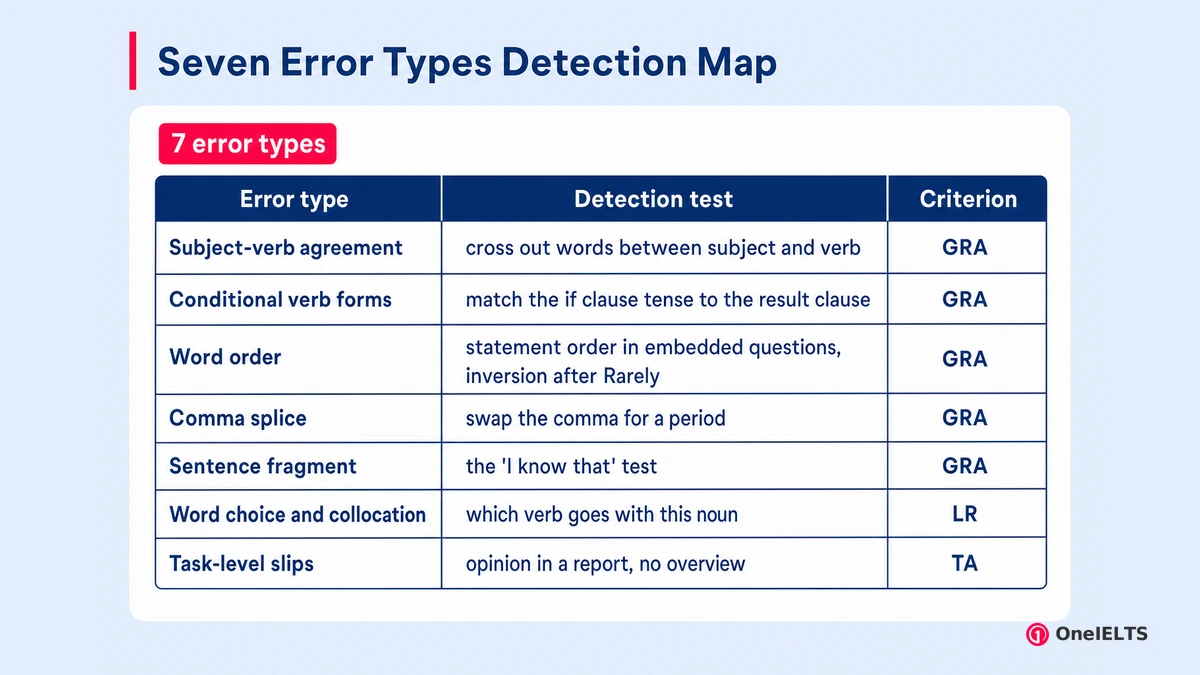
The errors worth hunting fall into sentence grammar (agreement, conditionals, word order, punctuation and incomplete sentences) and word choice (collocation and word form). Examiners mark the first family under Grammatical Range and Accuracy and the second under Lexical Resource. The common IELTS Writing mistakes page explains why these slips happen and how to avoid them; this page trains you to find them.
Seven error types make up the checklist, one per section further down, each with its own detection test.
- Subject-verb agreement: a singular subject paired with a plural verb, or the reverse.
- Conditional verb forms: an if clause and a result clause in clashing tenses.
- Word order in questions and inversions: question order inside a statement, or missing inversion.
- Comma use and comma splices: two full sentences joined by a comma alone.
- Sentence fragments: a clause or phrase punctuated as a sentence without a main verb.
- Word choice and collocation: a real word that doesn’t fit, such as “do a decision”.
- Task-level slips in Task 1 and Task 2: opinion inside a report, or no overview.
How Do You Spot Subject-Verb Agreement Errors?
A subject-verb agreement error happens when a singular subject takes a plural verb, or the reverse. In IELTS scripts it hides in a long subject, where the noun next to the verb isn’t the real subject.
Detection test: find the main verb, cross out everything between it and its subject (a prepositional phrase or who/which clause), then read subject and verb together.
Five triggers cause most slips. “The number of” is singular; “a number of” is plural. “Each”, “every” and “one of the” take singular verbs, and so does “the percentage of” in Task 1.
An uncountable noun such as information, research, evidence or advice never takes a plural verb. “There is” before a plural list is the fifth trap. Misread one long subject and you’ll misread them all; that repetition pulls Grammatical Range and Accuracy down.
- Wrong: The number of students who study abroad have increased since 2010.
- Right: The number of students who study abroad has increased since 2010.
Practice: The research on air pollution in large cities show a clear link with asthma.
Answer: show becomes shows. Cross out “on air pollution in large cities” and you’re left with “research show”; research is uncountable, so it takes a singular verb.
How Do You Spot Conditional Errors in IELTS Writing?
A conditional error is a clash between the verb form in the if clause and the verb form in the result clause. The commonest IELTS slip pairs a past-tense if clause with “will”.
Detection test: underline the verb in the if clause, name its tense, then check the result clause uses the partner form (present takes will, past simple takes would, past perfect takes would have).
| Pattern | If clause | Result clause |
|---|---|---|
| Zero conditional | present simple | present simple |
| First conditional | present simple | will + verb |
| Second conditional | past simple | would + verb |
| Third conditional | past perfect | would have + past participle |
A mixed conditional joins a past condition to a present result (“If I had studied harder, I would be at university now”). Advanced writers misuse it by forcing it where a plain second conditional fits. Task 2 solution paragraphs lean on the second conditional, so check those first. “Unless” and “provided that” open conditionals too, and they follow the same tense pairs.
- Wrong: If governments invested more in public transport, traffic congestion will fall.
- Right: If governments invested more in public transport, traffic congestion would fall.
Practice: If the city had built more cycle lanes in 2010, fewer people will drive to work today.
Answer: will drive becomes would drive. The past perfect condition with a present result makes this a mixed conditional, and its result clause takes would.
How Do You Spot Word Order Errors?
A word order error places a word where English grammar doesn’t allow it. In IELTS Writing the two repeat offenders are question order inside an embedded question and missing negative inversion after an adverb such as “Rarely”.
Detection test: if a clause inside a sentence starts with how, what, why or whether, check it uses statement order (subject before verb). If a sentence opens with Rarely, Never, Not only or Seldom, check the auxiliary verb comes before the subject.
Adverb position matters too: frequency adverbs such as “often” sit before the main verb but after “be”. Opinion adjectives come before size and age, and “enough” follows an adjective (“big enough”).
Task 1 writers copy question order from the prompt, producing “The chart shows how much did households spend”. Statement order fixes every embedded question.
- Wrong: The chart shows how much did households spend on energy.
- Right: The chart shows how much households spent on energy.
Practice: Not only cars pollute the air in big cities, but they also cause constant noise.
Answer: Not only cars pollute becomes Not only do cars pollute. A sentence opening with “Not only” needs the auxiliary do before the subject.
How Do You Spot Errors in the Use of Commas?
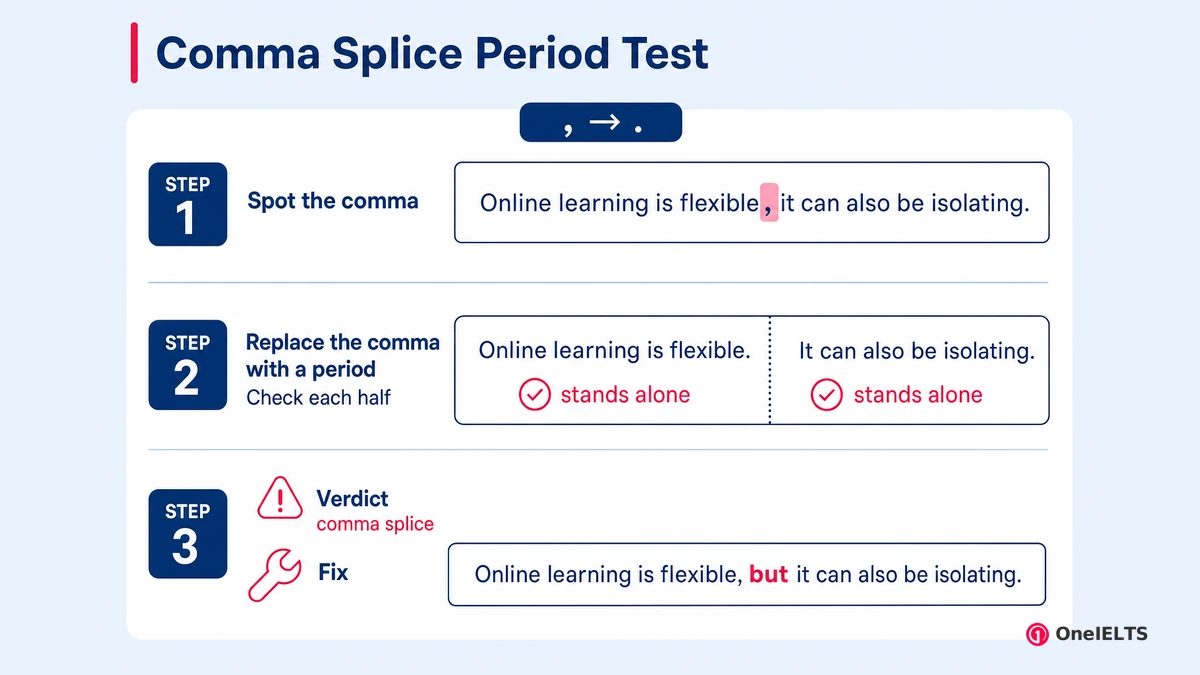
A comma error is either a comma joining two complete sentences (a comma splice) or a missing comma where English requires one, such as after a long introductory clause.
Detection test: replace the comma with a period. If both halves can stand as sentences, the comma is a splice and needs a period, a semicolon or a linking word such as but or so.
A linking adverb such as “however” can’t join two clauses with a comma alone; it needs a semicolon or period before it. A fronted introductory clause starting with “Although” or “When” takes a comma. A non-defining clause starting with “which” sits between commas.
Drop the punctuation entirely and you get a run-on sentence. Examiners mark punctuation under Grammatical Range and Accuracy, so repeated splices cost the same criterion as grammar errors.
- Wrong: Online learning is flexible, it can also be isolating.
- Right: Online learning is flexible, but it can also be isolating.
Practice: Car ownership rose steadily between 2000 and 2020, however, bus use fell after 2015.
Answer: the comma before however becomes a semicolon. Both halves stand alone as sentences, and a linking adverb can’t join them with a comma.
How Do You Spot Sentence Fragments?
A sentence fragment is a word group punctuated as a sentence that lacks a main clause, usually a “because”, “although” or “which” clause cut off from its sentence, or a phrase with no finite verb.
Detection test: read the word group alone after “I know that…”; if it doesn’t make a complete statement, or it starts with a subordinator and nothing follows, it’s a fragment.
Three fragment shapes appear in IELTS scripts: a detached subordinate clause starting with “because”, a “For example” phrase with no verb, and a lone -ing phrase like “Leading to higher costs”.
Attach the piece to the sentence before it, or add a subject and verb, the core of good sentence formation. The opposite fault, the run-on sentence, joins too much; the comma section covers it.
- Wrong: Many graduates move back home. Because they cannot afford housing in cities.
- Right: Many graduates move back home because they cannot afford housing in cities.
Practice: Some cities now charge drivers to enter the center. For example, London and Stockholm.
Answer: “For example, London and Stockholm” has no verb. Fold it in: Some cities, for example London and Stockholm, now charge drivers to enter the center.
How Do You Spot Word Choice and Collocation Errors?
A word choice error uses a real English word that doesn’t fit the sentence: a wrong collocation (“do a decision”), a wrong word form (“an economy problem”) or a near-synonym with the wrong meaning. Examiners mark these under Lexical Resource, not grammar.
Detection test: for every noun, ask which verb or adjective normally goes with it, then check each word form fits its job (noun, verb, adjective or adverb).
Three verb-noun pairs trip writers most: make a decision, pay attention and conduct research. Task 1 trend sentences confuse raise and rise; “raise” needs an object, so “the crime rate raised” is wrong. “Affect” is the verb, “effect” the noun.
Vague words such as “thing” fall under what the British Council calls over-generalisation. Forced synonyms often shift meaning; check each against IELTS Writing synonyms. Idioms jar in a formal essay.
- Wrong: Students should do a decision about their careers early.
- Right: Students should make a decision about their careers early.
Practice: Governments must take more attention to schools in rural areas.
Answer: take more attention becomes pay more attention. Attention collocates with pay, not take.
What Mistakes Should You Spot in IELTS Writing Task 1 and Task 2?
Each task has its own slips: opinion or no overview in a Task 1 report. A Task 2 essay slips by hiding its position or drifting off the question. You can spot both in any sample answer, beyond its sentence grammar. The first set costs Task Achievement, the second Task Response.
In each task, scan a script for the four tell-tale sentences listed per task, from missing key features to weak paragraphing and no clear position.
Task 1 report:
- Personal opinion or reasons in a data report: a line such as “I believe this is because people prefer cars.”
- No overview sentence of the main features: the report moves from the introduction into numbers with no “Overall” sentence.
- Every figure listed with no grouping: paragraph after paragraph reads “A was 20%, B was 25%, C was 30%.”
- Wrong tense for past or projected data: “In 2040, the population grew” where projected data needs “is expected to”.
Task 2 essay:
- No clear position in the introduction: the opening paraphrases the question but never says whether you agree or disagree.
- Paragraphs without one controlling idea: a body paragraph opens on cost, then ends on health with no topic sentence.
- Loss of focus on the exact question: an essay on university fees spends a whole paragraph on school uniforms.
- Over-complicated sentences that break grammar: a 50-word sentence where the main verb loses track of its subject.
Can You Spot the Error in This IELTS Writing Quiz?
Each sentence contains one error or none: find the faulty word or phrase and write the correction before you check the answer key in the next section.
This spot the error quiz tests seven error types through Task 1 report and Task 2 essay sentences, one per error type, and treats each as an error correction item.
- The number of students who study abroad have increased since 2010.
- If governments invested more in public transport, traffic congestion will fall.
- If I had studied harder last year, I would be at university now.
- Rarely people consider the long-term cost of fast fashion.
- The chart shows how much did households spend on energy.
- Online learning is flexible, it can also be isolating.
- Many graduates move back home. Because they cannot afford housing in cities.
- Students should do a decision about their careers early.
- The crime rate raised sharply in 2015.
- The figures for 2020 are worrying, and I believe the government should act.
Sentence 3 is a trap: it’s a correct mixed conditional, included because over-correcting a right sentence is a real exam habit. Full timed Task 1 and Task 2 tasks with feedback are on the IELTS Writing practice page.
What Are the Answers to the Spot-the-Error Quiz?
The answer key gives each correction, the detection test that exposes it and the criterion the error costs, so you can see which descriptor your misses would lower.
| Sentence | Error type | Correction | Detection test that exposes it | Criterion it costs |
|---|---|---|---|---|
| 1 | Subject-verb agreement | have increased becomes has increased | Cross out “of students who study abroad” | Grammatical Range and Accuracy |
| 2 | Conditional | will fall becomes would fall | A past if clause needs would | Grammatical Range and Accuracy |
| 3 | No error | Correct mixed conditional, leave it unchanged | Past condition with a present result | None, the sentence is correct |
| 4 | Word order | Rarely do people consider | A negative adverb needs inversion | Grammatical Range and Accuracy |
| 5 | Word order | how much households spent | An embedded question uses statement order | Grammatical Range and Accuracy |
| 6 | Comma splice | flexible, but it (or flexible. It) | Swap the comma for a period | Grammatical Range and Accuracy |
| 7 | Sentence fragment | home because they cannot afford | The “I know that” test fails | Grammatical Range and Accuracy |
| 8 | Collocation | make a decision | Ask which verb goes with decision | Lexical Resource |
| 9 | Word choice (raise/rise) | raised becomes rose | A trend verb without an object | Lexical Resource |
| 10 | Task-level slip | Delete the opinion clause entirely | No opinion in a Task 1 report | Task Achievement |
Score 9 or 10 and your self-editing is reliable. Score 6 to 8 and one error family needs targeted review, so go back to its section above. Score 5 or fewer and start with the grammar basics before more drills.
How Many Mistakes Are Allowed in IELTS Writing?
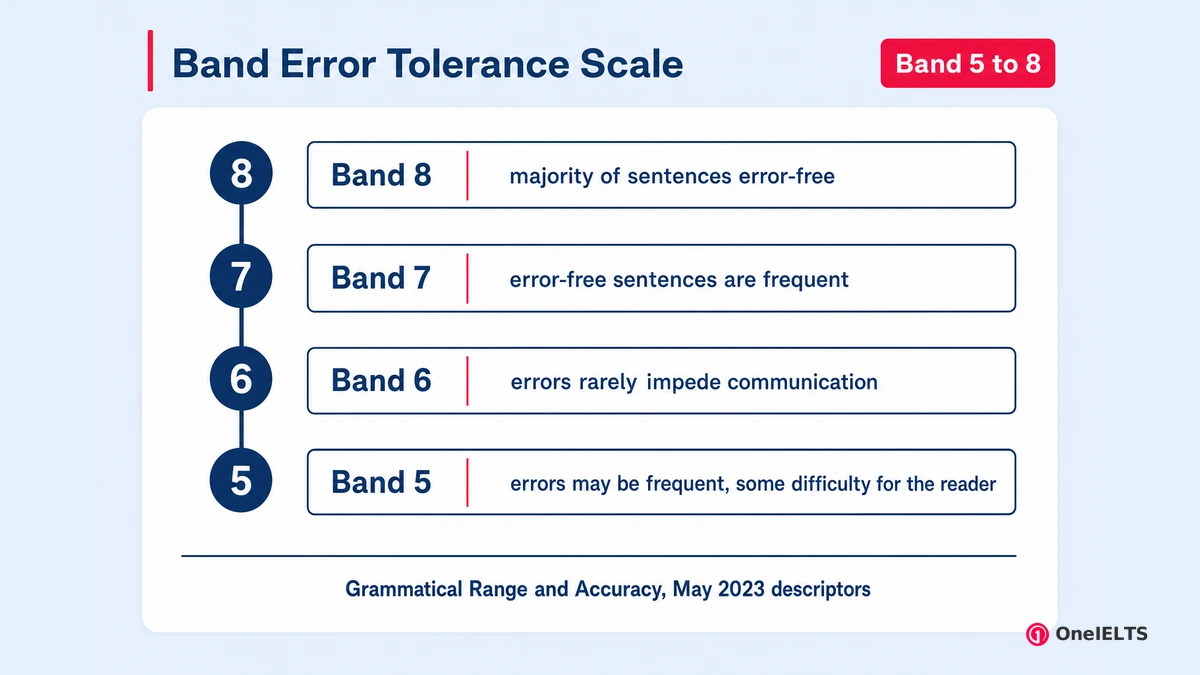
There’s no fixed number, because IELTS doesn’t count errors. Examiners judge how often errors appear and whether they make the writing hard to follow, using the Grammatical Range and Accuracy and Lexical Resource descriptors. These lines quote the Grammatical Range and Accuracy column of the public version of the band descriptors (May 2023), checked on 7 October 2026.
| Band | What the descriptor says about errors |
|---|---|
| Band 5 | “Grammatical errors may be frequent and cause some difficulty for the reader.” |
| Band 6 | “Errors in grammar and punctuation occur, but rarely impede communication.” |
| Band 7 | “Grammar and punctuation are generally well controlled, and error-free sentences are frequent.” |
| Band 8 | “The majority of sentences are error-free, and punctuation is well managed.” |
Error tolerance narrows band by band. One error type repeated across a script, the “repeated grammatical errors” pattern, does more damage than several one-off slips. Mark up a band 6 practice script and the red ink tends to cluster on one family, so your quiz result tells you which family to hunt first.
Do Spelling Mistakes Matter in IELTS Writing?
Yes, spelling mistakes matter in IELTS Writing, because spelling is assessed under Lexical Resource, but the descriptors judge how often they occur and whether they impede meaning rather than counting each one. Examiners accept British spelling and American spelling equally, though sticking to one is good practice. Misspelling a word form copied from the prompt is avoidable; see common spelling mistakes in English.
Can You Get 8.5 in IELTS Writing With a Few Errors?
Yes, you can get 8.5 in IELTS Writing with a few errors, because the band 8 descriptors still allow “occasional, non-systematic errors and inappropriacies” as long as the majority of sentences are error-free. Error-free sentences can carry a few slips. Your Writing band combines four criterion scores across both tasks, with Task 2 weighting double Task 1. IELTS publishes no Writing rounding rule; see the IELTS Writing band descriptors.
Why Should You Check Your Response for Errors Before Time Runs Out?
The errors you can still fix in the last minutes are the ones you trained to spot: agreement, comma splices and fragments. A short targeted check catches more of them than a full re-read. Good time management reserves 3 to 5 minutes across both tasks for an error checklist, subject-verb agreement first. The full IELTS Writing proofreading routine has its own page.
What Are the 20 Most Common Writing Mistakes?
The most common IELTS Writing mistakes fall into grammar, vocabulary, task response and organization, and the full list with causes and fixes is on the OneIELTS writing mistakes page. This page covers the grammar errors and vocabulary errors you can spot at sentence level, plus Task Response slips; the linked page owns all common mistakes.
Written by Jamil Ahmed, reviewed 7 October 2026.
Last verified: 7 October 2026
Practice for the Real IELTS Exam
Apply what you’ve learned with free, exam-style practice:
- Take a free IELTS mock test — all four skills, real exam timing, AI band scoring
- Sit a Writing section mock — Task 1 and Task 2 in one timed hour with a band estimate
- Practice by question type — self-paced Writing sets with model answers