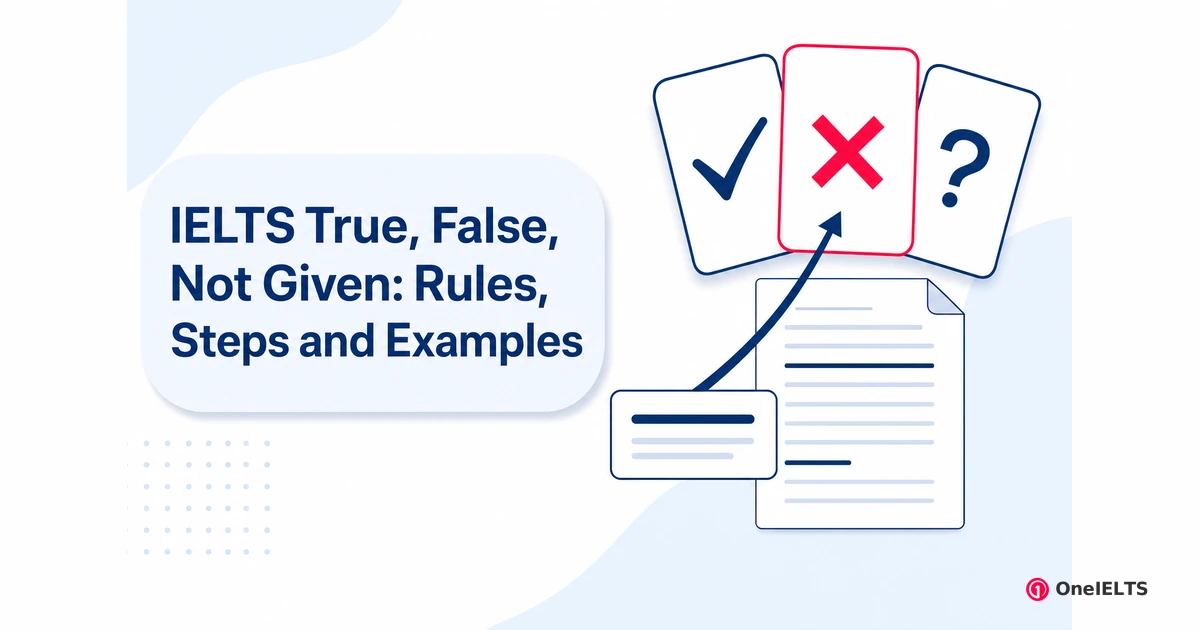
IELTS Reading True False Not Given items hand you a statement and three verdicts. TRUE means the reading passage states the claim. FALSE means the passage contradicts it.
NOT GIVEN means silence: the text never addresses the claim at all. Most lost marks come from reading “I cannot find it” as a contradiction.
This guide covers what the question type is, how many you face, the reading skills it uses, and the steps to follow. It then works through the FALSE versus NOT GIVEN decision, the pattern to notice, a worked example, where to practise, accuracy tips, and how the type fits the rest of the Reading paper.
What Are True, False, Not Given Questions in IELTS Reading?
Each statement gets judged against the passage, and you write one of three verdicts beside it. TRUE if the passage states the claim, FALSE if the passage contradicts it, NOT GIVEN if the passage does not address it at all.
The task is a numbered list of statements printed under an instruction line, set against one Reading passage. It tests locating information and identifying specific information, which is why it sits with the scanning-heavy question types rather than with the main-idea ones.
One line separates it from its twin. This type judges facts not views, while Yes/No/Not Given judges the writer’s claims and opinions. Nothing here rewards knowing the topic, because the passage is the only authority.
How Many True, False, Not Given Questions Are in IELTS Reading?
IELTS sets no fixed number of True, False, Not Given items per test. The type is one of the official Academic Reading question types, and how many appear changes from paper to paper. Any specific per-test count is.
The paper around it is fixed. Academic Reading sets forty questions across three passages in 60 minutes, and those forty are shared among whichever types that paper uses. The exam board publishes 11 Academic Reading question types, while some prep sites split the same material into 14. Each paper draws a subset per test rather than working through the whole list.
How Do You Use Reading Skills on True, False, Not Given Questions?
This type rewards scanning to locate the claim and close reading to test it. Skimming alone never settles a NOT GIVEN, because absence only becomes provable once you have read the relevant lines properly. Paraphrase recognition sits underneath both. The statement almost never reuses the passage’s keywords, so you hunt the idea and let the synonyms lead you to the sentence.
What Steps Should You Follow on True, False, Not Given Questions?
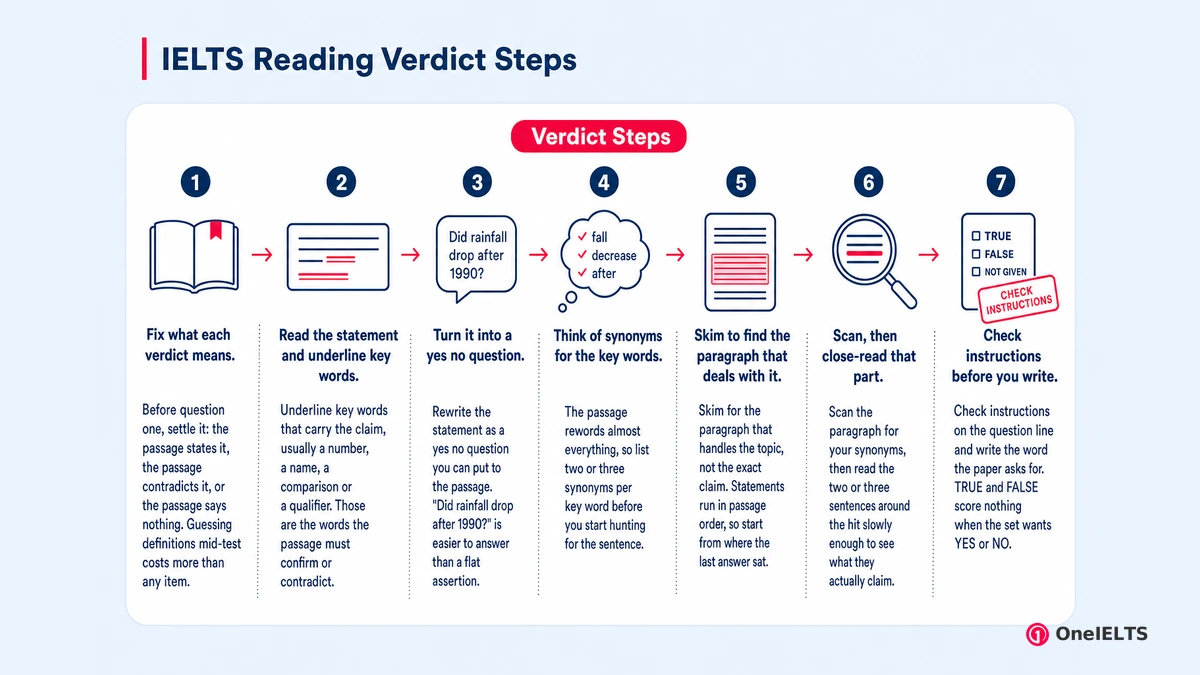
The method is one loop repeated for each statement. Fix the verdict definitions once, then work from key words to a paragraph to the sentence that settles it.
Seven steps make up that loop, in the order an experienced test-taker runs them.
- Fix what each verdict means. Before question one, settle it: the passage states it, the passage contradicts it, or the passage says nothing. Guessing definitions mid-test costs more than any item.
- Read the statement and underline key words. Underline key words that carry the claim, usually a number, a name, a comparison or a qualifier. Those are the words the passage must confirm or contradict.
- Turn it into a yes no question. Rewrite the statement as a yes no question you can put to the passage. “Did rainfall drop after 1990?” is easier to answer than a flat assertion.
- Think of synonyms for the key words. The passage rewords almost everything, so list two or three synonyms per key word before you start hunting for the sentence.
- Skim to find the paragraph that deals with it. Skim for the paragraph that handles the topic, not the exact claim. Statements run in passage order, so start from where the last answer sat.
- Scan, then close-read that part. Scan the paragraph for your synonyms, then read the two or three sentences around the hit slowly enough to see what they actually claim.
- Check instructions before you write. Check instructions on the question line and write the word the paper asks for. TRUE and FALSE score nothing when the set wants YES or NO.
What Is the Difference Between False and Not Given?
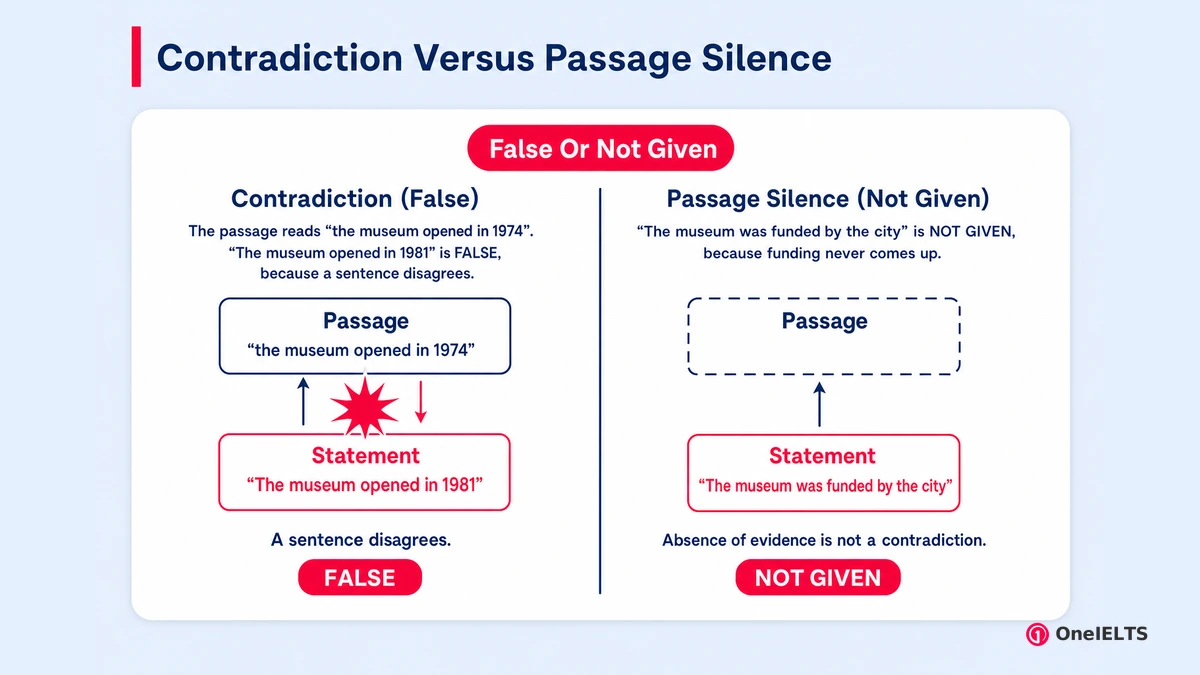
FALSE requires a sentence that contradicts the statement, and NOT GIVEN requires silence. Contradiction against nothing at all.
The passage reads “the museum opened in 1974”. “The museum opened in 1981” is FALSE, because a sentence disagrees. “The museum was funded by the city” is NOT GIVEN, because funding never comes up.
The failure mode is reading “I cannot find it” as FALSE, when absence of evidence is exactly what NOT GIVEN means. Can you point at the sentence that disagrees? If not, the answer is NOT GIVEN, whatever real world truth says.
What Pattern Should You Notice in True, False, Not Given Questions?
The order of statements follows the order of the passage. Once statement 2 is placed, everything above it can be left alone, which halves the searching. Two word-level patterns repay attention too. Writers use extreme qualifiers such as all, never and only, and those usually point to FALSE, because passages hedge. Comparative claims the passage never makes, such as cheaper or more common, usually point to NOT GIVEN.
What Does a True, False, Not Given Question Look Like?
Here is a worked example built on an original extract written for this page, not a Cambridge passage. The instruction line asks you to write one word for each statement.
Rooftop beekeeping in Lisbon began in 2016, when the city council placed twelve hives on municipal roofs. The scheme was designed to monitor air quality rather than to produce honey, and pollen samples went to a laboratory at the University of Lisbon. Hive numbers grew to forty by 2021. Beekeepers reported that colonies in the city centre survived the winter more often than colonies in the surrounding farmland, a result the council attributed to warmer night-time temperatures among the buildings.
Each statement carries its verdict and the one-line reason that settles it.
- The Lisbon hives were installed mainly to gather air-quality data. TRUE. The extract says the scheme was designed to monitor air quality rather than to produce honey.
- Lisbon had forty rooftop hives in 2016. FALSE. The extract puts twelve hives in 2016 and forty in 2021, so a sentence directly contradicts the number.
- Honey from the hives is sold to fund the scheme. NOT GIVEN. Most candidates write FALSE here, because “rather than to produce honey” feels like a denial. The extract never says whether honey is sold or how the scheme is paid for, so nothing contradicts it.
Where Can You Practise True, False, Not Given Questions?
Practise on OneIELTS rather than on scattered worksheets. Our IELTS Reading True False Not Given practice pages filter practice questions down to this single type. A free OneIELTS account is required to open them.
A question type drill and a full timed test do different jobs. The drill isolates the contradiction-versus-silence decision, so you can make the same mistake ten times in a row until it stops being one. A timed test puts that decision back among matching headings, completion sets, a clock and a passage you have never seen. Drill the type first, then sit the whole thing.
Worksheet PDFs are easy to find, including one from the British Council, and they are fine on a bus. They are also static and unmarked. A PDF cannot tell you whether a wrong answer came from confusing contradiction with silence or from missing a paraphrase, and that diagnosis is the point of practice.
Across our marked Reading practice, wrong answers cluster on NOT GIVEN rather than on TRUE or FALSE. Review every mistake with one question. Did I write FALSE when the passage was simply silent?
What Are the Best Tips and Tricks for True, False, Not Given?
Most tips and tricks for this type are about discipline rather than speed. Accuracy rises when you demand a contradicting sentence before you write FALSE, and it falls when the statement’s plausibility decides the verdict for you.
Five habits carry most of the gain, in the order they pay off.
- Learn the verdict definitions first. Fix what TRUE, FALSE and NOT GIVEN mean before your first practice question.
- Turn every statement into a question. Rewrite it as a question the passage can answer with yes, no or nothing.
- Find the contradicting sentence before you write FALSE. If you cannot underline it, the answer is NOT GIVEN.
- Treat extreme qualifiers as FALSE signals. Words such as all, never and only rarely survive an academic passage intact.
- Never leave blank. A blank scores zero, while a three-way guess scores about one item in three.
How Does True, False, Not Given Fit With the Other IELTS Reading Question Types?
Among the 11 official Academic Reading question types, this one belongs to the claim checking family, where you are handed a proposition and asked whether the text supports it. Yes/No/Not Given is its direct twin. Matching paragraph information asks a related question in reverse, sending you to find where a claim lives rather than whether it holds.
The rest of the reading test works differently. Completion tasks want words copied out, matching headings wants the main idea of a paragraph, multiple choice hands you the options, and diagram labelling sends you to a picture. Everything above this line treats the type on its own. What follows connects it to those neighbours and to how you practise.
Is True, False, Not Given the Same as Yes, No, Not Given?
No — True/False/Not Given judges factual information, while Yes/No/Not Given judges the writer’s opinions and claims. The three-verdict logic is identical, so a candidate trained on True False Not Given already handles the opinion version. Only the target changes, and the split is facts versus views. Our IELTS Reading Yes No Not Given guide covers the opinion side.
Is True, False, Not Given Harder Than Multiple Choice?
Yes for most candidates, because NOT GIVEN asks you to prove an absence, and there is no option list to eliminate against. Multiple choice prints the options for you and lets you work backwards. Here you work forwards from a blank page, and proving that a passage never mentions something takes longer than proving that it does. Our IELTS Reading Multiple Choice guide sets out the elimination method.
Can You Drill True, False, Not Given Alongside the Other Question Types?
Yes, and you should — a full Reading passage mixes question types, so isolated drilling only builds half the skill. The other half is allocation, meaning you know when to stop hunting for one absent claim. Timed practice on a full passage tests both halves. Sit a free IELTS Reading mock test once your per-type accuracy holds up.
Written by Fahimur Rahman, reviewed 14 August 2026.
Last verified: 14 August 2026
Practice for the Real IELTS Exam
Apply what you’ve learned with free, exam-style practice:
- Take a free IELTS mock test — all four skills, real exam timing, AI band scoring
- Sit a Reading section mock — one full timed paper with an instant band score
- Practise by question type — self-paced passages with answer explanations