Flow chart completion gives you a sequence of boxes joined by arrows, and you fill the blank ones with words taken from the passage. The arrows carry a promise. The boxes follow the passage’s own order, so once box 3 is filled you never look back for box 4. Every chart is one of two kinds, a process or chronology, and the kind changes the words you scan for.
This guide covers the task, the word limit, the two question types, the skills tested and the passage-order rule. It then gives the method, the common errors, a worked example, where to practise, the best tips, and where the type sits among the rest.
What Is Flow Chart Completion in IELTS Reading?
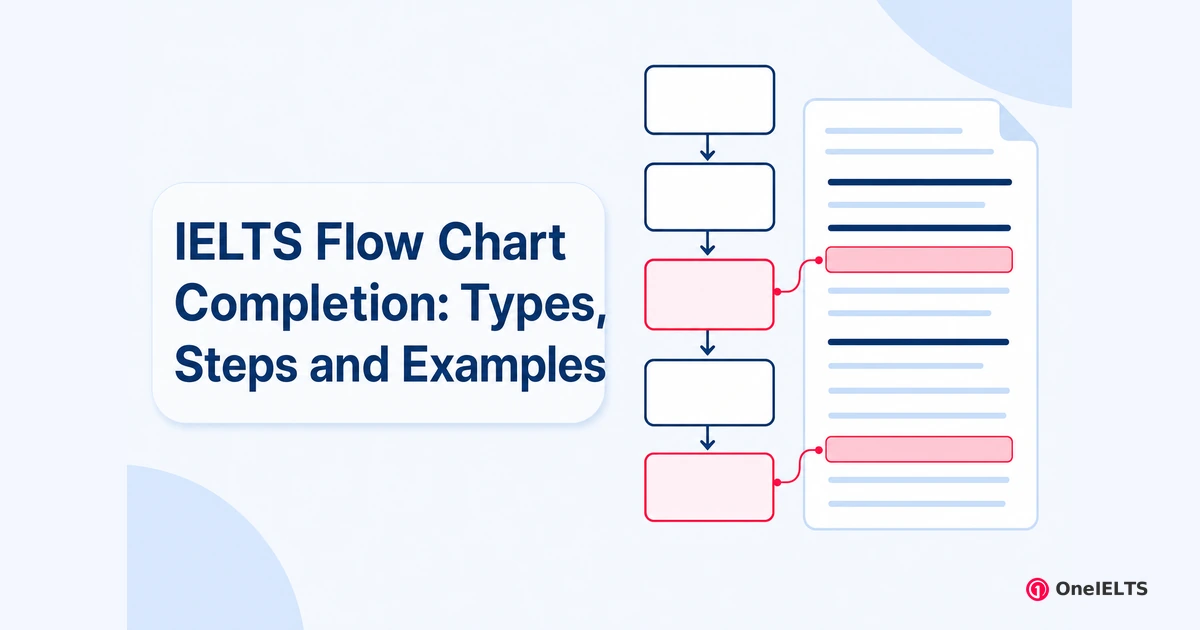
You get a flow chart summarising a process or a sequence of events with some boxes left incomplete, and you fill each gap with words from the passage, written inside a stated word limit.
The container is a diagram of boxes and arrows. Every arrow points from one box to the next, and that direction is the reading path through the task.
The rule of thumb is one stage per box. A box holds a step, an action, a result or a date, and it almost never holds a full clause.
A chart usually covers one section of the passage rather than all of it, so whole paragraphs hold no answers at all.
The official Academic Reading sample task for this type is framed around selecting words from the text. That makes the job one of choosing existing wording rather than composing your own.
How Many Words Can You Write in an IELTS Reading Flow Chart Completion Answer?
The instruction above the chart sets a hard cap, and an over-length answer scores zero even when you have identified the stage correctly. The commonest wording allows two words and a number, printed as NO MORE THAN TWO WORDS AND/OR A NUMBER.
That cap belongs to the question set rather than to the paper. Read the instruction every time, because the next set on the same passage can carry a different figure.
Boxes take unmodified words. You may not switch a plural to a singular, or shift a verb’s tense, to make the box read more smoothly.
Where a number is allowed, the instruction line says so explicitly.
Ignoring the word limit is the first error on the only published errors list for this question type, ahead of any failure of comprehension.
What Are the Two Types of IELTS Reading Flow Chart Completion Questions?
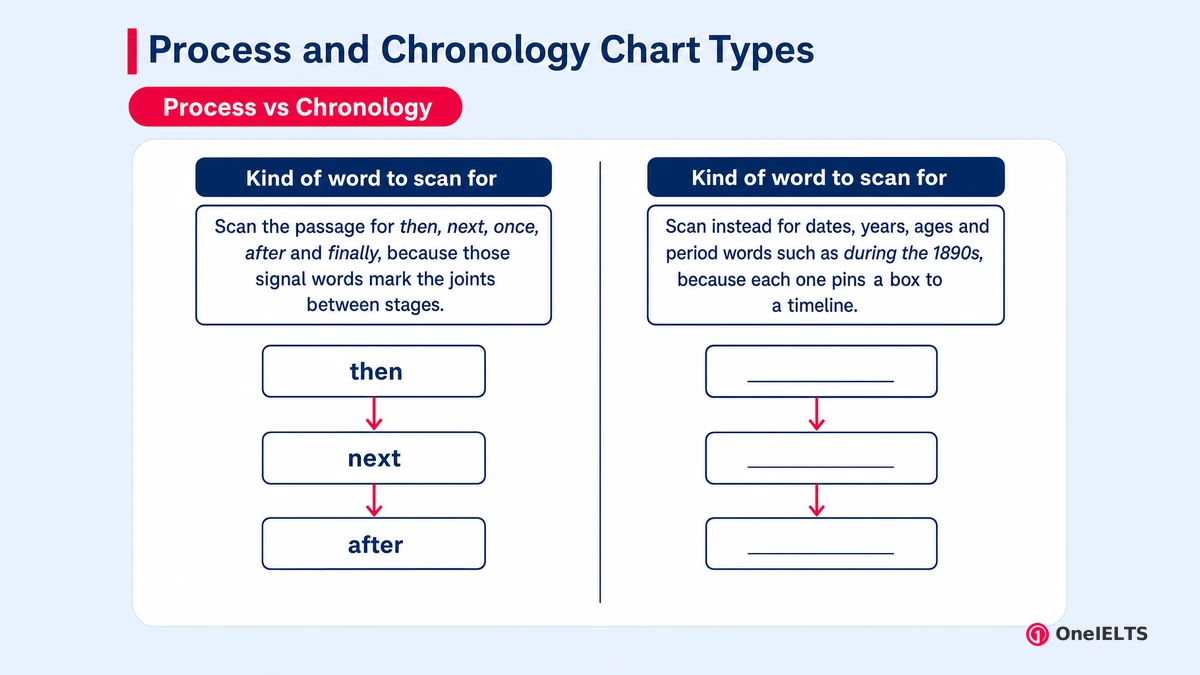
A flow chart either describes how something is done or when things happened. IDP’s own guidance uses two names for that split, process questions and chronological questions.
The two forms differ in what the boxes track and in the words that betray them in the passage.
- Process questions. The boxes are stages of a method, so the chart tracks how something is done. Scan the passage for then, next, once, after and finally, because those signal words mark the joints between stages.
- Chronological questions. The boxes are events in time, so the chart tracks when things happened. Scan instead for dates, years, ages and period words such as during the 1890s, because each one pins a box to a timeline.
You can tell the two apart before you read a line of the passage. Box labels built on verbs, such as heated, filtered and poured, mark a process. Labels built on dates and stages of a career or an institution mark a chronology.
What Skills Does IELTS Reading Flow Chart Completion Test?
Three abilities carry this task. You follow a sequence through the passage, you recognise a paraphrase of each stage, and you scan for the detail that fills the box once you know where you are.
Skim and scan do different jobs here. Skimming finds the section where the sequence starts, and scanning finds the words inside it.
The chart’s own phrases are already paraphrases of the passage, so the match happens at the level of meaning. A box may read cooled slowly where the text says left to stand overnight.
One extra skill belongs to this type alone. You read the diagram itself, tracking which box an arrow leads to, which the prose completion types never ask of you.
Do IELTS Reading Flow Chart Completion Answers Follow the Passage Order?
Yes — the boxes follow passage order, because the arrows mirror the order in which the passage presents the stages. You move forward once through the text and never track back.
Compare that with matching information, where the answers sit in no order at all and any question can send you anywhere in the passage. Arrows and sequence buy you real minutes.
The guarantee sets the order of the boxes, not their spacing. Box 2 can sit three paragraphs after box 1, or in the very next clause.
A chart that splits into a branching path still behaves. Each branch runs forward on its own, so finish one arm before you start the other.
Misreading the sequence is the second error on that published list, and it costs two boxes rather than one.
How Do You Answer IELTS Reading Flow Chart Completion Questions?
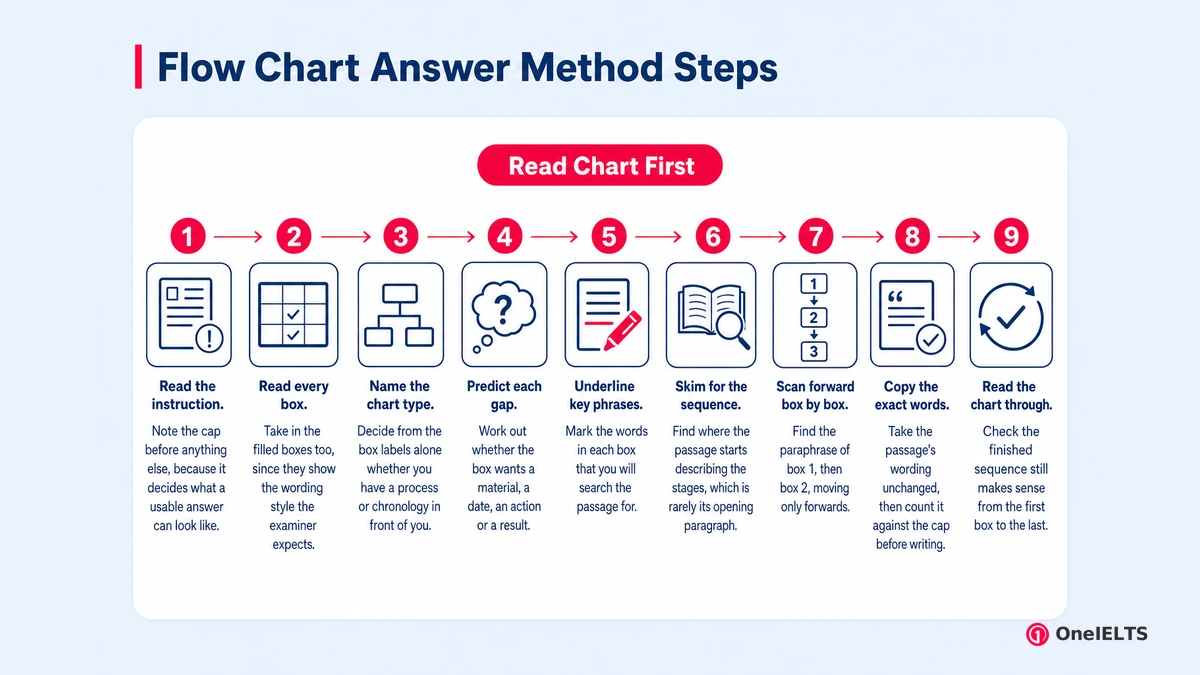
The method inverts the usual habit. You read the whole chart before you open the passage, because the chart sets both the target and the order of the search.
These nine steps run from the instruction line to the last filled box.
- Read the instruction. Note the cap before anything else, because it decides what a usable answer can look like.
- Read every box. Take in the filled boxes too, since they show the wording style the examiner expects.
- Name the chart type. Decide from the box labels alone whether you have a process or chronology in front of you.
- Predict each gap. Work out whether the box wants a material, a date, an action or a result.
- Underline key phrases. Mark the words in each box that you will search the passage for.
- Skim for the sequence. Find where the passage starts describing the stages, which is rarely its opening paragraph.
- Scan forward box by box. Find the paraphrase of box 1, then box 2, moving only forwards.
- Copy the exact words. Take the passage’s wording unchanged, then count it against the cap before writing.
- Read the chart through. Check the finished sequence still makes sense from the first box to the last.
What Are the Common Errors in IELTS Reading Flow Chart Completion?
Marks disappear on this type for mechanical reasons more often than for comprehension ones. Most wrong boxes hold words the candidate located correctly and then handled badly.
These eight slips account for the marks lost on charts that were understood perfectly well.
- Ignoring the word limit. Three words in a two-word box score zero, however precisely the stage has been identified.
- Misreading the flow. A sequence misread puts the right words in the wrong box, so two answers fall together.
- Writing your own words. The mark scheme accepts the passage’s wording only, so a neat paraphrase in the box scores nothing.
- Altering the word form. Changing a plural to a singular so the box reads better turns a correct find into a wrong answer.
- Taking words from the wrong stage. Two stages worded alike tempt you into the later one, which the arrows had already ruled out.
- Rereading from the top for every box. Backtracking through the passage per box burns the minutes the arrows were handing you.
- Copying a spelling wrongly. Spelling counts on this task, so a mistyped word inside a correct box still scores zero.
- Leaving a box empty. An empty box earns nothing, while a plausible guess from the passage occasionally lands exactly right.
What Does an IELTS Reading Flow Chart Completion Question Look Like?
A set prints an instruction line, a short chart title and a chain of boxes and arrows with numbered gaps. Here is a worked example built on an original passage written for this page.
From fleece to insulation batt
The Cardrona mill takes wool too coarse for clothing and turns it into building insulation. Raw fleece arrives bagged from farms across the valley, and the first job is a hot wash in a mild detergent that lifts out grease and dust. The clean fleece is then dried on slatted trays in a warm room for about six hours.
Once dry, the fibres go through a carding drum, which combs them into a loose even web. That web is washed again at this point in some mills, but Cardrona rinses nothing after carding, because the drum’s teeth would tangle damp fibre. The web then passes to a needle loom, where thousands of barbed needles punch up and down to lock the fibres into a felt. The felt is finally cut into batts of standard width and stacked for delivery.
Complete the flow chart below. Choose NO MORE THAN TWO WORDS from the passage for each answer.
+----------------------------------------------------+
| 1 Fleece given a hot wash in a mild...(1)... |
+----------------------------------------------------+
 |
 v
+----------------------------------------------------+
| 2 Clean fleece dried on trays for six hours |
+----------------------------------------------------+
 |
 v
+----------------------------------------------------+
| 3 Dry fibres combed into a web by a...(2)... |
+----------------------------------------------------+
 |
 v
+----------------------------------------------------+
| 4 Web punched by barbed needles in a needle loom |
+----------------------------------------------------+
 |
 v
+----------------------------------------------------+
| 5 Felt cut to...(3)... and stacked for delivery |
+----------------------------------------------------+
Each gap is placed by a word in the passage that fixes its position in the sequence.
- 1 = detergent. The first job marks stage one, and the passage supplies a hot wash in a mild detergent.
- 2 = carding drum. Once dry opens the following stage, and the fibres go through a carding drum.
- 3 = standard width. Finally marks the closing stage, from cut into batts of standard width.
Two similar stages sit in this passage on purpose. Washing is mentioned twice, and the second mention arrives after carding, so a candidate hunting for wash-words can drop it into box 1. The arrows rule that out, because box 1 comes before the carding drum.
A chronology works the same way with different signal words. Take one sentence: Elsie Rowan trained as a draughtswoman in 1937, left the drawing office for the aircraft factory in 1941, and returned to bridge design in 1952.
+---------------------------+ +---------------------------+ +---------------------------+
| 1937 trained as a |-->| 1941 moved to the |-->| 1952 returned to bridge |
| draughtswoman | |...(4)... | | design |
+---------------------------+ +---------------------------+ +---------------------------+
Gap 4 is the aircraft factory, and the year 1941 rather than any verb is what places it.
Where Can You Practise IELTS Reading Flow Chart Completion?
Practise this type on OneIELTS rather than chasing worksheet PDFs. Our IELTS Reading flow chart completion practice filter narrows the Reading bank to practice questions of this single type. Opening them needs a free OneIELTS account.
Flow charts turn up less often than sentence, summary and note completion. Meeting one inside a full passage therefore teaches you more than drilling the type in isolation, because a whole passage makes you find where the sequence starts.
A question type drill still earns its place. It isolates one decision at a time, and ninety unhurried seconds on a single box teaches more than a rushed paper does. In the flow chart sets we mark, the box that goes wrong most often is the last one, filled in a hurry from a stage the candidate had already passed.
Review your errors with three questions. Did the answer break the cap, was the word form altered, or did the words come from the wrong stage?
What Are the Best Tips for IELTS Reading Flow Chart Completion?
The flow chart tips that move accuracy are about order and restraint. You settle the shape of the chart before you touch the passage, and you write down less than you feel like writing.
Take these nine habits into your next practice set, one at a time.
- Read the instruction first. The cap changes between question sets, so check it before you fill a box.
- Read all the boxes before the passage. The filled ones show the wording style you must match.
- Decide process or chronology. That single call changes which words you hunt for in the text.
- Chase the signal words. Then, next, once and after locate stages faster than the topic words do.
- Trust the arrows. Working forward covers every box, because the passage introduces the stages in chart order.
- Copy unchanged. Take the passage’s exact wording, with its plural, its tense and its spelling intact.
- Read the finished chart through. A sequence that no longer reads sensibly points at one wrong box.
- Leave no box empty. A guess in the right category costs nothing and sometimes matches the passage.
- Cap one box at ninety seconds. Move on, because a later box often reveals the one you skipped.
How Does Flow Chart Completion Fit With the Other IELTS Reading Question Types?
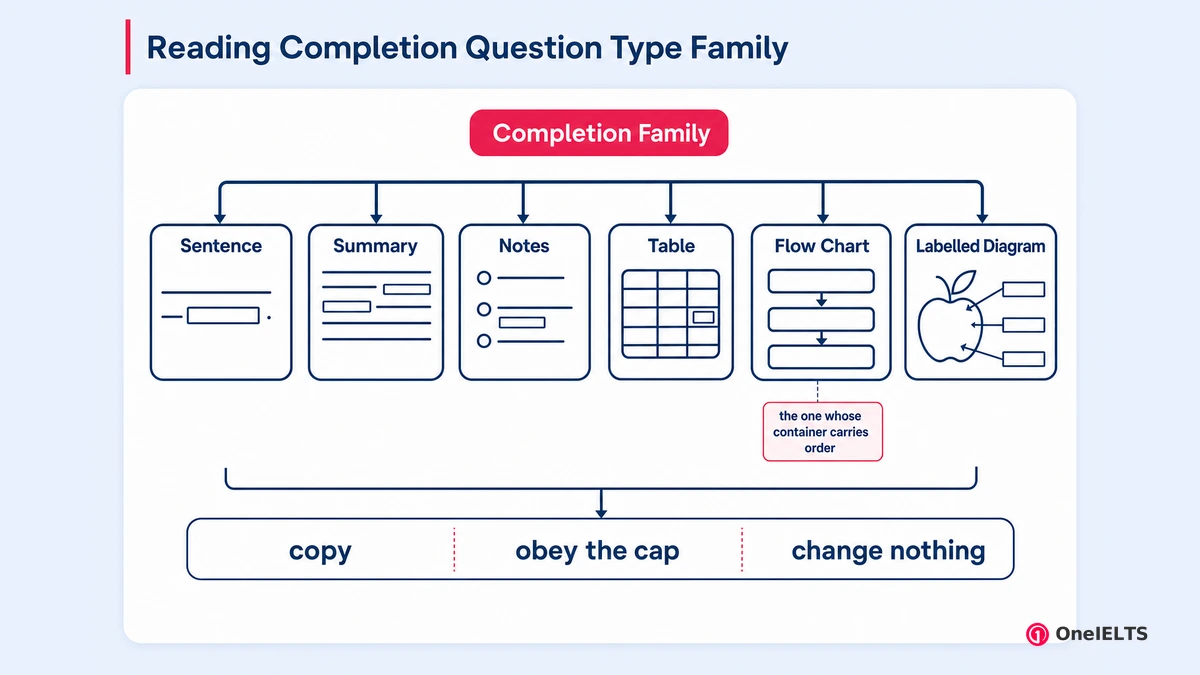
Among the official Academic Reading question types, flow chart completion belongs to the completion family, and all six containers in that family obey the same rule set. You copy from the passage, you obey the cap, and you change nothing.
Only the container changes across the family. A sentence, a summary, a set of notes, a table, a flow chart and a labelled diagram each hand you a different clue for free.
The flow chart is the family member whose container encodes order. That is why it needs the fewest passes through the passage once you trust the diagram.
Everything above treats the type on its own. What follows sets it beside its nearest neighbours in the family, and beside the Listening task that shares its name.
Are IELTS Reading Flow Chart Completion Questions Similar to Table Completion?
Yes, closely — both fill gaps in a diagram under the same word limit. A table sorts information into categories while a flow chart puts it in sequence, so the table tells you what kind of word to expect and the chart tells you when it appears. One ranking page asks this in its own FAQ, so readers arrive already wondering. Our IELTS Reading table completion guide covers the grid version.
Which Other IELTS Reading Question Types Use a Diagram Instead of Prose?
Diagram labelling is the other one. It asks you to name the parts of a picture rather than the stages of a process, so its spatial layout carries position instead of sequence. Table completion is the third non-prose container, sorting facts into a grid. All three obey the same rules on copying, which is passage words only, inside the cap, unaltered. Our IELTS Reading diagram labelling guide sets out the picture task.
Is IELTS Listening Flow Chart Completion the Same Task as IELTS Reading Flow Chart Completion?
No. The chart and the cap behave the same way, but in Listening the stages arrive once, in real time, so the sequence is doing the work for you rather than being something you verify. Listening flow chart completion follows the recording box by box. Reading lets you re-scan and re-check the order, so the same chart punishes far less here. Our IELTS Listening question types guide covers the audio version.
Written by Fahimur Rahman, reviewed 14 August 2026.
Last verified: 14 August 2026
Practice for the Real IELTS Exam
Apply what you’ve learned with free, exam-style practice:
- Take a free IELTS mock test — all four skills, real exam timing, AI band scoring
- Sit a Reading section mock — one full timed paper with an instant band score
- Practise by question type — self-paced passages with answer explanations