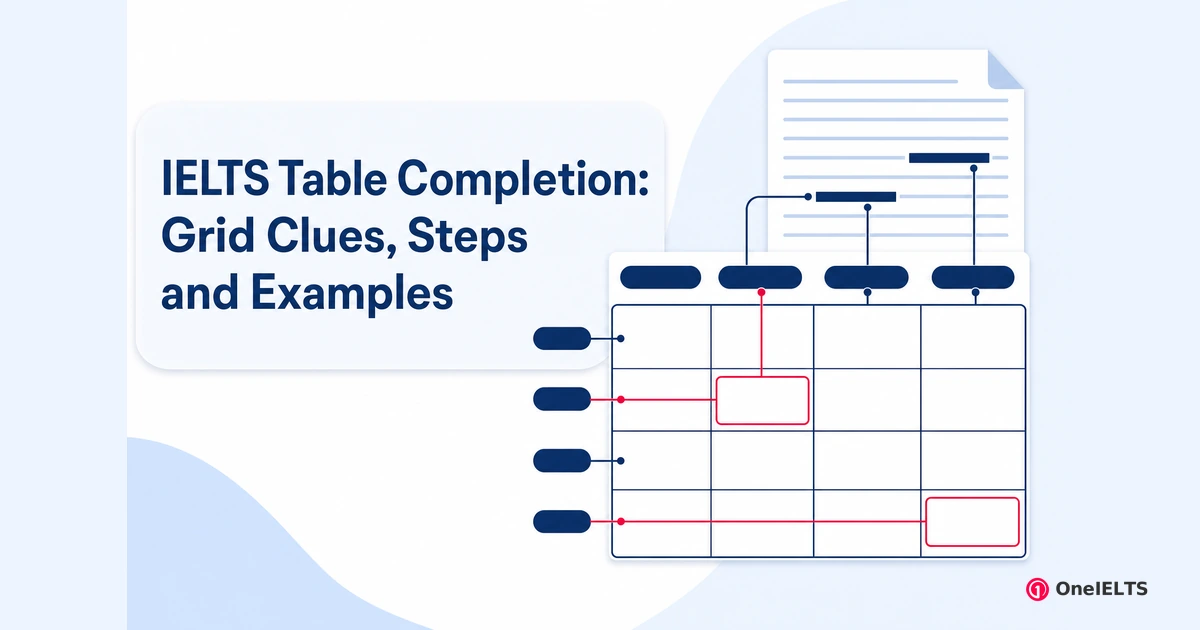
Table completion hands you a grid with some cells left blank, and you fill them with words taken straight from the passage. Every gap sits under a column heading and beside a row label. Those two labels fix the category of the answer, whether that is a year, a cost, a material or a name. Each entry also has to stay inside the word limit printed above the grid.
The passage rarely follows the table’s order, so the grid rearranges the text instead of summarising it.
This guide covers the task itself, the word limit, the skills it tests, the grid clues and the method. It then gives the common mistakes, a worked example, where to practise, the best tips, and how the type fits the rest.
What Is Table Completion in IELTS Reading?
You get a table of information with some cells left blank, and you fill each one with words from the passage, written inside a stated word limit. Nothing is chosen from a list here, and nothing is written in your own phrasing.
The table in this task is a grid that reorganises facts from the passage by category rather than by paragraph. Rows normally stand for the things being compared. Columns stand for the kind of information given about each one.
The blank cells can sit anywhere in that grid, including the top row or the last column. Entries stay short. A noun phrase, a number or a date fills most of them, and a full clause almost never does.
One feature catches people out. A table usually covers only part of the passage, so whole paragraphs hold no answers at all.
The computer-delivered test presents the same task in an on-screen grid, with a typing box inside each blank cell. The British Council groups it with the other completion tasks in its guidance on the family.
How Many Words Can You Write in an IELTS Reading Table Completion Answer?
The instruction line above the table sets a hard cap, and going over it scores zero even when the information is right. The most common wording allows two words and a number, printed in capitals as NO MORE THAN TWO WORDS AND/OR A NUMBER.
That cap belongs to the question set, not to the paper. Read the instruction every time, because the sentence completion task ten questions later can carry a different figure.
A hyphenated word normally counts as one word, and where a number is allowed the instruction line says so. Copy the word in the form the passage uses. Turning a plural into a singular, or a noun into an adjective, converts a correct find into a wrong answer.
The same word limit governs the whole completion family, so sentence, summary, note, flow chart and diagram tasks all obey it. Only the number changes.
What Skills Does IELTS Reading Table Completion Test?
The task asks for three things at once. You scan for detail rather than read for gist, you recognise a paraphrase when the writer rewords a row label, and you read the grid closely enough to know what each empty cell wants.
This is a detail task. Nothing in it rewards a grasp of the writer’s argument, because every mark sits in a single fact.
Numbers and dates are the easiest scan targets, since figures survive paraphrase untouched. A year printed as 1994 stays 1994 in the text, so those cells go first and fix your position for the rest.
Grid reading is the part the prose completion types never test. Sentence completion gives you grammar to work with. A table gives you two labels and a blank.
How Do Row and Column Headings Narrow an IELTS Reading Table Completion Answer?
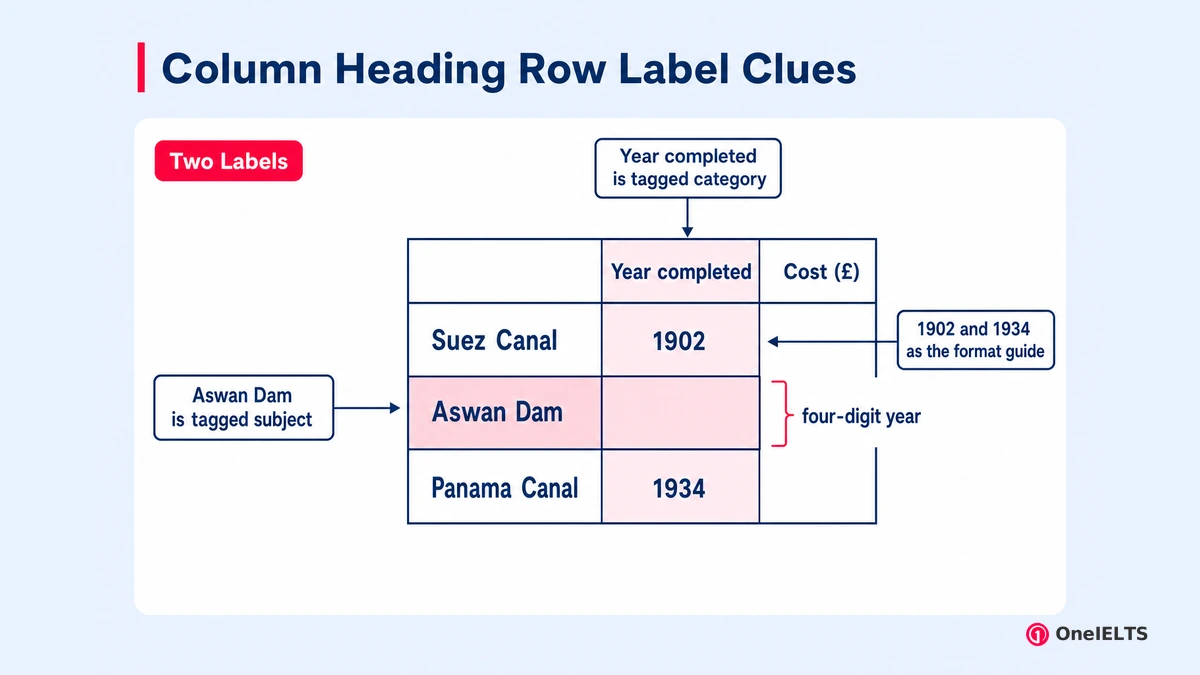
A gap’s column heading names the category of information wanted, and its row label names the subject it belongs to. Read across and down, and the pair of them settles what kind of word can go in before you have read a line of the passage.
Take a row labelled Aswan Dam under a column headed Year completed. The column heading sets the category of answer as a four-digit year, so every date that is not a completion date can be dismissed on sight.
Filled cells finish the job. When the same column already shows 1902 and 1934, the neighbouring cell format tells you to write figures rather than words. When the heading reads Cost (£), the currency is supplied for you.
An entry of the wrong category is marked wrong even though the words do appear in the passage. That is what makes the scan quick. You are hunting one kind of thing, not a keyword.
How Do You Answer IELTS Reading Table Completion Questions?
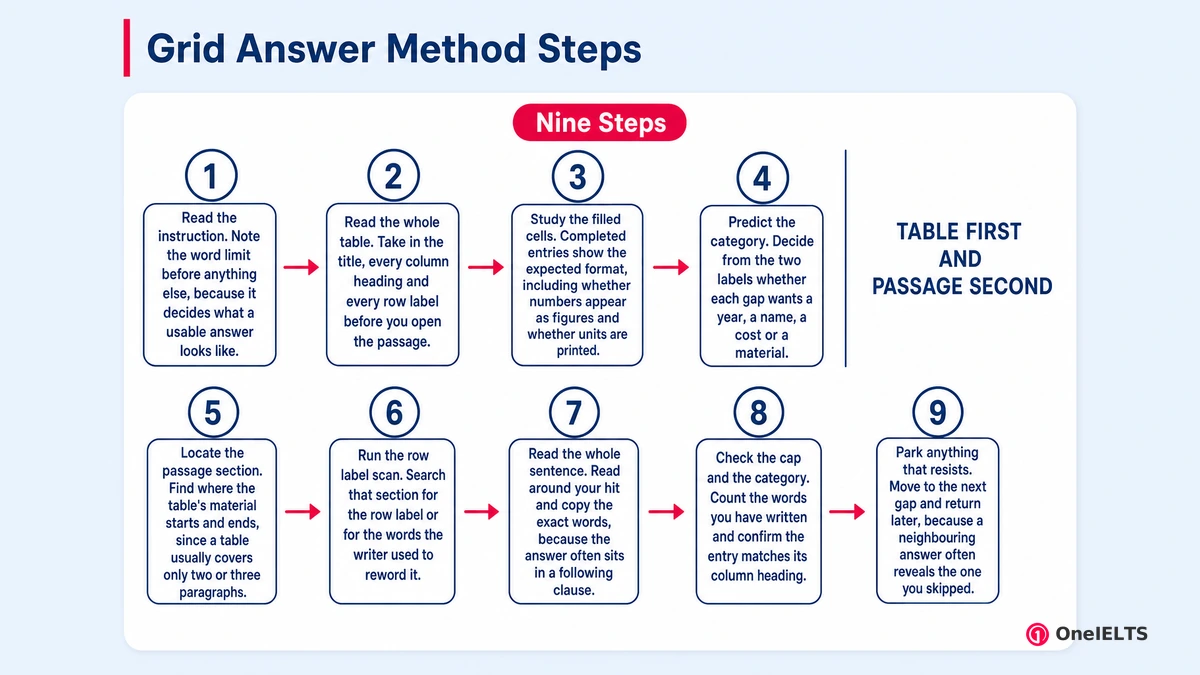
The method inverts the habit most candidates bring from other question types. You read the table first and the passage second, because the grid tells you what kind of answer you need while the passage only tells you where it sits.
These nine steps run from the instruction line to the last filled cell.
- Read the instruction. Note the word limit before anything else, because it decides what a usable answer looks like.
- Read the whole table. Take in the title, every column heading and every row label before you open the passage.
- Study the filled cells. Completed entries show the expected format, including whether numbers appear as figures and whether units are printed.
- Predict the category. Decide from the two labels whether each gap wants a year, a name, a cost or a material.
- Locate the passage section. Find where the table’s material starts and ends, since a table usually covers only two or three paragraphs.
- Run the row label scan. Search that section for the row label or for the words the writer used to reword it.
- Read the whole sentence. Read around your hit and copy the exact words, because the answer often sits in a following clause.
- Check the cap and the category. Count the words you have written and confirm the entry matches its column heading.
- Park anything that resists. Move to the next gap and return later, because a neighbouring answer often reveals the one you skipped.
What Are the Common Mistakes in IELTS Reading Table Completion?
Marks go missing on this type for mechanical reasons rather than comprehension ones. Most wrong entries on a table were found correctly in the passage and then written down badly.
These seven slips cost more marks on tables than misreading ever does.
- Writing your own words. The mark scheme accepts the passage’s wording only, so a tidy paraphrase in the cell scores nothing.
- Exceeding the word limit. Three words in a two-word cell score zero, however accurate the information inside them happens to be.
- Entering the wrong category. An answer naming a place, where the column heading asks for a year, is marked wrong.
- Repeating units already given. Writing 45 kg under a heading that reads Weight (kg) duplicates the unit and loses the mark.
- Assuming the table’s row order. The passage often presents rows two and four before row one, so sequential scanning misses answers.
- Copying a spelling wrongly. Spelling counts on this task, and a mistyped word inside a correct cell still scores zero.
- Leaving a cell blank. An empty cell earns nothing, while a category-correct guess from the passage sometimes lands exactly.
What Does an IELTS Reading Table Completion Question Look Like?
A set prints an instruction line, a short title and a grid with numbered gaps. Here is a worked example built on an original passage written for this page.
The Kestrel Valley water towers
Three water towers still stand in the Kestrel Valley, and no two were built the same way. The newest, at Denby Hill, was welded from steel plate rather than laid in courses, and at 34 metres it is the tallest of them. The oldest went up at Marnie’s Cross in 1908 to serve the wool-washing sheds below it, and its builders chose local red brick because stone had to be carted forty miles.
The tower at Ashfold followed in 1931, by which time concrete had become cheap, and the council put it up to supply a growing railway town. Ashfold cost 4,200 pounds, a figure the county surveyor recorded as unusually low. Marnie’s Cross had cost 1,150 pounds twenty-three years earlier. Denby Hill was finished in 1962 for a canning factory that closed within a decade.
Complete the table below. Choose NO MORE THAN TWO WORDS AND/OR A NUMBER from the passage for each answer.
| Tower | Year built | Material | Original purpose | Cost (£) |
|---|---|---|---|---|
| Marnie’s Cross | 1908 | red brick | wool-washing sheds | 1……… |
| Ashfold | 2……… | concrete | railway town supply | 4,200 |
| Denby Hill | 1962 | 3……… | 4……… | not recorded |
Each answer is fixed by its two labels before the passage is consulted.
- 1 = 1,150. The Cost (£) column heading wants a figure and prints the currency already, so 1,150 pounds is the word limit trap here.
- 2 = 1931. Year built wants a four-digit year, and the passage attaches 1931 to the tower at Ashfold in the second paragraph.
- 3 = steel plate. Material plus the Denby Hill row points at welded from steel plate, which the passage gives out of order, ahead of the older towers.
- 4 = canning factory. Original purpose wants a short noun phrase, and the fuller phrase a canning factory that closed within a decade breaks the two-word cap.
Two of the four answers arrive out of order, which is the normal state of affairs on this type rather than a quirk of this worked example.
Where Can You Practise IELTS Reading Table Completion?
Practise this type on OneIELTS rather than chasing worksheet PDFs. Our IELTS Reading table completion practice filter narrows the Reading bank to practice questions of this single type. Opening them needs a free OneIELTS account.
Working on screen matters more here than on most types. The computer-delivered version puts the answer boxes inside an on-screen grid, and the passage scrolls in a separate pane, so your eyes travel a route no paper table ever asks for.
A question type drill isolates the one decision you are training, which a full timed paper cannot do. In the sets we mark, the commonest wrong entry on a table is a fact the candidate located correctly and then wrote in the wrong form.
Review your errors with three questions. Was the category wrong, did the entry break the cap, or did a paraphrase slip past you?
What Are the Best Tips for IELTS Reading Table Completion?
The table completion tips that move accuracy are about order and restraint. You settle what the answer must be before you go looking for it, and you write down less than you feel like writing.
Work through these eight habits, one per practice session.
- Read the word limit first. The instruction line changes between question sets, so check it before you fill anything.
- Read the whole table before the passage. Titles, headings and row labels tell you what to hunt for.
- Use the filled cells as a format guide. They show whether entries carry figures, units or capital letters.
- Take the numbers first. Gaps wanting a date or a figure are quickest to find and anchor your position.
- Never repeat a unit from the heading. Where the column says Cost (£), write the bare figure.
- Copy the spelling exactly. A misspelled word in the right cell is marked wrong, so transcribe letter by letter.
- Assume nothing about the order. The passage arranges the same facts its own way, so scan the whole covered section.
- Leave no cell empty. A guess in the right category costs nothing and occasionally matches the passage exactly.
How Does Table Completion Fit With the Other IELTS Reading Question Types?
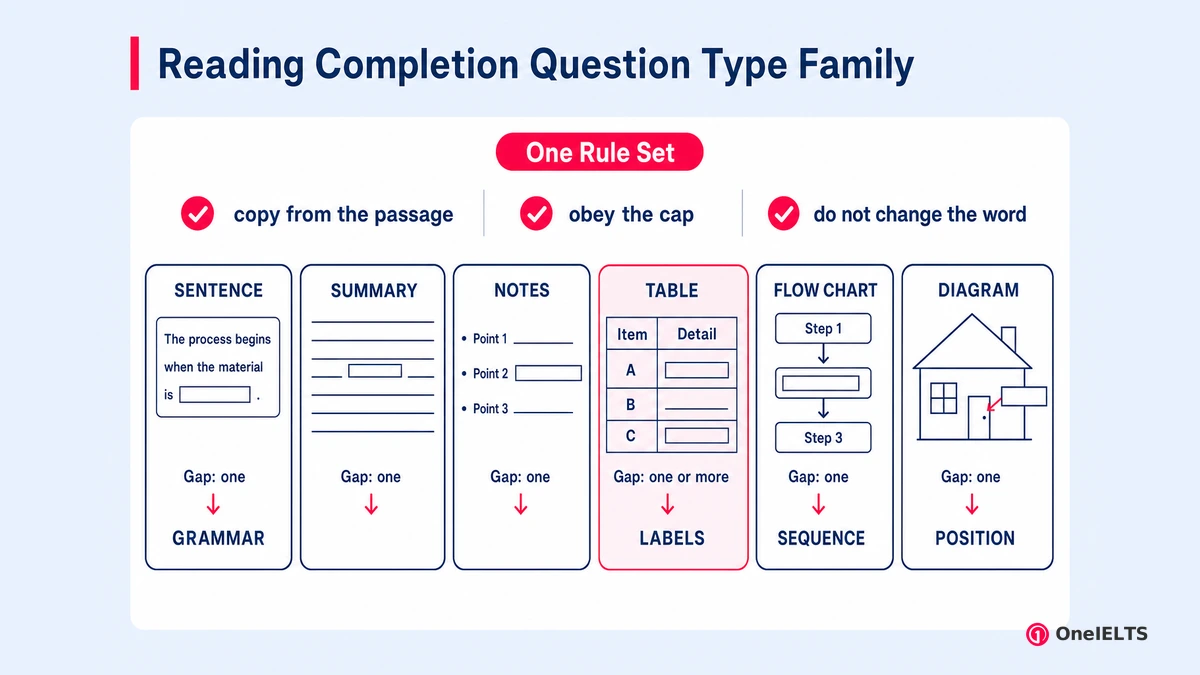
Among the official Academic Reading question types, table completion sits inside the completion family, where one rule set covers six different containers. You copy from the passage, you obey the cap, and you never alter the form of the word.
The completion family runs on that same rule set from end to end. Only the container changes, and a different container hands you a different clue for free.
A sentence hands you grammar. A table hands you two labels. A flow chart hands you sequence, and a labelled diagram hands you position on a drawing.
Everything above treats table completion on its own. What follows sets it beside its nearest neighbours in the family, and beside the Listening task that shares its name.
Is IELTS Reading Table Completion the Same as Flow Chart Completion?
Nearly — both fill gaps in a diagram-like container under the same word limit, but a flow chart imposes an order on the boxes while a table imposes categories on the cells.
Flow chart completion walks you through a sequence of boxes, so its answers follow the passage far more reliably than a table’s do. The page ranking first for table completion uses a flow chart as its second example, which is fair evidence the two are worth learning together. Our IELTS Reading flow chart completion guide covers the sequenced version.
Does IELTS Reading Table Completion Use the Same Word Limit as Sentence Completion?
No, not automatically — both are capped by their own instruction line, so a two-word limit on the table and a three-word limit on the sentences can appear in the same Reading paper. The cap is set per question set. The rule to copy unchanged from the passage holds right across the family, which is why only the number needs re-checking. Our IELTS Reading sentence completion guide sets out that task.
Is IELTS Listening Table Completion the Same Task as IELTS Reading Table Completion?
No — the grid and the word limit work the same way. In Listening the entries arrive in the recording’s order and you cannot go back, so predicting each cell’s category beforehand is not optional there.
Listening table completion follows recording order strictly, one gap after the next. You predict the category before the audio starts, never after. Reading lets you scan the passage as often as you like, which is why the two feel so unalike under time pressure. Our IELTS Listening question types guide covers the audio version.
Written by Fahimur Rahman, reviewed 14 August 2026.
Last verified: 14 August 2026
Practice for the Real IELTS Exam
Apply what you’ve learned with free, exam-style practice:
- Take a free IELTS mock test — all four skills, real exam timing, AI band scoring
- Sit a Reading section mock — one full timed paper with an instant band score
- Practise by question type — self-paced passages with answer explanations