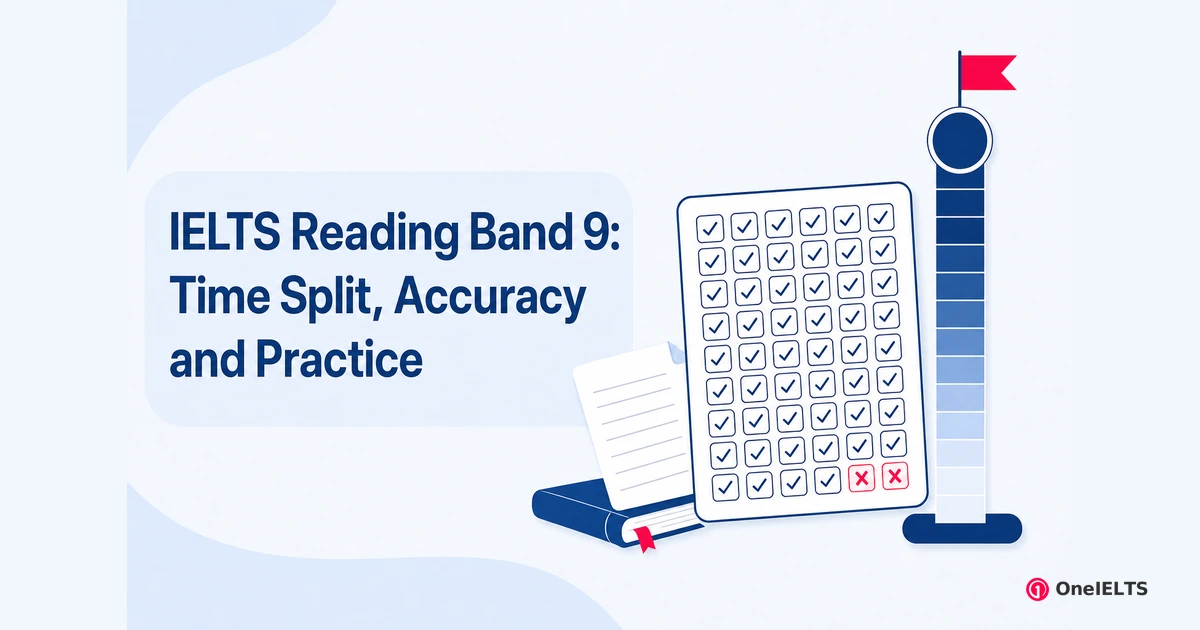
A band 9 in IELTS Reading is an error budget: forty questions, two or three marks of tolerance. This page covers what the band means, why candidates stall at band 8, how to split the hour, and the core strategies and accuracy habits that hold. Then comes the diagnostic loop, how band 9 scorers prepared, the resources they used, whether a 9 is realistic for you, and the raw score behind it.
The fifteen general in-test tactics live on our IELTS Reading tips page, and the multi-week plan lives on our how to improve IELTS Reading skills page. This page only covers what changes when the target is band 9. Most band 9 advice online is anecdote. Here are the numbers instead.
What Does a Band 9 in IELTS Reading Mean?
A band 9 in Reading is the top of the nine-band scale, awarded off a raw score at or very near forty out of forty. The descriptor calls that reader an expert user, someone who handles the paper with full and accurate comprehension.
Reading and Listening are the two components where a 9 is a counted number of correct answers rather than an examiner’s judgement. That is why a 9 is more attainable here than in Writing or Speaking. The band is awarded per component, so a 9 in Reading does not require a 9 overall.
The conversion is fixed rather than curved to the day’s cohort, and that fixed conversion differs between Academic and General Training. The same raw score is not the same band on the two papers.
One thing a band 9 is not: a claim about your reading speed or the size of your vocabulary.
Why Do Candidates Stall at Band 8 in IELTS Reading?
Candidates stall because the errors that survive at band 8 are not comprehension errors, and more practice does not remove them. A candidate at band 8 already reads well enough. The remaining two or three marks go to a small, repeating set of procedural faults.
Six faults account for almost everything a band 8 reader still loses.
- A word limit slip. You write three words where the instruction line caps the answer at two, and a completion item that reads correctly scores zero.
- A Not Given marked False. The statement felt untrue, so you judged the world instead of the passage, and the passage never contradicted it.
- One spelling error. You copy a word straight off the page and still mistype it, and a misspelled completion answer is marked wrong.
- A referencing word followed wrongly. You track “it” or “this” back to the nearest noun rather than the right one, and the whole sentence shifts meaning.
- The last two questions of Passage 3. Time ran out, so you guessed both or left them blank, and one of the two was gettable.
- A plausible answer instead of a stated one. You accepted a reading the text supports in spirit, while the mark scheme wanted the phrase the text actually prints.
Each of those costs exactly one mark. That is why the band 8 plateau is invisible in a score and obvious in an error log. Across the error logs candidates bring us, the two causes that survive longest are word limit slips and a Not Given judged on truth rather than on the text. That is the whole argument for the diagnostic loop further down this page.
How Should You Split Your Time Across the Three IELTS Reading Passages for Band 9?
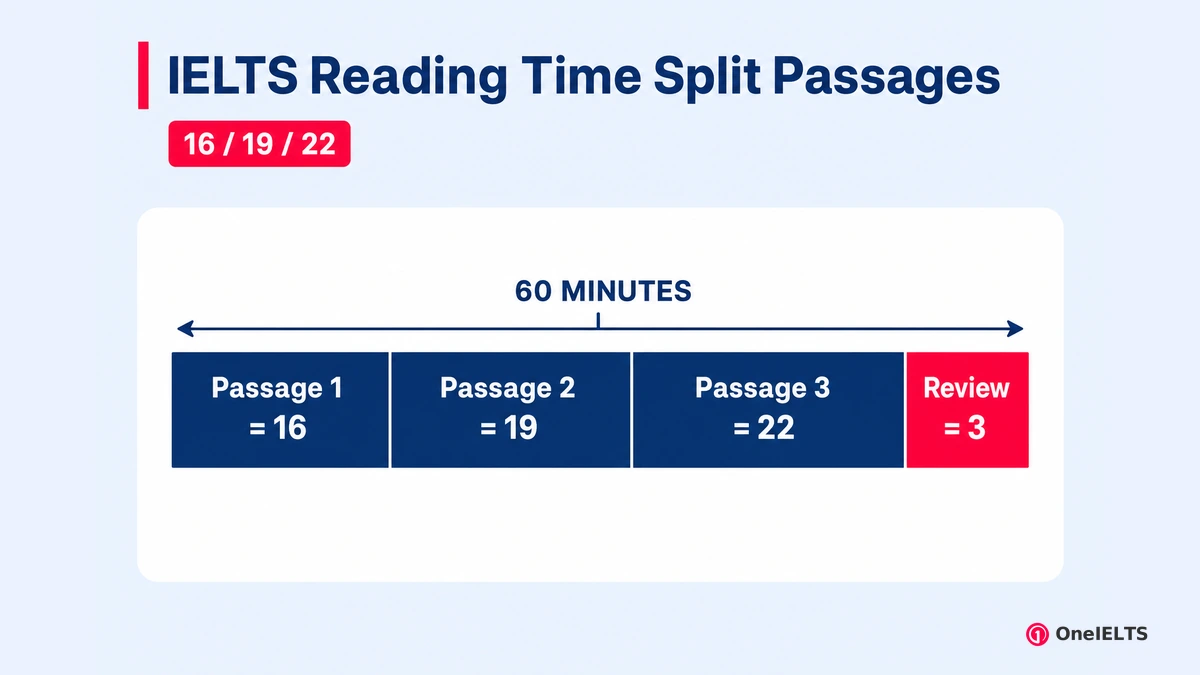
Split the hour unevenly and keep a real review margin: roughly 16, 19 and 22 minutes, with the last three minutes reserved for checking rather than reading. The table sets out that time split passage by passage, with what should already be finished in each.
| Passage | Minutes | What happens in them | What you must NOT still be doing |
|---|---|---|---|
| Passage 1 | 16 | Skim, answer in order, and write answers straight onto the sheet while the text is short and factual. | Reading whole paragraphs twice, or hunting for a word the question has already paraphrased. |
| Passage 2 | 19 | Skim, then work question-first, because the answers now sit under paraphrase rather than on the surface. | Leaving items open for later, since the later minutes already belong to the third passage. |
| Passage 3 | 22 | Read for paragraph function first, then attack matching and Yes, No, Not Given sets under the ninety-second cap. | Meeting the passage for the first time with under fifteen minutes left on the clock. |
| Review | 3 | Check word caps, spellings and blanks across all forty answers, in that order, and nothing else. | Re-reading passages, or re-arguing answers you can already point at a sentence for. |
Google’s AI Overview on this query advises “roughly 17-18 minutes per passage, leaving time to review answers”, then prescribes 16 minutes on Section 1, 20 on Section 2 and 24 on Section 3. Both cannot be true. 16 plus 20 plus 24 is the entire hour with nothing left to review, while 17 to 18 minutes across three passages spends only 51 to 54.
At band-9 tolerance those last three minutes are what turn a 38 into a 40. Passage three is where the margin usually dies, so the ninety-second rule protects it. Mark any item that has taken ninety seconds, move on, and settle it inside the review window. On the paper-based test there is no transfer time to borrow from, because you write on the answer sheet as you go.
What Core Reading Strategies Do Band 9 Scorers Use?
Three, and all three are about reading less: a two to three minute skim, synonym-first scanning, and a method chosen by question type before the passage is touched. A band 7 reader uses the same three moves. The difference at band 9 is that each move finishes before it turns into a search.
Below are those three strategies with the band-9 refinement of each, plus the timing cap that keeps all three inside the hour.
- Skim first, for two to three minutes. A band-9 reader comes out with a two-word paragraph job pencilled beside each block, not a general sense of the topic, so matching sets are half-solved.
- Scan for meaning, never for identical words. Synonym scanning means holding the idea and accepting any wording of it, because the paper paraphrases almost every answer before it asks you for it.
- Pick the method from the question type first. Read the headings before the passage for matching headings, and go question-first for completion sets, so the passage is only ever read with a target.
- Give no single item more than ninety seconds. At band 9 the cap is automatic rather than remembered, which is what leaves the last two items of the paper reachable instead of guessed.
These are refinements, not the basics. Our IELTS Reading tips page carries the fifteen general tactics, including skimming and scanning from scratch.
What Accuracy Habits Separate Band 8 From Band 9?
Four habits, and none of them is about reading: the word cap, spelling, blanks, and never crossing from stated to plausible. At this level accuracy is a checking discipline rather than a language skill. Each habit below maps to a mark lost at band 8, and the fifth is the pencil work that makes the fourth possible.
- Re-read the word cap before you write. Three words in a two-word box scores zero even when all three are right, so the instruction line gets checked every time.
- Spell copied answers letter by letter. Spelling counts on completion and short-answer items, and a misspelled word taken straight off the page is a direct loss.
- Leave nothing blank. There is no negative marking, so an empty box and a wrong guess cost you the same mark, and the guess sometimes lands.
- Cross out eliminated options. Elimination only pays when it is permanent, because a struck-through option cannot re-open an item you have already settled.
- Refuse any answer you cannot point at. A stated answer sits in one sentence you can put a finger on, and a plausible one is the band 8 reader’s most expensive habit.
These are the same faults from the plateau section above, rewritten as habits. A band-9 reader has automated them rather than memorised them.
How Do You Analyse Your IELTS Reading Errors to Reach Band 9?
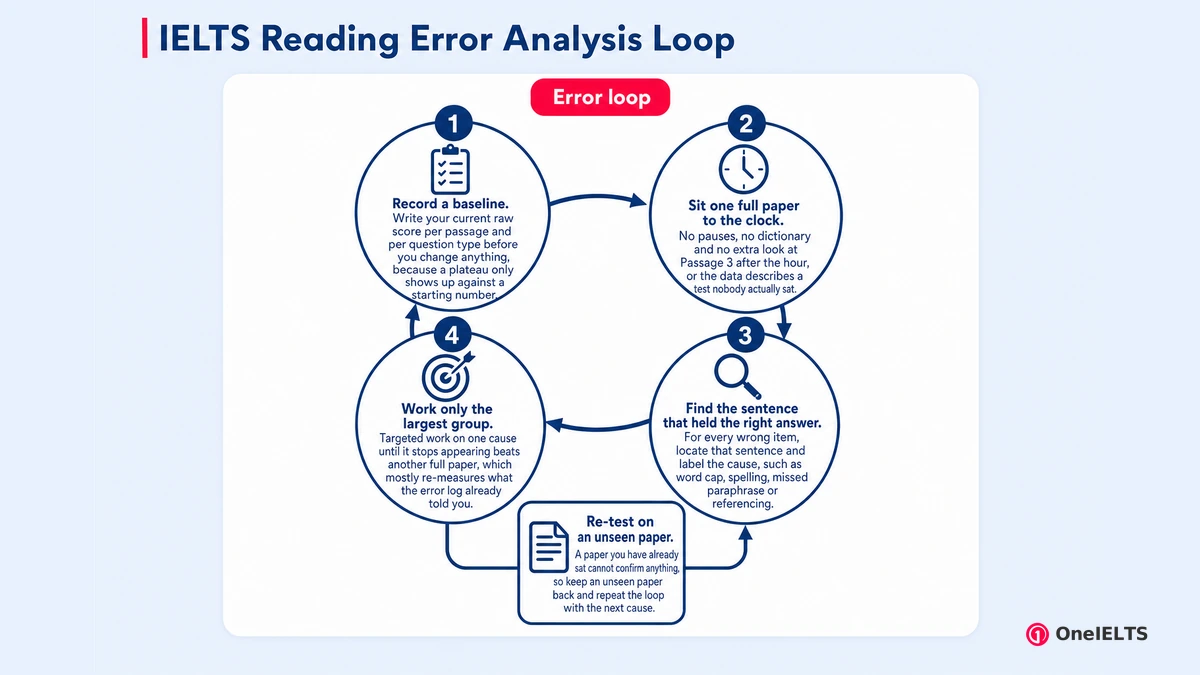
Run a four-step loop after every paper: baseline, attempt, error analysis, then targeted work on the biggest cause. Repeat it until the log is nearly empty. The loop is what converts practice into marks, and it takes six concrete actions.
- Record a baseline. Write your current raw score per passage and per question type before you change anything, because a plateau only shows up against a starting number.
- Sit one full paper to the clock. No pauses, no dictionary and no extra look at Passage 3 after the hour, or the data describes a test nobody actually sat.
- Find the sentence that held the right answer. For every wrong item, locate that sentence and label the cause, such as word cap, spelling, missed paraphrase or referencing.
- Group the causes and count them. Cause grouping turns eleven scattered mistakes into two named problems, and the count tells you which of the two is costing the band.
- Work only the largest group. Targeted work on one cause until it stops appearing beats another full paper, which mostly re-measures what the error log already told you.
- Re-test on an unseen paper. A paper you have already sat cannot confirm anything, so keep an unseen paper back and repeat the loop with the next cause.
The only methodical page ranking on this query is a Medium self-study guide that describes exactly this loop as machine-learning stages: weight initialisation, forward pass, back propagation and optimisation. The method is sound. The metaphor is why nobody uses it, so here it is in plain language.
An error log with fewer than five entries per paper is the real signal that you are at band-9 tolerance. At this point the log tells you more than the score does.
What Did Band 9 Scorers Actually Do to Prepare?
The same five things turn up in every documented account: consistency, mistakes treated as data, timed discipline, review, and expecting improvement. Those published accounts are individual stories rather than studies, so the honest claim is a pattern across accounts, not evidence of cause.
Five behaviours repeat across them, each described here as it looked in practice.
- Short daily sessions. Consistency beats motivation at this level, because forty minutes a day for six weeks holds the question-type rules in place better than two long weekend blocks.
- An error log they actually re-read. Mistakes were treated as information, so the log was opened before each new paper and the previous paper’s biggest cause was checked first.
- Papers sat to the clock from early on. Timed discipline came in weeks before the test rather than in the final week, so the hour stopped being a variable long before test day.
- Review time longer than the sitting. They spent more than sixty minutes reviewing a sixty-minute paper, working through the reasoning behind every wrong answer and every lucky right one.
- A plateau read as a diagnosis. A stuck score was treated as an unidentified cause rather than a ceiling, which is the mindset the test owner’s own band 9 profiles describe.
One widely cited account is a single student who moved from band 7.0 to band 9.0, and the test owner’s page profiles three candidates. Copy the patterns. Do not read them as proof of causation.
Which Resources Do Band 9 Scorers Use?
Band 9 scorers use official and authentic material almost exclusively, meaning Cambridge papers and the test owners’ own sample tasks, with third-party banks kept for volume. The table below prices each resource at band-9 level.
| Resource | What it gives you at band-9 level | When to use it | Limit |
|---|---|---|---|
| Official Familiarisation test | A free, exact model of the paper’s instructions, wording and answer sheet, so nothing on test day is new. | In the first week, once, to fix the format and the instruction lines before any timed paper. | One short test only, so it measures familiarity rather than your band or your error pattern. |
| Official sample tasks | Genuine wording for each question type, so you drill the exact phrasing that catches band 8 readers out. | Whenever one question type dominates your cause grouping and you need clean examples of it. | A few items per type, which is drill volume rather than a full timed paper. |
| Cambridge IELTS series | Whole authentic papers with reliable answer keys, the only material that can price your error budget honestly. | Weekly, to the clock, from the first week of a band-9 push onwards. | Finite and widely memorised, so a paper you have met before proves very little. |
| Test partners’ free practice tests | Extra full papers from the test owners, with answer keys you can trust at a two-mark tolerance. | Between Cambridge papers, when you want more volume without leaving authentic material. | Fewer of them, and some overlap with material the same partners publish elsewhere. |
| Full online mock platforms | Screen practice, an automatic timer and per-question-type scoring that builds your baseline table for you. | Before a computer-delivered test, and whenever you want the marking done quickly. | Third-party keys vary, so a disputed answer needs checking against an official paper. |
| Question-type lesson pages | Targeted method for one weakness, such as matching headings or True, False, Not Given sets. | During targeted work, between full papers, on your single largest cause group. | Teaching rather than measurement, so they cannot confirm the cause has gone. |
Authenticity matters more at this level than at any other. A third-party paper with a loose answer key manufactures errors that are not yours, and at a two or three mark tolerance one false error sends the whole diagnostic loop off course.
A paper you have already seen cannot measure you either. Keep at least two official papers unseen for the final weeks, because an unseen paper is the only honest confirmation that a cause has stopped appearing.
Is Band 9 in IELTS Reading Realistic for You?
Answer that from your own error log rather than from encouragement. If your last three papers show fewer than six errors and most of them are procedural, band 9 is a matter of weeks. If the errors are vocabulary gaps and unfinished passages, band 9 is not your next target yet.
Band 9 is genuinely more reachable in Reading than in Writing or Speaking, because nothing here is judged, which is why so many candidates aim for it in this component first. Almost nobody needs it. Most requirements sit at 6.5 to 7.5, so check the component requirement you actually face before spending weeks on a 9.
Chasing a 9 in Reading while a weaker component holds your overall band down is the commonest misallocation in this cluster. Two of the eight related searches on this query drop the target to band 7 or the 5-to-7 path, which suggests many readers here sit further from 9 than the query implies. Our how to improve IELTS Reading skills page is the better starting point in that case.
What Raw Score Do You Need for Band 9 in IELTS Reading?
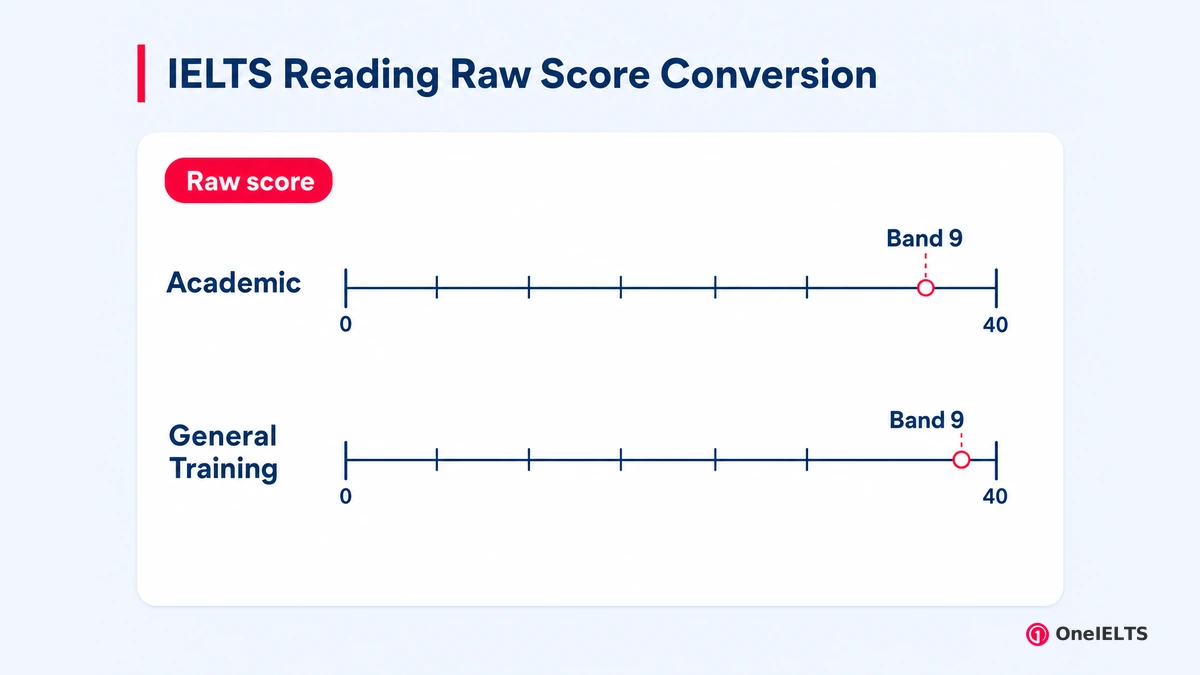
Near-perfect: band 9 sits at or within a mark or two of forty out of forty, and the exact figure differs between Academic and General Training. Everything above this point is about how a band 9 gets produced. From here the page turns to the score mechanics underneath it, which is the raw score conversion, the module difference and the rounding rules.
The error budget is measured against forty marks, one per question, and the table gives it for the top three bands.
| Band | Correct answers needed (Academic) | Correct answers needed (General Training) | Wrong answers you can afford |
|---|---|---|---|
| 8 | 35 | not published | 5 on the Academic paper |
| 7 | 30 | 35 | 10 on the Academic paper |
| 6 | 23 | 30 | 17 on the Academic paper |
| 5 | 15 | 23 | 25 on the Academic paper |
Band 8 is the highest rung the exam board puts a number on, at 35 of forty marks, and it calls that an average that “will vary slightly from test version to test version”. Nothing is published for band 8.5 or band 9. That is why no ranking page answers this query, and why one competitor asks it in an FAQ heading and then leaves it unanswered.
So build the error budget from the top anchor down. Band 8 on the Academic conversion leaves five wrong answers; band 9 leaves at or near zero, which is the whole difference between the two.
Direction still holds where the numbers stop. The General Training conversion asks for more correct answers than the Academic conversion at the same band, so a band 9 is arithmetically harder on the General paper.
How Do You Get Band 9 in IELTS General Reading?
You follow the same procedure as Academic, but with a smaller error budget, because the General Training conversion asks for more correct answers at every band. The marks go missing in Section one, whose short texts hide a single misread notice or advert line that an Academic candidate never risks. The exact figure varies from one test version to the next against the current official conversion. Our IELTS General Reading guide sets out the paper section by section.
What Is 27 Out of 40 in IELTS Reading?
Twenty-seven out of forty is around band 6 on the Academic conversion and lower on General Training, which puts that raw score roughly thirteen marks short of a band 9. The question keeps landing beside band 9 searches because readers arrive with a mid-band score and a band 9 target. Naming that band gap honestly beats encouraging it, and our IELTS band score chart shows every step between the two.
How Does IELTS Round Your Reading Band Score?
Each component band comes straight off the raw conversion in half-band steps, and it is the overall band that gets rounded, to the nearest half band or whole band. An average of 7.25 rounds up to 7.5, while 7.125 rounds down to 7. That rounding rule means one extra Reading mark can buy half an overall band. Our IELTS result page works through the arithmetic.
Is IELTS Band 9 Difficult to Achieve?
Yes in absolute terms, the error budget is two or three marks across forty questions. But it is the least difficult 9 in the test, because Reading is scored by counting rather than by judgement. Objective marking removes the examiner. A 9 in Writing needs the top band descriptors awarded across all four criteria, which is far rarer than an expert user getting the answers right. Our IELTS band 9 page compares the components.
Written by Fahimur Rahman, reviewed 14 August 2026.
Last verified: 14 August 2026
Practice for the Real IELTS Exam
Apply what you’ve learned with free, exam-style practice:
- Take a free IELTS mock test — all four skills, real exam timing, AI band scoring
- Sit a Reading section mock — one full timed paper with an instant band score
- Practise by question type — self-paced passages with answer explanations