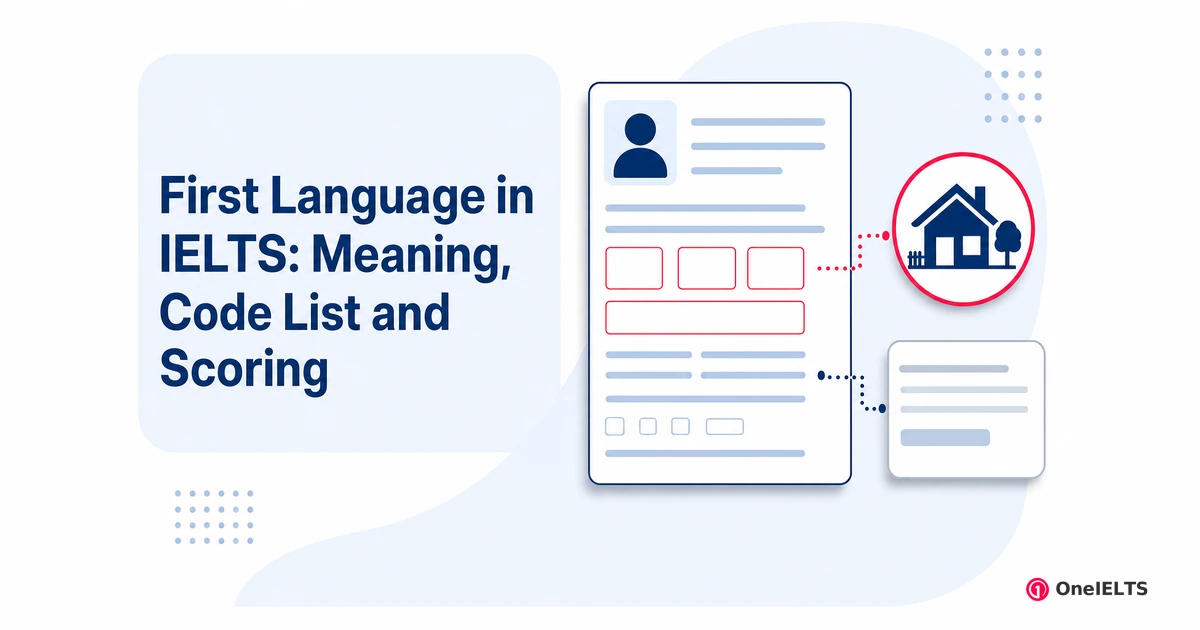
The first language field on the IELTS application form records the language you learned first at home and still think in most naturally. For most candidates in India that answer is a regional language such as Hindi, Tamil or Bengali, not “Indian” and not your nationality. It has no effect on your band score. The entry still travels: the official form warns that a wrong language code puts wrong information on your Test Report Form.
This page covers the meaning, the mother tongue overlap, why IELTS asks and the code list. Then come filling it in with IDP, the India, bilingual and English cases, the other background questions, mistakes, who sees it, scoring and preparation. Booking steps, documents and fees sit on the OneIELTS IELTS registration page.
What Does “First Language” Mean on the IELTS Form?
The first language on the IELTS form is the language you learned first in early childhood, usually spoken at home with family, and the one you still use most naturally to think and communicate. Candidates often search for it as mother tongue or native language, but “first language” is the test’s own wording.
The field takes one language only. Your answer is self-declared, so you don’t upload a certificate or any document to prove it. On the online booking form you pick it from a list, and on the paper application form you write a three-digit code plus the language name (question 14). For most people that’s simply their home language, the one used at the family dinner table.
How Is First Language Different from Mother Tongue, Native Language and Nationality?
On the IELTS form, first language, mother tongue and native language mean the same thing; nationality is a separate field and does not decide your first language. A citizen of India may have Tamil, Punjabi or Urdu as a first language, and a British citizen may have Gujarati.
Your citizenship is answered elsewhere. The paper form asks for your country of nationality as its own coded question (question 13), and any country or region of origin a form asks for is separate again. Neither decides the language box. Ethnicity and religion aren’t part of the answer either.
A second language is one you learned later, at school or at work. For most candidates in India, English is exactly that: a second language picked up in class, not at home.
Why Does IELTS Ask for Your First Language?
IELTS collects first language as background data for research and statistics on test-taker groups; it is not used to decide your band score. The official application form states that your personal information may be processed in anonymous form by the IELTS Test Partners for statistical and research purposes.
Those partners are IDP, the British Council and Cambridge University Press & Assessment. Their statistical analysis of test-taker performance by first language and by nationality appears on the “Test statistics” page of ielts.org, latest edition 2024-2025. Researchers also use it to check test fairness across language groups. Your answer stays stored with your candidate record.
What Are the IELTS First Language Codes?
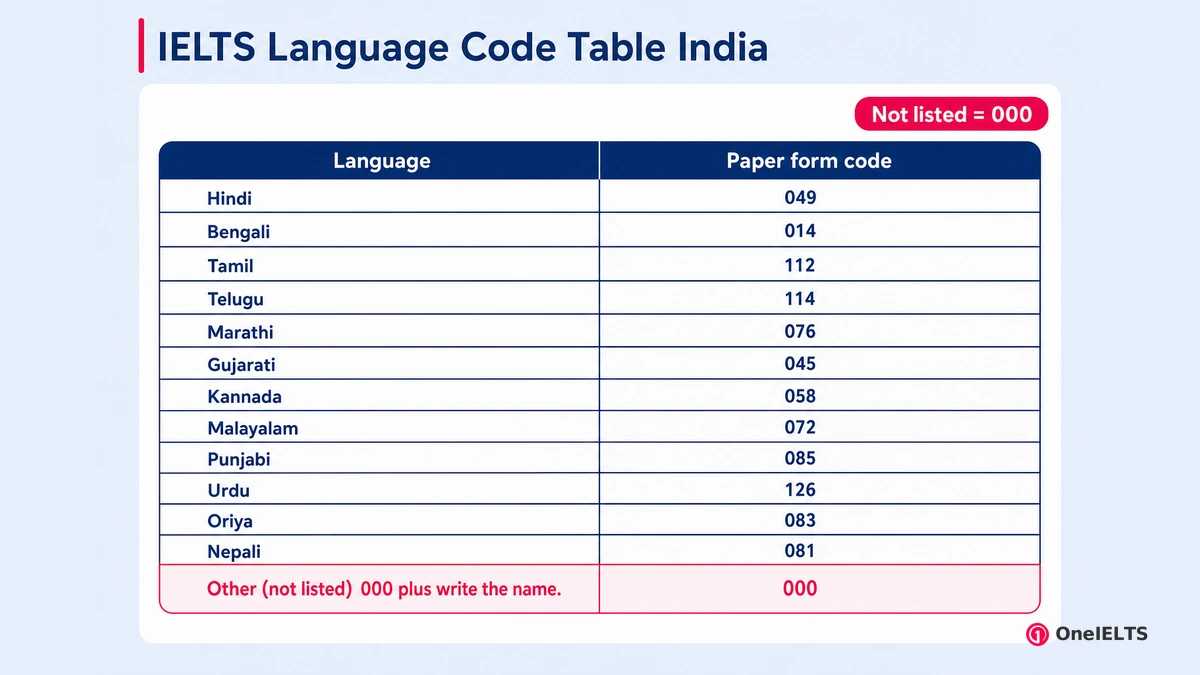
The paper IELTS application form lists languages with a three-digit numeric code, and candidates whose language is not listed enter code 000 and write the language name. The official code list sits on the detachable code pages of the application booklet, under “Question 14 – First language”.
The online booking form may show first language as a list to pick from rather than a code to type, unlike the paper application form. IDP India’s form-filling guide still lists “the first language and its corresponding code” among the details you give, so check how your language is worded on the screen in front of you.
Every paper form code below comes from the IELTS application form published by IDP India (checked on 7 October 2026). One quirk catches people from Odisha: the form still spells Odia as “Oriya”.
Twelve languages that candidates from India declare most often are shown here with their paper form codes, plus the fallback for anything missing.
| Language | Code on the paper form | How it appears in the online drop-down |
|---|---|---|
| Hindi | 049 | |
| Bengali | 014 | |
| Tamil | 112 | |
| Telugu | 114 | |
| Marathi | 076 | |
| Gujarati | 045 | |
| Kannada | 058 | |
| Malayalam | 072 | |
| Punjabi | 085 | |
| Urdu | 126 | |
| Odia | 083 (printed as “Oriya”) | |
| Nepali | 081 | |
| Other (not listed) | 000 |
How Do You Fill In the First Language Field on the IELTS Form?
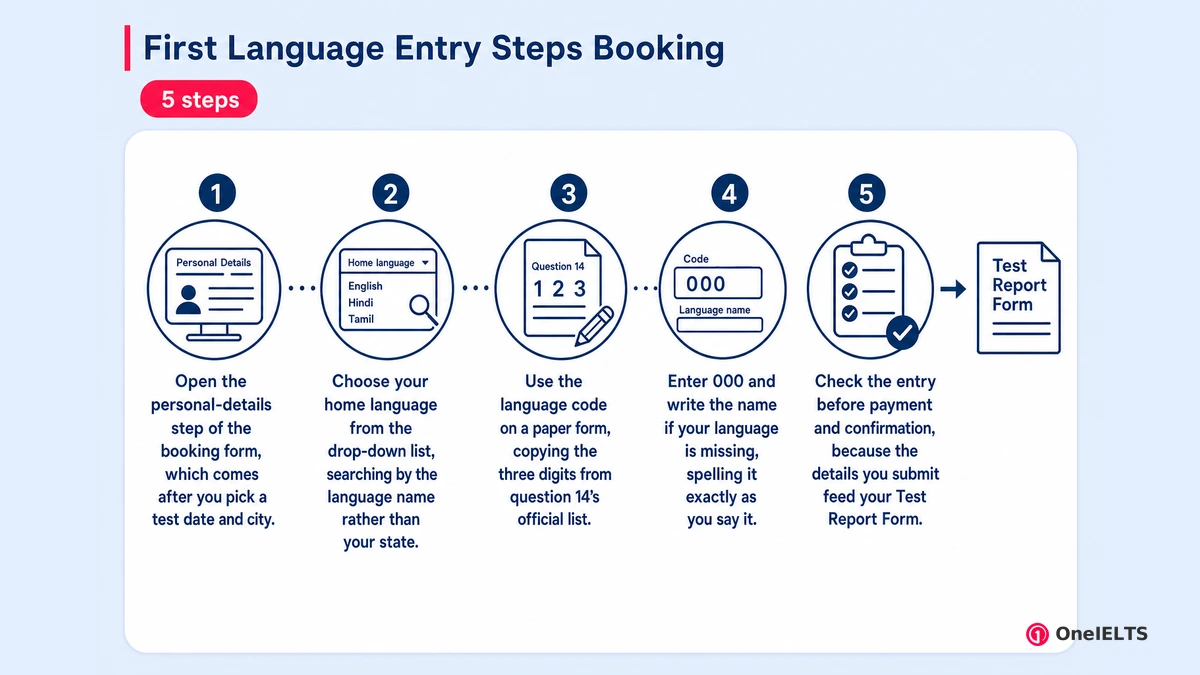
You answer it in the personal details step of the online booking, after you choose a test date and city and before payment. On paper, it sits in the candidate details section, after name, date of birth and nationality. The full booking process belongs to our IELTS registration guide. In India, every IELTS test has been delivered by IDP since 25 July 2021, per the British Council India site.
Five short steps get the field right before your booking confirmation arrives.
- Open the personal-details step of the booking form, which comes after you pick a test date and city.
- Choose your home language from the drop-down list, searching by the language name rather than your state.
- Use the language code on a paper form, copying the three digits from question 14’s official list.
- Enter 000 and write the name if your language is missing, spelling it exactly as you say it.
- Check the entry before payment and confirmation, because the details you submit feed your Test Report Form.
What Should You Put as Your First Language in IELTS If You Are from India?
Enter the language you grew up speaking at home, such as Hindi, Bengali, Marathi, Tamil, Telugu or another regional language, not “Indian”, not English by default, and not your state. “Indian” is a nationality, not a language.
The Indian Constitution’s Eighth Schedule names 22 scheduled languages, but the IELTS form doesn’t mirror that list. A dialect missing from the form goes in through the “not listed” route under its own name rather than being forced into Hindi. Some smaller languages do have codes: Tulu is 120 and Kashmiri is 059. English-medium school history doesn’t change your home language. The table maps five common situations.
| Your situation | What to enter | Why |
|---|---|---|
| Scheduled language spoken at home (for example Kannada) | Kannada, code 058 | It’s the home language you learned first |
| Dialect not on the list (for example Bhojpuri, Tulu or Konkani if missing) | 000 plus the dialect’s own name (Tulu has code 120, so use that) | The form asks for your real language, not the nearest big one |
| Hindi at school, Marathi at home | Marathi, code 076 | School languages are second languages |
| Family moved states, home language unchanged | The home language, for example Bengali, code 014 | Your address doesn’t change your first language |
| English-medium schooling, regional language at home | The regional language, for example Malayalam, code 072 | Teaching language isn’t home language |
What If You Grew Up Bilingual or Speak Several Languages?
Choose the one language you learned first or, if you learned two at the same time, the one you use most to think and express yourself; the form accepts only one. That rule covers bilingual candidates and multilingual ones alike.
A practical tie-breaker helps. Ask which language you count in, dream in or use with your parents. That’s your primary language for daily thinking. Between two genuine home languages there’s no wrong choice, because the answer doesn’t change marking.
Consistency matters more than the pick. If you sit a repeat test, enter the same language again. A different entry on a later TRF can prompt questions from an institution comparing your results.
Can You Put English as Your First Language in IELTS?
Yes, but only if English is genuinely the language you learned first at home; schooling in English or high fluency does not make it your first language. English-medium education gives you strong English, but it doesn’t make you a native English speaker on this form.
Choosing English brings no advantage and no exemption. The same test and the same band descriptors apply to everyone. Most candidates take IELTS because they come from a country where English isn’t the majority language, and entering English won’t make you look stronger. Your language background is a background detail; institutions judge only your band scores.
Which Other Questions Sit Next to First Language on the IELTS Form?
The first language field sits inside a short block of background questions that are used for research and do not affect your score. On the official paper form they follow first language directly: occupation sector and level, your reason for taking the test, your destination country, your level of education and your years of studying English. Answer them honestly and quickly.
Each question needs only a one-line answer, and the official options are summarized here.
- Occupation sector: pick the field you work or study in, such as Education, which is code 08.
- Occupation level: choose your position, for example Student (7) or Employee, middle or junior level (4).
- Reason for taking the test: tick the main purpose, such as immigration, higher education or nurse registration.
- Country you intend to go to: tick Australia, Canada, New Zealand, Ireland, the UK, the USA or other.
- Years spent studying English: tick a number from 1 or less up to 9 or more.
- Highest level of education completed: choose secondary up to 16, secondary 16 to 19, degree or postgraduate.
What Are the Common First Language Mistakes and How Do You Fix Them?
Most errors come from confusing language with nationality or picking a code from an unofficial code list, and you can correct them before test day. Contact the test center or IDP with your booking reference and ask for a correction request on your candidate details. After results, the official form’s terms say to contact the center where you took the test, with documentation that proves the correct details.
Each of the six mistakes below comes paired with its fix.
- Entering Indian or your nationality: Indian is a nationality, so replace it with the language you actually grew up speaking, such as Marathi (076).
- Copying a code from a third-party list: an unofficial code list can carry outdated numbers, so take the code only from question 14 of the official form.
- Choosing English to look stronger: the entry earns no credit with examiners or institutions, so declare the language you really grew up speaking at home.
- Forcing a dialect into Hindi: if your dialect has no code, enter 000 and write its own name instead of borrowing Hindi’s 049.
- Leaving the field blank on a paper form: the form’s declaration says an incomplete application may not be processed, so write a code or 000.
- Not checking the entry before confirmation: review your details before you pay, and contact IDP straight away if the language is wrong.
Who Can See Your First Language After You Register?
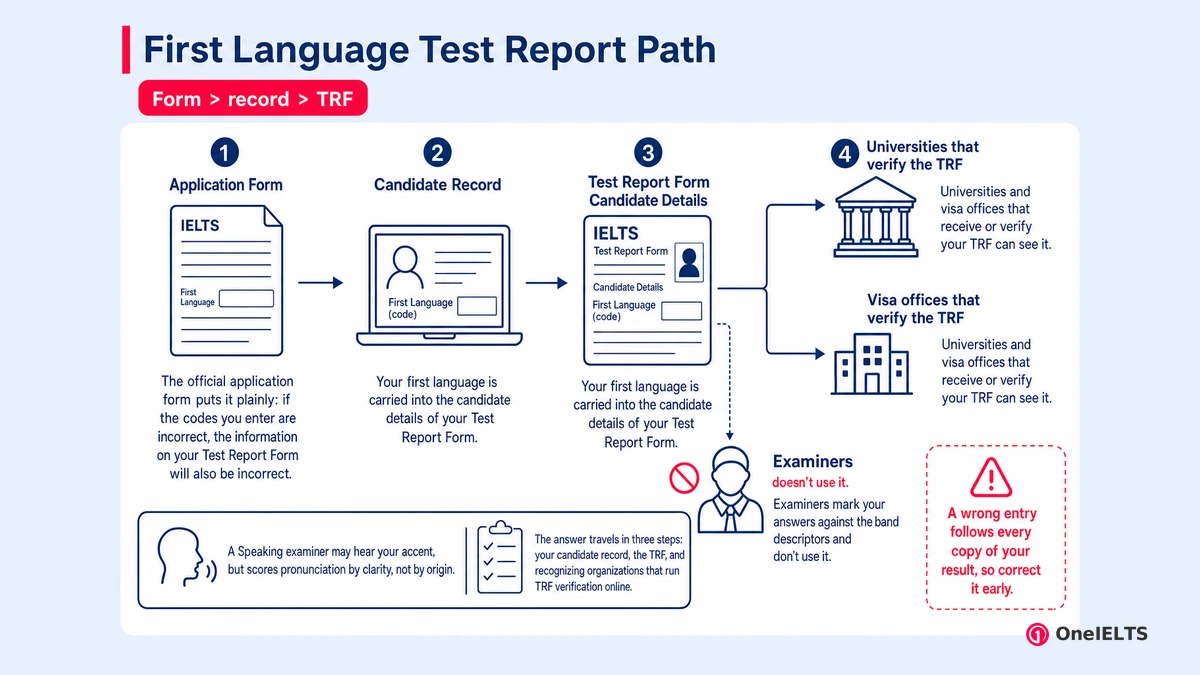
Your first language is carried into the candidate details of your Test Report Form, so universities and visa offices that receive or verify your TRF can see it. Examiners mark your answers against the band descriptors and don’t use it. The official application form puts it plainly: if the codes you enter are incorrect, the information on your Test Report Form will also be incorrect.
The answer travels in three steps: your candidate record, the TRF, and recognizing organizations that run TRF verification online. A Speaking examiner may hear your accent, but scores pronunciation by clarity, not by origin. A wrong entry follows every copy of your result, so correct it early.
Does Your First Language Affect Your IELTS Score?
No. Every candidate is marked against the same band descriptors, and your declared first language plays no part in the band you receive. There’s no separate scoring system for any language group.
Scoring myths mix up two different things. The declaration changes nothing in marking. Your actual language background can still make some skills feel harder, which the next section covers.
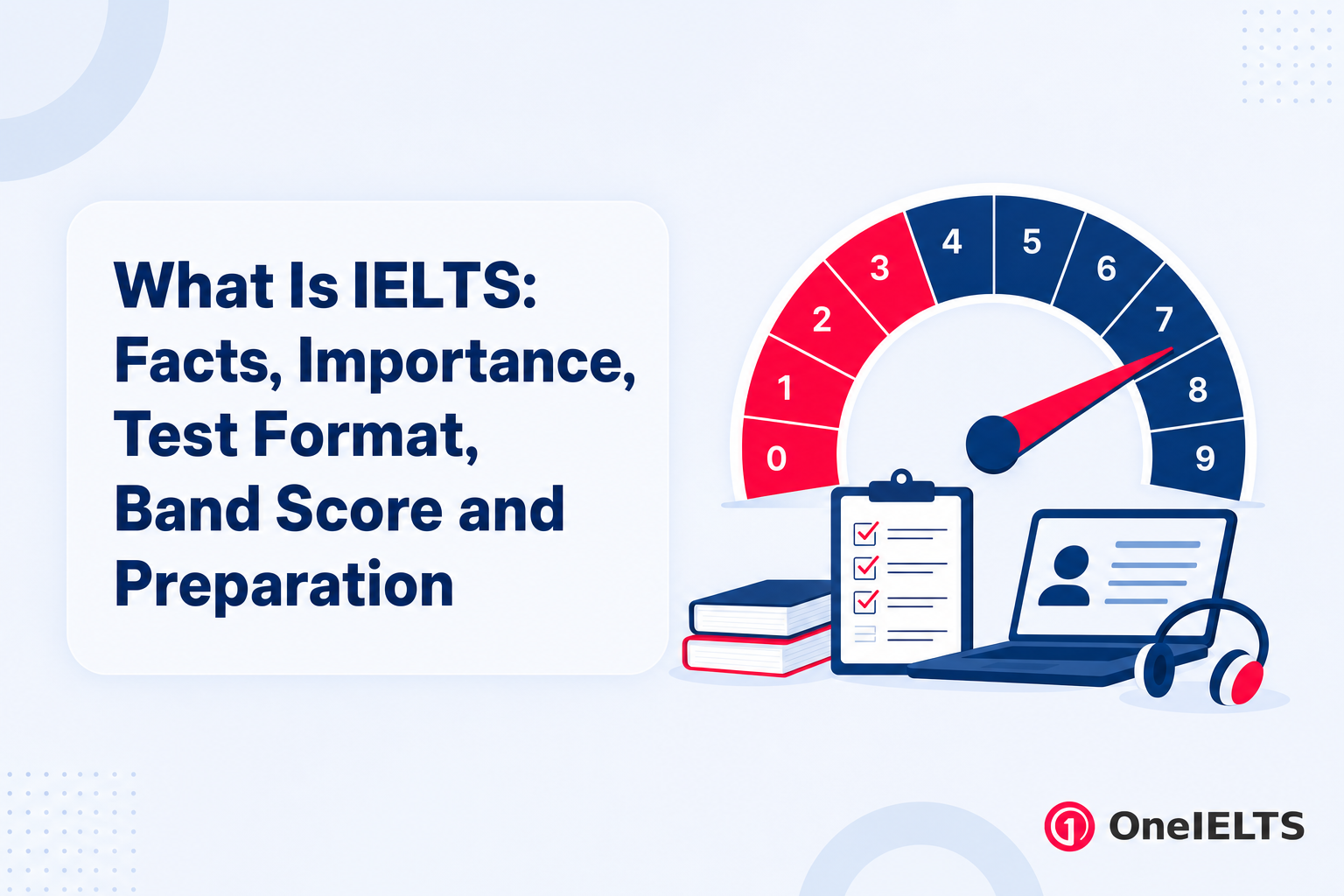
Listening, Reading, Writing and Speaking are all reported on the same 0-9 band scale; see how the band scale works. Under the Pronunciation criterion, accent isn’t penalized in itself; intelligibility is what counts. The band 8 descriptor reads “L1 accent has minimal effect on intelligibility”.
How Does Your First Language Influence IELTS Preparation?
The declaration doesn’t change your score, but your home language influences pronunciation, spelling, word order and article use, so it should shape what you practice. That’s first language interference, and every one of the four skills shows it.
For candidates in India the patterns are familiar. In Writing, article omission (“I went to market”) and tense consistency cost Grammatical Range and Accuracy. In Speaking, retroflex t and d sounds and a fast pace can blur clarity. Literal translation of idioms shows up in both.
Listening and Reading suffer when you translate in your head instead of reading for meaning. Non-native speakers who name their own patterns improve faster than those who just do more tests.
What Challenges Does Your First Language Create in IELTS?
The challenges your first language creates most often are interference in grammar, pronunciation and spelling, and translating ideas word for word. First language interference costs marks through small, repeated slips with articles, prepositions and spelling.
Five patterns cost most of these marks, and each one needs its own fix.
- Article and preposition errors: dropping a or the, and choosing in, on or at by translating from home.
- Tense consistency: sliding between past and present in one answer, because your home language may mark time differently.
- Spelling of similar-sounding words: writing their for there or advice for advise when sounds merge in your accent.
- Word-for-word translation: carrying idioms and sentence order straight across, such as “do one thing” or “I am having a doubt”.
- Speaking pace and fillers: rushing answers and leaning on basically or actually, which cuts clarity and fluency.
The full list sits in our guide to common spoken English mistakes.
How Can You Overcome Your First Language Influence in Speaking?
The ways to overcome first language influence in Speaking are focused sound practice, recording yourself, and aiming for clarity rather than a native accent. Work on two sound pairs Indian candidates often mix. For v and w, say “vest, west” slowly with teeth on lip for v. For “th”, contrast “thin, tin” with your tongue between your teeth.
Self-recording exposes word stress and intonation problems you can’t hear live. The Pronunciation criterion rewards clear stress, not a British or American accent. Our IELTS Speaking pronunciation guide provides the drills.
What Do B1, B2, C1 and C2 Mean in IELTS?
B1, B2, C1 and C2 are CEFR levels, and IELTS bands map onto them – roughly band 4 to 5 for B1, 5.5 to 6.5 for B2, 7 to 8 for C1 and 8.5 to 9 for C2. That band mapping comes from IDP’s Common European Framework comparison, and ielts.org confirms the B2 level and C1 level ranges.
Knowing your current level tells you how far preparation must move you. The full conversion sits on our IELTS vs CEFR page.
How Can a Mock Test Show Where Your First Language Holds You Back?
The way a mock test shows this is by giving you a band per skill under real timing, so the skill where your first language interferes most stands out. Real test conditions expose slips that untimed practice hides.
Do an error review by type (articles, spelling, pronunciation), not only by score. Then spend two to three weeks on targeted practice and retest. Start with a free IELTS mock test.
Written by Fahimur Rahman, reviewed 7 October 2026.
Last verified: 7 October 2026
Practice for the Real IELTS Exam
Apply what you’ve learned with free, exam-style practice:
- Take a free IELTS mock test — all four skills, real exam timing, AI band scoring
- Start with the free mock test — one full test, no payment needed
- Practice skill by skill — Listening, Reading, Writing and Speaking sets