Table completion gives you a grid of rows and columns to fill, and the headers tell you the category of every gap before the audio starts. You read each gap as a known type — a price, a date, a place — then catch that value as the speaker moves through the table. This guide covers what these questions are, how to tackle them, and how to track answers across rows and columns. It also compares the type to form completion, shows what a real question looks like, lists the strategies that work, and explains how to practise. Throughout, one skill repeats: using category headers to fill grid cells.
Last verified: 30 June 2026
What Are IELTS Listening Table Completion Questions?
Table completion asks you to fill gaps in a grid where rows and columns set the category of each answer. Each empty cell sits where a row label crosses a column label, and those two labels tell you what kind of word or number belongs there. The category headers do the work a question stem does elsewhere, so you read a gap as “a year” or “a cost” rather than guessing.
These questions appear in the IELTS Listening test, most often in Section 1 or Section 4. A speaker walks through structured information that you fill grid by grid as you hear it. The audio follows the table’s layout, so the order you hear matches the order you read.
How Should You Tackle Table Completion Questions?
A clear method beats raw listening here: you decode the grid first, settle what each gap needs, then collect the values in the order the speaker delivers them. The four steps below turn the table into a checklist you work through as the recording plays.
- Read the row and column headers first. Before the audio begins, read every header so you grasp the table’s subject and what each line and column covers; this primes you for the values to come.
- Work out each gap’s category. For each blank, name the gap category in your head — a number, a name, a date — so when you read headers you already expect the right type of answer.
- Track the speaker across the grid in order. Follow the audio cell by cell and track the grid the way it is laid out, since the recording usually moves through the rows in the sequence you see.
- Write the value within the limit. Note the answer using only the permitted words, because the word limit caps every cell and an over-length entry is marked wrong even when its meaning is right.
How Do You Track Answers Across Rows and Columns?
The grid structure tells you what to listen for: every row groups one kind of item and every column groups one attribute, so a cell’s meaning comes from where the two meet. That layout lets you predict each gap and follow the recording without losing your place. The cues that keep you on track are set out here.
- Row category. Each row category fixes the subject of that line — one tour, one product, one day — so every gap on the row describes that same thing.
- Column category. Each column category fixes the attribute being recorded — price, time, location — so you know the data type before you hear it.
- Left to right. Speakers often describe one row left to right, giving its details in column order, so read along the line as they talk.
- Top to bottom. When a recording compares items, it usually moves top to bottom through the rows, so expect the next row once the current one is complete.
How Does Table Completion Compare to Form Completion?
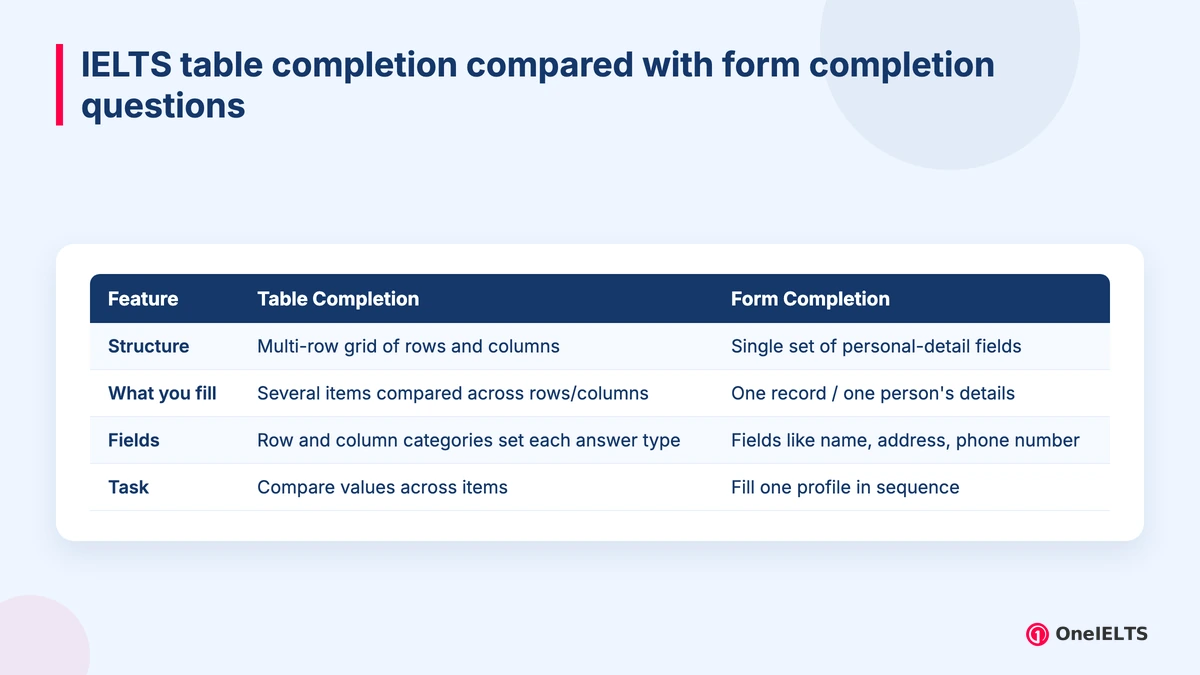
Table completion uses a multi-row grid, while form completion follows a single set of personal-detail fields. A form collects one record through form fields such as name, address and phone number, where you supply each person’s personal details in sequence. A table instead spreads several items across rows and columns, so you compare values rather than fill one profile.
What Does a Table Completion Question Look Like?
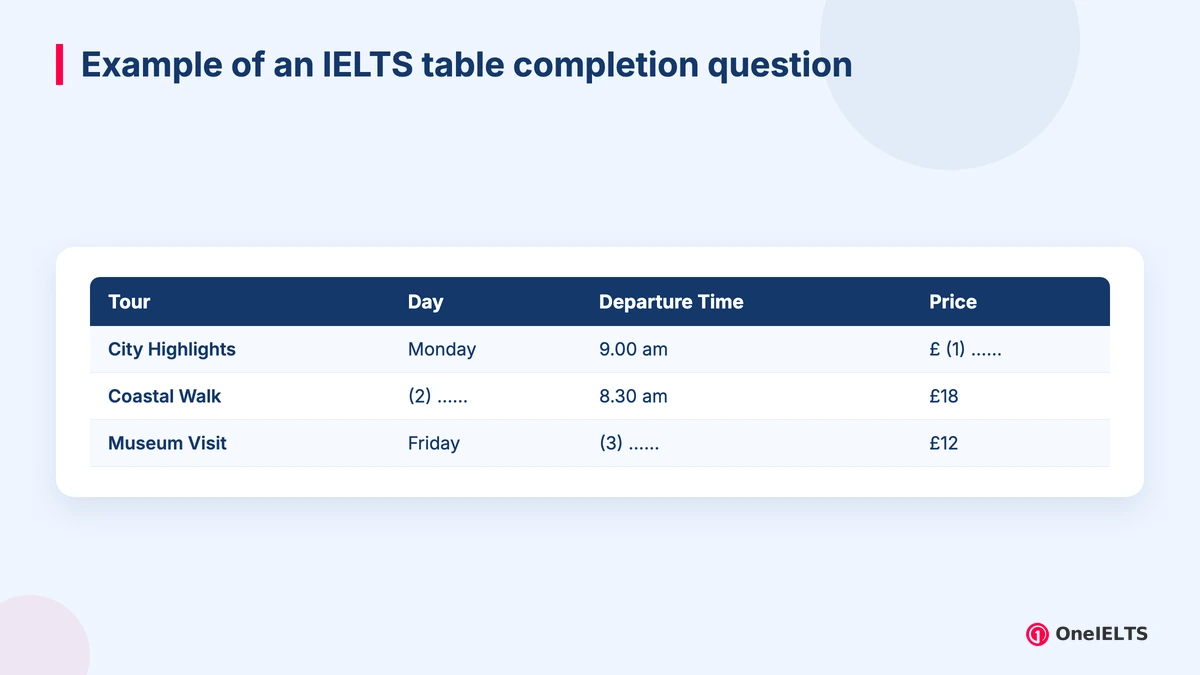
A typical question shows a table with column and row headers, a few cells already filled, and the rest left as gaps to complete. The headers define each answer’s category, and you fill the cells in the order the audio describes, keeping every entry inside the word limit.
| Tour | Day | Departure Time | Price |
|---|---|---|---|
| City Highlights | Monday | 9.00 am | £ (1) …….. |
| Coastal Walk | (2) …….. | 8.30 am | £18 |
| Museum Visit | Friday | (3) …….. | £12 |
In this example the Price column sets the answer category for gap 1, so you listen for a cost. The Day column sets gap 2, so you listen for a weekday, and the Departure Time column sets gap 3, so you listen for a clock time. Reading the headers first tells you the type of each answer before the speaker reaches it.
What Strategies Help With Table Completion?
The strongest approach combines preparation and discipline: use the headers to forecast every answer, then write cleanly and never skip a cell. These tactics turn a predictable task into reliable marks.
- Predict from headers. Predict from headers during the reading time, naming the likely answer type for each gap so you recognise the value the moment the speaker says it.
- Expect the common answer types. Most cells hold one of three answer families — numbers dates names — so tune your ear for figures, calendar terms and proper nouns rather than long phrases.
- Follow the reading order. Keep to the grid reading order, moving along rows and down the table as the audio does, so you never hunt for the cell a speaker is currently describing.
- Mind spelling and plurals. Check spelling and singular-or-plural endings before the transfer time ends, because a misspelt or wrongly pluralised word loses the mark outright.
- Never leave a blank. Always write something in every cell, since an unanswered gap scores nothing while a sensible guess sometimes lands the point.
How Can You Practise These Questions With Real Audio?
Drill this question type with timed practice tests and replay every miss until you hear why you lost the cell. Sitting timed practice under real conditions builds the speed the grid demands. When you replay misses, you find whether the slip was spelling, category or pace. Before full papers, isolate the type and run table-only sets so the skill becomes automatic. Our IELTS Listening practice test gives you full sections to rehearse with.
Practice IELTS Listening
Put this into practice with real, exam-style questions: