IELTS reading comprehension means locating a stated answer in the passage and proving the passage really says it, inside sixty minutes. Most comprehension advice online is written for school students or aptitude tests, and two of its rules are wrong here: never read the passage first, and answer in your own words. In IELTS you copy the passage’s words, inside the word limit.
This page covers what comprehension means in IELTS, what to do before, while and after reading, and the question types you answer. It then covers inference, unknown words for a second-language reader, common mistakes, practice, per-passage timing, and the faster tricks. Our tips page holds the fifteen in-test tactics, and the improve page holds the multi-week plan.
What Is Reading Comprehension in IELTS?
Reading comprehension in IELTS is finding the place in the passage that answers a question and confirming the passage really says it, inside a fixed time. The test never asks you to summarise, discuss or respond to a passage. Full understanding is not the goal, and full reading is not the method.
Each of the forty marks rewards a located answer backed by text evidence rather than by an opinion. Two components sit underneath the skill. Word recognition is decoding the words on the page, and language comprehension is making sense of them together. Vocabulary is the component that limits most candidates.
The whole paper is a comprehension test in one strict sense, because no question can be answered from outside the text. This is not a school comprehension exercise, where you write about the passage afterwards. It is not an aptitude-test passage either, where the argument matters more than the wording.
What Should You Do Before You Read an IELTS Reading Passage?
Three things, and they take about ninety seconds: read the title and subheadings, read every instruction line, and choose your reading order from the question types. None of it involves reading the passage properly. All of it decides how you will.
The widely repeated rule “do not read the passage first” comes from aptitude-test preparation, and it is wrong here. Matching headings and locating-information sets need the shape of the passage before the questions make sense. Completion and short-answer sets do not. The rule is type-dependent rather than universal.
Five moves fill that ninety seconds, ordered the way you should run them.
- Read the title and subheadings. They place the topic and tell you which paragraph is likely to hold the specialist material.
- Count the question sets. Each question set carries its own instruction line, and that line is where the word limit lives.
- Note which question types you face. Matching headings behaves nothing like sentence completion, so the type decides your next move.
- Decide your reading order from those types. Skim first for matching sets, and go straight to the questions for completion sets.
- Set a stop time before you start. Write the clock time you will leave this passage at the top of the page.
What Should You Do While Reading an IELTS Passage?
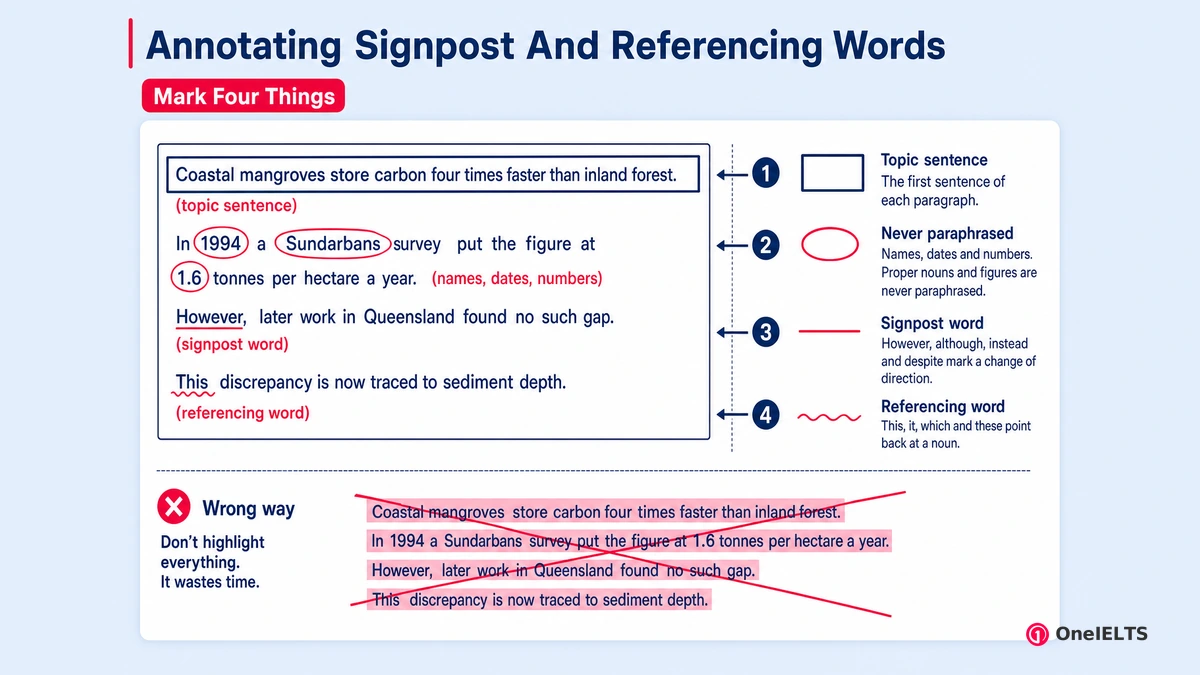
Mark the passage as you go, and mark four things rather than everything. Annotation is the only part of comprehension that survives contact with the clock, because a mark you made at minute four is what stops you re-reading at minute twelve. On the first pass you read for paragraph function, meaning the job each paragraph does. You read for detail only when a question sends you back.
On the computer-delivered test the highlight and note tools replace the pencil, so the same four marks still apply. Generic advice tells you to slow down and read at a comfortable pace. A sixty-minute paper cannot fund that.
Four mark types earn their place on the page, and each one has a reason.
- The first sentence of each paragraph. This topic sentence usually carries the paragraph’s job, which is what matching headings tests.
- Names, dates and numbers. Proper nouns and figures are never paraphrased, so they are the fastest route back into the text.
- Signpost words. However, although, instead and despite mark a change of direction, and answers cluster around those turns in the argument.
- Referencing words. This, it, which and these point back at a noun, and a wrong referent produces a wrong answer.
Here is one short paragraph, written for this page, marked the way yours should look.
Coastal mangroves store carbon four times faster than inland forest. (topic sentence) In 1994 a Sundarbans survey put the figure at 1.6 tonnes per hectare a year. (names, dates, numbers) However, later work in Queensland found no such gap. (signpost word) This discrepancy is now traced to sediment depth. (referencing word)
What Should You Do After Reading an IELTS Passage?
Nothing that resembles a summary. After reading, you check each answer against the sentence that produced it and get the answers recorded. That is the entire after-reading stage under exam conditions.
The standard advice is to retell the text in your own words. In IELTS that is both unnecessary and dangerous, because answers must be the passage’s own words inside a word limit. It is generic-reader advice, and it costs marks here.
Order matters too. The Reading test gives you no transfer time, which is why recording happens per passage rather than at the end.
Five checks close a passage, and none of them involves reading it again.
- Point at the proof sentence. For every answer, find the one sentence in the passage that forces it, and mark its line.
- Re-read the instruction line. Confirm the answer obeys the word limit and the answer format that the instruction line specifies.
- Run a spelling check on anything copied. A misspelled word taken straight from the passage scores zero, however right the idea is.
- Write the answer onto the answer sheet. Record it in the box or on the sheet now, because later never comes on a timed paper.
- Flag every guess. Mark the question number in the margin so you can return to it if this passage’s questions run short.
What Types of Reading Comprehension Questions Will You Face?
The eleven official IELTS Reading question types collapse, for comprehension purposes, into four jobs: locate a fact, judge a claim, complete a text, or find the right paragraph. Grouping them matters because the reading you do is decided by the job rather than by the type’s name.
That is also why the last column answers the questions-first-or-passage-first argument type by type instead of as one rule. Here are the four comprehension jobs with the reading each one demands.
| Comprehension job | IELTS question types that do it | What you read for | Read questions first or passage first |
|---|---|---|---|
| Fact location | Short answer, sentence completion and note completion sets | One sentence holding a named detail, and these sets usually run in passage order | Questions first, because you are hunting a specific detail rather than a whole argument |
| Claim judgement | True/False/Not Given and Yes/No/Not Given sets | Whether the passage states the claim, contradicts it, or stays silent about it | Questions first, then read only the span of text the claim points at |
| Text completion | Summary, table, flow-chart and diagram completion questions | The passage’s own words that fit the gap and obey the stated word limit | Questions first, since the gap already fixes the part of speech you need |
| Paragraph finding | Matching headings, matching information, matching features and matching sentence endings | The job each paragraph does, rather than the details inside the paragraph | Passage first, because paragraph function has to exist before the options mean anything |
How Do You Answer Inferential Reading Comprehension Questions?
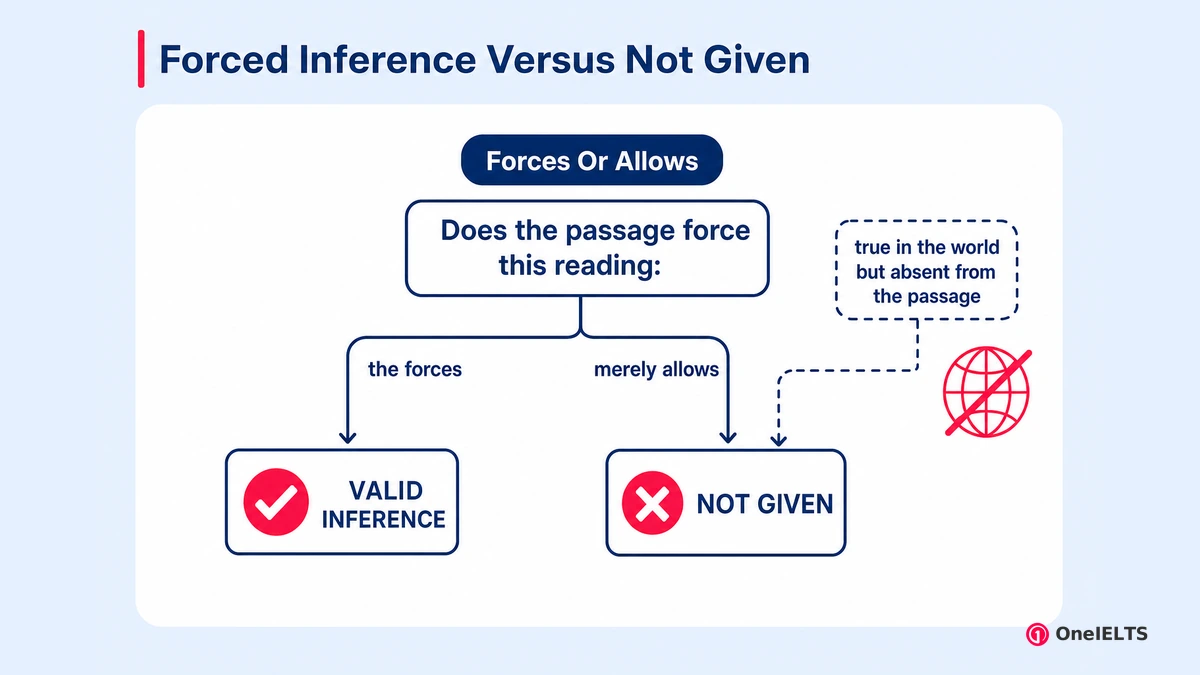
By drawing the smallest possible inference. An inference counts in IELTS only when the passage forces it, and anything the passage merely allows is Not Given.
A referential question sends you to a stated fact. An inferential question asks what the stated facts necessarily mean. IELTS asks both, and it scores them the same way, against the text.
Three tests clear an inferred answer. Can you point at the sentence that forces it? Would a reader who disagreed have to contradict the passage? Are you importing world knowledge you already had?
The trap is the statement that is true in the world but absent from the page. That is where Not Given lives, and where general knowledge costs marks. In yes/no/not given the thing under judgement is the writer’s claim rather than a fact about the world, so you judge it against what the writer argues.
Solar panels on the school roof cut its electricity bill by 38% in 2023. The savings paid for the installation within four years.
Stated: the bill fell by 38%. Inferred and safe: the installation cost less than four years of the old bill. Not Given: solar panels save money on every school.
How Do You Deal With Unknown Words in an IELTS Reading Passage?
Decide in two seconds whether you are looking at a load-bearing word, meaning one an answer depends on. If no answer depends on it, mark it and move on. If one does, work it out from the sentence around it.
This is the defining problem of a second-language reader, and it is the one thing every generic comprehension page assumes away. Two facts change the odds. Technical terms in an IELTS passage are usually explained or glossed on first use, so the frightening word is rarely the expensive one. The expensive unknown word is an ordinary word used as a paraphrase of the question’s term.
Six steps handle an unknown word without spending a minute on it.
- Check where the word sits. If the unknown word is not in a sentence that answers a question, it cannot cost you a mark.
- Mark it and keep reading. A circled word you can come back to beats a stalled first pass through the paragraph.
- Read the sentence before and after. A context clue often arrives as a definition, an example, or a contrast with something familiar.
- Use the word’s job, not its meaning. Decide whether it is a noun or a verb, and whether it sounds positive or negative.
- Look for a glossed term later. Academic writers often define a specialist word the second time they use it, further down the passage.
- Accept a best guess and move on. Two seconds of doubt is the budget, and anything more comes out of Passage 3.
What Are the Most Common Mistakes in IELTS Reading Comprehension?
Comprehension marks are lost at the answer, not at the reading. Watch a marked script and the losses cluster where a candidate who understood the passage still wrote the wrong words, in the wrong place, or nothing at all.
The first two mistakes and the fourth are imported straight from non-IELTS comprehension advice, which is why a well-read candidate can still under-perform. Nine errors account for most lost comprehension marks, running from the reading stage to the answer sheet.
- Understanding the whole passage first. Full understanding is not scored, and chasing it spends the minutes that answering needs.
- Reading every word at a comfortable pace. Comfort is a luxury that a three-passage paper in sixty minutes does not fund.
- Accepting what is true in the world. World knowledge is not text evidence, and the passage is the only marker that counts.
- Answering in your own words. A correct idea in your phrasing scores nothing when the passage already supplied the wording.
- Breaking the word limit. Three words in a two-word gap is marked wrong, however accurate the paraphrase happens to be.
- Stopping at an unknown word. Most of them sit in sentences that no question in the set ever asks about.
- Following a referencing word wrongly. This and it point backwards, and the nearest noun is not always the right one.
- Treating Not Given as False. Not Given means the passage is silent, while False means the passage contradicts the claim.
- Leaving an unanswered question. A blank scores zero, and a guess between three options never scores less than that.
How Do You Practise IELTS Reading Comprehension?
Practise the procedure on single passages before you practise the paper. One passage, timed, with the annotation and the proof-sentence check done properly beats three passages rushed. A single passage drill traces every answer back to its proof sentence, while a full paper marked and forgotten teaches almost nothing.
The progression runs in three stages: one passage untimed, then one timed passage in twenty minutes, then a full three-passage paper. Sit that last stage on a full OneIELTS Reading paper, which needs a free account. Reading outside the test builds the vocabulary this procedure runs on, but it does not train the procedure.
Use the answer key harder than most candidates do. For every wrong answer, find the proof sentence and name which procedure step failed, before reading, while reading, or after. The multi-week plan lives on our improve page, so it is not repeated here.
How Long Should It Take You to Solve One IELTS Reading Passage?
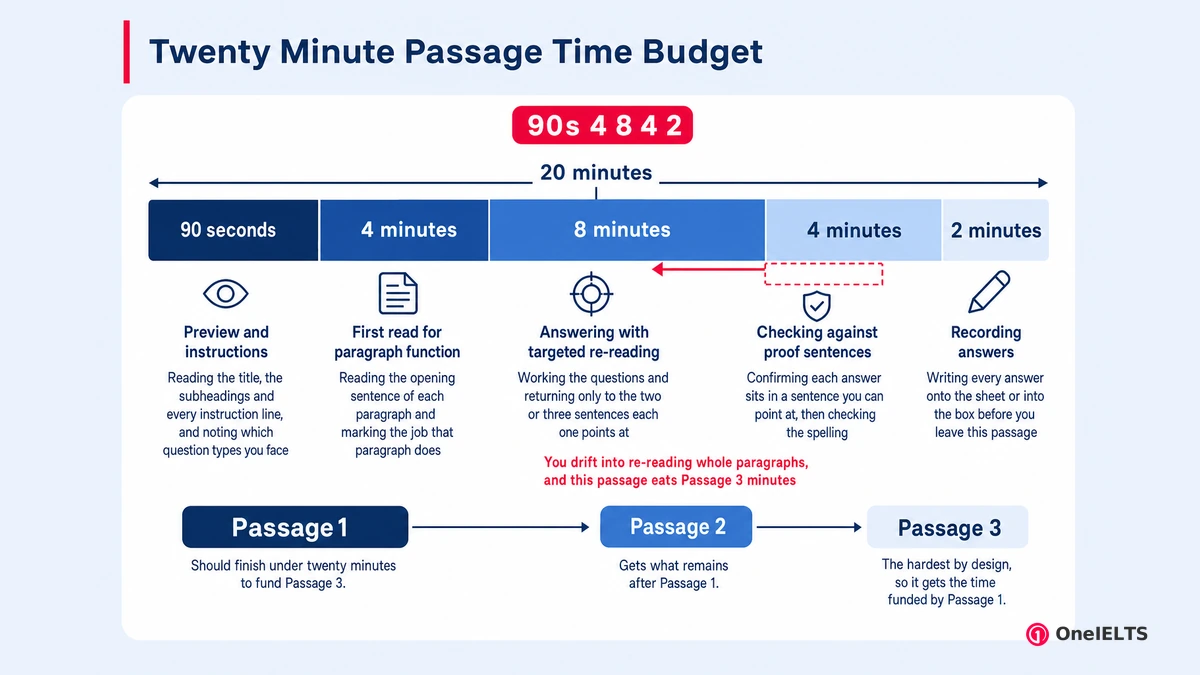
About twenty minutes, split into roughly ninety seconds of preview, eleven to twelve minutes of reading and answering, and the rest on checking and recording. The three passages should not get equal time.
Passage three is the hardest by design, so Passage 1 should finish under twenty minutes to fund it. The most common timing failure is spending the proof check minutes on re-reading instead. Each stage needs its own slice of those twenty minutes, and each one has a price when you skip it.
| Stage | Time | What you are doing | What it costs you to skip |
|---|---|---|---|
| Preview and instructions | 90 seconds | Reading the title, the subheadings and every instruction line, and noting which question types you face | You miss a word limit and lose marks on answers that were otherwise completely right |
| First read for paragraph function | 4 minutes | Reading the opening sentence of each paragraph and marking the job that paragraph does | Matching headings turns into guesswork, and every later search restarts from paragraph one |
| Answering with targeted re-reading | 8 minutes | Working the questions and returning only to the two or three sentences each one points at | You drift into re-reading whole paragraphs, and this passage eats Passage 3 minutes |
| Checking against proof sentences | 4 minutes | Confirming each answer sits in a sentence you can point at, then checking the spelling | Copied answers keep their typos, and Not Given errors survive onto the answer sheet |
| Recording answers | 2 minutes | Entering every answer into its box before you leave this passage | There is no transfer time, so unrecorded answers score nothing |
What Are the Best Tips and Tricks to Solve Reading Comprehension Faster?
The tricks that genuinely save time are all about not reading things, and the ones that fail are all about reading faster. Everything above this line is the procedure itself. What follows is the shortcut layer, and only part of it survives an IELTS paper.
Six tricks hold up under sixty minutes of pressure, and one folklore group does not.
- Trust the instruction line once. Read it, register the word limit, and stop re-checking it every second question.
- Follow the passage’s question order. Work the sets in the order the passage answers them rather than the order they are printed.
- Hunt proper nouns, numbers and dates first. They are never paraphrased, so they anchor you in the right paragraph within seconds.
- Use bracketing. Two answered questions fix the span between them, and the next answer almost always sits inside it.
- Apply the ninety-second rule. Leave any question that resists after ninety seconds, and come back once the rest are done.
- Stop re-reading a mined paragraph. Once you have taken an answer out of a paragraph, that paragraph is finished with you.
Three habits from aptitude-test folklore change nothing here: eye span drills, lip-reading cures and finger-tracking exercises. None of them moves an IELTS band, because the paper rewards where you look rather than how fast your eyes travel.
What Is the Trick to Reading Comprehension?
There is one, and it is not a reading trick: answer from the sentence you can point at, and never from the sense you have formed of the passage. That sentence is your proof sentence, the only text evidence that scores. Everything else people call a trick, from signpost words to paragraph function, is a way of reaching it sooner. The fifteen in-test tactics sit in our IELTS Reading tips guide.
What Are the 7 Reading Comprehension Strategies?
The seven usually listed are activating prior knowledge, predicting, questioning, monitoring, visualising, inferring and summarising, and only four of them earn their keep in IELTS. Predicting, questioning, monitoring and inferring transfer. Visualising and summarising belong to school reading. Activating prior knowledge costs marks, because it turns a true-in-the-world claim into a wrong Not Given answer. Our how to improve IELTS Reading skills guide covers the seven strategies.
How Do You Solve Reading Comprehension Fast?
Speed comes from reading less, not from reading quicker: preview once, read for paragraph function once, then re-read only the two or three sentences a question sends you to. The biggest saving is refusing to re-read a paragraph you have already mined. The second is working the sets in the passage’s question order. Targeted re-reading drills well on IELTS Reading practice sets, which need a free account.
Should You Read the Questions Before the IELTS Reading Passage?
Sometimes. It depends on the question type, which is why the blanket rule you read elsewhere is wrong. Read the questions first for locating information and completion sets, and skim the passage first for matching headings. The blanket rule comes from aptitude and MBA entrance preparation, where passages run shorter and nothing asks you to match a heading to a paragraph. Set your reading order per set while you work through IELTS Academic Reading.
Written by Fahimur Rahman, reviewed 14 August 2026.
Last verified: 8 October 2026
Practice for the Real IELTS Exam
Apply what you’ve learned with free, exam-style practice:
- Take a free IELTS mock test — all four skills, real exam timing, AI band scoring
- Sit a Reading section mock — one full timed paper with an instant band score
- Practise by question type — self-paced passages with answer explanations