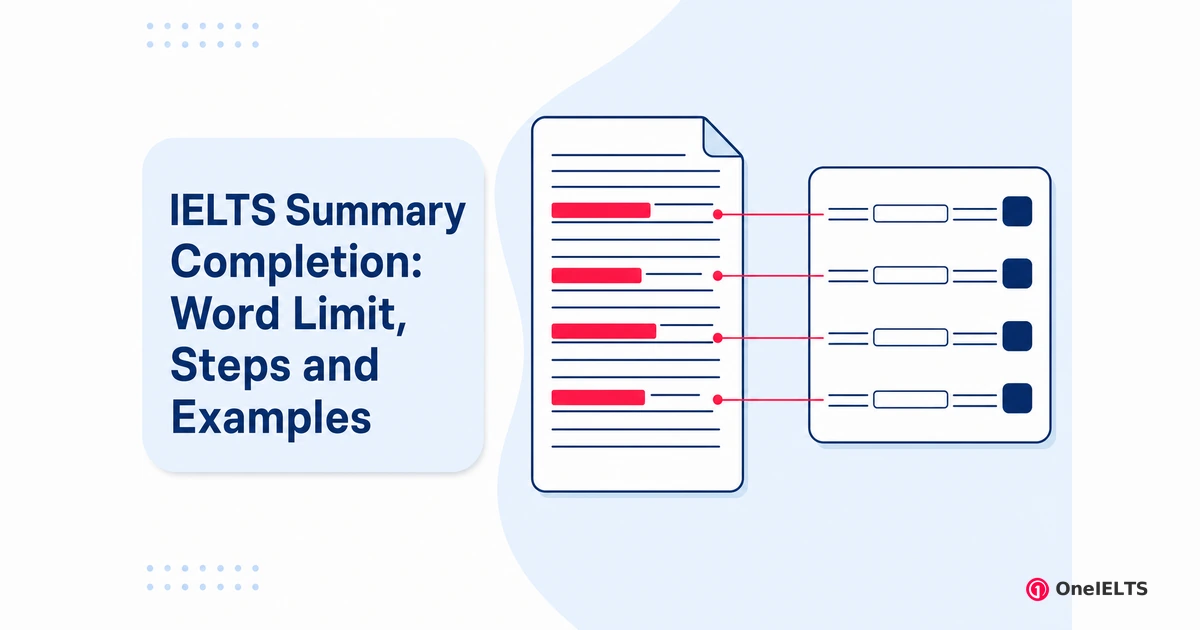
IELTS Reading summary completion gives you a shortened version of part of the passage with gaps, and you fill each gap using words from that passage.
The gap is bounded twice. It has to match the passage and fit the grammar of the sentence around it, so working out the part of speech a gap needs narrows your search before you reread anything. The word limit is the other hard rule, and a gapped summary will tempt you to break it.
This guide covers the task, the word limit, and how it differs from note and sentence completion. It then gives the method, why marks go, a worked example, where to practise, the tips, and how the type fits the other Reading question types.
What Are IELTS Reading Summary Completion Questions?
Summary completion hands you a gapped summary of one section of the passage, and you complete each gap with words from the text.
The summary is not a copy. It condenses that section into a short paragraph of rewritten prose, so the wording around every gap is a paraphrase of what the passage actually says.
The task tests two skills at once. You hold the main idea of the relevant section, which is how you find the right paragraph, and then you lift one precise detail out of it.
Summary completion also comes in two variants. In the default one you choose freely from the passage under a stated word limit. In the word list variant the paper prints a lettered box of words and you pick from it, so you write a letter and the limit no longer applies. IDP publishes a sample of the free-choice form under the title Summary completion text and question.
What Word Limit Applies to Summary Completion?
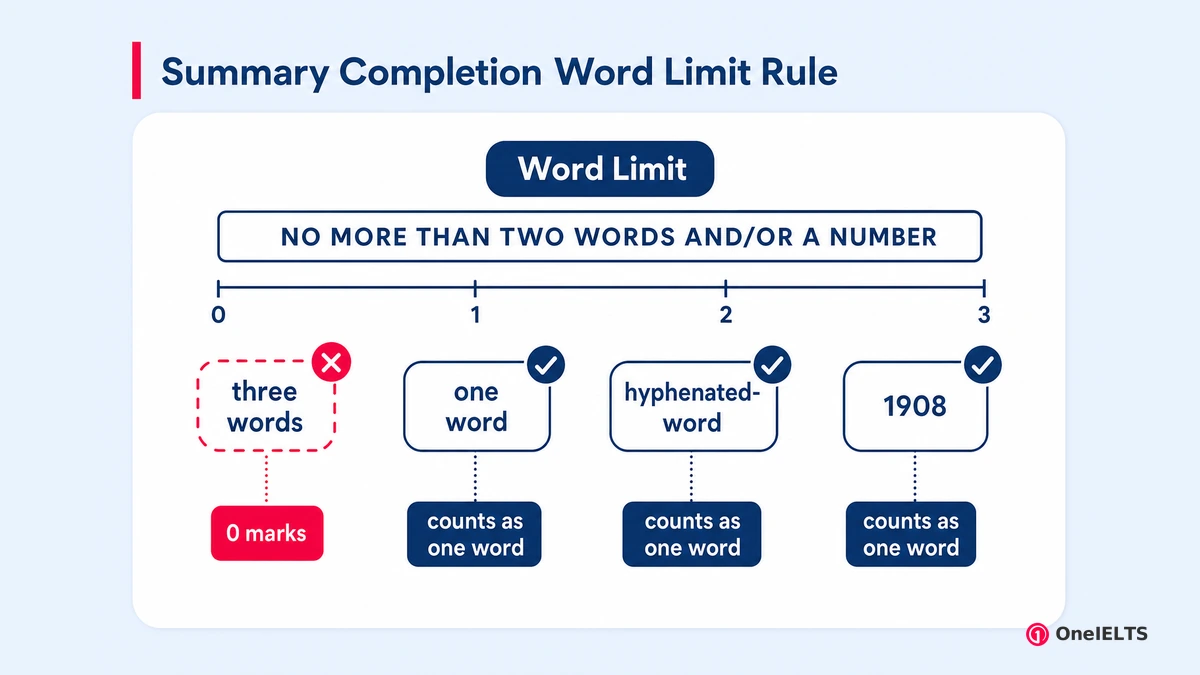
The instruction line above the questions sets the cap, and the usual wording is NO MORE THAN TWO WORDS AND/OR A NUMBER. Three words where two are allowed scores zero, however well the answer matches the meaning.
Read that line every time. Some sets allow one word only, others allow three, and the word limit can change between question groups on the same paper.
Two words and a number means exactly that. Writing 1908 plus census returns stays inside the cap, while the 1908 census returns is four words and falls outside it.
Two smaller rules settle borderline answers. A hyphenated word normally counts as one word, and a number written in digits counts as one word.
Copy exactly what the passage prints. Spelling, singular or plural, and verb tense all have to survive the move from the passage into the gap, because the marker compares your answer with the printed form.
How Does Summary Completion Differ From Note and Sentence Completion?
The difference is grammatical reach. A summary runs as continuous prose, so every gap answers to the sentence around it, while notes are fragments and sentence completion gives you one sentence at a time.
Note completion prints headings, dashes and clipped phrases. A noun dropped into a slot like “Main cause” fits almost anything grammatically, so meaning does nearly all the work of choosing.
Sentence completion gives you a whole sentence with a gap in it, so grammar does constrain the answer. Each sentence still stands alone, though, and nothing carries over from one question to the next.
Summary completion is the only one of the three where your finished answers have to read as a single coherent paragraph. A wrong article, plural or verb tense in gap 3 will jar against gap 4, and that is a free check the other two types never offer you.
How Do You Answer IELTS Reading Summary Completion Questions?
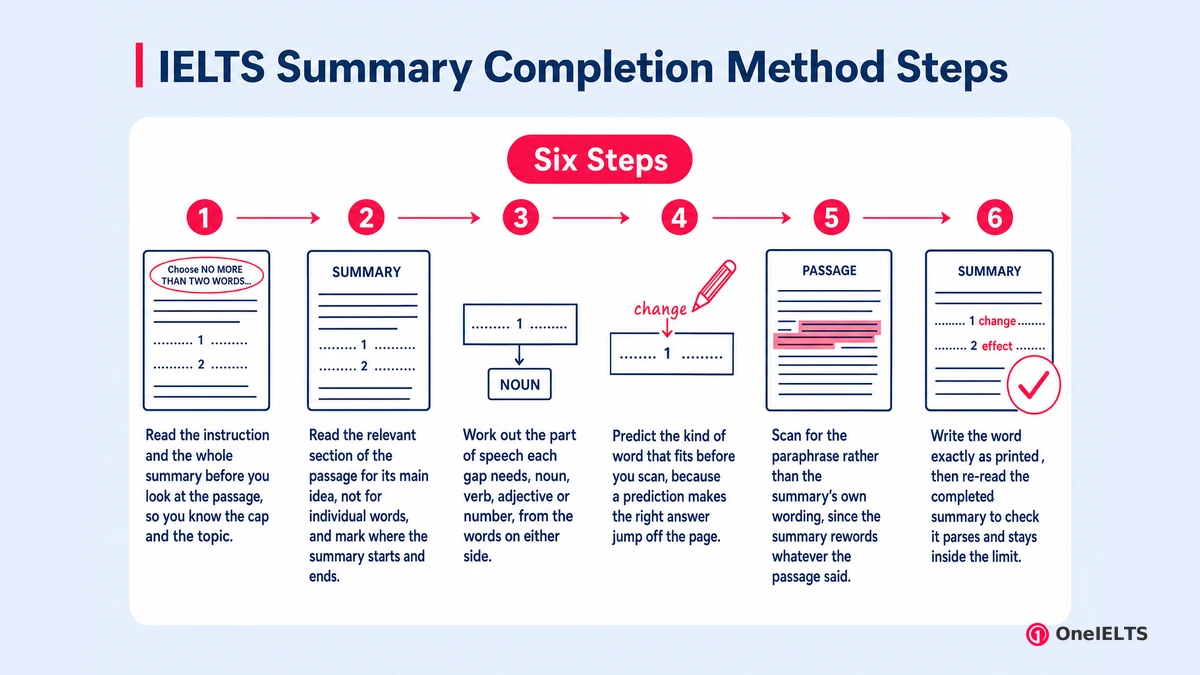
Work the summary before the passage. Read the summary first, decide what each gap needs grammatically, and only then go hunting in the text.
Six steps take you from the instruction line to a checked answer.
- Read the instruction and the whole summary before you look at the passage, so you know the cap and the topic.
- Read the relevant section of the passage for its main idea, not for individual words, and mark where the summary starts and ends.
- Work out the part of speech each gap needs, noun, verb, adjective or number, from the words on either side.
- Predict the kind of word that fits before you scan, because a prediction makes the right answer jump off the page.
- Scan for the paraphrase rather than the summary’s own wording, since the summary rewords whatever the passage said.
- Write the word exactly as printed, then re-read the completed summary to check it parses and stays inside the limit.
Why Do Candidates Lose Marks on Summary Completion?
Three causes dominate. Candidates break the word limit, copy a grammatically wrong form, or answer from memory of the passage instead of its printed wording.
The grammar failure is the quiet one. A gap that needs a plural takes students, and student scores zero even though you found the right sentence. The memory failure has the same shape, because you recall the idea and then write your own noun for it.
The search itself often goes wrong from the start. The summary is a paraphrase of the passage, so looking for the summary’s words in the text finds nothing, and the sentence you need is worded differently.
What Does an IELTS Reading Summary Completion Question Look Like?
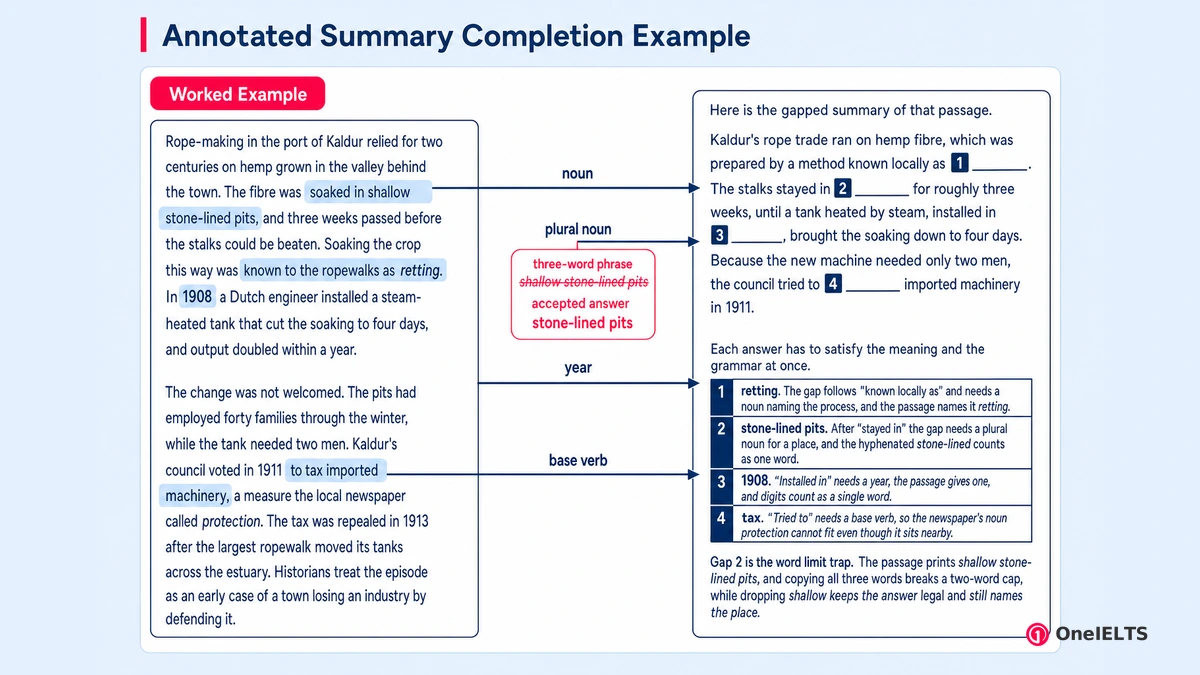
This worked example uses a passage written for this page, not a Cambridge extract. The summary that follows it has four gaps, and the instruction is NO MORE THAN TWO WORDS AND/OR A NUMBER.
Rope-making in the port of Kaldur relied for two centuries on hemp grown in the valley behind the town. The fibre was soaked in shallow stone-lined pits, and three weeks passed before the stalks could be beaten. Soaking the crop this way was known to the ropewalks as retting. In 1908 a Dutch engineer installed a steam-heated tank that cut the soaking to four days, and output doubled within a year.
The change was not welcomed. The pits had employed forty families through the winter, while the tank needed two men. Kaldur’s council voted in 1911 to tax imported machinery, a measure the local newspaper called protection. The tax was repealed in 1913 after the largest ropewalk moved its tanks across the estuary. Historians treat the episode as an early case of a town losing an industry by defending it.
Here is the gapped summary of that passage.
Kaldur’s rope trade ran on hemp fibre, which was prepared by a method known locally as 1 ______. The stalks stayed in 2 ______ for roughly three weeks, until a tank heated by steam, installed in 3 ______, brought the soaking down to four days. Because the new machine needed only two men, the council tried to 4 ______ imported machinery in 1911.
Each answer has to satisfy the meaning and the grammar at once.
- 1 retting. The gap follows “known locally as” and needs a noun naming the process, and the passage names it retting.
- 2 stone-lined pits. After “stayed in” the gap needs a plural noun for a place, and the hyphenated stone-lined counts as one word.
- 3 1908. “Installed in” needs a year, the passage gives one, and digits count as a single word.
- 4 tax. “Tried to” needs a base verb, so the newspaper’s noun protection cannot fit even though it sits nearby.
Gap 2 is the word limit trap. The passage prints shallow stone-lined pits, and copying all three words breaks a two-word cap, while dropping shallow keeps the answer legal and still names the place.
Where Can You Practise IELTS Reading Summary Completion?
Practise this type on OneIELTS rather than on the loose PDFs the search results push at you. Our IELTS Reading summary completion practice pages filter Reading questions down to this one task. Practising needs a free OneIELTS account.
The demand for a summary completion PDF makes sense, and the format has one limit. A printed set gives you an answer key and nothing else, so a wrong gap never tells you whether the meaning was off or the grammar was, and those two errors need different fixes.
A practice lesson on a single type and a full timed test train different things. A question type drill isolates the read, predict and scan loop and lets you run it many times over, which is how the part of speech habit gets built. A timed test puts that loop back among headings, matching sets and a clock.
The pattern we see most often in marked practice is a right word in a wrong form. The candidate found the correct sentence, then copied a singular where the summary needed a plural.
What Are the Best Tips for IELTS Reading Summary Completion?
The summary completion tips that move accuracy are about order of work. Decide what a gap needs before you go looking for it.
Five habits carry most of the gain on this task.
- Read the whole summary first. Take in the whole gapped paragraph before the passage, so you know where it starts.
- Mark the part of speech each gap needs. Write n, v or adj beside every gap before you start scanning.
- Never exceed the stated word limit. Count your words, because a third word cancels an otherwise correct answer.
- Copy the spelling exactly. Transfer the word letter for letter, including plurals and capitals, from the passage.
- Reread the finished summary. Check the completed paragraph is grammatical English, since a wrong form reads wrong immediately.
How Does Summary Completion Fit With the Other IELTS Reading Question Types?
Summary completion is one of the 11 official Academic Reading question types, and it belongs to the completion family, the group where you write words rather than pick letters. Note completion, sentence completion, table completion and flow-chart completion are its siblings, and an instruction line sets a word limit for all of them.
Everything above this point treats summary completion on its own. What follows sets it beside the rest of the reading test, so you can tell which method a question set wants and how the type behaves once you practise it with the others.
Is Summary Completion Harder Than Sentence Completion?
Yes for most candidates, because a summary is continuous prose – every gap has to fit the paragraph’s grammar as well as the passage’s meaning.
Sentence completion gives you separate sentences, so an error in one cannot damage another. Summary completion links its gaps into a single paragraph, and the connective words between them, articles, prepositions and conjunctions, restrict what can go in. The upside is a built-in check, because a wrong form is audible when you read the paragraph back. Our IELTS Reading sentence completion guide covers the simpler task.
Is the Word Limit the Same Across All Completion Question Types?
Yes, the instruction sets the cap and it applies identically to note, table, flow-chart and summary completion – always read it rather than assuming two words.
One word limit can differ from the next on the same paper, so check it at every question group. The exception is the with-choices variant, where you pick from a supplied box of words and count nothing. Drill that form on our summary completion with a word list set. The IELTS Reading note completion guide covers the fragment format.
Can You Drill Summary Completion Alongside the Other Question Types?
Yes, and you should – a full passage mixes completion tasks with matching and multiple choice, so isolated drilling leaves the switch between them untrained.
Type drills build the method. Timed practice on a full passage builds pacing and the decision about which question types to answer first. Run both, and finish with our free IELTS Reading mock test once the summary method is automatic. It is free, and a OneIELTS account gets you in.
Written by Fahimur Rahman, reviewed 14 August 2026.
Last verified: 14 August 2026
Practice for the Real IELTS Exam
Apply what you’ve learned with free, exam-style practice:
- Take a free IELTS mock test — all four skills, real exam timing, AI band scoring
- Sit a Reading section mock — one full timed paper with an instant band score
- Practise by question type — self-paced passages with answer explanations