You have just attempted the exploration passage and you want to know whether your answers are right. It is Reading Passage 3 of Cambridge 15 Test 1, the third and last Academic Reading text of that paper. This page gives you the question map and the reasoning behind each answer, not a reprinted passage and not a bare answer list.
Check your numbering before you check anything else. Several widely ranking pages print question numbers and a task type this passage does not have.
What follows is the source book, the task types, and why those pages disagree. Then the reasoning for multiple choice, matching and summary completion, where to get the passage legally, how hard it is, and which passages to practise next.
What Is the What Is Exploration IELTS Reading Passage?
An Academic Reading passage from an official Cambridge past paper, printed in the third passage slot of its test and built around what exploration has meant and why people have undertaken it. It is real exam material rather than a practice imitation written to look like one.
Almost nobody searches this title cold. You search it after an attempt, which is what “reading answers” means as a search term. Candidates use it for the answer key plus the explanation of how each answer was reached. The key alone tells you that item 34 went wrong. Only the explanation tells you why, and that is what this page is built around.
The third passage slot matters more than the subject does. It carries the densest text of the paper and it meets you with the least time left, so errors there are often clock errors rather than reading errors. Check the exact argument the passage makes against your own copy.
Which Cambridge Book and Test Is the What Is Exploration Reading Passage From?
Cambridge IELTS 15, Academic Test 1, Reading Passage 3, which means questions 27 to 40. Getting the source paper right is the only way to be sure the answers you are checking belong to the questions in front of you. The same passage is republished across dozens of sites under slightly varying titles, and those titles drift faster than the content does. Verify the book, the test number and the question range against your physical copy before you mark anything.
Each detail of the source sits in the table underneath, with the items to check against your own book flagged.
| Detail | Value |
|---|---|
| Book | Cambridge IELTS 15, the official practice volume published by Cambridge University Press |
| Test number | Academic Test 1, the first of the complete papers printed in that volume |
| Module | Academic Reading rather than General Training, so the text sits in the academic paper |
| Passage number | Reading Passage 3, the final and densest text of that Academic Reading paper |
| Question numbers | Questions 27 to 40, the standard numbering for a third passage |
| Number of questions | Fourteen questions in total, split across three separate task types |
| Position in the paper | Last of three passages, so it meets the final twenty minutes of the hour |
| Other two passages | Nutmeg a valuable spice as Passage 1 and Driverless cars as Passage 2 |
What Question Types Does the What Is Exploration Reading Passage Contain?
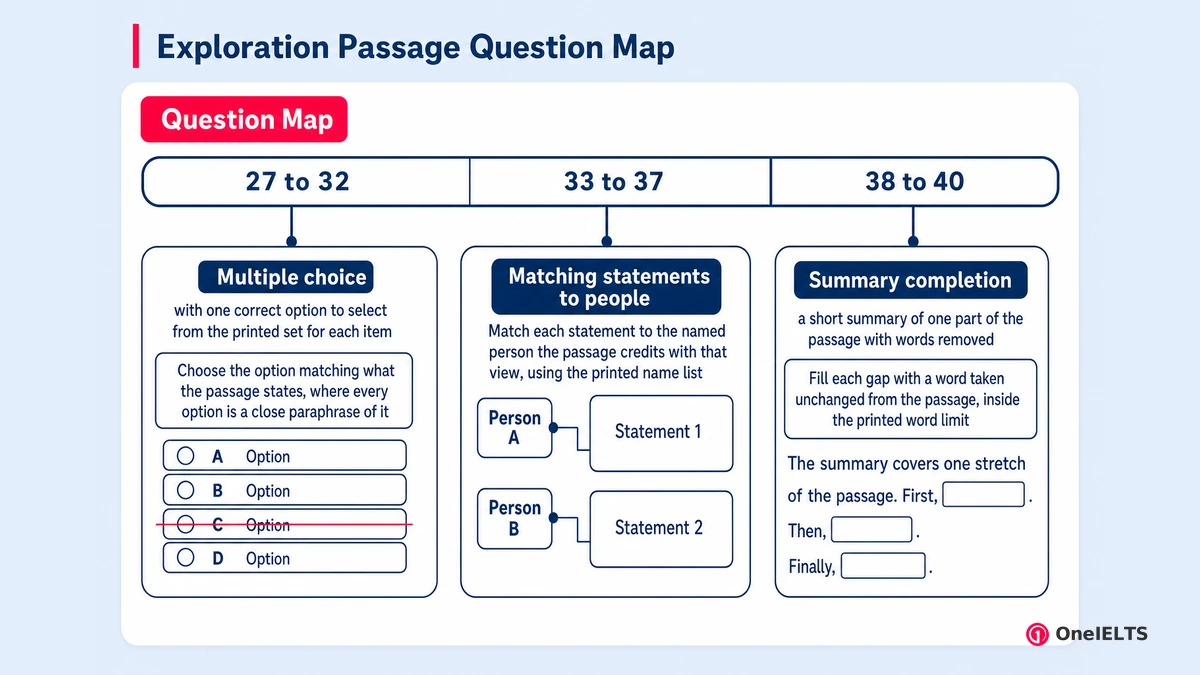
Fourteen questions run across three task types, which are Multiple Choice, Matching Features and Summary Completion. That grouping is the question map for this passage.
The table sets each block of question numbers against its task type, its demand and the reason it bites.
| Question numbers | Task type | What it asks you to do | Which paragraph the evidence sits in | What makes it hard |
|---|---|---|---|---|
| Questions 27 to 32, the opening six items and the first block you meet | Multiple choice, with one correct option to select from the printed set for each item | Choose the option matching what the passage states, where every option is a close paraphrase of it | Mark this yourself in your own copy as you locate each answer | The options differ by a single qualifier, so overall feel picks the wrong one repeatedly |
| Questions 33 to 37, five items sitting in the middle of the set | Matching features — matching statements to the people credited with them — the distinctive and comparatively rare task in this passage | Match each statement to the named person the passage credits with that view, using the printed name list | The names are scattered, so log each one in the margin as you find it | A name printed near a view does not own it, and attribution verbs settle every item |
| Questions 38 to 40, the last three items and the end of the paper | Summary completion, a short summary of one part of the passage with words removed | Fill each gap with a word taken unchanged from the passage, inside the printed word limit | The summary covers one stretch, so locate that stretch before the gaps | It sits at the very end of a Passage 3, which is where the clock usually runs out |
The matching block is why this passage repays study rather than marking. Matching statements to people appears far less often than matching headings, so the practice transfers less easily and has to be learned on a passage like this one. Summary completion at the end of a Passage 3 is where time runs out, and the evidence paragraph behind those last three gaps is the one candidates never reach.
Why Do Ranking Pages Disagree About the What Is Exploration Reading Questions?
Because several of them publish a reconstructed question set rather than a transcribed one, and at least two use numbering that cannot belong to a Passage 3. All three accounts were fetched and compared on 2026-08-05.
The page ranking first documents questions 27 to 40 in three task types. A higher-authority page at position four presents the same passage as True/False/Not Given 1 to 7 plus Sentence Completion 8 to 13. A third, at position nine, lists four task types including matching information. Those three accounts cannot all describe one text.
Question numbering settles which one cannot be right. Items numbered 1 to 13 belong to a Passage 1 slot, never to a third passage. The consequence lands on you. A candidate marking an attempt against the wrong published answer page will fail questions never answered, then read their own reading as weaker than it is.
One rule of verification comes out of this. Before trusting any answers page, check its question numbers against the numbers printed in your own book, and close the page when they differ.
How Do You Answer the Multiple Choice Questions in What Is Exploration?
Treat each option as a claim to be disproved, and eliminate on a single mismatched word rather than on overall feel. These six items are hard for one reason. The options are built by close paraphrase of the passage and separate from each other by one qualifier.
Five steps make up the elimination routine, in the order an experienced marker runs them.
- Locate from the stem. Take the proper noun or the date in the question stem and find it in the text. That proper noun anchor survives paraphrase when ordinary vocabulary does not.
- Read two sentences. Read the whole sentence you land on, then the one after it. Options in a Passage 3 are often assembled from a claim split across both.
- Test against the text. Test each option against that sentence, never against your memory of the passage. Memory blends what you read with what you expected to read.
- Cut on the qualifier. Eliminate any option carrying a qualifier the passage never uses, such as only, first or always. Option elimination on one word beats judging overall fit.
- Prefer the smaller claim. Choose the option that says less rather than the one that says more. Overstated options are the standard distractor built into this task.
Multiple choice in a Passage 3 usually follows passage order, so a located answer brackets the next one. Here is the elimination on an original extract written for this article, not taken from the book.
The Ferrand expedition mapped the eastern shore in 1911, working from sketches its crew made on land. Later surveys reused those charts, although several inlets were redrawn after 1930. Ferrand never claimed the map was finished.
Option A says Ferrand produced the first charts of the eastern shore. Option B says later surveys reused Ferrand’s charts. The extract supports B, and it never uses the word first, so A falls on that one qualifier.
How Do You Answer the Matching Questions in What Is Exploration Reading?
Work from the names, not from the statements. Find every named person in the passage first, then read the statements against them. Matching statements to people is the distinctive task in this passage, and it is where most marks go, because candidates search the text for the statement’s wording instead of building the name list first. This task is not matching information to paragraphs, which readers confuse with it.
Six steps turn the names into the anchor for all five statements.
- Mark every name. Scan the passage once and mark each name in the margin. Five statements against a handful of researchers is a small closed set.
- Label each name. Note beside each named researcher what the passage credits them with, in two or three words. That short label is what you match against.
- Match statement to name. Read the first statement and match it to a name, rather than hunting the passage for the statement’s wording, which costs far more time.
- Check the attribution. Confirm the passage attributes the view to that person. Attribution verbs such as argues, rejects and concedes decide it, and proximity does not.
- Allow repeats or gaps. Expect one name to be used twice, or not at all, whenever the instruction line allows it. Read that line before you start.
- Place the doubtful one last. Leave the least certain statement until the others are placed. Elimination does most of the work on the final item.
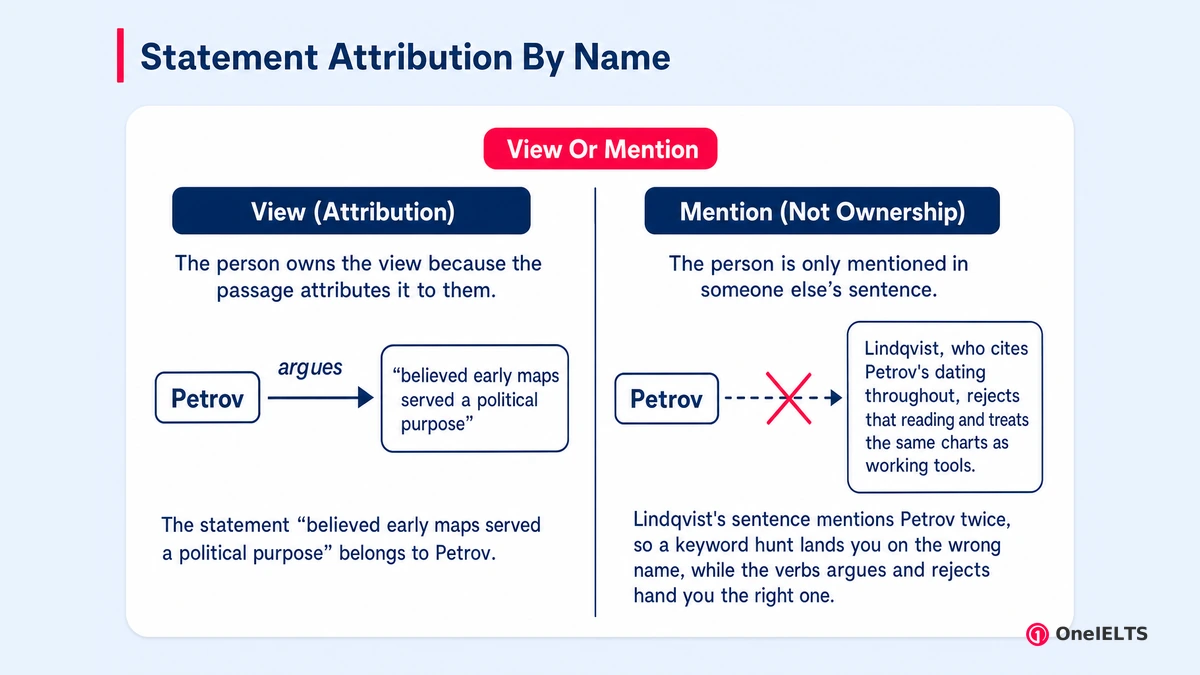
A name appearing in a sentence is not the same as a view belonging to that name. That distinction, view versus mention, decides most of these five items, and the original two-name extract underneath shows it.
Petrov argues that early charts were political documents before they were navigational ones. Lindqvist, who cites Petrov’s dating throughout, rejects that reading and treats the same charts as working tools.
The statement “believed early maps served a political purpose” belongs to Petrov. Lindqvist’s sentence mentions Petrov twice, so a keyword hunt lands you on the wrong name, while the verbs argues and rejects hand you the right one.
How Do You Complete the Summary in What Is Exploration Reading?
Predict the part of speech for each gap before you look for the word, then copy the word exactly. The task gives you a short summary of one part of the passage with words removed, and it tests location and accuracy rather than understanding.
The routine for these last gaps runs through six checks.
- Read the summary whole. Read all of it before writing anything. It covers one stretch of the passage, and knowing which stretch removes most of the searching.
- Predict the word class. Decide for each gap whether it needs a noun, a verb or an adjective. Fixing the part of speech first rules out most wrong candidates.
- Find the stretch. Locate the matching part of the passage through a word the summary shares with it, usually a name, a number or a technical term.
- Copy unchanged. Take the word straight from the passage. Copy unchanged means no plural added, no tense altered and no synonym substituted, however odd it reads.
- Obey the word limit. Check the word limit printed in the instruction line. Three words where the paper allows two scores nothing, whatever the meaning.
- Re-read the sentence. Re-read each completed sentence to confirm it is grammatical. A gap that reads wrong usually holds the wrong part of speech.
Whether the words come from a box or from the passage changes the method completely, and the instruction line is where that is stated. Summary completion sits at the very end of this passage, so it is the task most often rushed. The marks lost here are word-limit and spelling losses far more often than comprehension losses.
Where Can You Get the What Is Exploration Reading Passage Legally?
From the Cambridge IELTS 15 volume itself, in print, through a library, or in an official digital edition, and this page deliberately does not reprint it. The passage is copyrighted exam-board material. Most pages ranking for this query reproduce it in full; this one does not, which is a choice rather than an oversight.
Three of the related searches on this query ask for a PDF. An unofficial PDF often carries a wrong answer key, and a wrong answer key is worse than no key at all, because it manufactures errors that were never yours.
Five legitimate routes to the passage are given below.
- The printed Cambridge IELTS 15 book. The full paper with the official answer key, published by Cambridge University Press and stocked by most exam bookshops.
- An official digital edition. The same volume licensed for reading on a tablet or in a browser, which keeps the official answer key intact.
- A library copy or a test-centre copy. Public libraries and IELTS test centres hold the Cambridge volumes, and reading one there costs nothing at all.
- The test owners’ free official sample tasks. Reading tasks published by the exam board itself, matched to the real format, for practice equivalent to this passage.
- A full-length OneIELTS Reading mock. A timed rehearsal built on an original passage rather than a Cambridge one, and it needs a free account.
How Difficult Is the What Is Exploration Reading Passage?
Harder than average, and the reason is its slot rather than its subject. It is a Passage 3, so it carries the densest text of its paper and it meets the least remaining time.
The matching block raises the difficulty again, because an attribution task asks who holds a view rather than where a fact sits. The vocabulary is historical and narrative rather than technical, which suits candidates who read non-fiction outside their exam material.
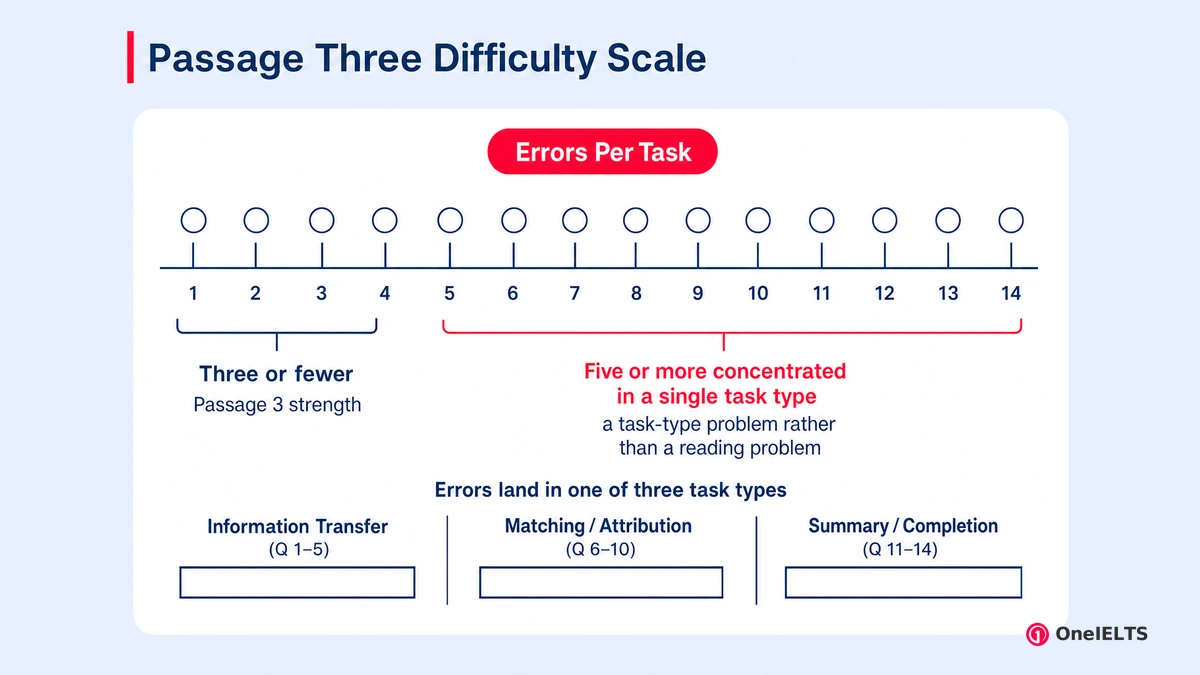
Read your result as errors per task type instead of as a band. A raw score on fourteen questions is not a band, and no band conversion exists for one passage, because the IELTS Reading band score is set by the full forty-question paper.
Three or fewer errors across the fourteen is Passage 3 strength. Five or more concentrated in a single task type is a task-type problem rather than a reading problem, and it tells you which of the three methods above to drill.
Which Other Cambridge 15 Test 1 Reading Passages Should You Practise?
Practise the other two passages of the same paper next, then move to a different test, because one passage cannot rehearse the thing that decides your Reading band, which is the hour.
Cambridge 15 Test 1 is a full paper of three passages of rising difficulty, forty questions and sixty minutes, with this text sitting last. Its sibling passages are the two that precede it, Nutmeg a valuable spice and Driverless cars, and the related searches show readers moving between all three.
The practice sequence that works is fixed. Attempt the three passages of one paper in order and against the clock. Review by task type across all three, counting errors per type rather than per passage. Only then open another test.
How Do You Approach the Nutmeg a Valuable Spice Reading Passage?
Nutmeg a valuable spice is Passage 1 of the same paper, so it is the easiest of the three. Finish it well inside twenty minutes and carry the saved time forward to fund the passage you have just been reading about. A Passage 1 rewards straightforward location work, so an error there is a procedure error rather than a comprehension one. Our IELTS Academic Reading guide covers the paper it belongs to.
How Do You Approach the Driverless Cars Reading Passage?
Driverless cars is the middle passage of the same paper, so treat twenty minutes as a hard ceiling and carry any saved time forward rather than spending it here. A Passage 2 on a technology subject usually mixes an argued section with factual detail, so the task shift happens inside the passage itself. Our IELTS Reading practice hub is free to use with an account.
How Do You Use Cambridge 15 Test 2 Reading for Practice?
Use Cambridge 15 Test 2 as a measurement paper rather than a study paper. Sit all three passages in one unbroken hour without looking anything up, then mark the whole thing. Keep at least one unseen test in reserve, because a paper you have already read can only test your memory. That reserve paper is what tells you where you stand. Our IELTS Reading topics page shows the subject range.
Does Practising One Cambridge Passage Improve Your IELTS Reading Score?
Only if you review it by task type. A single passage teaches you a method, and it is that review by task type, rather than the attempt, that moves the score. What one passage cannot do is rehearse the full hour, or show where your time goes across three passages of rising difficulty. Our guide on how to improve IELTS Reading skills sets out that review routine.
Written by Fahimur Rahman, reviewed 14 August 2026.
Last verified: 14 August 2026
Practice for the Real IELTS Exam
Apply what you’ve learned with free, exam-style practice:
- Take a free IELTS mock test — all four skills, real exam timing, AI band scoring
- Sit a Reading section mock — one full timed paper with an instant band score
- Practise by question type — self-paced passages with answer explanations