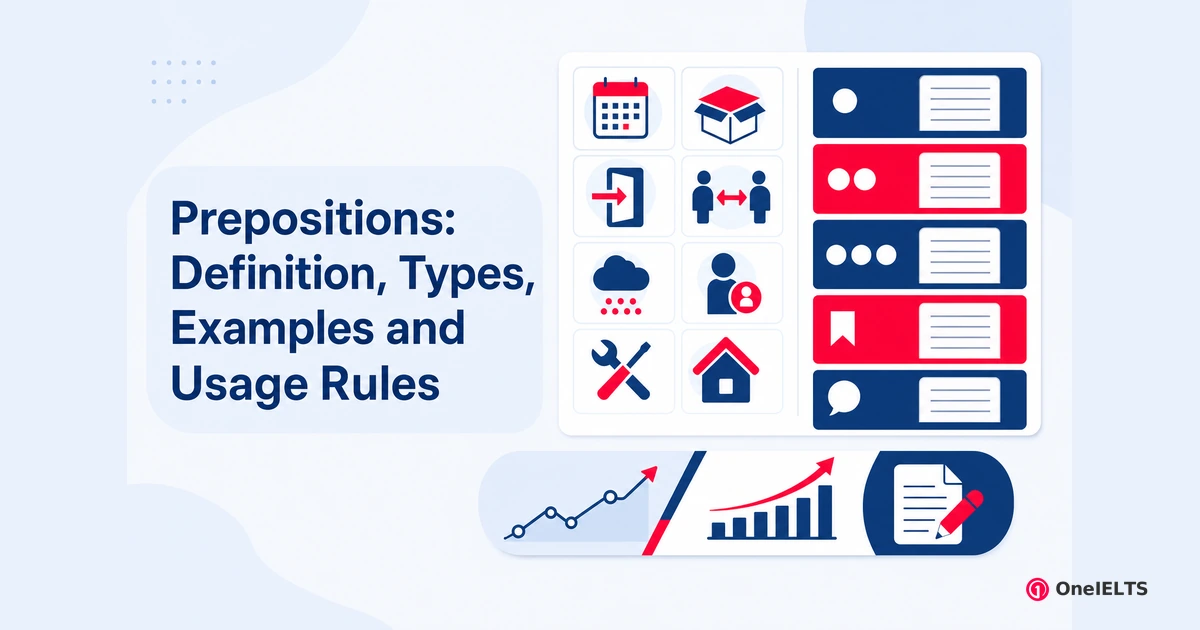
A preposition links a noun or pronoun to the rest of a sentence and shows when, where, in which direction or how something happens. IELTS examiners mark prepositions under Grammatical Range and Accuracy, and in IELTS Writing Task 1 they also carry data: “rose by 10%” and “rose to 10%” report different numbers.
This page defines the prepositional object and prepositional phrase, then sorts types by function (prepositions of time, prepositions of place and six more) and by structure, up to the compound preposition. Then come 40 common prepositions, ten examples, in/on/at, dependent prepositions, recognition, end position, mistakes Hindi speakers repeat, practice and IELTS use. Phrasal verbs and Task 1 vocabulary have their own pages.
What Is a Preposition?
A preposition is a word, or a fixed group of words, placed before a noun, pronoun or noun phrase to show its relationship to another word in time, place, direction, manner or cause. The word after it is the prepositional object, and the two form a prepositional phrase: “on the table”, “after the test”.
A pronoun there takes the object pronoun form: “between you and me”, not “between you and I”. The phrase works as an adjective phrase (“the book on the table”) or an adverbial phrase (“She lives in Pune”). Swap the preposition and the scene changes: “on the box” isn’t “in the box”.
How Many Types of Prepositions Are There?
There’s no single fixed number, because grammars sort prepositions in two ways: by function and by structure. Most school grammar books list eight types by function. By structure, the three main categories are the simple preposition, the double preposition and the compound preposition. Counts differ because some books merge direction with place, or cause with purpose.
This classification table sets out both systems.
| Classification | Type | What it shows or how it is built | Example |
|---|---|---|---|
| By function | Time | When something happens or how long it lasts | at 9 a.m., on Monday, since 2019 |
| By function | Place | Where a person or thing is located | in the hall, under the desk |
| By function | Direction | Movement toward, into or through a place | into the room, across the road |
| By function | Manner | How an action is done | with care, by hand, like a pro |
| By function | Cause and purpose | Why something happens or what it is for | because of rain, for practice |
| By function | Agent | Who does the action in a passive sentence | marked by two examiners |
| By function | Instrument | The tool or means used for an action | cut with scissors, travel by train |
| By function | Possession | Ownership or a link between two nouns | a map of the town |
| By structure | Simple | One single word | at, by, for, in, on |
| By structure | Double | Two simple prepositions written as one word | into, onto, upon, within |
| By structure | Compound | Two or more words acting as one unit | because of, in front of |
| By structure | Participle | A word formed from a verb | during, regarding, including |
| By structure | Phrase | A fixed phrase that ends in a preposition | on behalf of, with regard to |
What Are the Types of Prepositions by Function?
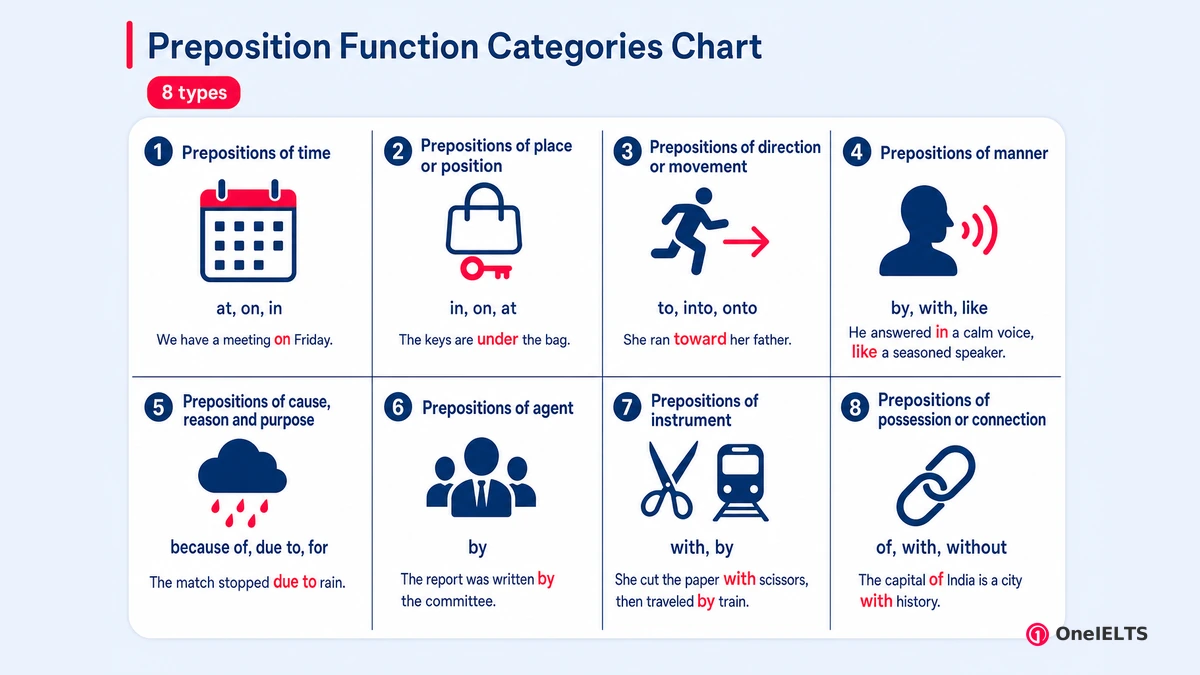
The function of a preposition is the relationship it shows between its object and the rest of the sentence: when, where, which way, how, why, who, with what or whose. One word can do more than one job, so “in” shows time in “in May” and place in “in Delhi”.
Eight functional types cover nearly every preposition you’ll meet, each with its usual members and one sentence.
- Prepositions of time show when something happens: at, on, in, before, after, during, until, since, for. “We have a meeting on Friday.”
- Prepositions of place or position show where something is: in, on, at, under, over, behind, between, among. “The keys are under the bag.”
- Prepositions of direction or movement show motion toward or through a place: to, into, onto, through, across, toward. “She ran toward her father.”
- Prepositions of manner show how an action happens: by, with, like, in. “He answered in a calm voice, like a seasoned speaker.”
- Prepositions of cause, reason and purpose show why something happens or what it’s for: because of, due to, for, owing to. “The match stopped due to rain.”
- Prepositions of agent name the doer of a passive action, almost always with “by”. “The report was written by the committee.”
- Prepositions of instrument name the tool or means behind an action: with, by. “She cut the paper with scissors, then traveled by train.”
- Prepositions of possession or connection show ownership or a link between nouns: of, with, without. “The capital of India is a city with history.”
What Are the Types of Prepositions by Structure?
Structural types sort prepositions by form: one word, two words joined into one, or a fixed group of words that acts as a single preposition. Form, not meaning, decides whether you write a preposition as one word or several.
Five structural types appear in most grammars, from the shortest form to the longest.
- Simple prepositions are single words, the most frequent group in English: at, by, for, in, on, to, with. Every simple preposition is one unbroken word.
- Double prepositions join two simple prepositions into one written word: into, onto, upon, within, throughout. “She walked into the exam hall.”
- Compound or complex prepositions are two or more words acting as one unit. A compound preposition includes because of, in front of, according to, in spite of.
- Participle prepositions come from verb forms but work as prepositions: during, regarding, considering, including. “Regarding your question, the answer is yes.”
- Phrase prepositions are fixed phrases that end in a preposition: on behalf of, in addition to, with regard to. “I’m writing on behalf of my company.”
Compound and phrase prepositions are frequent in formal IELTS Task 2 prose (“in addition to”, “with regard to”, “in spite of”). Both “in spite of” and despite take a noun or an -ing form, never a full clause: “despite the rain”, not “despite it was raining”.
What Are the 40 Most Common Prepositions?
English has roughly 150 prepositions, but about 40 single-word prepositions cover most everyday English and exam English. Here they are as an alphabetical list, four columns of ten.
| About to before | Behind to during | Except to off | On to with |
|---|---|---|---|
| about | behind | except | on |
| above | below | for | onto |
| across | beneath | from | out |
| after | beside | in | over |
| against | between | inside | since |
| along | beyond | into | through |
| among | by | like | to |
| around | despite | near | toward |
| at | down | of | under |
| before | during | off | with |
By frequency, of, in, to, for, with and on lead. “Toward” is American and “towards” British.
What Are 10 Examples of Prepositions in Sentences?
These ten example sentences cover every functional type on this page in the kind of English IELTS candidates write and say. Several are time expressions you’ll use in IELTS Speaking, and one shows a Task 1 value.
Each line has one bold preposition and its functional type in brackets.
- The test starts at 9 a.m. (time)
- My exam is on Monday. (time)
- She has lived in Pune since 2019. (time; place)
- The library is next to the station. (place)
- We walked across the bridge. (direction)
- The figure rose to 40% in 2010. (Task 1 value)
- He answered with confidence. (manner)
- The flight was canceled because of fog. (cause)
- The essay was marked by two examiners. (agent)
- This is a map of the town center. (possession)
How Do You Use In, On and At?
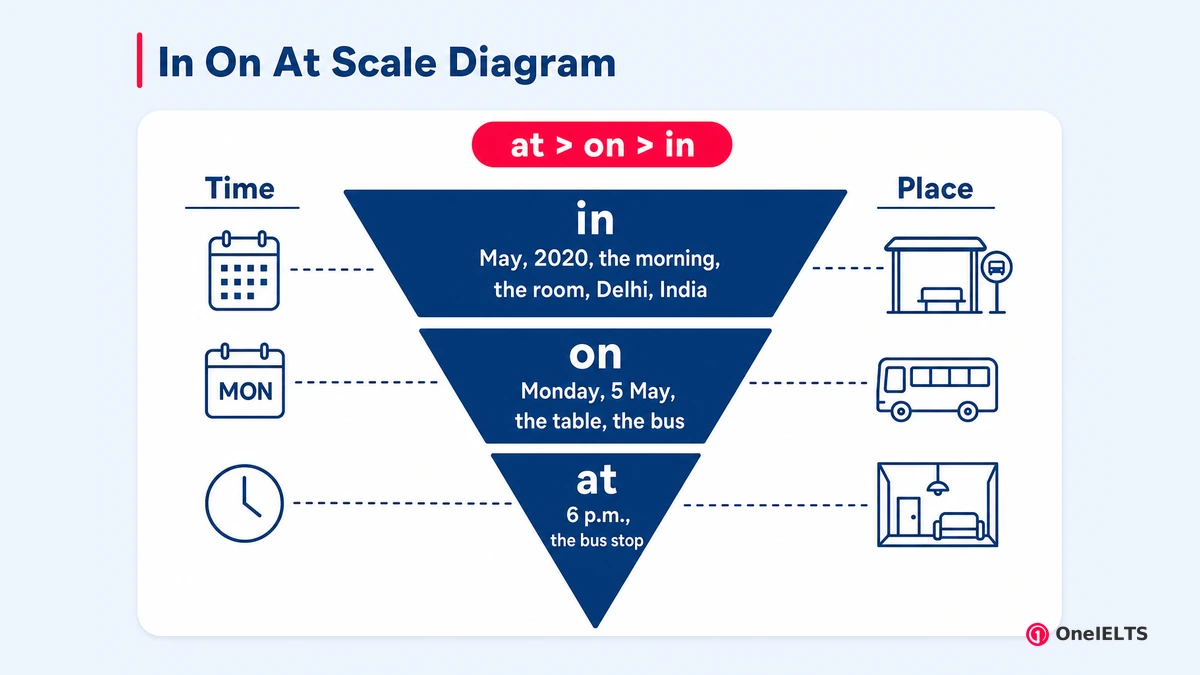
Use “at” for a point, “on” for a surface or a day, and “in” for an enclosed space or a longer period. The scale runs from small and exact (at) to large and general (in), for time and place alike.
The table sets each word’s time use beside its place use.
| Preposition | Time use | Time examples | Place use | Place examples |
|---|---|---|---|---|
| at | A point in time on the clock | at 6 p.m., at night, at the weekend (British) | An exact point or spot | at the bus stop, at the test center |
| on | Days and dates | on Monday, on 5 May | A surface, a street, public transport | on the table, on MG Road, on the bus |
| in | Months, years, seasons, decades, parts of the day | in May, in 2020, in the 1990s, in the morning | An enclosed space, a city or a country | in the room, in Delhi, in India |
Candidates trip on five exceptions. It’s “at night” but “in the morning”. American English says “on the weekend”, while British English says “at the weekend”. You sit “in the car” but “on the bus”. Finally, drop the preposition before next, last, this and every: “next Monday”, never “on next Monday”.
Which Prepositions Go With Verbs, Nouns and Adjectives?
Many verbs, nouns and adjectives take a fixed, dependent preposition that you learn as a collocation rather than work out from a rule. “Depend on” is right and “depend of” is wrong, and no meaning-based rule tells you why.
Three groups of dependent preposition pairs come up again and again in IELTS essays and answers.
- Verb + preposition
- depend on: Your overall band depends on your scores in all four skills, not one.
- consist of: The Writing test consists of two tasks, and you get 60 minutes in total.
- apply for: Thousands of Indian students apply for Canadian study permits every year after IELTS.
- result in: Longer working hours often result in higher stress levels among young office employees.
- contribute to: Private cars contribute to air pollution in large Indian cities such as Delhi.
- rely on: Many older people rely on public transport to reach the local hospital every week.
- focus on: This essay will focus on the economic effects of remote working for small firms.
- account for: Students aged 18 to 24 account for 30% of all users in the chart.
- Noun + preposition
- increase in: The chart shows a sharp increase in coffee sales after 2015 in both cities.
- decrease in: There was a steady decrease in rainfall over the twenty-year period shown in the graph.
- reason for: The main reason for this change is the falling cost of international flights.
- demand for: Demand for skilled nurses has grown sharply in Australia over the last decade.
- access to: Rural families in many regions still lack access to reliable internet at home.
- effect on: Social media has a strong effect on how teenagers spend their free time.
- solution to: Better public transport is one practical solution to traffic congestion in growing cities.
- impact on: Tourism has a clear impact on prices in small coastal towns and villages.
- Adjective + preposition
- interested in: I’ve always been interested in cooking food from different regions of India.
- responsible for: Governments are responsible for funding public schools and for training qualified teachers.
- aware of: Most drivers are aware of the risks of using mobile phones while driving.
- good at: My younger brother is good at mathematics but finds essay writing quite hard.
- different from: City life is very different from life in a small farming village up north.
- similar to: The pattern for Japan is similar to the pattern shown for South Korea.
- capable of: Young children are capable of learning two languages at the same time quite easily.
- dependent on: The local economy is heavily dependent on tourism during the busy summer months.
A prepositional verb keeps its object after the preposition (“look at the chart”), while a phrasal verb’s particle can move (“turn the volume down”). The particle changes the verb’s meaning, so phrasal verbs get their own guide.
How Do You Recognize a Preposition in a Sentence?
A word is a preposition only when it’s followed by an object. The same word can be an adverb, a particle or a subordinating conjunction in another sentence, so you judge it by what comes after it.
Four checks settle the question, each shown with a contrasting pair.
- It has an object. “She sat behind the desk” uses a preposition; “She stayed behind” uses an adverb with no object.
- Its object is a noun, pronoun or -ing form. “Before the test” and “before leaving” both use “before” as a preposition.
- It isn’t followed by a full clause. “After the exam” is a preposition; “after the exam ended” makes “after” a subordinating conjunction.
- It can’t move away from its object, unlike a phrasal-verb particle. You say “look at it”, never “look it at”.
A verb after a preposition takes the -ing form, the gerund: “interested in studying”, “before submitting”. “Before submit” is one of the most common slips in timed essays.
Can You End a Sentence With a Preposition?
Yes, ending a sentence with a preposition is grammatical in modern English and often sounds more natural, as in “Which university did you apply to?”.
The old rule against it came from Latin grammar, not English.
Four structures end with a stranded preposition. Questions use one (“what is it made of”), as does a relative clause (“the course I signed up for”). The passive voice (“he was laughed at”) and infinitive phrases (“a topic to write about”) do too.
A formal register can move it forward (“the university to which I applied”). In IELTS Writing either form works, so pick the natural one and avoid a doubled preposition such as “the city in which I live in”.
What Are the Most Common Preposition Mistakes?
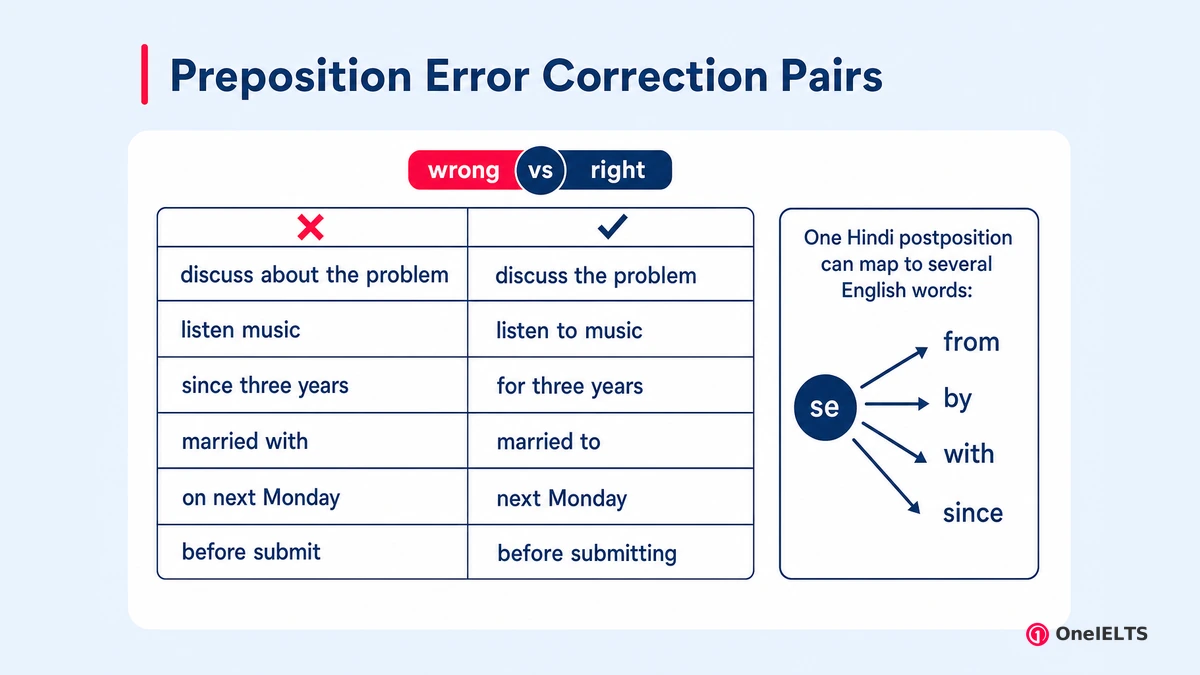
Preposition mistakes fall into three groups: an unnecessary preposition, a missing preposition and the wrong preposition. Hindi and Bengali speakers make predictable ones, because those languages put a postposition after the noun (Hindi “mein”, “par”, “se”). One Hindi postposition can map to several English words: “se” covers from, by, with and since.
That first-language transfer shapes much of Indian English. “Since three years” copies “teen saal se”, and “angry on” copies “par”. Treat this as a pattern to check for, not a statistic.
Seven mistakes cover most of what examiners see, each with the wrong and the corrected version.
- Unnecessary preposition: “discuss about the problem” becomes “discuss the problem”; “where is it at” becomes “where is it”.
- Unnecessary preposition: “off of the table” becomes “off the table”; “inside of the box” becomes “inside the box”.
- Missing preposition: “listen music” becomes “listen to music”, and “explain me” becomes “explain to me”.
- Since vs for: “since three years” becomes “for three years”, because “for” takes a length of time.
- Wrong dependent preposition: “married with” becomes “married to”; “good in” becomes “good at”; “angry on” becomes “angry with”.
- Wrong time preposition: “on next Monday” becomes “next Monday”; “in the night” becomes “at night”.
- Wrong verb form after a preposition: “before submit” becomes “before submitting”, since prepositions take the -ing form.
How Do You Practice Identifying Preposition Types?
The quickest self-test is to label the type of each preposition in a sentence, then correct a short paragraph. Both exercises use only the rules on this page, so you can treat them as a printable worksheet.
Two short exercises follow, with an answer key after them.
- Identify the type. Label the type of the bold preposition in each of these eight sentences.
- The class begins after lunch.
- Her bag is under the desk.
- The students walked into the hall.
- She solved the puzzle with ease.
- The road closed because of flooding.
- The bridge was designed by a local engineer.
- He opened the box with a knife.
- The roof of the house is red.
- Correct the errors. Fix the five preposition mistakes in this Task 1 paragraph, one per sentence.
The line graph shows bicycle sales in Pune between 2010 to 2020. Sales rose by 40,000 units in 2015, up from 30,000. They peaked on 55,000 in 2018. After that, there was a fall of sales. In the end on the period, sales stood at 45,000.
Answer key for exercise 1 (identify the type):
- after lunch: time, because it says when the class begins.
- under the desk: place, because it says where the bag is.
- into the hall: direction, because it shows movement into a space.
- with ease: manner, because it says how she solved it.
- because of flooding: cause, because it gives the reason for closing.
- by a local engineer: agent, because it names the passive’s doer.
- with a knife: instrument, because it names the tool used.
- of the house: possession, because it links the roof to its owner.
Answer key for exercise 2 (error correction):
- “between 2010 to 2020” becomes “from 2010 to 2020”, since between pairs with and.
- “rose by 40,000” becomes “rose to 40,000”, because 40,000 is the end value.
- “peaked on 55,000” becomes “peaked at 55,000”, since a point value takes at.
- “a fall of sales” becomes “a fall in sales”, since fall takes in.
- “In the end on the period” becomes “At the end of the period”.
Mark your own paragraph the same way: read it once looking only at prepositions, which catches slips a full read hides. Then move to timed practice with full IELTS Writing practice tests.
How Are Prepositions Used in IELTS Writing and Speaking?
Prepositions matter most in three places: figures and changes in Task 1 charts, locations on Task 1 maps, and dependent prepositions in Task 2 and Speaking (“impact on”, “interested in”). Examiners mark them under Grammatical Range and Accuracy in IELTS Writing Task 1, IELTS Writing Task 2 and IELTS Speaking.
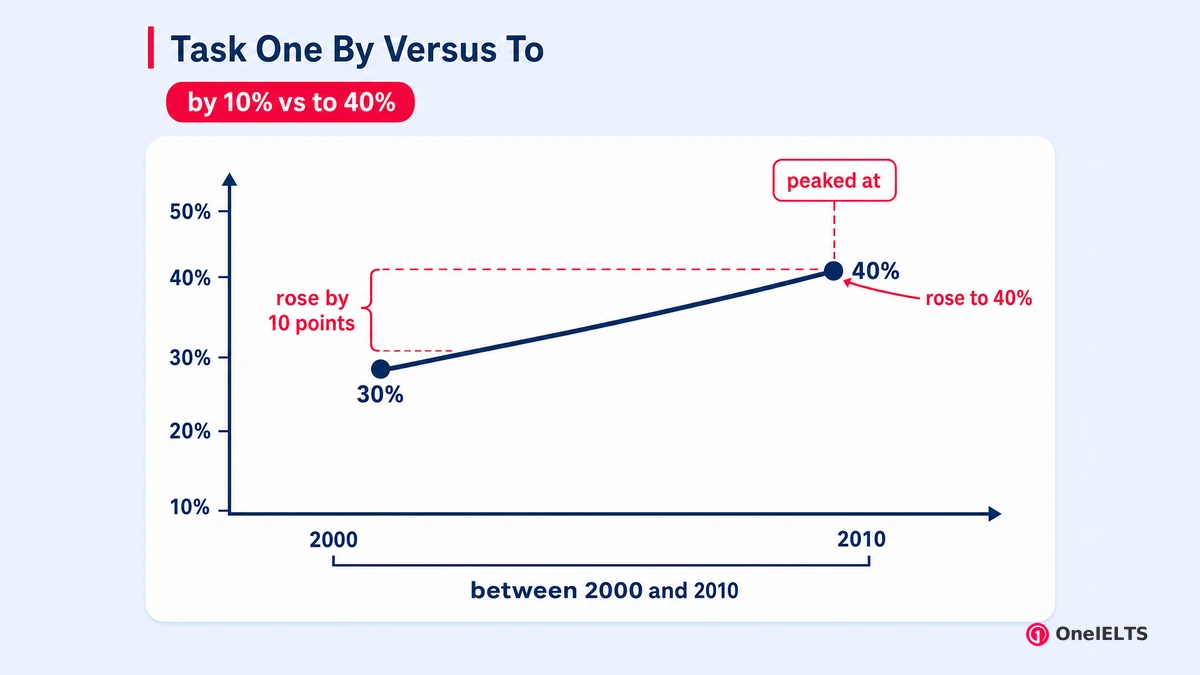
In IELTS Writing Task 1 they also decide whether the data is right, which counts under Task Achievement. Writing “rose by 40%” where the chart shows “rose to 40%” is worse than a grammar slip, because it misstates the chart.
Examiners don’t count every slip. They judge how often your sentences are error-free sentences, so a repeated preposition pattern weighs more than one stray error. The four sections below take each area in turn.
Which Prepositions Describe Trends in IELTS Writing Task 1?
The prepositions that describe trends in IELTS Writing Task 1 are the small set that fix the amount, the end point and the time frame of a change. They’re the same in a line graph and a bar chart.
Five contrasts carry most Task 1 data, each with one chart sentence.
- by vs to: “by” gives the size of a change, “to” the end value: rose by 10%, rose to 40%.
- from … to: marks the start and end: sales climbed from 20% in 2000 to 40% in 2010.
- at: gives a point value: the line peaked at 60 and stood at 25% by 2015.
- of: follows a noun of change: a rise of 10%, or an increase in sales of 10%.
- between, over, during: fix the period: prices doubled between 2000 and 2010, and over the period.
The verbs and adverbs of change sit on the IELTS Writing Task 1 vocabulary page.
Which Prepositions Describe Locations on an IELTS Task 1 Map?
The prepositions that describe locations on an IELTS Task 1 map are the position and direction phrases that place one feature relative to another. Every map description depends on relative position, and compass points fix each location.
Five groups cover a typical map, each shown in one map sentence.
- Compass position: the park lies to the north of the river, the school in the southeast corner.
- Nearness: the car park was built next to the station, beside the library and adjacent to the hospital.
- Facing and crossing: the bank stands opposite the post office, and a bridge now runs across the river.
- Along a line: shops were built along the main road, alongside the railway and parallel to the coast.
- Inside and between: a fountain sits in the center of the square, between the museum and the hotel.
“In the north of” puts a feature inside the area, while “to the north of” puts it outside, a common map-report error. Change verbs and full sentence frames sit on the IELTS map vocabulary page.
Are Preposition Errors Marked Under Grammatical Range and Accuracy?
Yes, preposition errors are marked under Grammatical Range and Accuracy, because each one makes a sentence not error-free, and the share of error-free sentences separates band 6 from band 7.
The May 2023 IELTS Writing band descriptors require frequent error-free sentences at band 7. One slip costs little, but repeated “discuss about” or “married with” errors hold a script at band 6; the mistakes list above fixes them.
Which Prepositions Trip Candidates Up in IELTS Speaking Part 1?
The prepositions that trip candidates up in IELTS Speaking Part 1 are the time and dependent prepositions used in answers about daily life, work, study and hobbies. Speaking Part 1 asks about your daily routine, work and study, and hobbies, so these slips come up in the first five minutes.
Four short pairs show the right form and the slip to avoid.
- I work in an IT company (not on), and I study at Delhi University.
- I usually read in the evening and at night, never in the night.
- I am interested in cooking, not interested on cooking at home.
- I have lived here for five years, not since five years.
Fixing them before test day protects your fluency, because you won’t stop to self-correct. Sample answers sit in the IELTS Speaking Part 1 guide.
Written by Fahimur Rahman, reviewed 7 October 2026.
Last verified: 7 October 2026