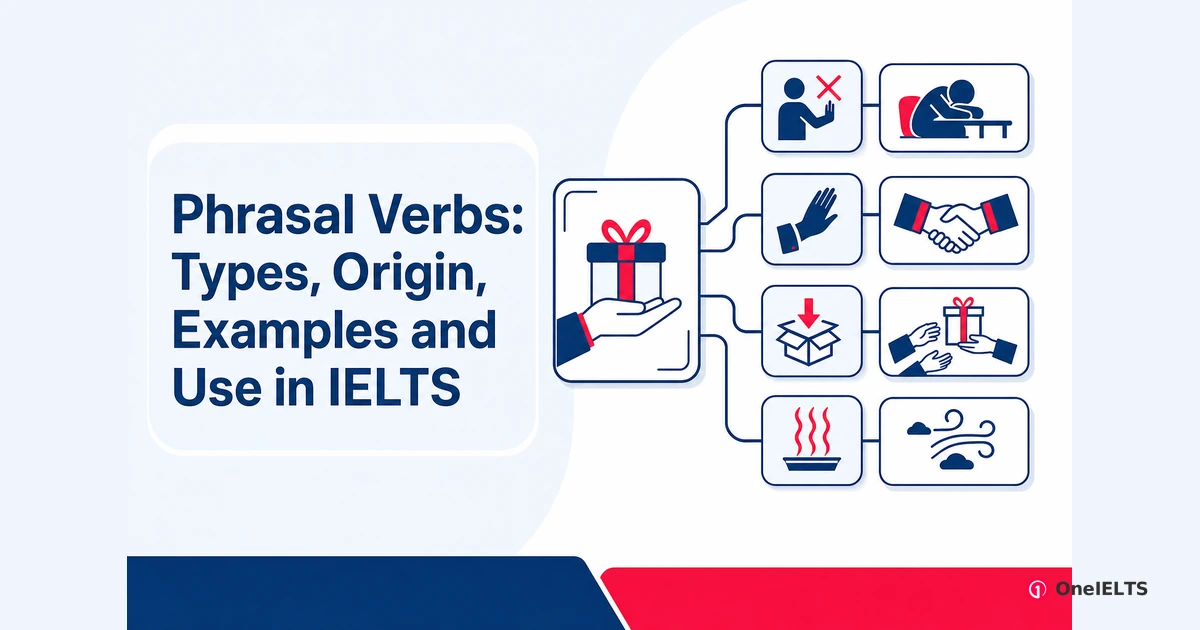
A phrasal verb joins a verb to a particle such as up, out, off or on, and builds a meaning the verb alone doesn’t carry. Give means hand over; give up means stop trying. The form is a verb plus one or two particles, and the result is often an idiomatic meaning you can’t guess from the parts.
Below are the three types of multi-word verb, objects and where a separable phrasal verb splits, then the prepositional-verb test, particle meaning, origin, noun forms, the 20 most common examples and practice. For IELTS, phrasal verbs lift Lexical Resource in IELTS Speaking, while IELTS Writing Task 2 needs a formal swap such as tolerate for put up with.
What Is a Phrasal Verb?
A phrasal verb is a verb combined with one or two particles that together act as a single verb, often with a meaning the parts don’t reveal: wake up, break down, turn on, give up. A particle is a short word such as up, down, out, off, on, in, over, away or back, acting as an adverb particle, a preposition, or both.
Linguists also say particle verb, and Cambridge uses multi-word verb as the umbrella for phrasal, prepositional and phrasal-prepositional verbs. Logan Pearsall Smith popularized the term phrasal verb in Words and Idioms (1925), crediting Henry Bradley of the Oxford English Dictionary.
Everyday spoken English is full of them, so learners meet them in conversation before any lesson in English grammar.
What Are the Types of Phrasal Verbs?
Grammarians split multi-word verbs into three types: phrasal verbs, prepositional verbs and phrasal-prepositional verbs. The small word after the verb sorts them, along with one test: whether that word can move past the object. Each type gets one structure line and two everyday examples here.
- Phrasal verbs (verb + adverb particle): give up, turn off. The adverb particle can usually move past a noun object, so “turn off the heater” and “turn the heater off” both work.
- Prepositional verbs (verb + preposition): look after, rely on. A prepositional verb keeps the preposition directly in front of its object, so “rely on your notes” never becomes “rely your notes on”.
- Phrasal-prepositional verbs (verb + particle + preposition): look forward to, put up with. A phrasal-prepositional verb never splits, and its last word is a preposition, so you say “look forward to the weekend”.
Learners also sort them a second way, as transitive or intransitive and as separable or inseparable; those labels cut across all three types, and the next section explains them.
How Do Phrasal Verbs Work With Objects?
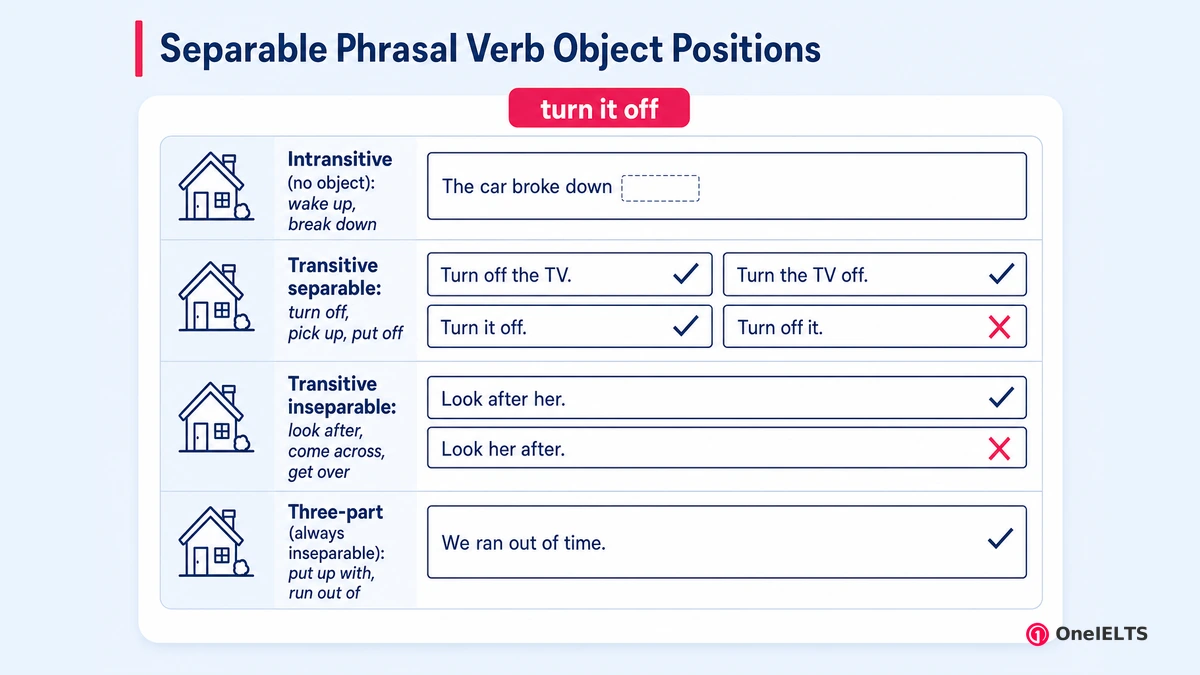
An intransitive phrasal verb takes no object: the car broke down. A transitive phrasal verb does, and with a separable phrasal verb the object can go before or after the particle, so turn off the TV and turn the TV off are both correct. A pronoun object must go between the two words: turn it off, never turn off it.
Four object patterns cover every phrasal verb you’ll meet, each with the mistake it most often invites.
| Pattern | Object position | Example | What goes wrong |
|---|---|---|---|
| Intransitive (no object): wake up, break down | No object follows; the verb ends the clause or takes an adverb | The bus broke down just outside the station. | Making it passive: “the bus was broken down” is wrong here |
| Transitive separable: turn off, pick up, put off | A noun object goes before or after the particle; a pronoun goes between | Turn off the lights, or turn the lights off. | Putting the pronoun last: “turn off it” instead of “turn it off” |
| Transitive inseparable: look after, come across, get over | The object always follows the whole verb and never splits it | She looks after her grandmother every single weekend. | Splitting the verb: “look her grandmother after” is never correct English |
| Three-part (always inseparable): put up with, run out of | The object comes after all three words, pronouns included | We ran out of time in the final task. | Dropping the last word: “I can’t put up the noise” |
Linguists call moving the particle past the object particle shift, and an inseparable phrasal verb never allows it. End weight decides which order sounds natural: a long object usually follows the particle, as in “she turned down the offer from the London firm”. Dictionaries mark the separable type with sth between the words (turn sth off), which is the fastest check you have.
How Do You Tell a Phrasal Verb From a Prepositional Verb?
Move the small word. If it can follow the object (look the word up), it’s an adverb particle and the verb is a phrasal verb. If it can’t (look the baby after is wrong), it’s a preposition and the verb is a prepositional verb.
The distinction matters because it fixes object position, pronouns included: you look it up, but you look after it. Four tests separate the two, and the first one settles most cases by itself.
- Particle movement: look it up vs look after it. A particle can follow a pronoun object, while a preposition always stays in front of the pronoun.
- Stress: the particle is stressed in a phrasal verb (she turned it DOWN), the preposition usually is not. Say the sentence aloud and listen for that stress pattern.
- Adverb insertion: an adverb can come before a preposition (look carefully after) but not before a particle. “She looked carefully after the twins” works; “she looked carefully up the word” doesn’t.
- Relative clause: a preposition can move to the front (the child after whom…), a particle cannot. In a relative clause, “the word up which I looked” is impossible English.
The same word can play both roles. Run up a bill is a phrasal verb (run it up), while run up the stairs uses a preposition, since you can’t say run the stairs up. The rules for the words themselves, their meanings and fixed pairings, live on our page about prepositions, not here.
How Does the Particle Change the Meaning of a Phrasal Verb?
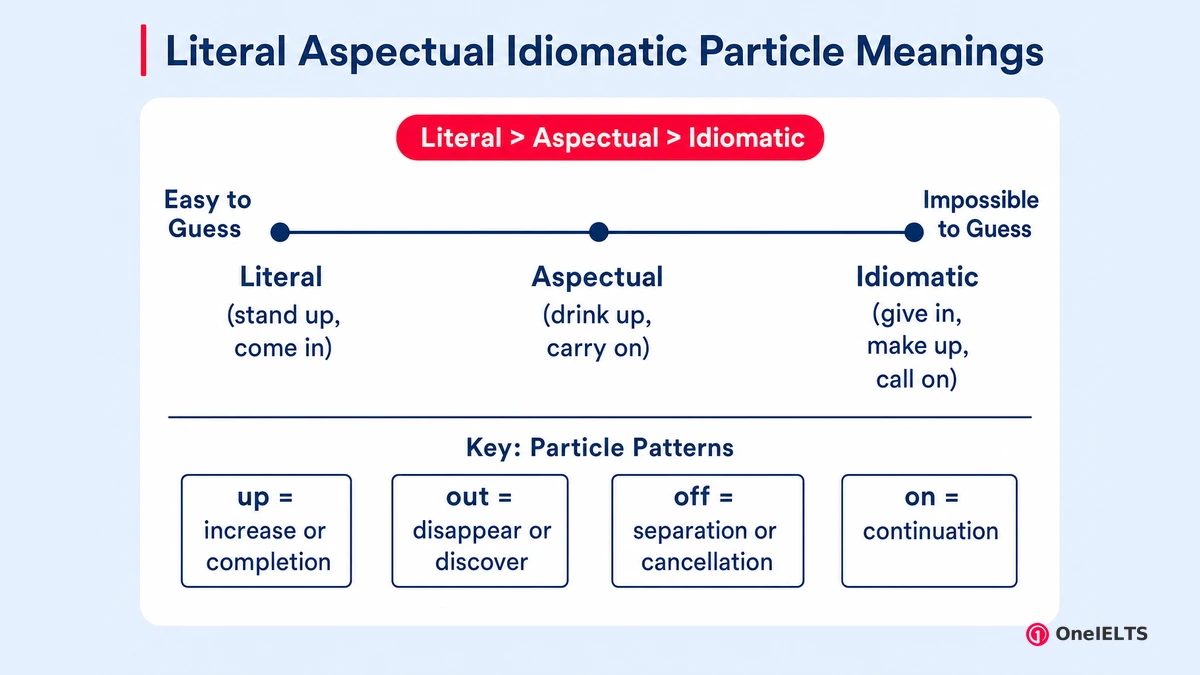
The particle keeps its literal direction, adds an aspect such as completion, or fuses with the verb into a new idiomatic meaning. Sit down and go out are literal. Eat up, use up and burn down add completion, while give up, put off and turn down an offer mean something neither word has alone. These three meaning types run from easy to guess to impossible to guess.
- Literal: the particle keeps its direction, as in stand up and come in. The literal meaning is the sum of the parts, so these phrasal verbs are the easiest to guess.
- Aspectual (completive or continuing): the particle adds completion or continuation, as in drink up and carry on. An aspectual particle changes how the action unfolds, while the action itself stays the same.
- Idiomatic: the meaning is new, as in give in, make up and call on. You can’t build an idiomatic meaning from the verb plus the particle, so learn each with a sentence.
Polysemy adds a second layer, since one phrasal verb can carry several meanings. Take off means a plane leaves the ground, you remove a coat, or a product suddenly becomes popular. Make up can mean invent, reconcile or form a total.
Some particles do follow patterns you can generalize. Up often signals increase or completion, out signals disappearing or discovering, off signals separation or cancellation, and on signals continuation.
Where Do Phrasal Verbs Come From?
Phrasal verbs are a Germanic feature of English. Old English marked many verb meanings with a verb prefix, and Middle English particle verbs grew out of those prefixed verbs, so Old English inngan became go in. By the Middle English period, particle verbs worked much as they do now, and the pattern has kept spreading since.
English isn’t alone among the Germanic languages here. German separable verbs split off the particle and send it to the end of the clause, so anrufen becomes ich rufe dich an, and Dutch uses the same split.
A few non-Germanic languages have something comparable. Italian pairs a verb with an adverb in andare via (go away) and far fuori (get rid of).
This history affects you as a learner. Speakers of languages without phrasal verbs, most Indian languages among them, tend to reach for the formal single-word verb, which sounds stiff in conversation.
How Do Phrasal Verbs Form Nouns and Adjectives?
Many phrasal verbs compound into nouns and adjectives: break down gives a breakdown, take over gives a takeover, lay off gives a layoff, and wear out gives worn-out. Eight common pairs follow, each with the spelling its compound noun or adjective takes.
| Phrasal verb | Noun or adjective | Spelling (closed, hyphenated) | Example sentence |
|---|---|---|---|
| break down | breakdown (noun) | Closed | The talks ended in a complete breakdown. |
| set back | setback (noun) | Closed | The injury was a serious setback for her. |
| break out | outbreak (noun) | Closed, particle moves first | An outbreak of flu closed the school. |
| drop out | dropout (noun) | Closed | The course has a high dropout rate. |
| check in | check-in (noun) | Hyphenated | Online check-in opens a day before departure. |
| work out | workout (noun) | Closed | She does a short workout every morning. |
| wear out | worn-out (adjective) | Hyphenated | He walked in wearing a pair of worn-out boots. |
| lay back | laid-back (adjective) | Hyphenated | Our new manager has a very laid-back style. |
Worn-out and laid-back each work as a hyphenated adjective before a noun. A stress shift sets the two forms apart: the verb stresses the particle (to break DOWN), and the noun stresses the first part (a BREAKdown).
The noun forms are often more formal, so they suit a Task 2 essay where the verb wouldn’t: an outbreak of disease, a setback for the economy. The IELTS section at the end builds on that point.
What Are the 20 Most Common Phrasal Verbs?
These 20 cover everyday conversation and appear in every frequency list of English phrasal verbs. The table pairs each one with its most common meaning, its object pattern and an example.
| Phrasal verb | Meaning | Separable? | Example sentence |
|---|---|---|---|
| wake up | stop sleeping and become alert | Yes | I wake up at six on test days. |
| get up | get out of bed | No object | She gets up before her alarm rings. |
| break down | stop working because of a fault | No object | My laptop broke down the night before the exam. |
| turn on | start a device or light | Yes | Please turn the fan on before class starts. |
| turn off | stop a device or light | Yes | Turn your phone off before you enter the room. |
| give up | stop trying to do something | Yes | Don’t give up after one low practice score. |
| give in | finally agree after refusing | No | My parents gave in and let me study abroad. |
| put off | delay something until later | Yes | He kept putting off his speaking practice. |
| put on | dress yourself in clothing | Yes | Put your jacket on; the test center is cold. |
| make up | invent a story or excuse | Yes | She made up an excuse for missing class. |
| look after | take care of someone | No | I look after my younger brother on weekends. |
| look for | try to find something | No | We’re looking for a cheaper apartment near campus. |
| find out | discover a fact or information | Yes | You can find out your result online. |
| pick up | collect someone or something | Yes | Can you pick me up from the station? |
| carry on | continue doing something | No | Carry on speaking until the examiner stops you. |
| set up | establish or arrange something | Yes | They set up a study group last month. |
| come across | find something by chance | No | I came across a useful article yesterday. |
| get on with | have a good relationship with | No | I get on with all my classmates. |
| run out of | use something until none is left | No | We ran out of time in the reading test. |
| call on | ask someone to speak or act | No | The teacher called on me to answer first. |
Longer lists of 50, 100 or 200 verbs circulate as PDFs, but 20 learned in context beat 200 memorized out of context.
How Can You Practice Phrasal Verbs With Exercises?
Learn phrasal verbs in small groups, always with an example sentence, and test yourself with gap-fill, matching and swap exercises until you can use them in speech. Group them by particle (all the up verbs) or by topic (travel, work, study). Topic groups carry over to Speaking better. Five exercise types move from recognition to speech, each with a sample item.
- Gap-fill: complete the sentence with the right particle. Sample: “The flight was late, so we set ___ at noon.” A gap-fill exercise trains the particle itself.
- Matching: pair each phrasal verb with its meaning. Sample: match put off, come across, give in and carry on to delay, find, surrender and continue.
- Swap to phrasal verb: replace a formal verb (tolerate → put up with). Sample: “I can’t tolerate the noise” becomes “I can’t put up with the noise.”
- Swap to formal verb: replace a phrasal verb (look into → investigate). Sample: “The council will look into the complaint” becomes “The council will investigate the complaint.”
- Speak it: answer a question aloud using two phrasal verbs. Sample: “How do you relax?” becomes “I work out, then catch up with friends.” Record it and check.
A matching exercise builds recognition fast, but only speaking proves you can use the verb. Keep a vocabulary notebook that records the object pattern (turn sth off) beside each example. Books and any phrasal verbs PDF are reference, not practice; the practice is what you write and say yourself.
How Should You Use Phrasal Verbs in IELTS Speaking and Writing?
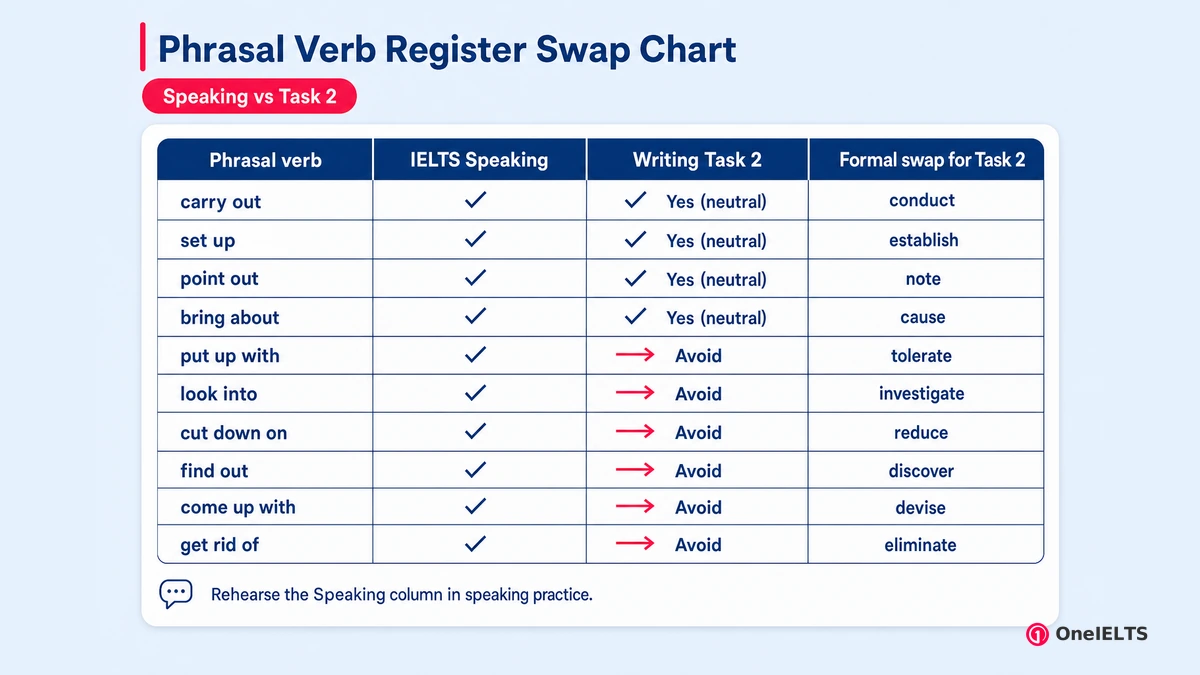
Use phrasal verbs freely and accurately in IELTS Speaking, keep to neutral ones in Academic Writing Task 2, and swap colloquial ones for a single formal verb. In a General Training letter to a friend, phrasal verbs fit the friendly tone.
In the band descriptors on ielts.org, Speaking Lexical Resource rises from “some ability to use less common and idiomatic items” at band 7 to “sustained use of accurate and idiomatic language” at band 9. The May 2023 Writing descriptors ask at band 7 for “an awareness of style and collocation”, and style is register. Checked on 7 October 2026.
Ten common phrasal verbs are mapped by skill, each with its formal verb.
| Phrasal verb | IELTS Speaking | Writing Task 2 | Formal swap for Task 2 |
|---|---|---|---|
| carry out | Yes | Yes (neutral) | conduct |
| set up | Yes | Yes (neutral) | establish |
| point out | Yes | Yes (neutral) | note |
| bring about | Yes | Yes (neutral) | cause |
| put up with | Yes | Avoid | tolerate |
| look into | Yes | Avoid | investigate |
| cut down on | Yes | Avoid | reduce |
| find out | Yes | Avoid | discover |
| come up with | Yes | Avoid | devise |
| get rid of | Yes | Avoid | eliminate |
Rehearse the Speaking column in speaking practice.
Do Phrasal Verbs Raise Your IELTS Speaking Score?
Yes, accurate and natural phrasal verbs can raise your Speaking score, because the Lexical Resource criterion rewards idiomatic vocabulary used with control, but forced or wrong ones lower it. Candidates lose marks two ways: a wrong particle (“I will look forward the trip”) and memorized phrasal verbs stuffed into one answer, which also hurts fluency.
One well-placed phrasal verb per answer convinces more than five. Our IELTS Speaking vocabulary guide groups them by topic.
Which Phrasal Verbs Fit Common IELTS Speaking Topics?
These five groups match the Part 1 topics and cue card themes candidates get most often, with three verbs each.
- Work and study: take on, catch up on, hand in. “I took on extra shifts but handed in every assignment.”
- Travel: set off, check in, look around. “We set off at dawn, then looked around the old town.”
- Family and friends: get on with, grow up, bring up. “I grew up in Pune, where my grandparents brought me up.”
- Technology: log in, back up, switch off. “I back up my files weekly and switch off at ten.”
- Health and daily routine: work out, cut down on, wake up. “I wake up early, work out and cut down on sugar.”
Match each group to the question sets in our IELTS Speaking topics guide.
Are Phrasal Verbs Too Informal for IELTS Writing Task 2?
No, not all of them. Neutral phrasal verbs such as carry out, set up and point out suit an academic essay, but colloquial ones such as put up with or get rid of read as too informal.
Test it: if a natural single-word verb with a Latin root exists (tolerate, eliminate), use it in Writing Task 2. If the phrasal verb is the normal academic register choice (carry out research), keep it. Task 1 follows suit; a General Training informal letter doesn’t. See our IELTS Writing Task 2 vocabulary list.
Are Phrasal Verbs the Same as Idioms in IELTS Speaking?
No, a phrasal verb is a single verb made of a verb and a particle, while an idiom is a fixed phrase whose meaning is figurative (once in a blue moon). Some phrasal verbs are idiomatic, but they work as verbs in the sentence.
Lexical Resource covers both as idiomatic vocabulary. A fixed expression with a figurative meaning sounds rehearsed sooner, so phrasal verbs are safer; see our English idioms for IELTS Speaking.
Written by Fahimur Rahman, reviewed 7 October 2026.
Last verified: 7 October 2026