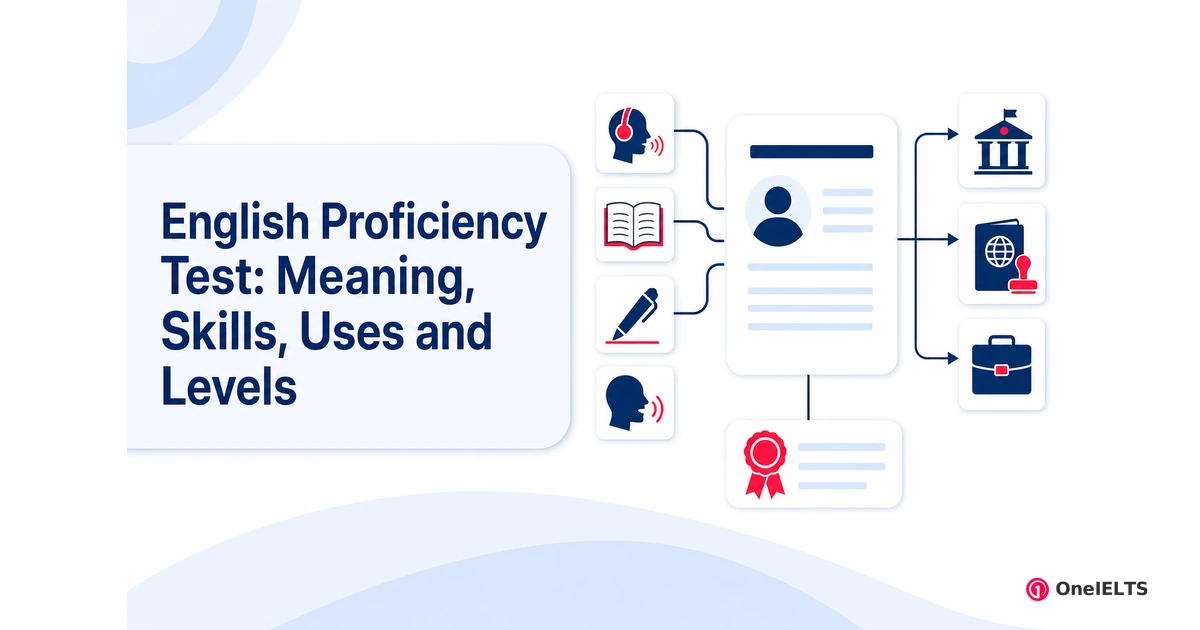
An English proficiency test measures how well a non-native speaker listens, reads, writes and speaks in English, then turns that into a score. University admissions teams, immigration authorities and employers accept that score as proof of English. Every major test scores the same four language skills, and a score only counts when it comes from a secure, recognized test such as IELTS. A free online level check isn’t proof.
This page covers English language proficiency testing: what it measures, why you’d take a test, who needs one. Then come the test groups, the A1 to C2 levels, whether IELTS is the same thing, checking your level, timing, and how IELTS compares. Test-by-test fees and head-to-head pages (IELTS vs TOEFL, CELPIP, OET, CEFR) sit elsewhere.
What Is an English Language Proficiency Test?
An English language proficiency test is a standardized exam that measures how well a non-native speaker uses English in real situations, across listening, reading, writing and speaking. It reports the result on a fixed score scale that institutions can compare.
Proficiency vs achievement is the key split. A proficiency test measures what you can do in English now, wherever you learned it, while a school exam tests a syllabus you were taught. Results come on a scale, not as pass or fail: IELTS reports bands 1 to 9 and PTE Academic reports 10 to 90. TOEFL iBT switched to a 1 to 6 scale on January 21, 2026, and adds a comparable 0 to 120 score for two years, per ETS.
Most institutions apply two-year validity because language ability changes. University and visa rules use “English language proficiency test”, “English proficiency test” and “English language test” for the same thing.
What Does an English Proficiency Test Measure?
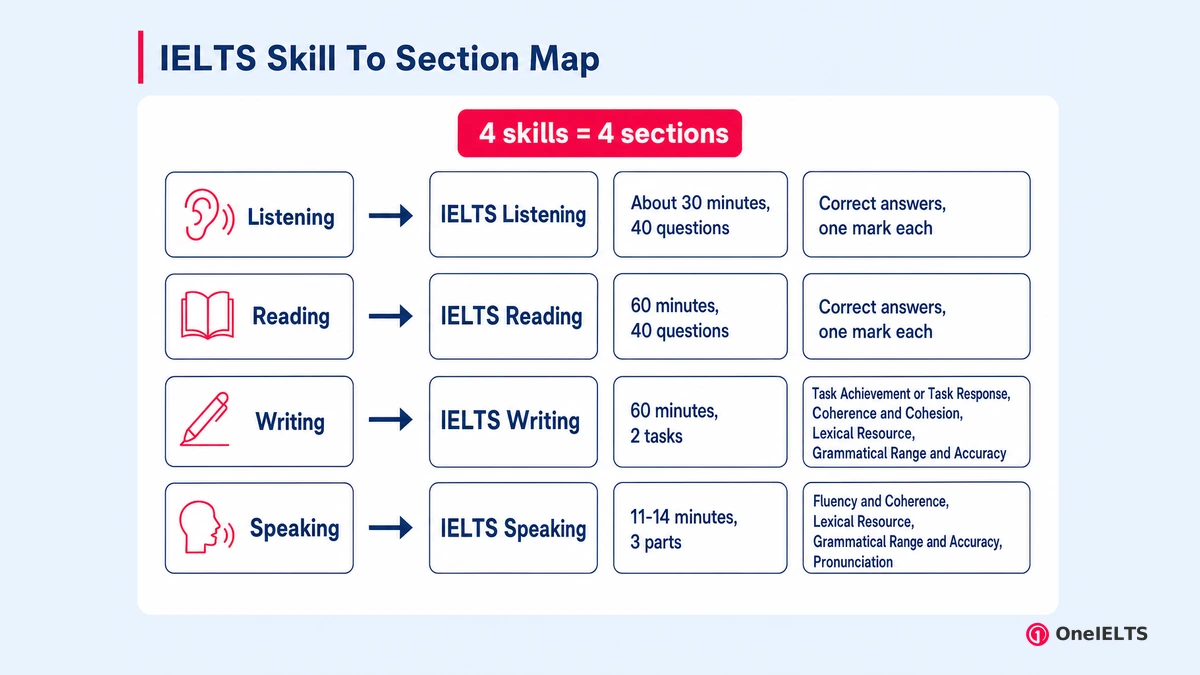
It measures four skills, Listening, Reading, Writing and Speaking, each scored separately and then combined into one overall score. Tests split ability this way because an applicant can read well and still struggle to follow a lecture, so institutions want each skill on record. This map ties each general skill to the IELTS section that tests it, with timings and marking criteria from the official IELTS test format.
| Skill | What the skill means in practice | IELTS section that measures it | IELTS timing and task count | What IELTS marks |
|---|---|---|---|---|
| Listening | Understanding spoken English in different accents and contexts, from everyday conversations to academic lectures | IELTS Listening | About 30 minutes, 40 questions | Correct answers, one mark each |
| Reading | Understanding articles, reports and long passages, including main ideas, specific detail and the writer’s view | IELTS Reading | 60 minutes, 40 questions | Correct answers, one mark each |
| Writing | Organizing ideas clearly in a report, letter or essay, with accurate grammar and precise vocabulary | IELTS Writing | 60 minutes, 2 tasks | Task Achievement or Task Response, Coherence and Cohesion, Lexical Resource, Grammatical Range and Accuracy |
| Speaking | Communicating in a live interview, answering questions, talking at length and discussing ideas without a script | IELTS Speaking | 11-14 minutes, 3 parts | Fluency and Coherence, Lexical Resource, Grammatical Range and Accuracy, Pronunciation |
Each section earns its own band, and the four bands average into the overall band. A weak Writing band therefore stays visible on the report even when the overall looks fine.
Why Take an English Proficiency Test?
You take one to prove your English to a third party that won’t accept your own word or your school marks: a university, an immigration authority, an employer or a professional regulator. The score turns your level into a number those bodies check against their rules for university admissions, a visa application, migration, employment and professional registration. Five reasons cover nearly every candidate in India.
- University admissions abroad and English-taught programs: A UK university offer letter usually sets an overall and per-skill minimum you must meet before a conditional offer becomes unconditional.
- Student, work and migration visas: Canada’s Express Entry awards points for your language result, and student or work visas for the UK and Australia often require a score.
- Employment with multinational companies and customer-facing roles: Employers hiring for overseas postings or client-facing jobs ask for a certified score rather than judging English from one interview.
- Professional registration for nurses, doctors and other regulated jobs: A nursing board such as the UK’s Nursing and Midwifery Council checks proof of English before registering an overseas nurse.
- A certified record of your own level for a CV or promotion: An independent score gives your CV a verifiable line that recruiters can compare directly against other candidates’ results.
Why Do International Students Require an English Language Proficiency Test?
Universities and visa authorities require one because they need independent, comparable evidence that you can follow lectures, write assignments and live in an English-speaking country. For some visas, the law also fixes which tests count. Admissions teams compare applicants from dozens of school systems, so one scale keeps the admissions requirement fair. A recognized test is also secure and identity-checked, which a transcript isn’t.
The UK shows how strict this gets. UK Visas and Immigration (UKVI) can require a Secure English Language Test (SELT) from approved test providers. Gov.uk lists IELTS for UKVI, LanguageCert SELT tests, PTE Academic UKVI and Trinity College London tests (checked on October 7, 2026). Your visa sponsor, usually the university, then sets its own overall and per-skill minimum on top.
A high school English mark or a medium of instruction letter satisfies some universities but rarely a visa rule. That’s why most applicants still sit a test.
Who Needs to Take an English Language Proficiency Test?
Anyone whose first language isn’t English and who’s applying to study, work or settle where English is the working language needs a test, unless the institution or visa rule grants an exemption. Four groups make up most test takers.
- International students applying to English-taught degrees: undergraduate and postgraduate applicants to universities in the UK, Canada and Australia.
- Skilled workers and migrants applying for visas or permanent residency: a skilled worker visa or PR file needs a score.
- Healthcare and other regulated professionals seeking registration: nurses and doctors in a regulated profession prove English before practicing abroad.
- Job applicants whose employer asks for certified English: overseas recruiters sometimes write a minimum score into the job offer itself.
Common exemptions cover nationals of majority English-speaking countries and applicants with a recent English-taught degree, and some universities accept a medium-of-instruction letter. Each institution or visa rule sets its own exemption, so check the exact wording of your requirement before you skip the test.
What Are the Main Types of English Proficiency Tests?
Tests fall into purpose groups: academic tests for study, general or migration tests, occupational tests for healthcare, country-specific tests such as Canada’s CELPIP, and at-home online tests, plus level-certificate exams. Each group here names one or two examples, and the fees, formats and score ranges of every test sit on the OneIELTS page on types of English tests.
- Academic tests: IELTS Academic, TOEFL iBT and PTE Academic, built for university entry.
- General and migration tests: IELTS General Training and IELTS for UKVI, for work and visas.
- Occupational tests: OET, written for nurses, doctors and other healthcare professionals.
- Country-specific tests: CELPIP, designed for Canadian immigration and citizenship.
- At-home online tests: the Duolingo English Test, taken on your own computer.
- Level-certificate exams: C1 Advanced and C2 Proficiency, part of Cambridge English Qualifications.
What Is A1, A2, B1, B2, C1, C2 in Language Proficiency?
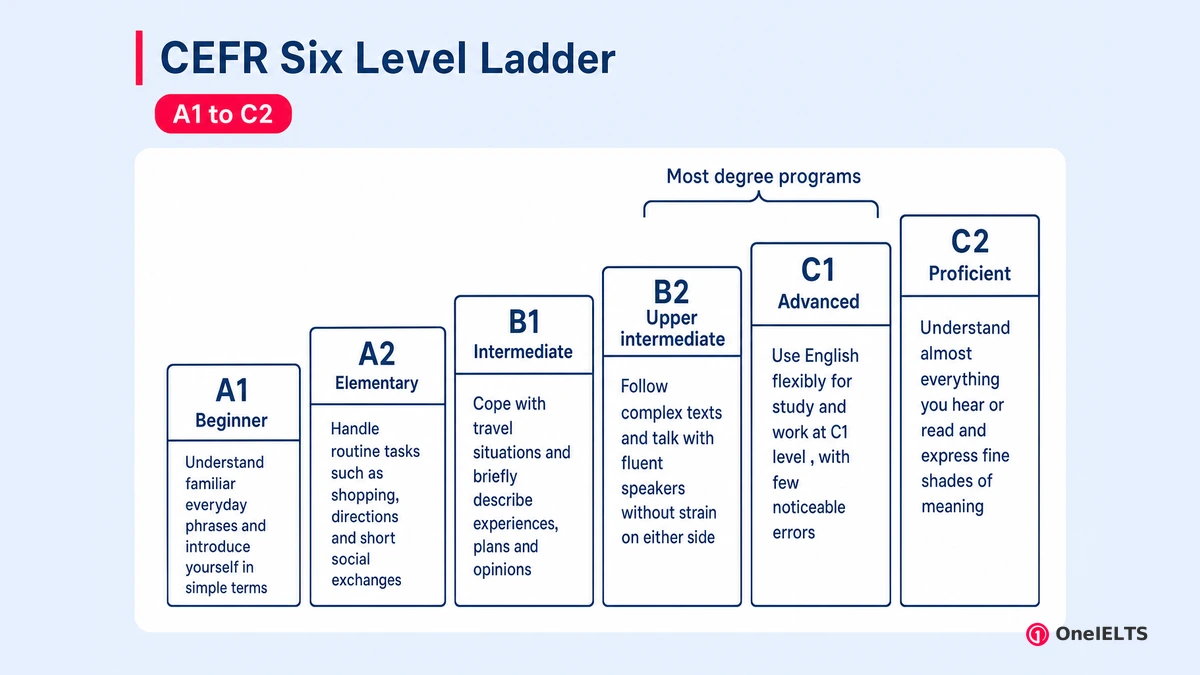
They’re the six levels of the Common European Framework of Reference for Languages (CEFR), from A1 (beginner) to C2 (proficient), and most English tests map their scores onto them. The CEFR is the common yardstick that lets a university or visa rule say “B2” and accept several different tests. Most degree programs ask for B2 or C1. Each level’s name and a one-line can-do summary appear in the table.
| CEFR level | Name | What you can do in English |
|---|---|---|
| A1 | Beginner | Understand familiar everyday phrases and introduce yourself in simple terms |
| A2 | Elementary | Handle routine tasks such as shopping, directions and short social exchanges |
| B1 | Intermediate | Cope with travel situations and briefly describe experiences, plans and opinions |
| B2 | Upper intermediate | Follow complex texts and talk with fluent speakers without strain on either side |
| C1 | Advanced | Use English flexibly for study and work at C1 level, with few noticeable errors |
| C2 | Proficient | Understand almost everything you hear or read and express fine shades of meaning |
Is IELTS the Same as English Proficiency?
No, IELTS is one English proficiency test, not the same thing as English proficiency itself; proficiency is your ability, and IELTS is one recognized way to measure and certify it. English proficiency is the skill, an English proficiency test is the category, and IELTS, the International English Language Testing System, is one test in that category. The British Council, IDP and Cambridge University Press & Assessment jointly own it.
IELTS is often treated as the default in India. It comes in IELTS Academic and IELTS General Training versions, covers study, work and migration, and reports each skill and the overall result on a band scale from 1 to 9. A requirement written as “IELTS or equivalent” means other accepted tests can stand in. There’s no separate proficiency test to pass before IELTS, because IELTS itself is the proficiency test.
How Can I Test My English Proficiency Level?
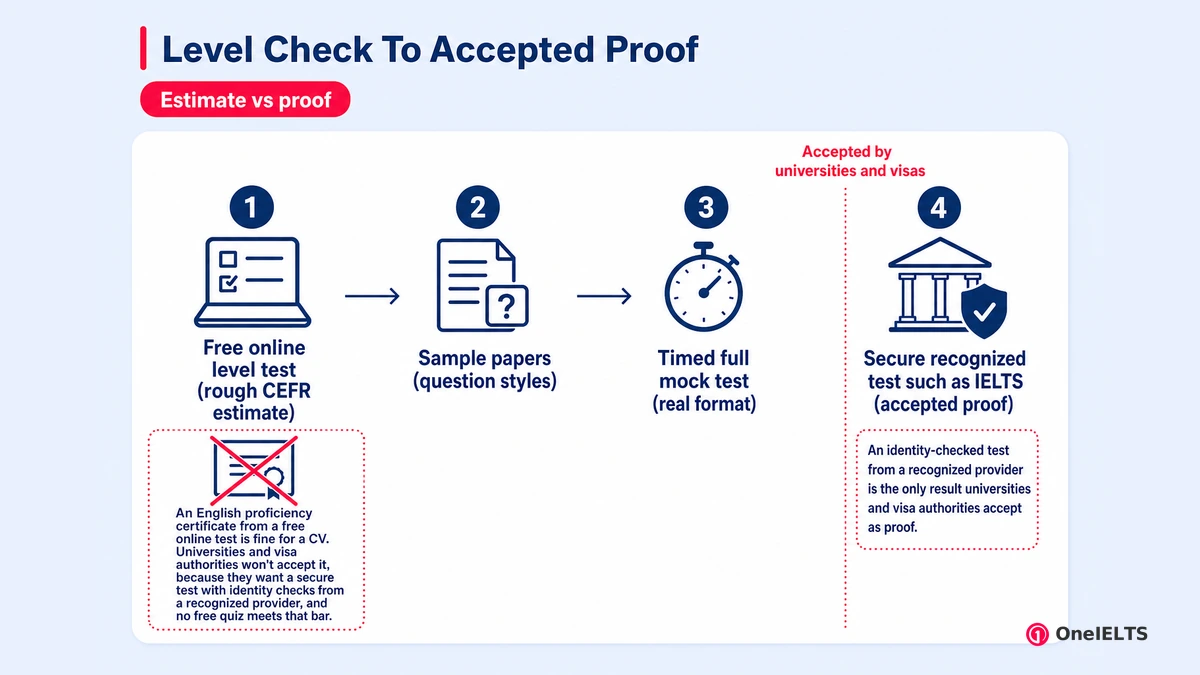
Start with a free online level test for a rough CEFR estimate, then a timed full-length practice test in your real exam format, and treat only a secure, recognized test result as proof. Each step adds reliability, because it tests more of the four skills under conditions closer to test day. The four options run from rough check to accepted proof.
- Free online level test for a quick CEFR estimate: A short online quiz returns a rough level within minutes, but most skip Writing and Speaking, so the estimate runs high.
- Sample papers and PDFs to see the question styles: Official sample papers show real question types and instructions, so you learn the format before you practice under timing.
- A timed full-length mock test in the real exam format: A free IELTS mock test under real timing shows which skill falls short and your gap to target.
- A secure, recognized test such as IELTS for an accepted result: An identity-checked test from a recognized provider is the only result universities and visa authorities accept as proof.
An English proficiency certificate from a free online test is fine for a CV. Universities and visa authorities won’t accept it, because they want a secure test with identity checks from a recognized provider, and no free quiz meets that bar.
When Should You Take an English Proficiency Test?
Take it about three to six months before your earliest application deadline or visa deadline, so the score arrives in time and you still have room for one retake. Result turnaround is short. Computer-delivered IELTS returns results in 1 to 5 days, and the version with Writing on paper within 5 days, per ielts.org.
Don’t test too early, either. Most universities and visa offices apply two-year validity. A result older than two years on the date they check it is normally rejected, and the IELTS score validity page covers the country rules.
If one skill falls short, the IELTS One Skill Retake lets you resit just that skill within 60 days of a test taken on computer, and IDP India offers it in every Indian city. IRCC doesn’t accept a One Skill Retake for Express Entry, though.
How Does IELTS Compare With Other English Proficiency Tests?
IELTS measures the same four skills as other major tests, but it’s widely accepted across study, work and migration, it keeps a face-to-face Speaking test, and it reports band 1-9 scores for each skill.
Four features set it apart. It comes in Academic and General Training versions. Paper or computer delivery now means a computer test with the option to handwrite Writing on paper, since the British Council no longer offers fully paper-based IELTS. Speaking is a live conversation with a trained examiner.
IELTS says over 13,500 institutions accept its results, more than any other English test. Each question below points to its own comparison page.
What English Proficiency Level Does Each IELTS Band Score Show?
The IELTS band ranges that line up with each CEFR level are roughly B1 at 4-5, B2 at 5.5-6.5, C1 at 7-8 and C2 at 8.5-9. IELTS publishes this CEFR alignment but says its bands never match CEFR transition points exactly. It flags 6.5 as borderline C1. That alignment explains why a B2 requirement often reads “IELTS 6.0 or 6.5”. IELTS vs CEFR maps every band range.
Is IELTS or TOEFL the Better English Proficiency Test?
No, neither test is better for everyone. IELTS suits most UK, Australian, Canadian and Irish applicants and anyone who prefers a face-to-face Speaking test, while TOEFL iBT suits applicants aiming mainly at North American universities. TOEFL focuses heavily on North American academic English and uses recorded Speaking on a computer. It now reports a 1 to 6 scale plus a comparable 0-120 score. Details sit in IELTS vs TOEFL.
Can CELPIP Replace IELTS for Canadian Immigration?
Yes, CELPIP-General is accepted by IRCC for Canadian permanent residence and citizenship, so it can replace IELTS General Training for most economic immigration programs. It’s built for immigration, so check your university’s admission list before using it for study. Both tests convert to Canadian Language Benchmark (CLB) levels, and Express Entry awards points on the CLB result. The CELPIP vs IELTS page carries the conversion.
Is OET an Alternative to IELTS for Healthcare Professionals?
Yes, OET (Occupational English Test) is accepted instead of IELTS by many healthcare regulators, for example in the UK, Australia, Ireland and New Zealand. It covers nurses, doctors and other clinicians because its tasks use real clinical scenarios.
The UK’s Nursing and Midwifery Council and General Medical Council both list it. Each healthcare regulator decides by profession, so check your board’s list before nursing registration, and compare both in IELTS vs OET.
Is IELTS Costly Compared With Other English Proficiency Tests?
No, IELTS is not unusually costly. Its fee in India sits in the same range as TOEFL iBT and PTE Academic. At-home tests such as the Duolingo English Test cost less but are accepted by fewer institutions and visa authorities.
The IELTS fee in India is INR 19,000, per IDP India (checked on October 7, 2026). IELTS for UKVI carries a test fee of INR 19,250. Booking steps sit on IELTS registration and fees.
Written by Fahimur Rahman, reviewed 7 October 2026.
Last verified: 7 October 2026