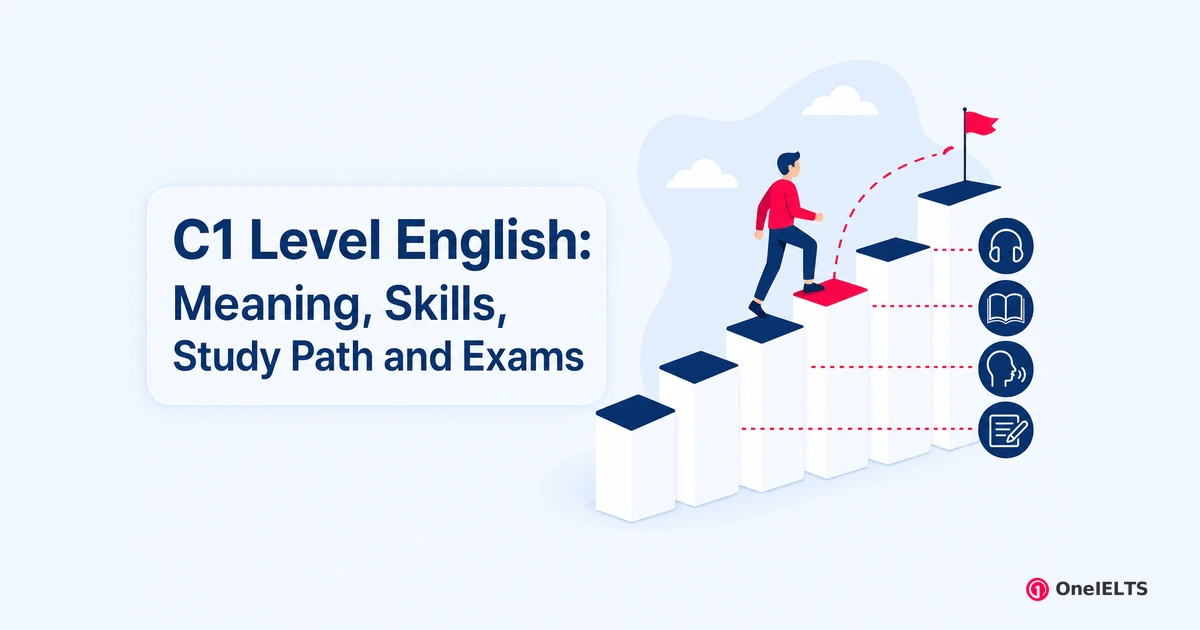
C1 marks the point on the Common European Framework of Reference (CEFR) where you stop working around English and start using it flexibly for study, work and complex social situations. It’s the fifth of six levels, the lower proficient user level, and the Council of Europe labels it Effective Operational Proficiency.
This guide covers what C1 means, where it sits, the can-do skills, grammar, examples and the B2 and C2 comparison. Then come self-checks, the study path, timing, common blocks and exams such as C1 Advanced. It closes on the IELTS band C1 matches and the criterion each skill feeds. The full score conversion lives on our IELTS vs CEFR page.
What Does C1 Level English Mean?
C1 level English is the fifth level of the Common European Framework of Reference, called Advanced or Effective Operational Proficiency. At C1 you understand demanding, longer texts and catch implicit meaning. You speak fluently and spontaneously, and you write clear, detailed text on complex subjects.
The Council of Europe published the CEFR in 2001 and extended it with the Companion Volume in 2020. The scale is language-neutral, so the same label describes learners of German, French or Spanish, which is why “C1 level German” is a common search too. For English, it means the same thing everywhere.
C1 describes what you can do, not a test score. In practice, this advanced level opens university study in English, professional work in English, and most employer and admissions requirements written as “advanced”.
Where Does C1 Fit in the CEFR Scale?
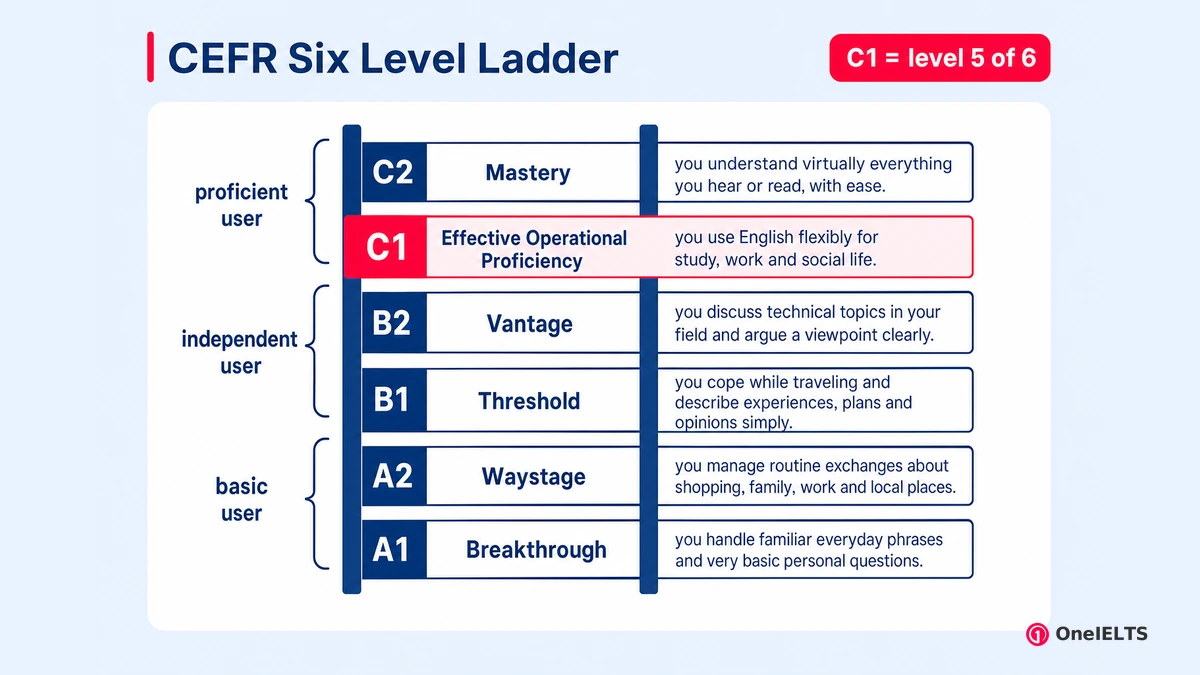
The CEFR groups six levels into three bands: basic user (A1, A2), independent user (B1, B2) and proficient user (C1, C2), with C1 as the fifth step. Read from the bottom up, the six official labels run from first contact with English to near-native control.
- A1 Breakthrough: you handle familiar everyday phrases and very basic personal questions.
- A2 Waystage: you manage routine exchanges about shopping, family, work and local places.
- B1 Threshold: you cope while traveling and describe experiences, plans and opinions simply.
- B2 Vantage: you discuss technical topics in your field and argue a viewpoint clearly.
- C1 Effective Operational Proficiency: you use English flexibly for study, work and social life.
- C2 Mastery: you understand virtually everything you hear or read, with ease.
The CEFR also has plus levels, such as A2+, B1+ and B2+, which sit between two main levels. They already appeared in the 2001 framework, and the 2020 Companion Volume strengthened their descriptors. There’s no official C1+; you’ll see “C1+” online as informal shorthand for a strong C1.
What Can You Do at C1 Level, Skill by Skill?
The CEFR describes each level through can-do statements, and a C1 user follows extended speech, reads between the lines, speaks spontaneously and writes structured text on complex subjects. Each skill carries its own C1 statements from the Council of Europe, paraphrased here in plain English.
- Listening: You follow extended speech, lectures and podcasts on abstract topics, even when the speaker only implies how ideas connect. You catch the point of a debate without signposts like “firstly”, and you can follow fast conversation between other people, though an unfamiliar accent still slows you.
- Reading: You read long, demanding texts, from academic articles to literary fiction, and recognize implicit meaning, attitude and tone. You understand specialized articles outside your own field, checking only the odd technical term. You notice when a writer is being ironic or quietly critical of an idea.
- Speaking: You express ideas fluently and spontaneously, without much obvious searching for expressions. You adjust register for a job interview, a seminar or a dinner with friends. Spontaneous speech at C1 still includes the occasional pause or slip, yet it doesn’t sound rehearsed or effortful to the listener.
- Writing: You produce clear, well-structured, detailed text on complex subjects, such as a report, an argumentative essay or a formal complaint. You show controlled use of connectors and cohesive devices, so paragraphs link logically without a fixed template, and you pick the tone your reader expects.
The 2020 Companion Volume also added descriptor scales for mediation: summarizing or relaying what someone else said or wrote, like explaining a lecture’s argument to a classmate. None of the four C1 guides ranking for this search mention it.
The exact speaking wording matters. The CEFR global scale says a C1 user speaks “without much obvious searching for expressions”, while Google’s AI Overview shortens that to “without searching for words”. The shorter version overstates the level. C1 speakers still pause, rephrase and slip now and then, and if you expect zero hesitation you’ll under-rate yourself.
What Grammar and Vocabulary Does C1 Level English Use?
C1 grammar and vocabulary differ from B2 in range and control rather than new rules. You already know the structures; at C1 you choose between them for precision, emphasis and register. Eight features show that choice at work, each with a short example sentence.
- Inversion for emphasis: you front a negative adverb and invert the verb, as in “Rarely have we seen prices rise so fast.”
- Cleft sentences: you split a sentence to spotlight one part, as in “What surprised me most was the cost,” not “The cost surprised me.”
- Mixed conditionals: you link a past condition to a present result, as in “If I had taken that job, I’d be living in Toronto now.”
- Advanced passive and reporting structures: you report claims impersonally, as in “The policy is thought to have reduced traffic,” which keeps the tone academic.
- Collocations and fixed phrases: you pair words the way fluent users do, such as “pose a threat”, “draw a conclusion” and “a sharp decline”.
- Idiomatic and phrasal verbs: you use phrasal verbs by register, saying “The plan fell through” in conversation but “The plan was abandoned” in a report.
- Hedging and stance language: you soften claims with hedging such as “This appears to suggest”, showing exactly how certain you are about the evidence.
- Formal and informal register control: you switch on purpose, writing “I would appreciate a prompt reply” to a manager and “Let me know soon” to a friend.
This page doesn’t reteach either topic. For the structures themselves, see English grammar for IELTS. To build range, improve your English vocabulary with a method rather than word lists.
What Do C1 Level English Examples Look Like?
You’ll recognize C1 faster from example sentences than from a descriptor, because the difference sits in small choices. Each row pairs a B2 version with a C1 version of the same idea, and the final row is a short conversation turn, the kind of reply you’d give in a speaking test.
| Situation | B2 version | C1 version | What changed |
|---|---|---|---|
| Giving an opinion | I think online learning is good because it is flexible. | I’d argue that online learning’s real strength is its flexibility. | Stance verb and noun phrase replace “I think” |
| Disagreeing politely | I don’t agree with you about this. | I see your point, but I’m not entirely convinced. | Concession first, then a softer disagreement |
| Describing a trend | Sales went up a lot in 2024. | Sales rose sharply in 2024, peaking in the final quarter. | Collocation “rose sharply” replaces “went up a lot” |
| Hedging a claim | Social media causes anxiety in teenagers. | Social media appears to contribute to anxiety among some teenagers. | Hedging limits the claim to the evidence |
| Short spoken reply (“Do you enjoy cooking?”) | Yes, I like cooking very much. | Not as much as I’d like to, to be honest; I rarely have time. | Idiomatic register and a reason, not a bare yes |
Notice that no C1 version uses rarer words for their own sake. The collocation, the hedging and the register do the work.
How Does C1 Compare With B2 and C2 English Levels?
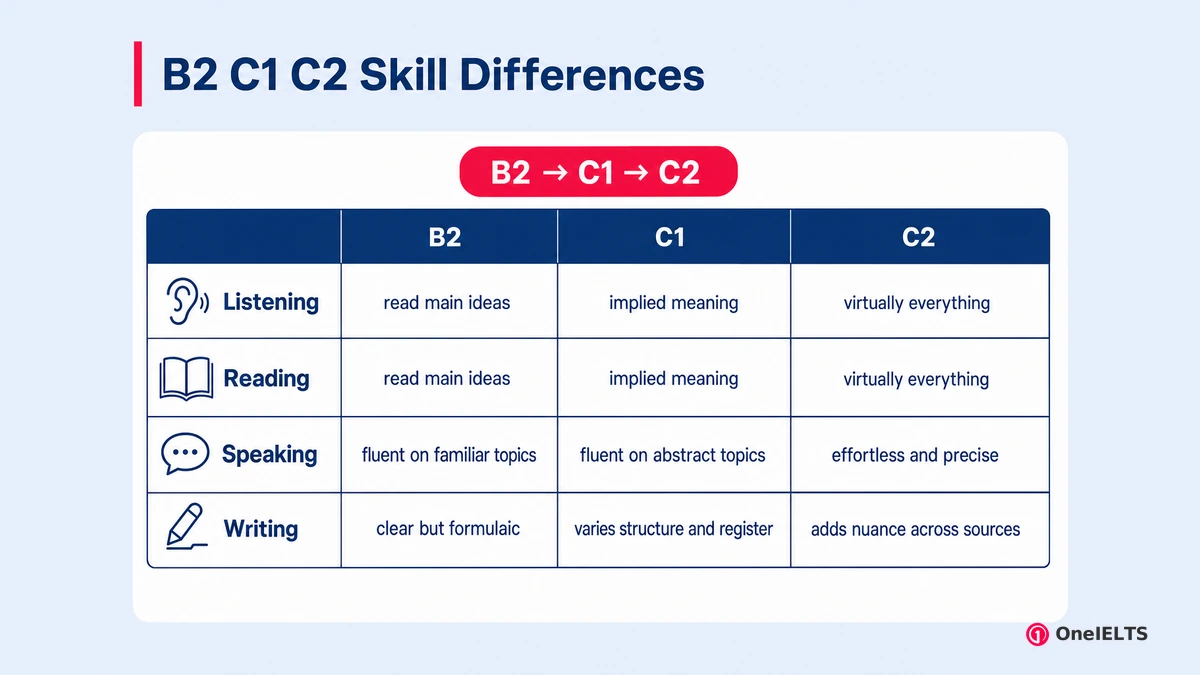
C1 is a step above B2 in flexibility and precision and a step below C2 in ease and nuance; C1 handles almost every real purpose fluently, while C2 is near-effortless mastery. The two neighboring comparisons show where each gap appears across all four skills.
- B2 vs C1: A B2 Upper-Intermediate learner follows standard speech and the main ideas of complex texts, while a C1 user also catches what’s implied. B2 speaking is fluent on familiar topics but searches for words on abstract ones; C1 covers both. B2 writing is clear but formulaic, and C1 writing varies structure and register for the reader.
- C1 vs C2: C1 understands demanding texts, and C2 understands virtually everything heard or read, with ease. A C1 speaker occasionally reaches for an expression, while a C2 speaker conveys fine shades of meaning with precision. In writing, C1 controls structure and register; C2 adds nuance and can merge several sources into one argument. C2 listening copes with any accent or speed.
Is C1 or C2 fluent? Both are. C1 is functional fluency, meaning you manage almost any real situation with occasional effort, while C2 is precise, effortless fluency. Is C1 Advanced or fluent? Advanced is the level’s common label, and fluency is part of what that label describes.
C2 is the top of the CEFR, labeled Mastery, and Cambridge English names its exam at that level C2 Proficiency. A C2 user can summarize information from different spoken and written sources and reconstruct the arguments in one coherent account.
How Can You Tell If You Are at C1 Level in English?
You can check your level two ways: a self-assessment against the CEFR can-do statements, or a test result from a recognized exam. The Council of Europe’s self-assessment grid is the official version, and these five questions condense its C1 column into checks you can answer honestly today.
- Can you follow a lecture or podcast on an unfamiliar topic without subtitles, for 20 minutes straight?
- Can you read an opinion article and name the writer’s attitude, not just the facts it reports?
- Can you argue a point for two minutes without rehearsing it or stopping to plan sentences?
- Can you switch between formal and informal register on purpose, in speech and in writing?
- Can you write a 250-word argument that holds together without a template or memorized phrases?
A free online level test such as EF SET gives you a CEFR estimate. It isn’t the certificate an admissions office asks for; that comes from a recognized exam, covered in the next two sections. Self-assessment also tends to over-rate speaking and under-rate writing, so test the skill you feel surest about hardest.
How Do You Reach C1 Level English?
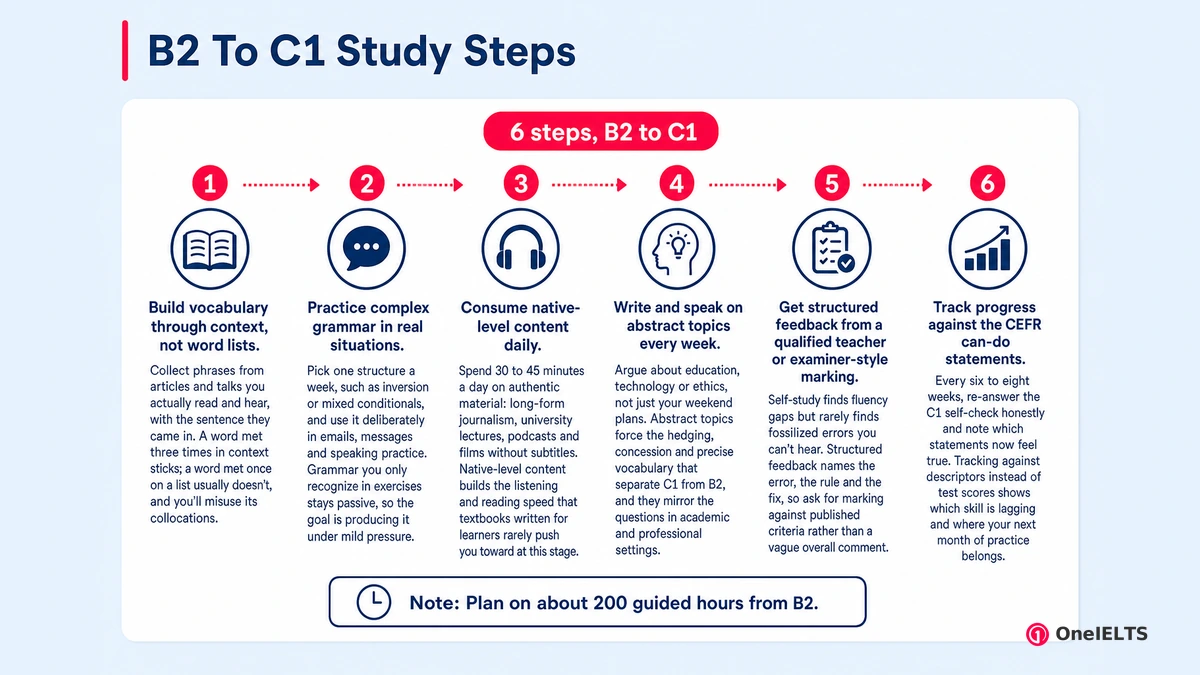
Moving from B2 to C1 is a shift from studying English to using authentic material in it, with deliberate feedback on accuracy. Start the six steps in this order, since each one feeds the next.
- Build vocabulary through context, not word lists. Collect phrases from articles and talks you actually read and hear, with the sentence they came in. A word met three times in context sticks; a word met once on a list usually doesn’t, and you’ll misuse its collocations.
- Practice complex grammar in real situations. Pick one structure a week, such as inversion or mixed conditionals, and use it deliberately in emails, messages and speaking practice. Grammar you only recognize in exercises stays passive, so the goal is producing it under mild pressure.
- Consume native-level content daily. Spend 30 to 45 minutes a day on authentic material: long-form journalism, university lectures, podcasts and films without subtitles. Native-level content builds the listening and reading speed that textbooks written for learners rarely push you toward at this stage.
- Write and speak on abstract topics every week. Argue about education, technology or ethics, not just your weekend plans. Abstract topics force the hedging, concession and precise vocabulary that separate C1 from B2, and they mirror the questions in academic and professional settings.
- Get structured feedback from a qualified teacher or examiner-style marking. Self-study finds fluency gaps but rarely finds fossilized errors you can’t hear. Structured feedback names the error, the rule and the fix, so ask for marking against published criteria rather than a vague overall comment.
- Track progress against the CEFR can-do statements. Every six to eight weeks, re-answer the C1 self-check honestly and note which statements now feel true. Tracking against descriptors instead of test scores shows which skill is lagging and where your next month of practice belongs.
How Long Does It Take to Reach C1?
Cambridge English estimates roughly 700 to 800 guided learning hours from zero to C1, and about 200 more from a solid B2, since its figures are cumulative and each level adds around 200 hours. Checked on 7 October 2026.
Guided learning hours count lessons and supervised study, so self-study and immersion sit on top of them, and real timelines vary widely. Daily exposure, regular feedback and a deadline such as a test date speed things up. Studying only grammar and avoiding speaking slow you down and keep you on the B2 plateau.
As an estimate, not a promise: at 8 to 10 hours a week, those 200 hours take about 5 to 6 months from a solid B2.
What Common Challenges Block C1, and How Do You Overcome Them?
Many learners stall at B2 because they can already communicate, so the pressure to improve disappears. Five blocks keep showing up, and each has a fix you can start this week.
- The intermediate plateau: you get your meaning across, so progress feels invisible. Fix it with a measurable target, such as a test date or a monthly recorded talk, that exposes gaps your daily routine hides.
- Formal vs informal register: many B2 learners write emails the way they speak. Fix it by rewriting one message in both registers every week, so switching becomes a habit rather than a guess.
- Accuracy vs fluency balance: fluent speakers stop correcting themselves, and accurate speakers stop talking. Fix it by alternating practice: one session for speed without stopping, the next for slow, corrected accuracy on the same topic.
- Passive vocabulary that never becomes active: you recognize thousands of words but use a few hundred. Fix it by using five new phrases in your own sentences each day, so they move into your active vocabulary.
- Avoiding difficult structures: learners steer around the grammar they fear, so it never improves. Fix it by forcing one avoided structure into every piece of writing until a teacher stops flagging it as an error.
Which Exams Certify C1 Level English?
Two kinds of exam can prove C1: a C1-specific exam you pass or fail at one level, or a multi-level test whose score you map to the CEFR. The five exams here cover both kinds, with the score that signals C1 for each non-IELTS test.
- C1 Advanced: Cambridge’s level-specific exam, reported on the Cambridge English Scale, where a score of 180 to 199 signals C1.
- IELTS: a multi-level test reported in bands from 0 to 9; the band range that matches C1 is in the IELTS section.
- TOEFL iBT: ETS’s academic test, reported on a 1 to 6 scale since January 2026, where bands 5 and 5.5 align with C1.
- PTE Academic: Pearson’s computer-based test scored from 10 to 90, and Pearson’s CEFR alignment chart places C1 at about 76 to 84.
- EF SET: a free online test where 61 to 70 indicates C1; it gives an unproctored estimate, not a secure exam result.
Score bands were checked on the ETS, Pearson, Cambridge and EF SET sites on 7 October 2026. For TOEFL, bands 5 and 5.5 equal roughly 95 to 113 on the old 0 to 120 scale. For the full side-by-side of formats and fees, see English tests accepted by universities.
What Is C1 Level English in IELTS?
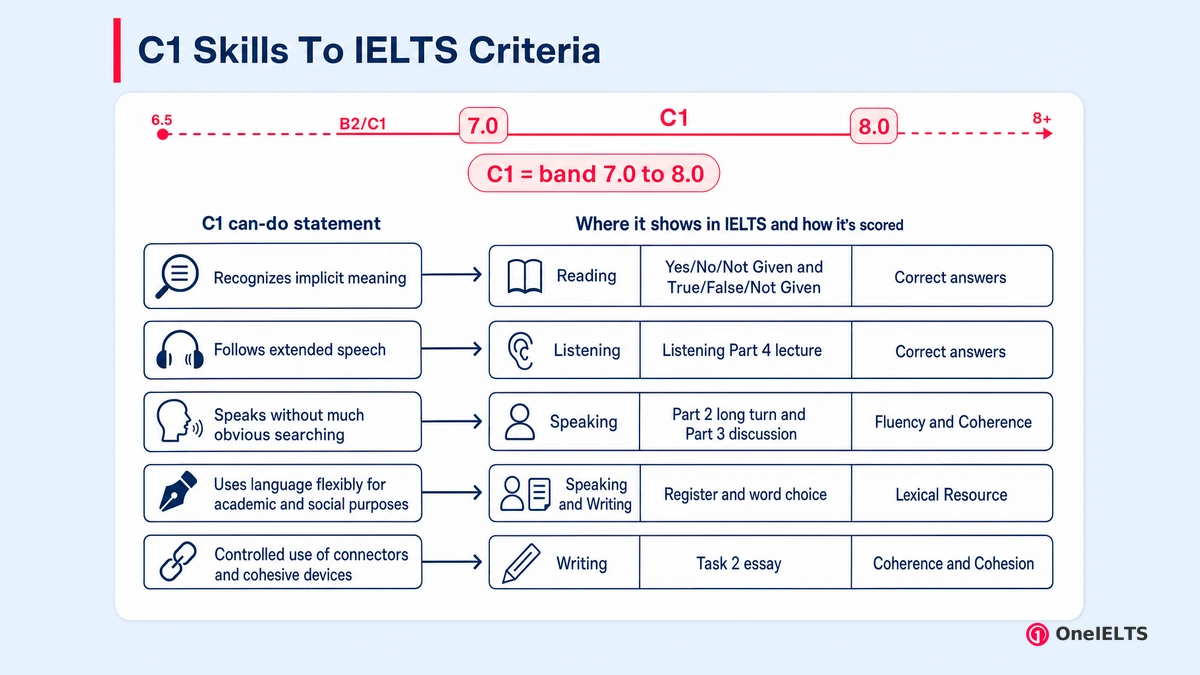
C1 corresponds to roughly IELTS band 7.0 to 8.0 on the CEFR alignment that IELTS publishes for overall band scores, checked on ielts.org on 7 October 2026. Some summaries, including Google’s AI Overview at 6.5 to 7.5, quote a lower range because band 6.5 sits on the B2/C1 boundary. IELTS’s own research puts the C1 threshold between 6.5 and 7 and treats band 8 as borderline C2. Our IELTS vs CEFR score comparison has the full conversion.
The band is only half the picture. Each C1 can-do statement shows up in a specific IELTS section and question type, and it’s scored either by correct answers or by a named marking criterion. The table traces five of them.
| C1 can-do statement | IELTS section | Where it shows (task or question type) | Marking criterion or score basis |
|---|---|---|---|
| Recognizes implicit meaning | Reading | Yes/No/Not Given and True/False/Not Given | Correct answers |
| Follows extended speech | Listening | Listening Part 4 lecture | Correct answers |
| Speaks without much obvious searching | Speaking | Part 2 long turn and Part 3 discussion | Fluency and Coherence |
| Uses language flexibly for academic and social purposes | Speaking and Writing | Register and word choice | Lexical Resource |
| Controlled use of connectors and cohesive devices | Writing | Task 2 essay | Coherence and Cohesion |
Read the table as a diagnosis tool. If you miss Not Given items, the gap is implicit meaning, not vocabulary.
How Do C1 Writing Skills Show in IELTS Writing?
The C1 writing skills are the ones the band descriptors reward at band 7 and above. That means a clear position developed across the essay, cohesion that is controlled rather than mechanical, and a range of less common vocabulary used with only occasional errors.
The C1 trap in a Task 2 essay is overusing linking words. The IELTS Writing band descriptors set the limit at band 6, where mechanical cohesion appears as “faulty or mechanical due to misuse, overuse or omission”.
How Do C1 Speaking Skills Show in the IELTS Speaking Test?
The C1 speaking skills show up as long, coherent answers in Part 2 and Part 3, speech that flows with only occasional content-related hesitation, and idiomatic language used with awareness of style.
In the Part 2 long turn and the Part 3 discussion, band 7 allows some hesitation, and at band 8 most hesitation is about content. That’s deliberate: nobody expects a C1 speaker to sound scripted, so memorized answers usually score lower. See band 7 in IELTS Speaking.
Is C1 Level English Good Enough for IELTS?
Yes, a genuine C1 user meets the band most universities and professional bodies ask for, though a candidate who is C1 overall can still lose half a band in the weakest section. University requirements and professional registration rules set a minimum component score as well as an overall band, so check your lowest section, not the average. Find out what counts as a good IELTS score for your goal.
Can a Free C1 Level English Test Online Predict Your IELTS Band?
No, a free online level test estimates your CEFR level from mostly reading and listening items, while an IELTS band also depends on examiner-marked Writing and Speaking under timed conditions. An online level test gives a CEFR estimate, nothing more. A full, timed IELTS mock test is the closer predictor, because it uses the real format and all four sections.
Written by Fahimur Rahman, reviewed 7 October 2026.
Last verified: 7 October 2026