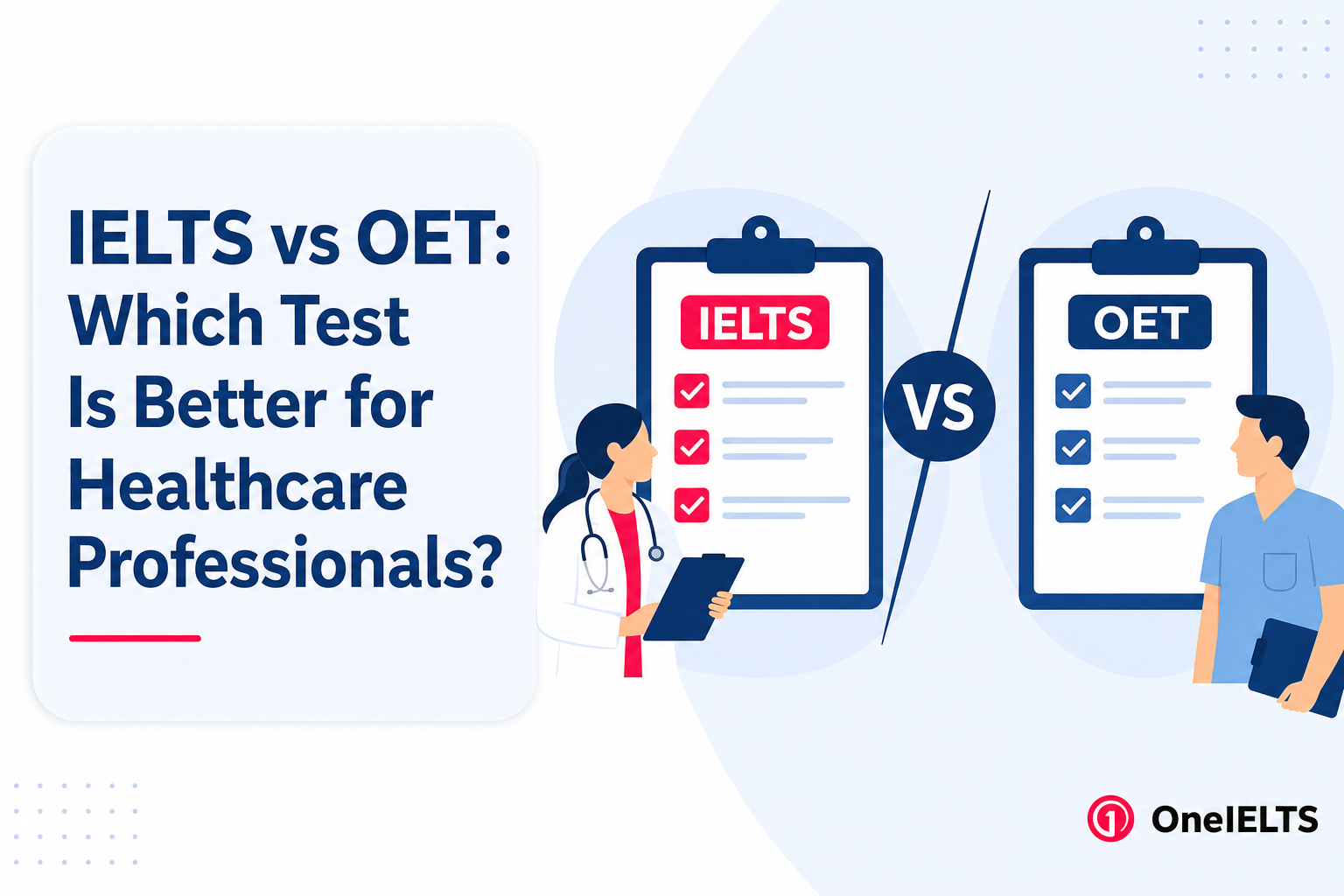
If you’re a nurse or doctor registering to work abroad, the better test is usually the one whose content matches your day job. IELTS vs OET comes down to fit, not difficulty.
OET sets every task in a clinical setting — reading patient notes, writing a referral letter — while IELTS measures healthcare English only indirectly, testing general and academic English across four skills. OET is the Occupational English Test, built for 12 healthcare professions; IELTS is the broader exam used for study, work, and migration. The NMC accepts both, so this guide walks through what each test is, the differences between them, which feels easier, how OET grades map to IELTS bands, and how to choose.
Last verified: 30 June 2026
What Is IELTS and How Does It Compare to OET?
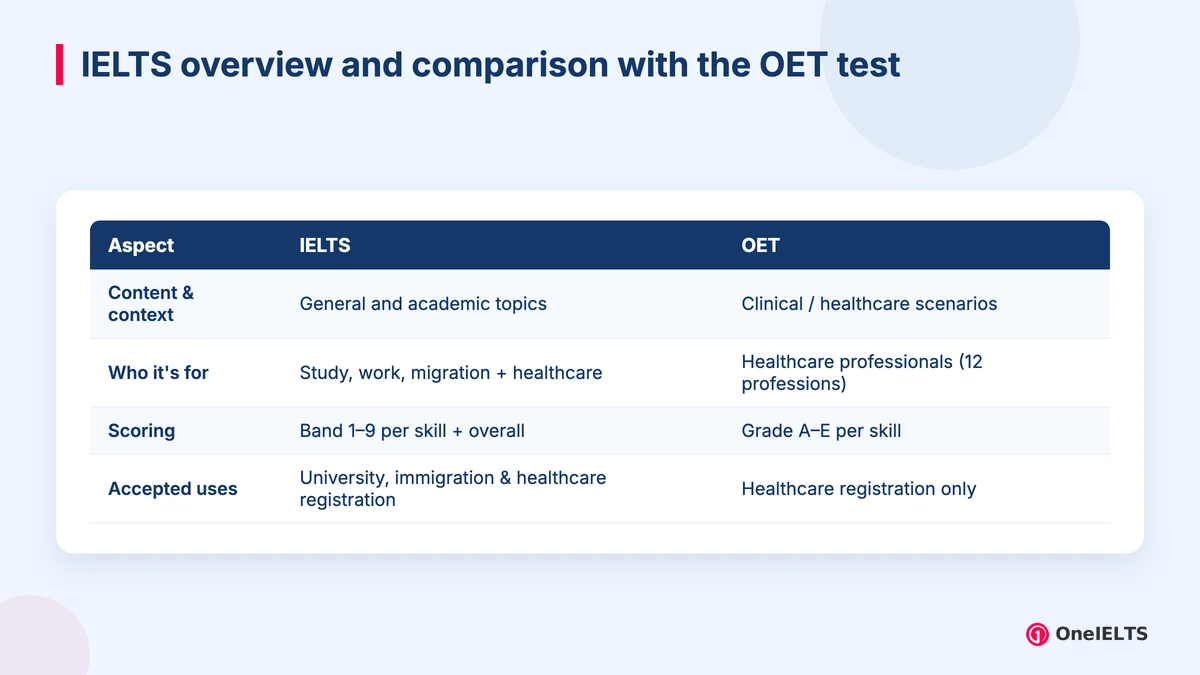
IELTS measures general English proficiency for study, work, and migration, which makes it far broader than OET’s single healthcare focus. The British Council, IDP, and Cambridge run it as a four skills exam covering Listening, Reading, Writing, and Speaking. It comes in two versions: Academic, which uses academic content drawn from university-style sources, and General Training, which uses everyday workplace and social material. Where OET keeps every question inside a clinical world, IELTS tests the same skills against general topics that anyone — not only a clinician — could be asked to handle.
What Is OET?
OET, the Occupational English Test, is a healthcare specific English exam that checks whether you can communicate the way your job actually demands. Instead of general reading passages, it gives you clinical tasks taken from real practice, such as reading a case file or writing a referral letter to a colleague.
OET is built for 12 professions, including nursing, medicine, dentistry, pharmacy, and physiotherapy, and each version uses vocabulary and scenarios drawn from that field. A nurse sits a nursing-focused paper; a dentist sits a dentistry-focused one.
What Are the Differences Between IELTS and OET?
Four differences separate the two exams, and each one matters more depending on why you’re sitting the test. The points below summarise where IELTS and OET diverge, with the full explanation in the sections that follow.
- Test content and context. This is the clinical vs general split: OET uses material rooted in patient care, while IELTS draws on general and academic topics tied to no single profession.
- Who each test is for. The target audience differs sharply, since OET serves healthcare professionals registering to practise, whereas IELTS suits study, work, and migration applicants too.
- Scoring systems. The scoring scale differs: OET reports a grade from A to E for each skill, while IELTS reports a band on its 1-to-9 scale, also per skill.
- Accepted uses. Healthcare regulators accept both for registration, but only IELTS is recognised for general university study and immigration routes.
1. Test Content and Context
OET sets its tasks inside healthcare scenarios you already recognise from work. You read patient notes, summarise a case, or write a referral letter to another clinician, so the language is the language of the ward. IELTS takes the opposite approach, using general topics and academic passages — newspaper-style articles, charts, lectures, and everyday conversations — that test English without assuming any clinical knowledge.
2. Who Each Test Is For
OET is healthcare only, designed for professionals who need to prove their English to a medical or nursing regulator before they can practise. IELTS is built for broad use, working for students applying to university, skilled workers, and families migrating, as well as nurses doctors and other clinicians who simply prefer a general test. If your goal sits outside healthcare, OET won’t help you, but IELTS will.
3. Scoring Systems
The OET grade A to E system reports each skill separately, with A the strongest and E the weakest, rather than combining them into one figure. IELTS uses its IELTS 1 to 9 band scale, again reporting a per-skill result for Listening, Reading, Writing, and Speaking plus an overall band. Because both are per-skill, a regulator can demand a minimum in Writing without forcing up your whole result.
4. Accepted Uses
Healthcare regulators accept both tests for registration, including the NMC GMC AHPRA bodies that license nurses and doctors across the UK and Australia. The difference is reach: both accepted for clinical registration, but IELTS broader recognition means it also covers university admission and immigration, which OET does not. A nurse can pass either to register, yet only an IELTS result will double as proof for a study visa or permanent residency.
Which Is Easier, IELTS or OET?
For healthcare workers OET can feel easier because its content is familiar, but the honest answer is that difficulty is background dependent. A clinician who reads case notes every day finds OET’s familiar content less of a stretch than an unrelated IELTS passage on, say, urban planning. IELTS may suit those who are stronger in general English or who studied in an English-medium system, since its tasks reward broad reading rather than clinical vocabulary. Neither test is objectively harder; the gap is how close the material sits to what you already know.
What Is the IELTS to OET Score Equivalent?
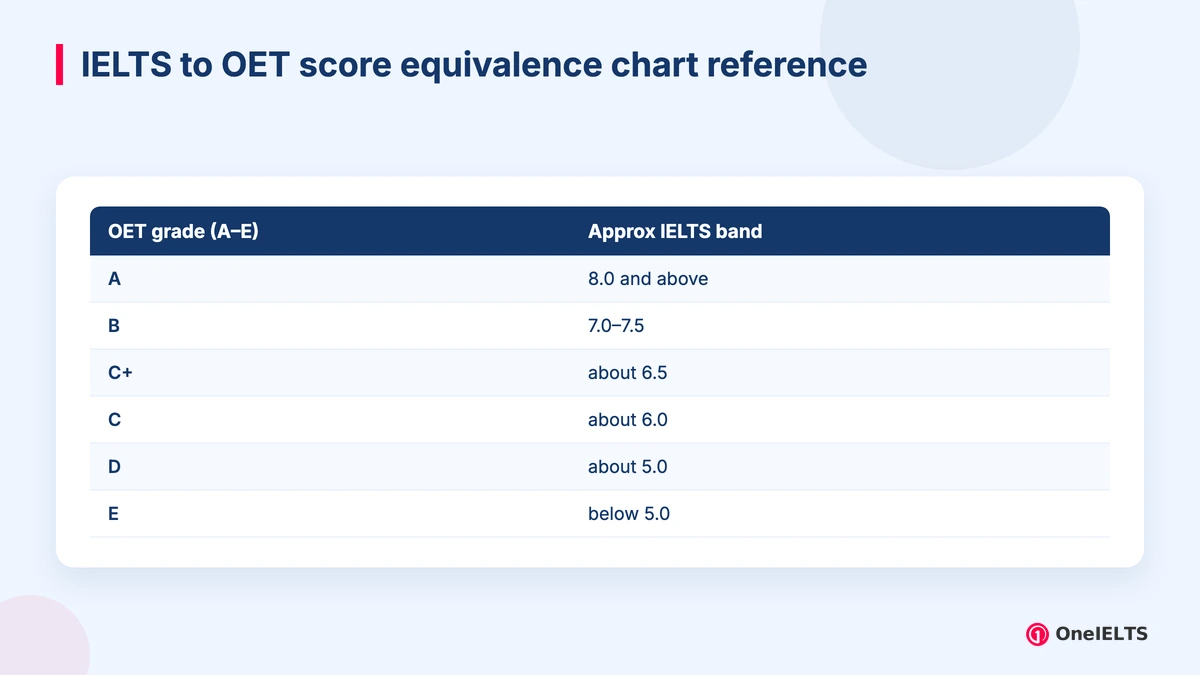
There’s no official conversion between the two exams, but the table below maps each OET grade A-E to the approx IELTS band it tends to sit near. Treat it as a rough guide for planning, not a guaranteed swap.
| OET grade (A-E) | Approx IELTS band |
|---|---|
| A | 8.0 and above |
| B | 7.0-7.5 |
| C+ | about 6.5 |
| C | about 6.0 |
| D | about 5.0 |
| E | below 5.0 |
That OET B ~ 7.0-7.5 row is the one most healthcare candidates care about. Each regulator sets its own body-set minimum, so an OET B might satisfy one council while another wants the same skill higher. The figures here are an unofficial equivalence only; always confirm the exact number against the body you are registering with.
Should You Take IELTS or OET?
Choosing comes down to matching the test to your goal and your strengths, since both are accepted for healthcare registration. Work through the decision rules below to settle which exam fits your situation.
- Take OET if you’re a healthcare professional comfortable with clinical English. When your daily work already involves case notes and referrals, the healthcare clinical English in OET plays to a skill you use constantly, which usually means less unfamiliar ground to cover.
- Take IELTS for general study, work or migration. If your plans reach beyond clinical registration into a degree or a general migration route, IELTS is the only one of the two that immigration and universities will accept.
- Confirm your regulator accepts your chosen test. Regulator acceptance varies by country and profession, so check your nursing or medical council’s current rules before booking, because a test that suits you is useless if your body won’t take it.
- Pick the content that matches your strengths. Strength fit decides borderline cases: choose OET if clinical material feels natural, or IELTS if you read widely across general and academic topics and prefer that variety.
Do Nurses Need IELTS or OET?
Nurses can use either — the NMC accepts both IELTS and OET for nursing registration, as do similar bodies in other countries. The catch is the threshold: each council names a required band or grade, often with a per-skill minimum, so confirm the exact figure before you book. Our guide to IELTS for nurses walks through the bands UK and overseas councils expect.
How Do IELTS and OET Scores Compare?
An OET grade B is broadly equivalent to IELTS 7.0, and grade C+ to about 6.5, and that OET B ~ IELTS 7 grade equivalence helps when you’ve taken one test and need to gauge the other. These figures are approximate, so always check the regulator table or stated equivalence rather than assuming the conversion holds. You can read how the 1-to-9 scale works in our IELTS band score guide before you compare the two.
Practice for the Real IELTS Exam
Apply what you’ve learned with free, exam-style practice:
- Take a full IELTS mock test
- Practice by section: Listening, Reading, Writing, Speaking
- Structure your essays with IELTS Writing templates