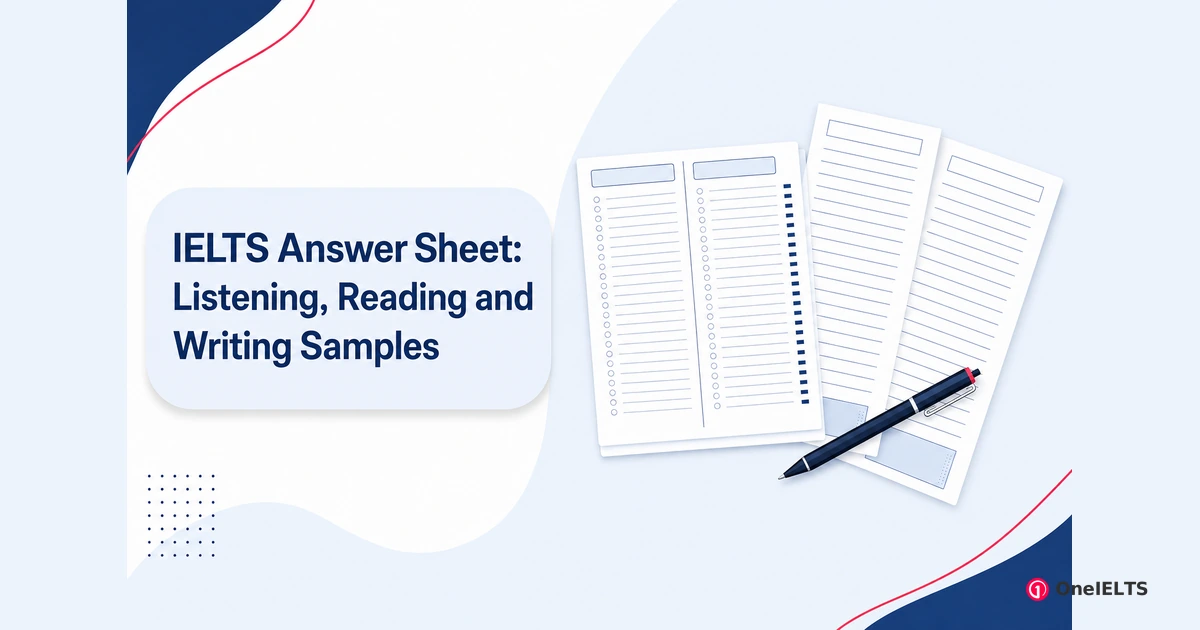
In a paper-based test, the IELTS answer sheet records your candidate details and every answer the examiner marks. Nothing outside it scores. Listening and Reading share one double-sided sheet with 40 numbered answer lines on each side, while Writing Task 1 and Writing Task 2 each get a separate lined sheet. Only Listening adds transfer time: 10 minutes on paper.
This page covers what the sheet is and how it looks, the Listening answer sheet and the Reading answer sheet, both Writing sheets, candidate details, writing rules, common mistakes, sample PDFs and practice. It decodes the examiner-only zones too. It’s about the blank form, not answer keys; those sit with the practice tests further down.
What Is an IELTS Answer Sheet?
An IELTS answer sheet is the official answer sheet on which a paper-based test taker writes candidate details and final answers for Listening, Reading or Writing. Examiners mark only what’s on it.
There are two kinds. One double-sided sheet carries Listening on one side and Reading on the other, and lined sheets carry Writing Task 1 and Task 2. Speaking has no sheet because it’s a face-to-face interview. The question booklet is for notes and is never marked.
IELTS Academic and General Training use the same sheet; you just shade a different module box. Paper-based IELTS is the only format with a paper sheet, since computer-delivered IELTS has you type answers on screen. One search mix-up is worth clearing early: an answer sheet is the blank form, not the “answers” to a Reading or Listening test.
What Does the IELTS Answer Sheet Look Like?
The Listening and Reading sheet is a single A4 page printed on both sides, with a candidate details block, 40 numbered answer lines and a narrow marker column beside each line. Each Writing sheet is lined, headed with the same details, and closed by an examiner-only area.
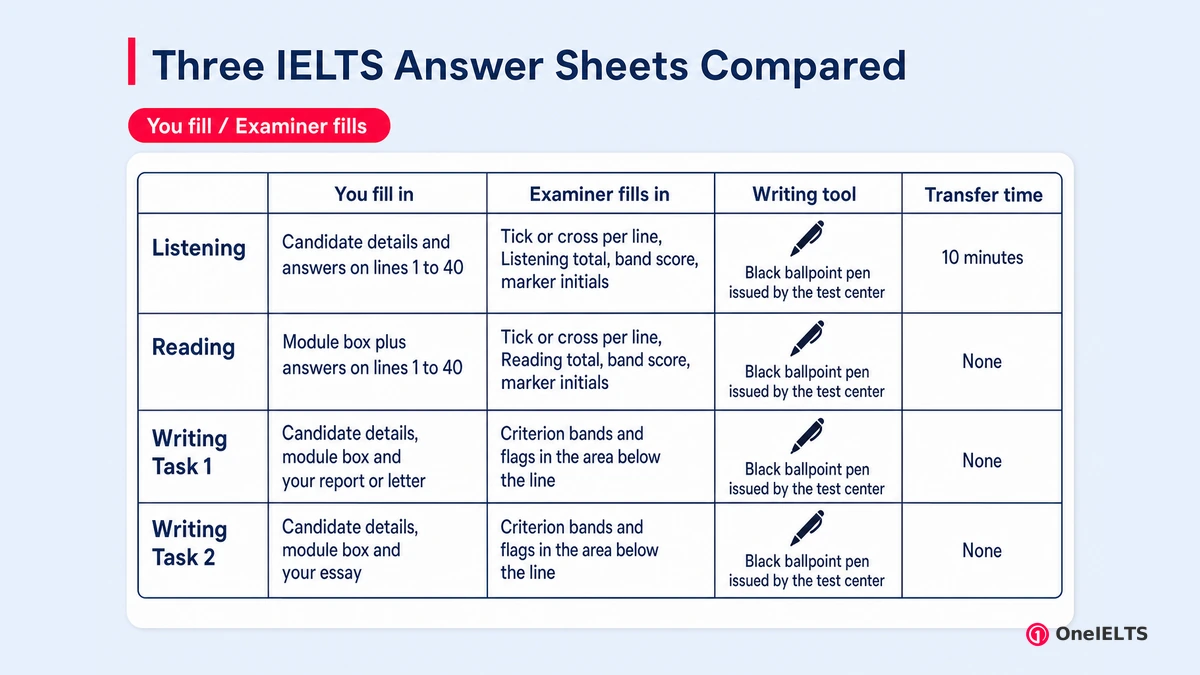
Each sheet splits the work between you and the examiner in the same way, and the table sets the four side by side.
| Sheet | Sides or pages | What you fill in | What the examiner fills in | Writing tool | Extra transfer time | Computer-delivered equivalent |
|---|---|---|---|---|---|---|
| Listening answer sheet | Front of the double-sided sheet | Candidate details and answers on lines 1 to 40 | Tick or cross per line, Listening total, band score, marker initials | Black ballpoint pen issued by the test center | 10 minutes after the recording ends | Answer boxes on screen, 2 minutes to check |
| Reading answer sheet | Reverse side of the same sheet | Module box plus answers on lines 1 to 40 | Tick or cross per line, Reading total, band score, marker initials | Black ballpoint pen issued by the test center | None, answers go straight on the sheet | Answer boxes on screen, no transfer step |
| Writing Task 1 answer sheet | Lined pages headed TASK 1 | Candidate details, module box and your report or letter | Criterion bands and flags in the area below the line | Black ballpoint pen issued by the test center | None, you write directly on the sheet | Typed response in an on-screen text box |
| Writing Task 2 answer sheet | Lined pages headed TASK 2 | Candidate details, module box and your essay | Criterion bands and flags in the area below the line | Black ballpoint pen issued by the test center | None, you write directly on the sheet | Typed response in an on-screen text box |
Many guides describe a green Listening side and a blue Reading side. No IELTS owner publishes the colors, and print runs differ between centers, so don’t rely on color to find the right side. The module box and the printed side name are what count. A labeled sample of each sheet sits in its own section below.
What Does the IELTS Listening Answer Sheet Include?
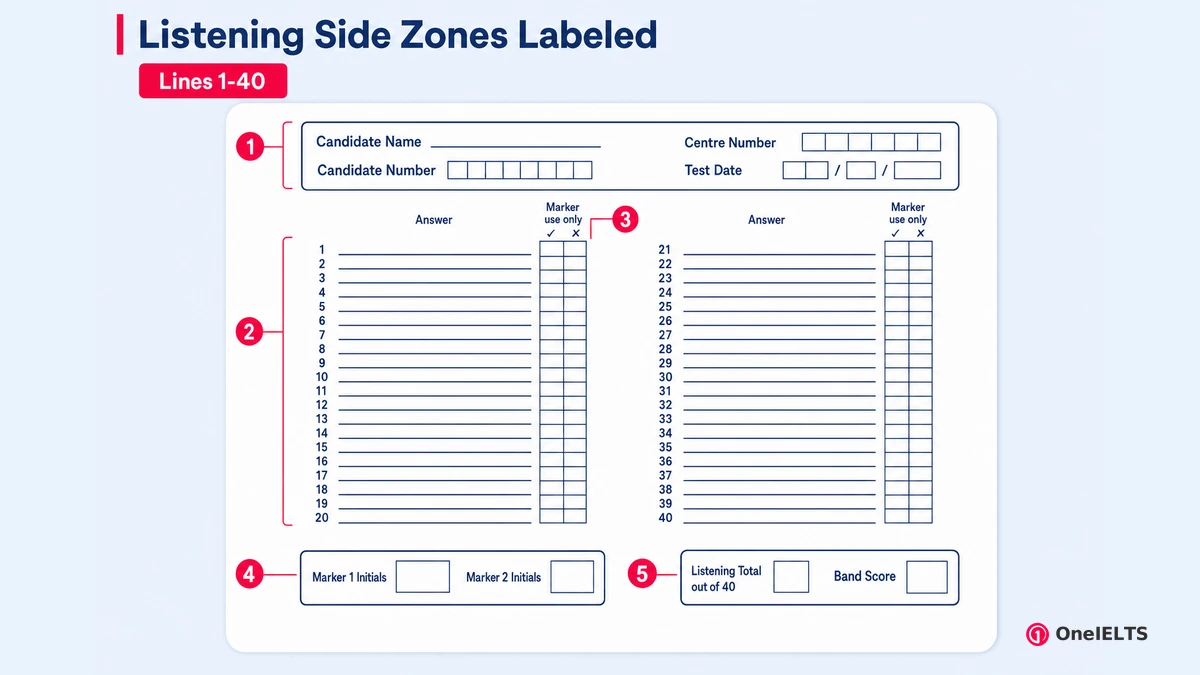
The Listening side carries the candidate details block, 40 numbered answer lines in two columns, a tick and cross column for the marker, and boxes for marker initials and the Listening total. Five zones make up the Listening answer sheet, from the header down to the footer.
- Candidate name, candidate number, center number and test date. The header block identifies your script and links every answer to you.
- Answer lines 1-40. Two columns run 1 to 20 and 21 to 40, one numbered line for each question in the recording.
- Marker use only tick/cross column. A narrow column beside each line where the marker records a tick or a cross; you leave it completely blank.
- Marker signatures. Boxes at the foot where the first and second markers initial the script, so a check of your marking can be traced.
- Listening total. The examiner writes your raw score out of 40 here, then converts it to a band in the box beside it.
The Listening total is a raw score, not a band. A total of 30 out of 40 becomes a band only after the examiner applies the conversion for that test. The column marked marker use only must stay empty, because a stray mark there can be read as part of the marking.
How Do You Fill In the IELTS Listening Answer Sheet?
Write your answers in the question booklet while the recording plays, then copy them onto the answer sheet in pen during the 10 minutes of transfer time at the end of the paper-based test. On computer you type answers as you go and get 2 minutes to check them.
Five steps take you from the first recording to a finished Listening side.
- Complete the candidate details before the recording starts, copying your name and numbers exactly as they appear on your registration.
- Write answers in the question booklet during the recording, keeping up with the audio rather than stopping to copy anything across.
- Transfer each answer to the matching numbered line once the recording ends, working through the 10 minutes in question order.
- Check spelling, plurals and the word limit during transfer, because the examiner marks only the version that reaches the sheet.
- Leave no line blank, because a wrong answer loses no marks and a blank line can never score.
The 10 minutes exist only on paper. In computer-delivered Listening, IDP says no extra time is given and you have 2 minutes to review. An answer left only in the question booklet scores nothing, per IDP’s examiner-approved tips. Spelling, singular or plural form and the word limit are all judged on the sheet, so the transfer is your last chance to fix them.
What Does the IELTS Reading Answer Sheet Include?
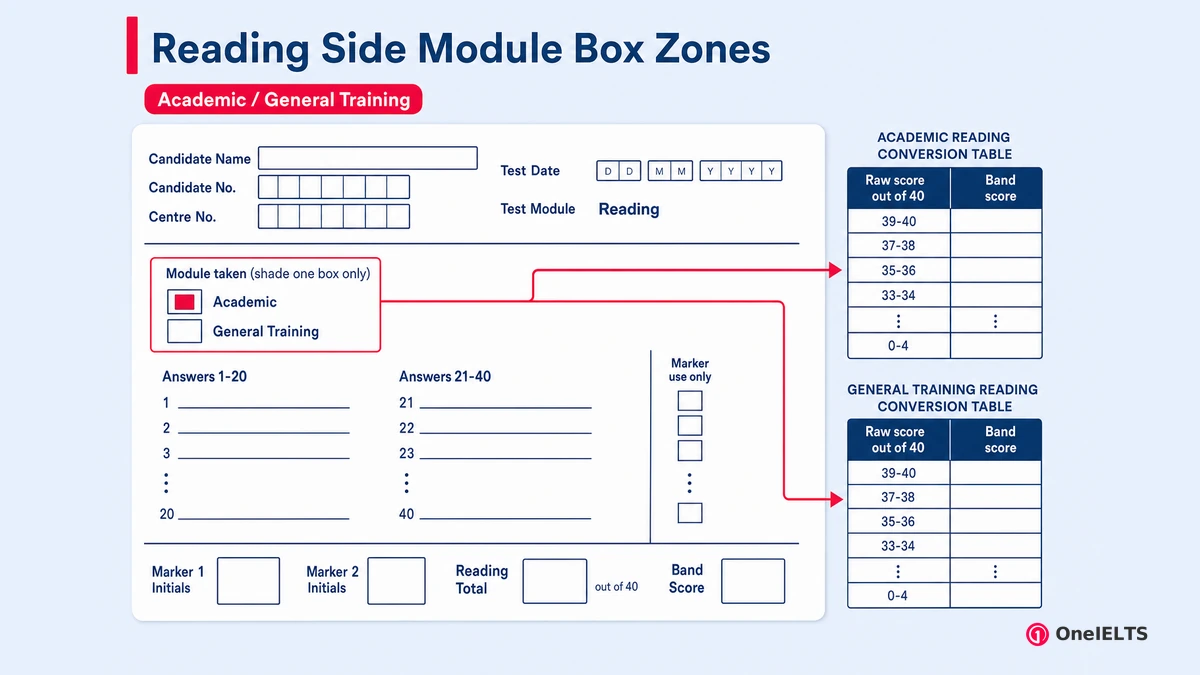
The Reading side mirrors the Listening side, with candidate details, 40 numbered answer lines and a marker column, plus the module box where you shade Academic or General Training. The candidate fields repeat the Listening header, so the list starts where the Reading answer sheet differs.
- Module box for Academic or General Training. Shade one box only: IELTS Academic or General Training, matching the test you booked and sat.
- Answer lines 1-40. Two columns of numbered lines, 1 to 20 and 21 to 40, for every Reading question across three passages.
- Marker use only tick/cross column. The marker ticks or crosses each line here, so you write nothing in this narrow column.
- Marker signatures. Two sets of marker initials at the foot show who marked the Reading script and who checked it.
- Reading total. The raw score out of 40, which the examiner converts to a Reading band in the box beside it.
The module box matters more than it looks. Academic and General Training Reading share one sheet but use a different conversion table to turn the Reading total into a band. Shade the wrong box and your script can be converted on the wrong table, so check it twice.
How Do You Fill In the IELTS Reading Answer Sheet?
Write each Reading answer straight onto the answer sheet as you work, because the 60 minutes include no transfer time. Anything left in the question booklet when time is called isn’t marked.
Five habits keep the Reading side complete when the clock runs out.
- Shade the module box before the first passage, so it’s done while you’re calm and not in the last minute.
- Write answers directly on the sheet passage by passage, rather than saving all 40 for the end of the test.
- Use the exact form the question asks for, whether a letter, a number, or words copied from the passage.
- Keep the last 2-3 minutes to fill blank lines with a best guess, since no mark is deducted for a wrong answer.
- Recheck that answer numbers match question numbers, especially after you skip a hard question and come back to it.
Reading has no transfer time, per IDP, and each question type asks for its own form.
TRUE/FALSE/NOT GIVEN and YES/NO/NOT GIVEN items take those words, and IELTS doesn’t publish a rule accepting T, F and NG, so write the words in full. Matching questions and multiple choice take a letter. Completion questions take words copied from the passage, spelled exactly. The True False Not Given guide covers how to decide between the three.
What Does the IELTS Writing Answer Sheet Include?
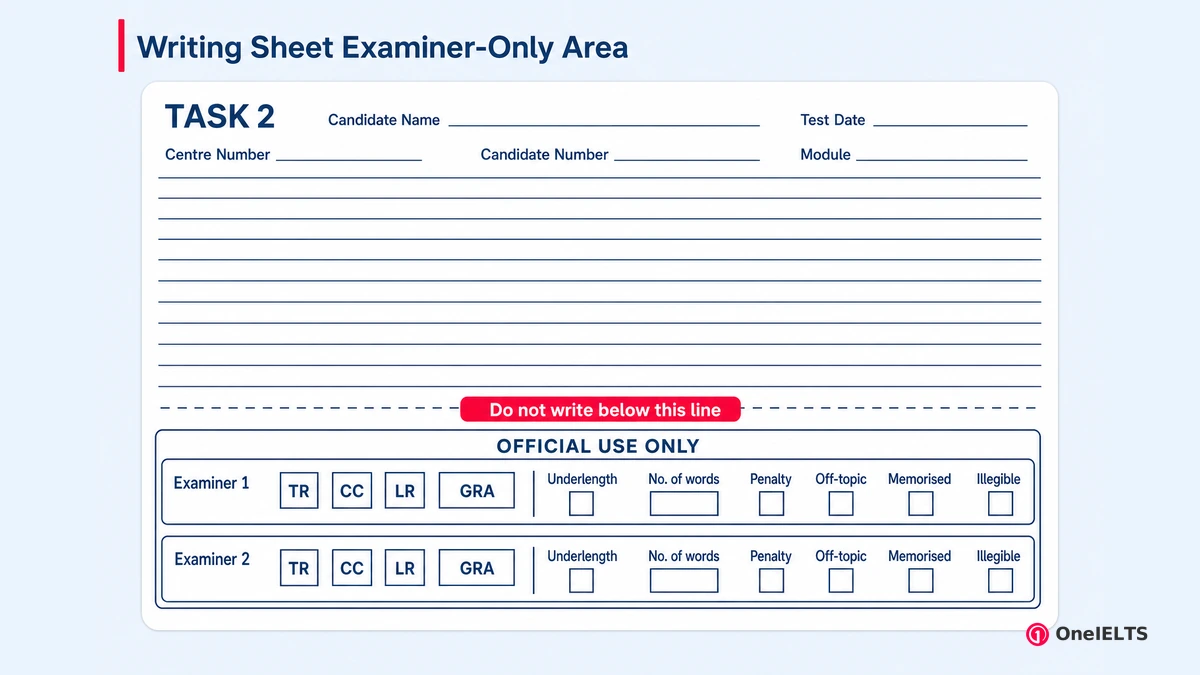
Writing uses two separate lined sheets, one headed Task 1 and one headed Task 2. Each starts with the candidate details block and ends with an area for examiner use only.
The two sheets look alike, and the differences sit in the task headings and the word targets.
| Sheet | Minimum words | Suggested time | Header details | Examiner-only area |
|---|---|---|---|---|
| Writing Task 1 answer sheet | 150 words for the report or letter | About 20 minutes of the 60 | Name, center number, candidate number, module, test date | TA, CC, LR, GRA boxes plus flags, twice |
| Writing Task 2 answer sheet | 250 words for the essay | About 40 minutes of the 60 | Name, center number, candidate number, module, test date | TR, CC, LR, GRA boxes plus flags, twice |
Below the printed line “Do not write below this line”, the sample sheets carry an “OFFICIAL USE ONLY” panel. It holds one box per assessment criteria code: TA or TR, CC, LR and GRA. It also holds fields for Underlength, No. of words, Penalty, Off-topic, Memorised and Illegible, repeated for a first and second examiner. The IELTS Writing band descriptors explain what each criterion box measures.
Don’t write in that panel. The lines aren’t a word count either, since handwriting size changes how many words fit on a line.
How Do You Fill In the IELTS Writing Answer Sheet?
Write Task 1 on the Task 1 sheet and Task 2 on the Task 2 sheet, start each on its own sheet, and ask the invigilator for extra paper when you run out of lines. Never spill into the margins or the examiner-only area.
Six steps cover both Writing sheets from header to last line.
- Complete the candidate details on both sheets before you start, including the module box on each Writing header.
- Plan in the question booklet, not on the answer sheet, because planning notes on the sheet look like part of your answer.
- Write each task on its own sheet, so the Task 1 sheet holds only the report or letter.
- Mark paragraphs clearly with a blank line or an indent, so the examiner can see your paragraphing at a glance.
- Cross out mistakes neatly with a single line, then write the correction beside it, as IDP’s 2025 guidance describes.
- Request extra paper from the invigilator if needed, by raising your hand before you reach the last line.
Report it to the invigilator at once if you start a task on the wrong sheet. A task written entirely in capital letters is acceptable, but it hides your paragraphing and punctuation. Legibility counts as well, because an examiner can’t credit words they can’t read. Task timing and structure sit on the IELTS Writing hub.
How Do You Fill In the Candidate Details on the IELTS Answer Sheet?
Copy your name, candidate number, center number and test date exactly as they appear on your registration documents, in capital letters. Then fill the matching digit boxes on the Listening and Reading sheet with the pen you’re given.
Five fields make up the header, and each has one rule worth knowing.
- Candidate name in block capitals. Write your full name in capitals, spelled exactly as on the passport or ID you registered with.
- Candidate number written and shaded digit by digit. Write the number in the boxes, then mark each digit in the grid beside it.
- Center number. Copy the center number from your test-day documents or from the invigilator, who reads it out at the start.
- Test date shaded as day, month and year. Mark one box each for day, month and year, using today’s date, not your booking date.
- Module box on the Reading side. Mark Academic or General Training to match the test you booked, because Reading bands depend on it.
The HB pencil most older guides mention is gone. Since 2025, IDP and the British Council have issued one black ballpoint pen for paper tests, so fill each digit box fully in pen. If you get a detail wrong, cross it out, write the correct version beside it and tell the invigilator, as IDP’s stationery notice instructs. The invigilator usually reads the details out at the start, so follow along rather than guessing.
Readers often ask about the language code. Older Listening and Reading sheets carried a three-digit language code grid for your first language. The British Council’s current sample Reading sheet shows no language code field, so leave it alone if your sheet has none. Checked on 7 October 2026.
How Do You Write on the IELTS Answer Sheet?
Use the black ballpoint pen the test center gives you on every paper sheet, write one answer per numbered line, and switch to capital letters if your handwriting is hard to read. IDP’s paper-test page says you must use a pen for Writing, Listening and Reading.
Six rules cover how answers should look on the page.
- HB pencil for Listening and Reading. This rule is retired; older sheets print “Pencil must be used”, but centers now issue a pen.
- Pen or pencil for Writing. Writing also takes the issued black ballpoint pen, so practice in pen to match test day.
- One answer per numbered line. Keep each answer on the line with its question number and never split it across two lines.
- Capital letters or clear lowercase, never a mix that blurs letters. Pick one style per answer so an a never looks like a d.
- Numbers as digits or words, spelled correctly. IDP accepts 320 or “three hundred and twenty”, but a misspelled number word is wrong.
- Erase cleanly instead of overwriting. With a pen there’s no eraser, so cross out with one line and rewrite clearly beside it.
Capitals and lowercase are both accepted, so capitals are a legibility choice rather than a rule. The capital letters in IELTS guide covers where case does matter in Writing. Spelling is tested right here on the sheet: IDP states that an incorrectly spelled Listening answer is marked wrong.
What Are the Common Mistakes on the IELTS Answer Sheet?
Most answer-sheet marks are lost to mechanics rather than knowledge: answers left in the booklet, answers on the wrong line, misspellings, and answers over the word limit. Seven mistakes cover nearly all of it, and each one has a quick fix.
- Answers left in the question booklet. Only the sheet is marked, so copy every Listening answer during transfer and write Reading answers straight onto the sheet as you go.
- Answers shifted onto the wrong numbered line. Skipping one number pushes every later answer onto the wrong line, so check the line number each time you write.
- Spelling and singular/plural errors. Spelling errors and a missing plural s both cost the mark, so compare each word with the booklet or passage before moving on.
- Exceeding the word limit. “No more than two words” means three words score zero, so cut articles and extra words during transfer.
- Wrong module box shaded. Your Reading total can be converted on the wrong table, so confirm Academic or General Training before the first passage starts.
- Writing in the marker column or examiner-only area. Those zones belong to the marker, so keep every answer, note and correction inside your own lines.
- Blank lines instead of a best guess. A wrong answer costs nothing, so a best guess on every empty line can only add marks to your total.
The shifted line is the costliest mistake. Skip line 14 by accident and answers 15 to 20 land one line up, so six answers you heard correctly score zero together. Singular and plural slips cost one mark at a time; a shift costs a block. Names cause many Listening misspellings, and the spelling names in IELTS Listening guide covers the alphabet traps.
Where Can You Download an IELTS Answer Sheet PDF?
The British Council’s takeielts site hosts the official sample answer sheet PDF files, marked “Sample Answer Sheet”. The ielts.org sample-test pages carry answer keys rather than blank forms, and no IDP-hosted blank sheet turned up. Both owners run the same paper test. You need three files.
- The Listening and Reading answer sheet
- The Writing Task 1 answer sheet
- The Writing Task 2 answer sheet
Print each printable answer sheet at A4, double-sided for Listening and Reading. Scribd copies can be older versions, so match them against the official sample. Checked on 7 October 2026.
Why Should You Practice With the IELTS Answer Sheet Before the Test?
Practicing on the real sheet turns the answer transfer, the spelling checks and the timing into habits, so on test day no marks are lost to the form itself. Three benefits come from timed practice on a printed official sample.
The first is timing the Listening transfer, so 10 minutes feels long enough. The second is writing Reading answers directly under time pressure, with no booklet stage to fall back on. The third is judging how much a 150-word and a 250-word answer fill on the Writing sheets in your own handwriting. A full mock test on paper rehearses all three in one sitting.
How Do You Practice With the IELTS Listening Answer Sheet?
The way to practice is to take a full Listening practice test, write in the booklet, then transfer to a printed sheet against a 10-minute timer. Mark the sheet against the answer key afterward. Comparing your booklet with your sheet sorts the errors: a right booklet answer marked wrong is one of your transfer errors, not a listening gap. Start with an IELTS Listening practice test.
Where Can You Practice IELTS Reading With Answers?
The best place is a full Reading practice test with an answer key, done in 60 minutes with answers written straight onto a printed sheet. Readers searching for Reading “answers” belong here. The answer key is for checking afterward; the answer sheet is for the test. Try a full IELTS Reading practice test and keep the key closed until time is up.
Can You Practice IELTS Writing on an Answer Sheet Online?
Yes, you can practice IELTS Writing online with timed Task 1 and Task 2 prompts, then copy one answer onto a printed Writing sheet to see how much space 150 and 250 words take in your handwriting. Online Writing practice grades each Task 1 prompt or Task 2 prompt response against the four criteria. The paper copy trains handwriting speed and layout. Both run through IELTS Writing practice.
Does Computer-Delivered IELTS Use an Answer Sheet?
No, computer-delivered IELTS does not use a paper answer sheet; answers are typed into boxes on screen, and Listening gives 2 minutes to check answers instead of 10 minutes to transfer them. Practice on-screen answers by typing, not by filling a sheet, if you’re booked on computer. Speaking is face-to-face in both formats. The IELTS paper vs computer comparison sets out the other differences from the paper-based test.
Written by Fahimur Rahman, reviewed 7 October 2026.
Last verified: 7 October 2026
Practice for the Real IELTS Exam
Apply what you’ve learned with free, exam-style practice:
- Take a free IELTS mock test — all four skills, real exam timing, AI band scoring
- Start with the free mock test — one full test, no payment needed
- Practice skill by skill — Listening, Reading, Writing and Speaking sets