IELTS stopped offering IELTS Indicator once test centers reopened after the COVID-19 closures, according to ielts.org. From April 2020, the at-home test let you sit all four IELTS skills online and returned an indicative score instead of an official Test Report Form. IDP, the British Council and Cambridge University Press & Assessment ran it as a stop-gap.
This page covers its definition, status, Academic-only version, eligibility, format, setup and registration. It then turns to fees, timing, scoring, the video Speaking test and the differences from IELTS, before benefits, problems, preparation and acceptance. For an official result from home today, IELTS Online has its own page.
Status checked on 7 October 2026.
What Is the IELTS Indicator Test?
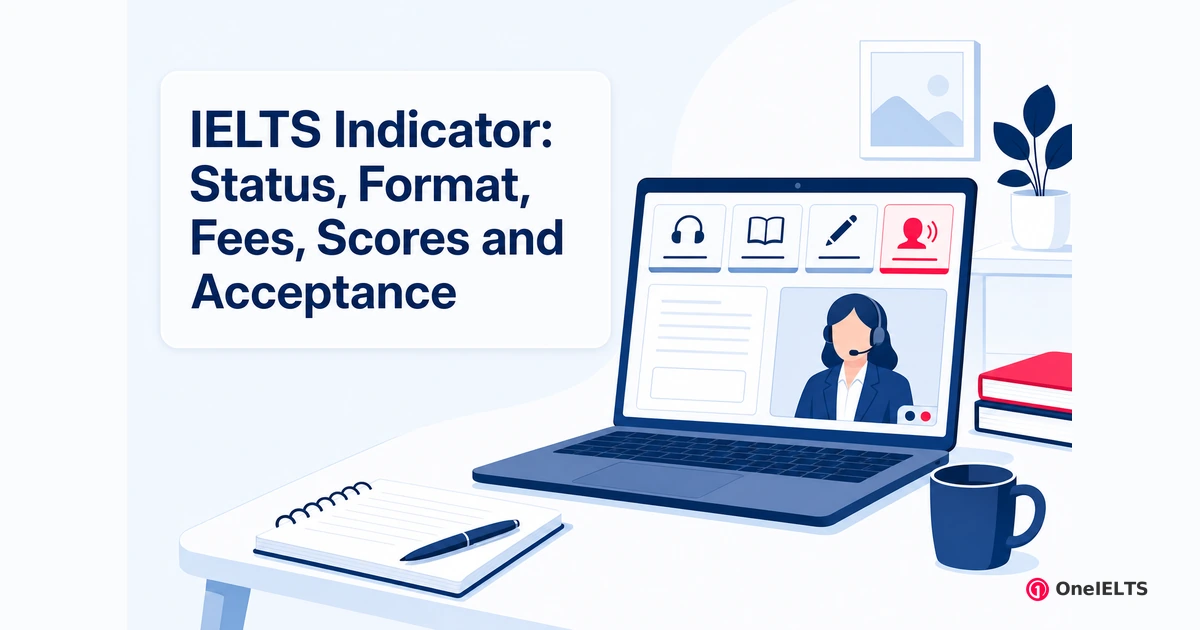
IELTS Indicator was an online test of English that you sat from home, covering Listening, Reading, Writing and Speaking, with the Speaking test held live with a certified examiner over video call. It gave an indicative band score, not an official IELTS result.
The IELTS partners ran it: IDP, the British Council and Cambridge University Press & Assessment. Content and marking followed the IELTS Academic test, so the questions looked like the real exam. The result gave a university an indication of your English level while test centers were closed. It was a separate product from IELTS Online, which came later and issues an official result.
Is the IELTS Indicator Test Still Available?
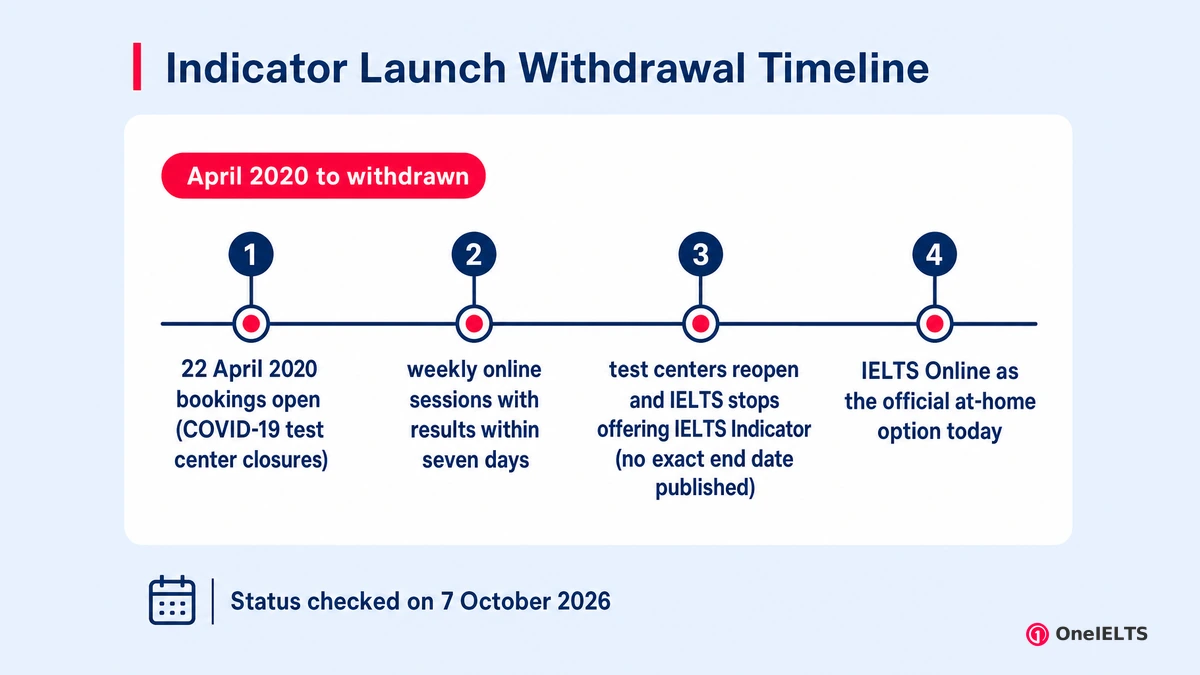
No. IELTS Indicator has been withdrawn, and the official status on ielts.org says IELTS stopped offering it once test centers reopened, without giving an exact end date. IELTS Online is now the official at-home option.
The partners opened bookings on 22 April 2020, the launch date, so students could keep applying through COVID-19 test center closures. In Canada, sessions ran weekly on Wednesdays, per WES.
The 2020 guides from ted-ielts, unicreds and gyandhan still describe it as new, and ApplyBoard’s guide now returns a 404. Hold an old result? Ask the receiving institution whether it still accepts it. Ielts.org says scores were valid for two years, so any 2020 or 2021 score is already past that window.
Is IELTS Indicator Available for Academic and General Training?
No. IELTS Indicator followed the IELTS Academic test only, and there was never an IELTS General Training version. WES described it as the same test as IELTS Academic. That fit its purpose: the partners built it for university applicants whose admission deadlines didn’t stop for the pandemic. Candidates who needed General Training for work or migration purposes had no Indicator route, so the answer for them was the standard test at a center.
Who Can Take the IELTS Indicator Test?
Test takers in countries where in-person IELTS was suspended could sit IELTS Indicator, as long as a university would take the score. The first condition was country availability: the test opened only where COVID-19 had halted testing. It suited university applicants whose chosen institutions had agreed to accept it. No official page states a minimum age, so treat any figure you see elsewhere as unconfirmed.
Five conditions decided whether a candidate could book.
- Country availability: the test ran only in countries where in-person IELTS testing was suspended by COVID-19.
- Minimum age: the current official page doesn’t publish one, and no partner notice we checked states it.
- Valid identity document: you needed a valid passport or national ID to book and to prove your identity.
- Home internet and computer: a PC or Mac with a stable connection; the test didn’t run on phones or tablets.
- Purpose of the score: university admission only, because the result wasn’t valid for visas or immigration.
How Does the IELTS Indicator Test Work?
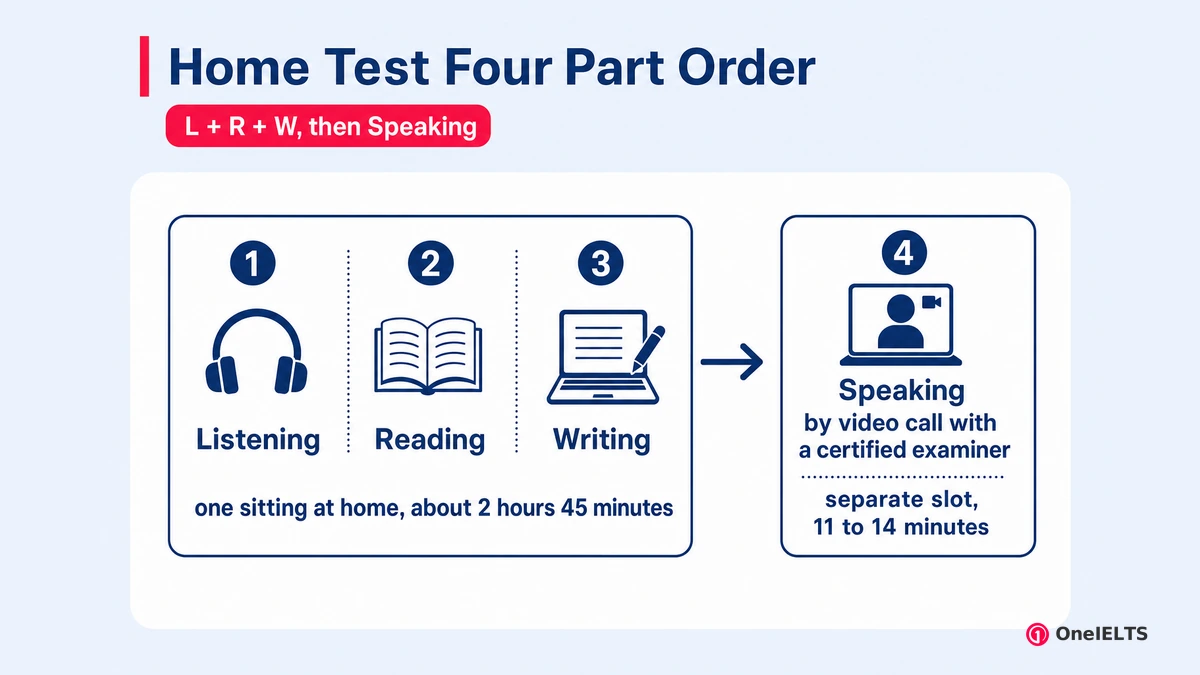
You took Listening, Reading and Writing online in one sitting at home, then Speaking as a separate live video call with an examiner, usually on a different day. Question types and the band scale mirrored IELTS Academic. You sat the test on your own computer with no test-center supervisor in the room. The Speaking interview had its own booked time slot.
Each of the four parts tested a different skill, in this order.
- Listening: you heard recorded conversations and talks through headphones and answered questions on detail, opinion and main ideas, as in IELTS Academic.
- Reading: you read three long academic passages on screen and answered questions testing skimming, scanning, inference and understanding of the writer’s argument.
- Writing: you typed a Task 1 report describing a chart, graph or diagram, then a Task 2 essay responding to an argument or problem.
- Speaking by video call: a certified examiner interviewed you live over video in three parts, testing fluency, vocabulary, grammar and pronunciation.
What Do You Need to Take the IELTS Indicator Test?
You needed a PC or Mac, a stable internet connection, a webcam, a microphone and headphones, all in a quiet private room, plus your passport or national ID. Before test day, the platform asked you to run a system check of your computer and browser. The current ielts.org page doesn’t say what happened after a failed check, so a refund was never something to count on.
A candidate had to have all seven items ready before the session.
- Desktop or laptop computer: a PC or Mac running a supported browser; phones and tablets couldn’t run the test.
- Stable internet connection: a reliable home internet connection that could carry a long test and a live video call.
- Webcam and microphone: a working webcam and microphone so invigilators could watch you and the examiner could hear you.
- Wired or built-in headphones: headphones for the Listening test, so recordings stayed clear and no sound leaked into the room.
- Quiet private room: a closed room with no other people, notes or phones within reach during the test.
- Passport or national ID: the same valid passport or national ID you used at registration, shown for identity verification.
- System check before test day: a computer and browser check run in advance, so problems surfaced before your booked session.
How Do You Register for the IELTS Indicator Test?
Registration for IELTS Indicator is closed, because IELTS no longer offers the test. While it ran, booking went through the official partner sites of IDP and the British Council, not through agents. You picked a date, uploaded an identity document and paid. Your Speaking slot was confirmed separately from the main test.
Booking took five steps from account to confirmation.
- Check country availability: confirm the test ran in your country, since it opened only where testing was suspended.
- Create an account and choose a date: register on the IDP or British Council site and pick a weekly session.
- Upload identity document: add a scan of the passport or national ID you would show on test day.
- Pay the fee: pay online by card in the currency the booking site set, often US dollars.
- Book the Speaking slot: choose a separate video-call time for the Speaking interview, confirmed apart from the main test.
How Much Does the IELTS Indicator Test Cost?
The test fee was US$149, the price IELTS New Zealand listed, and each partner set country pricing. IELTS Indicator was a paid test, never free, and there was no official download of it. Free practice tests are a different product.
No official page shows a figure in Indian rupees, and none still states the refund policy for cancellations. Regular IELTS fees in India are covered on the registration page. Fee checked on 7 October 2026.
How Long Does the IELTS Indicator Test Take?
The test duration was about 2 hours 45 minutes for Listening, Reading and Writing in one sitting, plus a separate Speaking call of 11 to 14 minutes, matching standard IELTS. WES reported the 2 hours 45 minutes figure in July 2020. The partners ran weekly sessions. Result time was up to seven days, per IELTS New Zealand, and scores arrived online.
How Is the IELTS Indicator Test Scored?
Certified IELTS examiners marked each skill on the same 0 to 9 band scale as IELTS, and you received an indicative band for each skill plus an overall band. It came as an online result, not a Test Report Form. The marking criteria matched IELTS, but the score wasn’t official. A 7 is a strong band that most universities accept, and 6.5 is a common minimum.
Each line of the result is set here against what an official IELTS result would show.
| Result item | What it shows | How it differs from an official IELTS result |
|---|---|---|
| Listening band | A 0 to 9 band for understanding recorded talks and conversations. | Same scale and marking, but indicative, with no Test Report Form behind it. |
| Reading band | A 0 to 9 band for reading academic passages and answering on screen. | Followed IELTS Academic marking, though institutions treated the band as unofficial evidence. |
| Writing band | A 0 to 9 band from examiners applying the four Writing marking criteria. | Same criteria as IELTS, but scripts were typed at home under remote invigilation. |
| Speaking band | A 0 to 9 band from a live examiner interview held by video. | Same four criteria, but audio quality and lag could affect the interview. |
| Overall band | The average of the four skill bands, rounded to the nearest half band. | Calculated the same way, but receiving institutions decided whether to accept it at all. |
| Result document | An online result sent within seven days, not a paper certificate. | No Test Report Form; IELTS also ended its Score Check service for organizations. |
How Is the IELTS Indicator Speaking Test Different From IELTS Speaking?
The content was the same three-part Speaking interview with a certified examiner, but it happened over a video call from your home instead of face to face at a test center. The three parts and the four Speaking criteria stayed the same, and so did the 11 to 14 minute length.
The setting changed four things: audio lag could make you talk over the examiner, poor camera framing hid your face, background noise carried, and no examiner sat in the room to read body language. No current official page states the rule for a dropped connection. A free Speaking mock test lets you rehearse a timed interview under similar pressure.
How Is IELTS Indicator Different From the IELTS Exam?
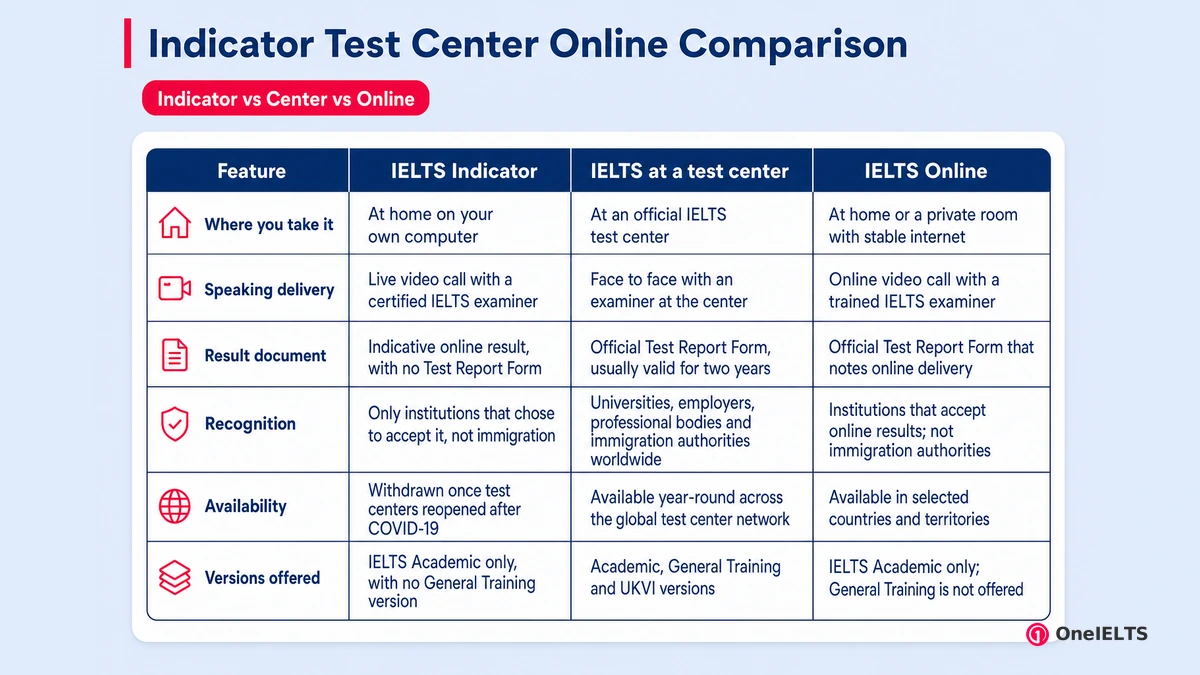
IELTS Indicator used the same skills, question types and band scale as IELTS Academic, but you took it at home and got an indicative result rather than a Test Report Form. Its recognition stopped at the institutions that agreed to it. Searchers asking how IELTS differs from IELTS usually mean Academic vs General Training, test center vs online, or official vs indicative result.
Set beside the test-center exam and IELTS Online, the gaps show up row by row.
| Feature | IELTS Indicator | IELTS at a test center | IELTS Online |
|---|---|---|---|
| Where you take it | At home on your own computer | At an official IELTS test center | At home or a private room with stable internet |
| Speaking delivery | Live video call with a certified IELTS examiner | Face to face with an examiner at the center | Online video call with a trained IELTS examiner |
| Result document | Indicative online result, with no Test Report Form | Official Test Report Form, usually valid for two years | Official Test Report Form that notes online delivery |
| Recognition | Only institutions that chose to accept it, not immigration | Universities, employers, professional bodies and immigration authorities worldwide | Institutions that accept online results; not immigration authorities |
| Availability | Withdrawn once test centers reopened after COVID-19 | Available year-round across the global test center network | Available in selected countries and territories |
| Versions offered | IELTS Academic only, with no General Training version | Academic, General Training and UKVI versions | IELTS Academic only; General Training is not offered |
What Are the Benefits of IELTS Indicator?
Candidates chose IELTS Indicator because at-home testing kept university applications moving during test center closures, with the familiar band scale and a live examiner for Speaking.
Five practical gains drew students to the test.
- Test from home: you sat the full test in your own room, with no exam-hall queue or travel day.
- No travel to a test center: candidates in lockdown avoided journeys while public transport and centers were shut.
- Same band scale as IELTS: results used the 0 to 9 scale, so admissions staff could read them easily.
- Live Speaking with an examiner: a live examiner ran the interview by video, so Speaking felt like standard IELTS.
- Kept applications moving during closures: university applications met 2020 deadlines while test center closures stopped in-person IELTS.
What Are the Problems With IELTS Indicator?
IELTS Indicator’s limits came from its home setting and its unofficial status. A weak internet connection could derail a session, and its recognition never reached visa applications. To protect integrity, the partners used identity verification and remote monitoring. From July 2020, WES reported, the Listening, Reading and Writing sessions were recorded and checked by human invigilators with AI support.
These five problems explain why many institutions treated the result with caution.
- Internet connection failures: a dropped connection or slow video could interrupt Listening audio or break up the Speaking interview.
- Limited recognition: only institutions that opted in accepted it, and some asked for a test-center IELTS once centers reopened.
- Not valid for visas or immigration: immigration authorities, including Canada’s IRCC, never accepted it for visa or residence routes.
- No General Training version: work and migration candidates had no Indicator option and had to wait for centers.
- Cheating and identity security concerns: an unsupervised home room raised doubts about impersonation, which recording and AI checks addressed.
How Do You Prepare for the IELTS Indicator Test?
Because content and marking followed IELTS Academic, standard IELTS preparation covered most of the work; the extra effort went into typing practice and a Speaking rehearsal on video. The same plan suits IELTS Online today. A timed IELTS mock test shows whether your pacing holds across the whole sitting.
These preparation steps cover both the content and the home setup.
- Take a timed full mock test: sit three skills back to back to build stamina for the long sitting.
- Practice typing Writing answers: type Task 1 and Task 2 within 60 minutes, because handwriting speed doesn’t carry over.
- Rehearse Speaking on video: answer Part 2 cue cards over a video call to get used to lag and framing.
- Run the system check early: test your browser, webcam and microphone days before, leaving time to fix any failure.
- Review IELTS Academic question types: work through all Reading and Listening task types, such as matching headings and form completion.
Who Accepts IELTS Indicator Scores?
Only the universities and colleges that chose to accept it recognized IELTS Indicator, and immigration authorities did not accept it for visas or residence. While the test ran, IELTS published the list of recognizing organizations on ielts.org; the current Indicator page no longer carries it.
Each institution decided for itself, so you checked the receiving organization before booking. Past acceptance doesn’t mean an institution takes an old Indicator result today, and ielts.org says scores were valid for two years. Ask the admissions office directly before you send one.
Does Canada Immigration Accept IELTS Indicator?
No, Immigration, Refugees and Citizenship Canada (IRCC) does not accept IELTS Indicator; Express Entry and other permanent-residence programs need IELTS General Training taken at an approved center. For English, IRCC’s language-testing page lists CELPIP-General, IELTS General Training and PTE Core. Canadian universities set their own admission rules, and a few accepted Indicator in 2020. See IELTS for Canada for current scores.
Does the GMC Accept IELTS Indicator for PLAB?
No, the General Medical Council (GMC) does not accept IELTS Indicator as evidence of English for medical registration or PLAB; it asks for an IELTS Academic result, taken in person or through IELTS Online. The GMC requires 7.0 in each skill and 7.5 overall from one sitting. IELTS for doctors covers the full route.
Which Universities Accept IELTS Indicator in the USA?
US universities that accepted IELTS Indicator appeared on the official recognition list on ielts.org while test centers were closed, but the current Indicator page no longer carries that list. Check each university’s current admissions policy on its own site, since a 2020 acceptance says nothing about today. Graduate admissions offices often set rules apart from undergraduate ones. IELTS for the USA lists current requirements.
Is IELTS Online Accepted Where IELTS Indicator Is Not?
Yes, IELTS Online is accepted more widely, because it produces an official IELTS Academic result rather than an indicative one, though it is still not accepted for most visa and immigration purposes. That official result is why the GMC, for example, takes IELTS Online but not Indicator. It’s the at-home test to choose now, and IELTS Online covers its requirements, recognition and fees.
Written by Fahimur Rahman, reviewed 7 October 2026.
Last verified: 7 October 2026
Practice for the Real IELTS Exam
Apply what you’ve learned with free, exam-style practice:
- Take a free IELTS mock test — all four skills, real exam timing, AI band scoring
- Start with the free mock test — one full test, no payment needed
- Practice skill by skill — Listening, Reading, Writing and Speaking sets