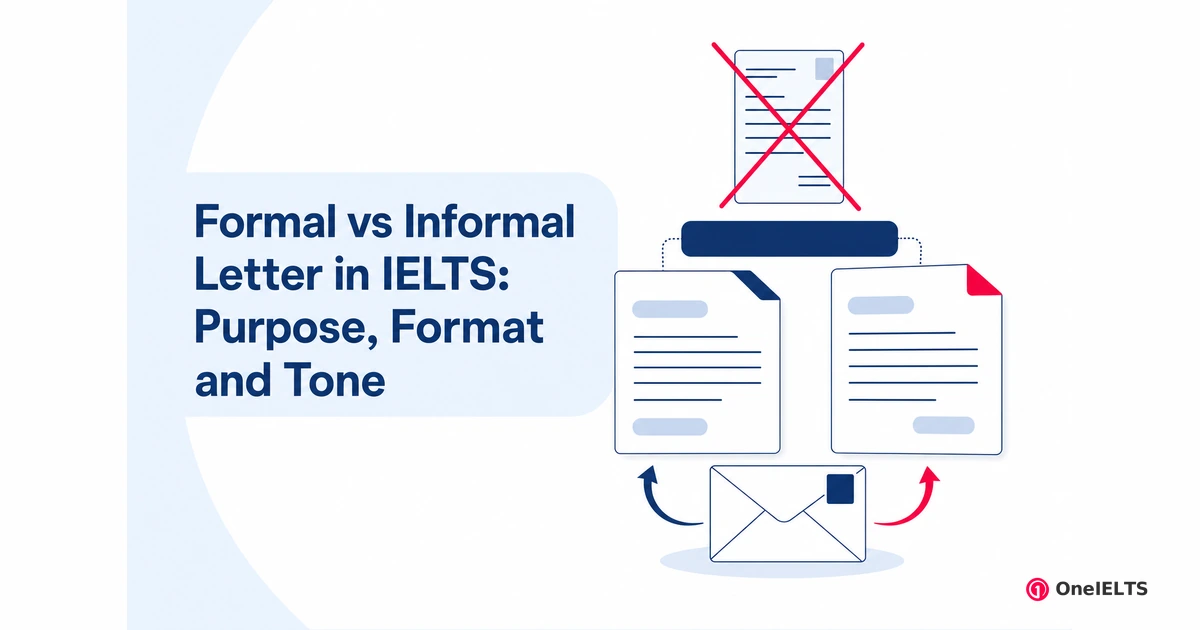
Every General Training Task 1 prompt names who you’re writing to, and that recipient sets the register. The register then decides your salutation, sign-off, vocabulary and how fast you state the purpose. A formal letter goes to a company or official, and an informal letter goes to a friend or relative.
Both need at least 150 words in about 20 minutes and cover three bullet points. The prompt also says “You do NOT need to write any addresses,” so the school layout with two addresses, a date and a subject line doesn’t apply. Checked on 7 October 2026.
This page compares the two registers: definitions, differences, when each applies, greetings, tone, structure, shared features, one situation written twice, and reading your prompt. Semi-formal letters, question types, first lines and tone marking have their own pages, and IELTS letter writing is the parent guide.
What Is a Formal Letter?
A formal letter is an official letter to an organization, an official or a person you don’t know personally, written in polite, impersonal language and closed with fixed conventions.
General Training Task 1 uses one for a complaint letter to a company or airline, or a request for information from an organization. It also covers a job application or course application, and letters to a local council or newspaper editor. A formal complaint stays polite and firm, never angry.
You sign with your full name, such as Anjali Mehta. IELTS drops the school layout of addresses, date and subject line, because the prompt says you do not need to write any addresses.
What Is an Informal Letter?
An informal letter is a personal letter to someone you know well, such as a close friend, a relative or a former classmate, written in a warm, conversational tone.
Informal in IELTS still means a planned letter: all three bullet points covered, clear paragraphs and at least 150 words. Contractions and everyday phrasal verbs are expected. Slang, text-speak such as “u” or “gonna”, and emoji are not, even though general writing guides list them as informal markers.
You sign with your first name only. The usual purposes are inviting, thanking, apologizing, giving advice and sharing news. The informal letter questions in IELTS page covers each type with samples.
What Are the Differences Between Formal and Informal Letters?
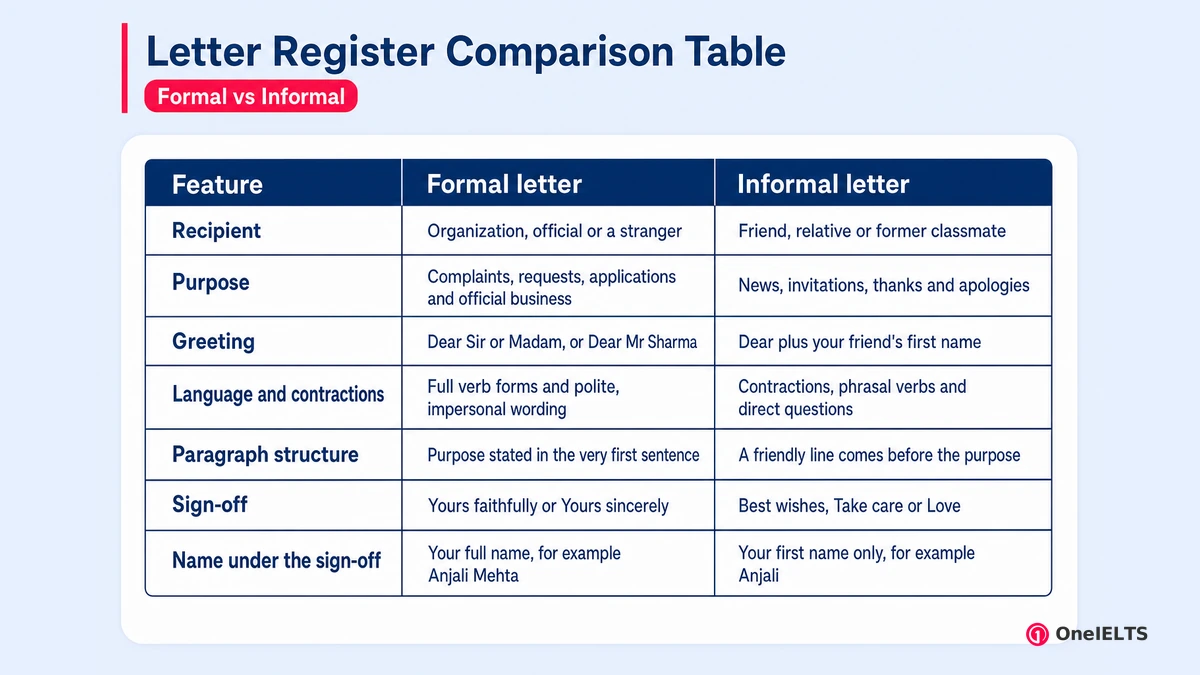
Formal and informal letters differ in who receives them, why they are written, how they open and close, the language they use, and how fast they state their purpose. The recipient drives every other row, from the salutation and complimentary close to contractions, paragraphing and whether you sign a full name.
Seven features separate the two registers, each summed up in one short clause.
| Feature | Formal letter | Informal letter |
|---|---|---|
| Recipient | Organization, official or a stranger | Friend, relative or former classmate |
| Purpose | Complaints, requests, applications and official business | News, invitations, thanks and apologies |
| Greeting | Dear Sir or Madam, or Dear Mr Sharma | Dear plus your friend’s first name |
| Language and contractions | Full verb forms and polite, impersonal wording | Contractions, phrasal verbs and direct questions |
| Paragraph structure | Purpose stated in the very first sentence | A friendly line comes before the purpose |
| Sign-off | Yours faithfully or Yours sincerely | Best wishes, Take care or Love |
| Name under the sign-off | Your full name, for example Anjali Mehta | Your first name only, for example Anjali |
Neither register uses the address-and-date block shown on many comparison pages, because IELTS removes it from the task.
When Do You Use a Formal or Informal Letter in IELTS?
Use a formal letter when the prompt names an organization, an official or a stranger (a manager, a company, a council, an editor). Use an informal letter when it names someone you know personally, such as a friend or a relative.
Purpose follows audience. Formal letters handle business, applications and complaints, while informal letters share news, invitations and thanks. Eight situations recur often enough in General Training prompts to learn by heart, and each one carries its register.
- Complaining to a company about a faulty product (formal): a letter of complaint asking for a fix.
- Applying for a part-time job or a course (formal): a job application that matches your skills to the role.
- Requesting information from an organization (formal): a request letter asking about fees, dates or opening hours.
- Writing to a local council or newspaper editor (formal): raising a public issue such as noise or parking.
- Inviting a friend to a celebration (informal): an invitation letter with the date, place and plan.
- Thanking a relative for their hospitality (informal): a letter of thanks naming one moment you enjoyed.
- Apologizing to a friend for missing an event (informal): an apology letter that explains and makes up for it.
- Giving advice to a friend moving to your city (informal): tips on housing, transport and where to eat.
A person you know only in an official role, such as your manager, landlord or teacher, sits between the two. That semi-formal case is answered in the last section of this page.
How Do Greetings and Sign-Offs Differ in Formal and Informal Letters?
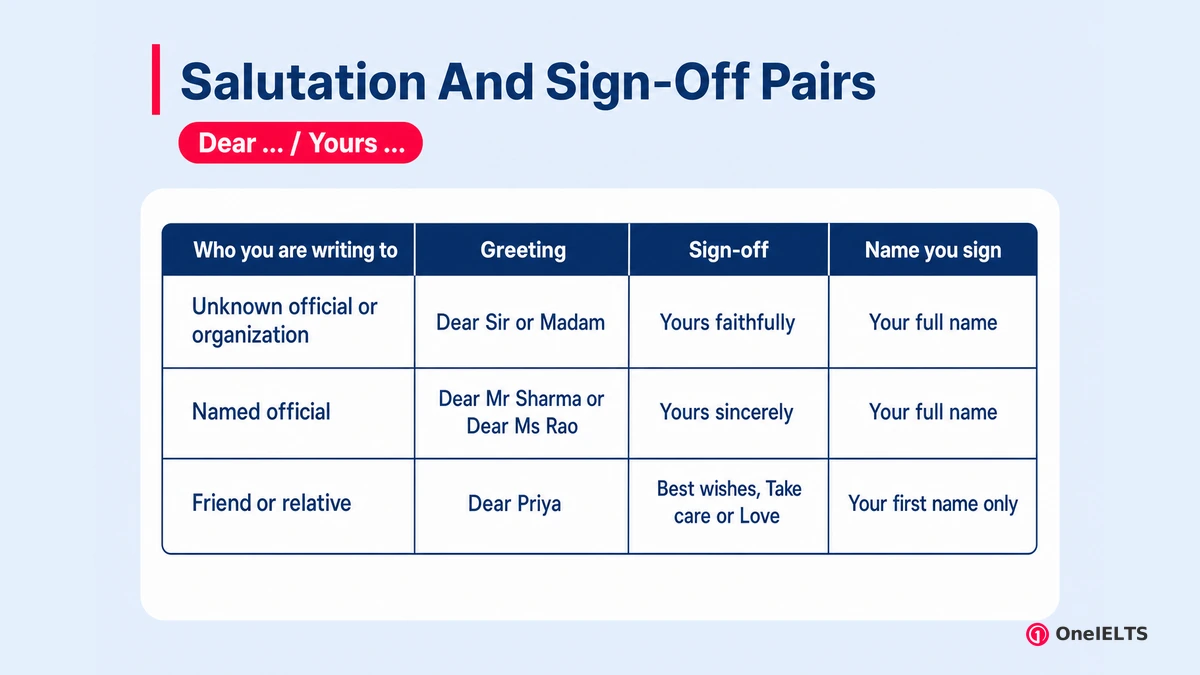
A formal letter opens “Dear Sir or Madam” and closes “Yours faithfully” when you don’t know the name, or “Dear Mr/Ms + surname” and “Yours sincerely” when you do. An informal letter opens “Dear + first name” and closes “Best wishes”, “Take care” or “Love”.
Three recipient types cover almost every prompt, and each one fixes a greeting, a sign-off and the name you sign.
| Who you are writing to | Greeting | Sign-off | Name you sign |
|---|---|---|---|
| Unknown official or organization | Dear Sir or Madam | Yours faithfully | Your full name |
| Named official | Dear Mr Sharma or Dear Ms Rao | Yours sincerely | Your full name |
| Friend or relative | Dear Priya | Best wishes, Take care or Love | Your first name only |
The IELTS prompt prints “Begin your letter as follows: Dear …”, so keep “Dear” even for a friend instead of “Hi” or “Hey”. Never write “To whom it may concern”. The faithfully or sincerely choice comes down to one test: do you know the surname? A semi-formal letter pairs a named greeting with “Kind regards” and has its own page. These conventions stay British, as IELTS materials print them, so “Mr” takes no period.
How Do Tone and Language Differ in Formal and Informal Letters?
A formal letter is polite and impersonal, with full verb forms, indirect requests and precise vocabulary, while an informal letter is conversational, with contractions, phrasal verbs and direct questions.
Six pairs show the same idea in each register, so you can see where word choice shifts.
| Language feature | Formal example | Informal example |
|---|---|---|
| Contractions | I am writing to ask | I’m writing to ask |
| Requests | I would be grateful if you could | Could you |
| Word choice | purchase, inform, assist | buy, tell, help |
| Phrasal verbs | postpone the meeting | put off the meeting |
| Apologies | I apologize for any inconvenience | Sorry I couldn’t make it |
| Closing line | I look forward to hearing from you | Can’t wait to see you |
General guides list more markers. Exclamation marks belong only in informal letters, and sparingly even there.
Formal sentences run longer and use the passive voice more often (“the item was delivered damaged”). Indirect requests soften a demand without weakening it. Whichever register you pick, it holds from the first line to the last. How examiners read tone, and what a slip costs, sits on the IELTS letter tone page.
How Does the Structure of a Formal Letter Differ From an Informal One?
Both registers use four or five short paragraphs built around the three bullet points. The difference sits in the first and last paragraphs. A formal letter states its purpose in the first sentence and closes with the action it expects, while an informal letter opens with a short personal line and closes warmly.
The body paragraphs barely change between the two. Here is the paragraph plan, with the formal and informal version of each part side by side.
- Greeting line: “Dear Sir or Madam” or “Dear Mr Sharma” for formal letters, “Dear Priya” for informal ones, then a comma.
- Opening paragraph: a purpose statement in the first sentence (formal), or one friendly line and then the purpose (informal).
- Body paragraphs: one per bullet point in both registers, so each of the three points gets its own block.
- Closing paragraph: the action you expect, such as a refund or a reply (formal), or a personal wrap-up (informal).
- Sign-off and name: “Yours faithfully” with your full name, or “Best wishes” with your first name only.
One paragraph per bullet point protects Task Achievement in both registers, and neither needs a subject line or an address block.
A formal letter might open with “I am writing to complain about a blender from your Pune store” as its first line. An informal one might open with “It’s been ages since your wedding, and I’ve got news” instead. The guide on how to start an IELTS letter covers first lines in depth.
What Are the Similarities Between Formal and Informal Letters?
In IELTS both are the same task: General Training Task 1, at least 150 words in about 20 minutes, three bullet points to cover, and the same four marking criteria.
Examiners mark a letter to a friend and a letter to an airline against the same Task Achievement, Coherence and Cohesion, Lexical Resource, and Grammatical Range and Accuracy descriptors. Seven features stay fixed whichever register the prompt calls for.
- Same task and time: both are General Training Task 1, with about 20 minutes suggested.
- Same minimum length: 150 words for both, and a shorter letter gives the examiner less to reward.
- Three bullet points to cover in full: each one answered with real detail.
- Same four marking criteria: each worth a quarter of the Task 1 score.
- A clear purpose the reader understands at once: stated early in the letter.
- Clear paragraphing: one paragraph for each bullet point and a short close.
- Accurate grammar, spelling and punctuation: marked the same way in a friendly or official letter.
The register is judged inside Task Achievement, so a correct register can’t rescue a letter that skips a bullet point. The IELTS Writing band descriptors show the exact wording.
What Do Formal and Informal IELTS Letters Look Like?
The clearest way to see the difference is one situation written twice: declining an invitation to an event, once to the event organizer (formal) and once to a friend who invited you (informal).
The same declined invitation, to a college alumni dinner, runs through six letter parts in original lines written for this page.
| Letter part | Formal version | Informal version |
|---|---|---|
| Greeting | Dear Ms Rao, using the event organizer’s surname from the invitation | Dear Priya, keeping the printed Dear with your friend’s first name |
| Opening sentence | Thank you for your invitation to the Class of 2016 alumni dinner on 14 June. | Thanks so much for asking me to the alumni dinner on the 14th! |
| Reason for not attending | Unfortunately, I am unable to attend, as I will be abroad for work that week. | Sadly I can’t come, because work’s sending me to Dubai that whole week. |
| Offer or request | I would be grateful if you could send me the photographs and future event dates. | Could you send me loads of photos and save me a seat next time? |
| Closing line | I look forward to hearing about future alumni events and wish you a successful evening. | Can’t wait to catch up properly when I’m back, so let’s grab coffee soon. |
| Sign-off | Yours sincerely, followed by your full name, for example Anjali Mehta | Best wishes, followed by your first name only, for example Anjali |
The table isolates contrast and stops short of a full letter. A complete sample letter and model answer for each type sit on the parent letter-writing page. For timed practice against the 20-minute guide, use IELTS Writing practice.
How Do You Identify Whether an IELTS Letter Is Formal or Informal?
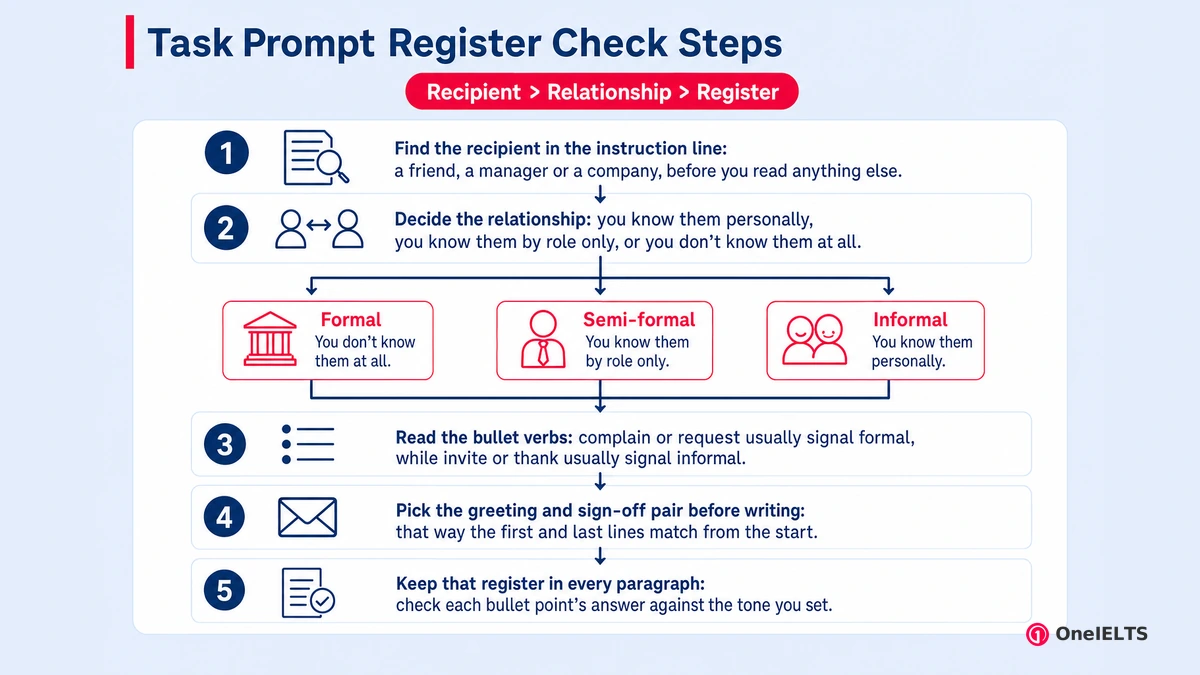
Read who the letter is addressed to in the instruction line and how well you know that person. The bullet points confirm the choice.
The task prompt hands you the register before you write a word, so the decision takes under a minute when you read in a fixed order. A common slip in practice letters is “Dear Sir or Madam” at the top and “Best wishes” at the bottom, which happens when the register gets chosen line by line. Five steps turn any prompt into one register decision.
- Find the recipient in the instruction line: a friend, a manager or a company, before you read anything else.
- Decide the relationship: you know them personally, you know them by role only, or you don’t know them at all.
- Read the bullet verbs: complain or request usually signal formal, while invite or thank usually signal informal.
- Pick the greeting and sign-off pair before writing: that way the first and last lines match from the start.
- Keep that register in every paragraph: check each bullet point’s answer against the tone you set.
What Are the Types of Letter Writing in IELTS?
The letter types in General Training Task 1 are formal, semi-formal and informal, set across purposes such as complaints, requests, applications, invitations, thanks and apologies.
School grammar lists of “seven types of letter” sort by letter purpose. IELTS effectively sorts by register, so the recipient matters more than the purpose label. An invitation to a cousin is informal; the same invitation to your manager is a semi-formal letter. The IELTS letter writing guide covers each type with samples.
What Are Examples of Informal Letter Questions in IELTS?
The informal letter questions IELTS sets ask you to write to a friend or relative to invite them, thank them, apologize, give advice or share news.
One typical instruction line asks you to write to a friend who is moving to your city. The word friend signals the informal register by itself, whether the task is an invitation or an advice letter. Full question sets with answers sit on the informal letter questions page.
Is a Semi-Formal Letter Different From a Formal Letter?
Yes, a semi-formal letter goes to someone you know only in a set role, such as a manager, a teacher or a neighbor you rarely speak to. It pairs a named greeting with polite but less rigid language.
The usual pair is “Dear Mr Sharma” with “Kind regards” or “Yours sincerely”, and contractions stay rare. The full treatment lives on the semi formal letter page.
How Do You Know If Your Letter Is Too Formal or Too Informal?
The signs that a letter is too formal or too informal are a greeting and sign-off that do not match, and contractions or slang in a complaint. Stiff phrases like “I am writing to inform you” in a note to a friend are the third sign.
Read the first and last lines together: a register mismatch there usually spreads through the middle too. The IELTS letter tone page explains how examiners mark stiff phrasing page.
Written by Jamil Ahmed, reviewed 7 October 2026.
Last verified: 7 October 2026
Practice for the Real IELTS Exam
Apply what you’ve learned with free, exam-style practice:
- Take a free IELTS mock test — all four skills, real exam timing, AI band scoring
- Sit a Writing section mock — Task 1 and Task 2 in one timed hour with a band estimate
- Practice by question type — self-paced Writing sets with model answers