Which IELTS you sit is decided by the body that reads your score, not by you. A university wants IELTS Academic, while a UK visa caseworker wants IELTS for UKVI or IELTS Life Skills. That split is why one applicant often sits two different tests. There are four types of IELTS in everyday use: Academic for study, IELTS General Training for work and migration, UKVI for British visa routes, and Life Skills for UK family and settlement applications. This guide explains each format, shows how the four shared sections differ, then maps your goal to the right test so you book once.
Last verified: 30 June 2026
1. IELTS Academic
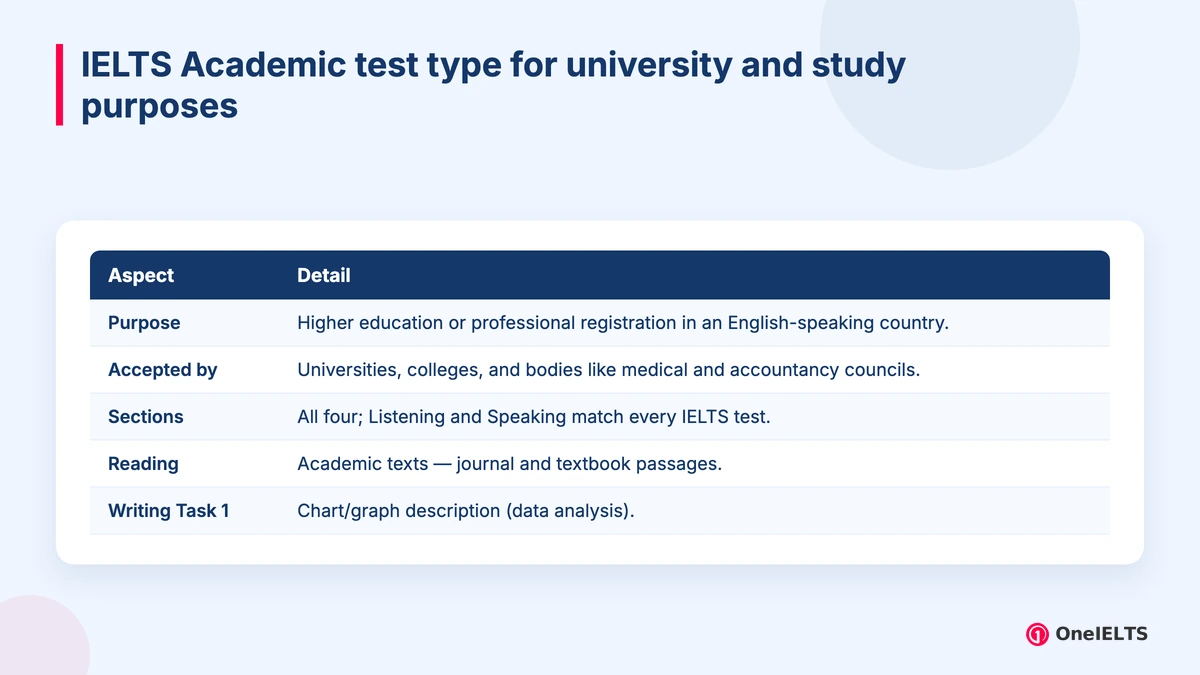
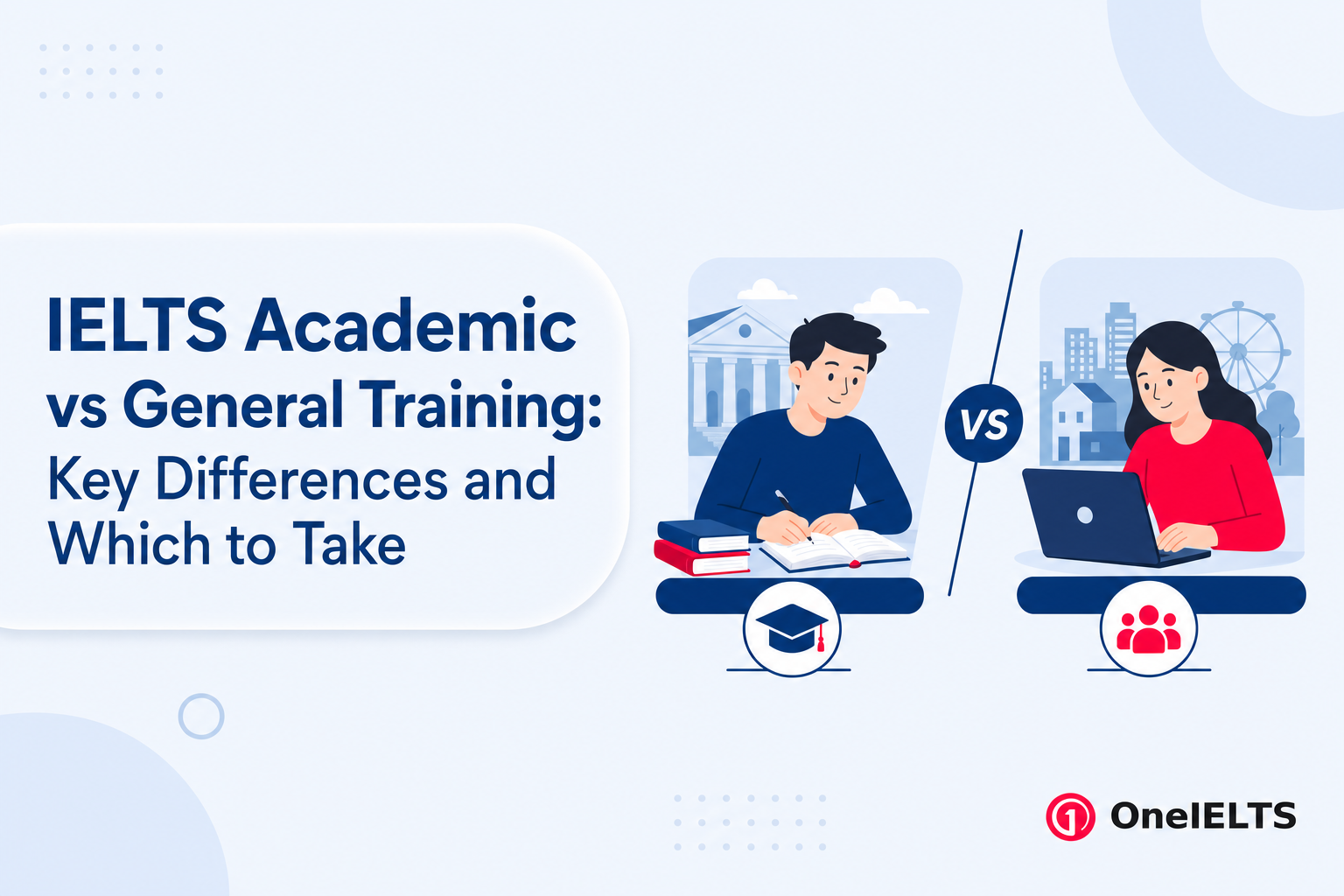
IELTS Academic is for people whose purpose is higher education or professional registration in an English-speaking country. It is accepted by universities, colleges, and bodies like medical and accountancy councils. All four sections appear, and Listening and Speaking match every IELTS test; only the Reading passages and Writing tasks differ, using academic texts and a chart-description Task 1.
2. IELTS General Training
IELTS General Training serves a different purpose: it measures everyday English for work, training programmes, and migration rather than study. It is accepted by employers and immigration authorities in Australia, Canada, New Zealand, and the UK. The same four sections run, with identical Listening and Speaking; its Reading uses workplace and social texts, and Writing Task 1 asks you to write a letter.
3. IELTS for UKVI
IELTS for UKVI has one purpose: it proves your English for UK Visas and Immigration applications. It is accepted by the Home Office because the test runs in an approved secure centre, so the content matches Academic or General Training while the certificate carries UKVI status. The four sections are unchanged; you simply choose the Academic or General Training version that your visa route demands.
4. IELTS Life Skills
IELTS Life Skills exists for a narrow purpose: it tests only Speaking and Listening at level A1, A2, or B1 for specific UK visa routes. It is accepted by UK Visas and Immigration for family, spouse, and settlement (ILR) applications. Unlike the other tests, it drops two of the usual sections entirely, since it assesses face-to-face conversation rather than Reading or Writing, and you pass or fail rather than receive a band.
What Are the Main Sections of the IELTS Exam?
Every IELTS test is built from the same four sections: Listening, Reading, Writing, and Speaking, marked on the nine-band scale. Listening and Speaking are identical across the test types, so practice transfers directly. The Academic vs General difference sits only in the other two skills. Academic Reading uses journal and textbook passages while General Training Reading uses notices and workplace material. Academic Writing Task 1 describes a graph, whereas General Training Task 1 asks for a letter.
Which Types of IELTS Should You Take?
You pick your IELTS type by matching the test to the organisation that will read the result, because your goal decides the format. When choosing IELTS type by goal, study points to Academic, work and migration point to General Training, and any UK visa route points to a UKVI or Life Skills test. The four common goals and the IELTS type each one needs are mapped here.
- Study at a university or college. Take IELTS Academic, which admissions teams and professional registration bodies use to confirm academic English.
- Work or professional registration abroad. Take IELTS General Training, which employers in Canada, Australia, and New Zealand accept for skilled roles.
- General migration outside the UK. Take IELTS General Training, which immigration authorities use for points-based permanent residence applications.
- Any UK visa, family, or settlement route. Take IELTS for UKVI, or IELTS Life Skills when only Speaking and Listening are required.
Which IELTS Exam Is Easier, General Training or Academic?
Many candidates find General Training Reading and Writing easier than Academic, while Listening and Speaking stay identical across both tests. Difficulty really tracks the task type, not the label. Academic Reading sets denser journal passages and Academic Writing Task 1 demands data analysis. People who struggle with charts feel the Reading difficulty and the Writing Task 1 load more in the Academic version. Our IELTS Academic vs General Training guide compares the two formats side by side.
Is IELTS for UKVI Valid for Non-UK Visas?
No, IELTS for UKVI is specifically for UK Visas and Immigration; other countries accept standard IELTS instead. The UKVI certificate signals that the test ran in a Home Office-approved centre, a status only the UK requires. For any non-UK destination you book standard IELTS, since universities and immigration bodies elsewhere treat the ordinary Academic or General Training result as full proof. Check the routes in our IELTS for UKVI guide.
Practice for the Real IELTS Exam
Apply what you’ve learned with free, exam-style practice:
- Take a full IELTS mock test
- Practice by section: Listening, Reading, Writing, Speaking
- Structure your essays with IELTS Writing templates