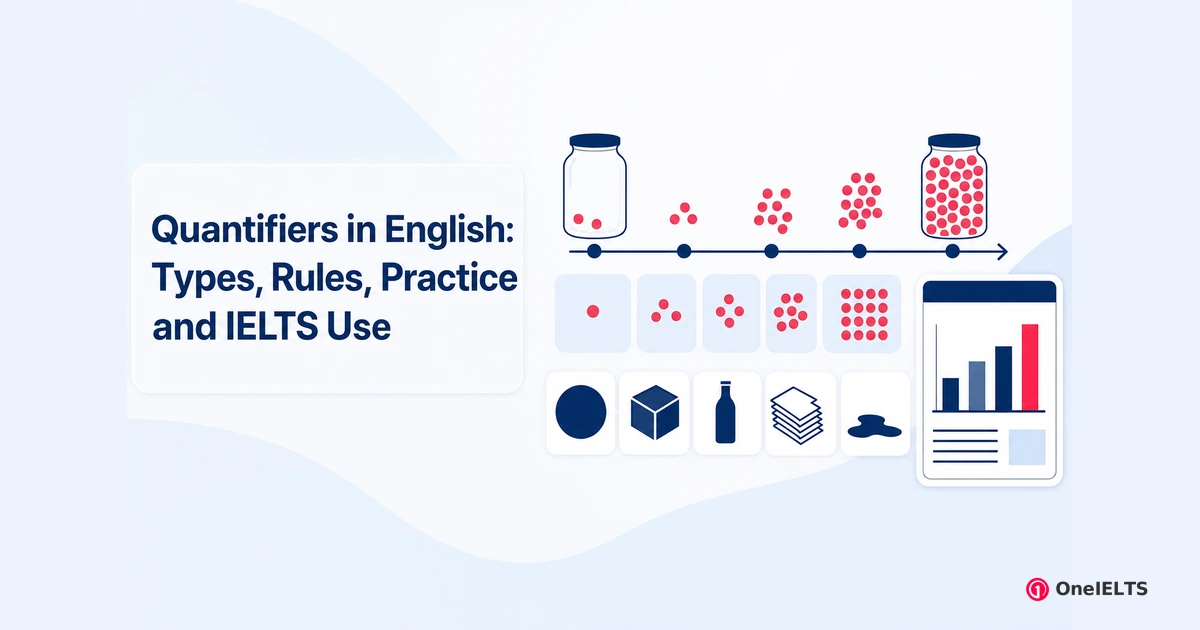
Quantifiers tell your reader how much or how many of a noun there is, from none to all, without giving an exact number. In IELTS Writing Task 1 they carry chart data (most, just under half, a small minority). In IELTS Writing Task 2 they keep claims accurate (many people, not all people), and examiners mark slips under Grammatical Range and Accuracy.
This page defines the quantifier and places it among the determiner classes. Then come the types, pairing with a countable noun or an uncountable noun, much and many, some and any, few and a few, fewer and less, the distributives, “of”, agreement, mistakes, exercises and IELTS use. Deciding a noun’s type belongs to the countable and uncountable nouns page, and article choice belongs to the articles page, so neither is retaught here as a quantity rule.
What Are Quantifiers in English?
A quantifier is a word or phrase placed before a noun to show its amount or number, as in many students, a little time or enough evidence. It answers the quantity question, “How much?” or “How many?”, without an exact figure. “Several countries” is a quantifier phrase, while “seven countries” uses a number.
Quantifiers come as single words (some, any, each) or as longer phrases (a lot of, a great deal of, a large number of). They run from zero (no, none) to the whole (all, every). Most also allow pronoun use once the noun is clear: “Most agreed.” “None came.” In both forms, the quantifier limits the noun phrase it belongs to.
How Are Quantifiers Different From Other Determiners?
Quantifiers are one class of determiner. Every determiner comes before a noun and limits it, but only quantifiers limit it by amount. An article, a demonstrative or a possessive determiner limits the noun by which one or whose instead.
Grammars disagree on whether numbers and each distributive word form separate classes or kinds of quantifier, so treat this split as one common model rather than the only correct one. An interrogative determiner such as which also sits in the set. A quantifier can follow another determiner in a fixed determiner order: the many reasons, my few friends, all the students.
Seven determiner classes appear in most school grammars, each with its own job before the noun.
- Articles (a, an, the): mark a noun as general or specific.
- Demonstratives (this, that, these, those): point to a noun by distance.
- Possessives (my, your, their): show who owns the noun.
- Quantifiers (some, many, much, few, enough): the quantifier class, limiting by amount.
- Numbers (one, two, first, second): give an exact count or order.
- Distributives (each, every, either, neither): pick out group members one by one.
- Interrogatives (which, what, whose): ask which noun the speaker means.
What Are the Types of Quantifiers in English?
Quantifiers are usually grouped by the nouns they go with and by what they express. A general quantifier gives a rough amount, a specific quantifier picks out members or shares, and a graded quantifier compares.
The two main types are quantifiers for countable nouns and quantifiers for uncountable nouns, with a third group that works with both. A graded quantifier such as more or fewer also behaves like an adjective, with a comparative form and a superlative form.
Six groups cover almost every quantifier you’ll meet, and the sections after this one give the rules for each.
- Quantifiers for countable nouns (many, few, several): used only with plural nouns.
- Quantifiers for uncountable nouns (much, little, a great deal of): used with mass nouns.
- Quantifiers for both noun types (some, any, a lot of, enough): flexible with either kind.
- Graded quantifiers that show more or less (more, most, fewer, less): used to compare.
- Distributive quantifiers that refer to members of a group (each, every, both, either, neither).
- Zero and whole quantifiers (no, none, all): mark the two ends of the scale.
Which Quantifiers Go With Countable Nouns, Uncountable Nouns or Both?
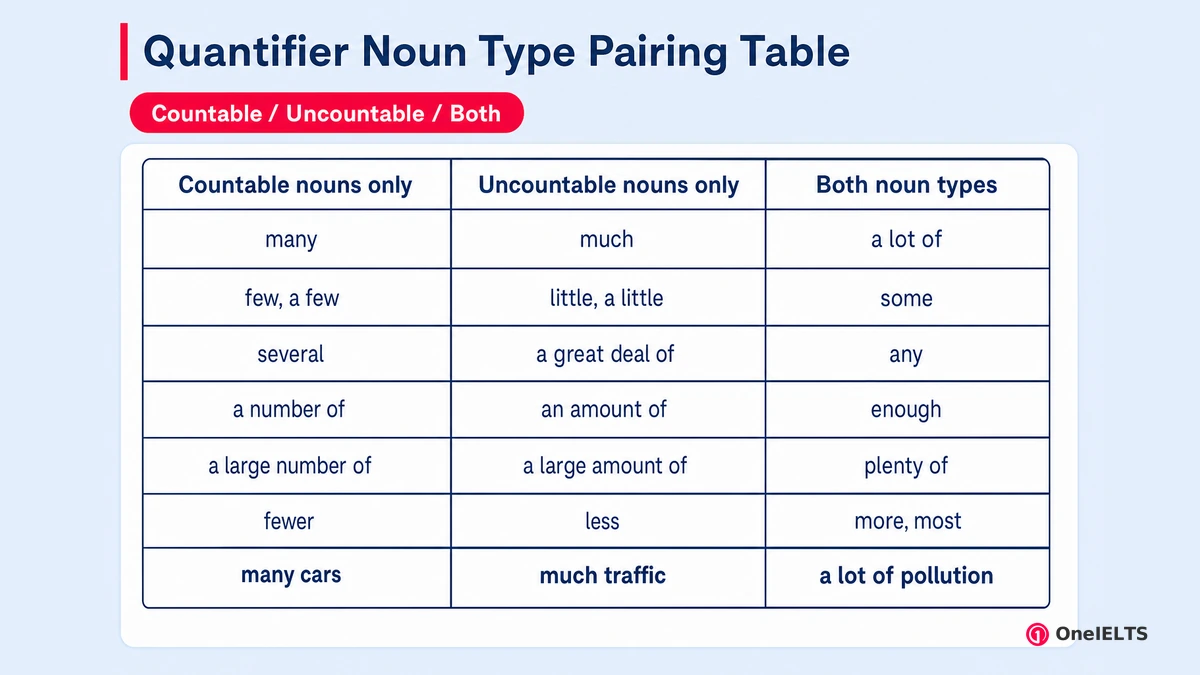
Many, few, a few, several and a number of go only with a plural noun that is countable. Much, little, a little, a great deal of and an amount of go only with an uncountable noun. Some, any, a lot of, lots of, plenty of, enough, more, most, all and no go with both.
The noun test takes one line: if you can put a number before the noun, it’s a countable noun. The full rules live on the countable and uncountable nouns page. Each quantity phrase in the table sits in the column of the noun type it accepts.
| Countable nouns only | Uncountable nouns only | Both noun types |
|---|---|---|
| many | much | a lot of |
| few, a few | little, a little | some |
| several | a great deal of | any |
| a number of | an amount of | enough |
| a large number of | a large amount of | plenty of |
| fewer | less | more, most |
With IELTS topic nouns, one example per column: many cars, much traffic, a lot of pollution.
When Do You Use the Quantifiers Much, Many and A Lot Of?
Use many with plural countable nouns and much with uncountable nouns, mostly in a question form or a negative sentence. Typical examples are “How many people?” and “There isn’t much time.” In positive statements, a lot of or lots of sounds more natural with both noun types (a lot of people, a lot of time).
Lots of belongs to the informal register. In an essay, the formal register prefers a large number of or many.
Six usage points cover nearly every choice between these words.
- Many goes with plural countable nouns, as in many students and many countries.
- Much goes with uncountable nouns, as in much money and much information.
- Questions and negatives suit much and many: How much water? Not many jobs.
- A lot of and lots of fit positive statements with both noun types: a lot of rain.
- Formal alternatives: a large number of (countable); a great deal of, a large amount of (uncountable).
- Too much, too many, so much and so many show excess: too many cars.
When Do You Use the Quantifiers Some and Any?
Use some in a positive sentence and any in a negative sentence or most questions. You say “I have some time” but “I don’t have any money” and “Do you have any questions?” Both work with plural countable nouns and uncountable nouns.
Each compound pronoun follows the same rule. Someone and somewhere suit positive sentences, while anybody and anything suit negatives and questions.
Three core rules and three exceptions decide most some and any choices.
- Some fits positive statements, as in Some students prefer online classes.
- Any fits negative sentences, as in There aren’t any seats left.
- Any fits most questions, as in Is there any evidence for this?
- Some fits offers and requests: Would you like some tea? Could I have some?
- Any in a positive sentence means it doesn’t matter which: Any student can apply.
- Some with a singular countable noun means an unknown one: Some person called you.
What Is the Difference Between the Quantifiers Few, A Few, Little and A Little?
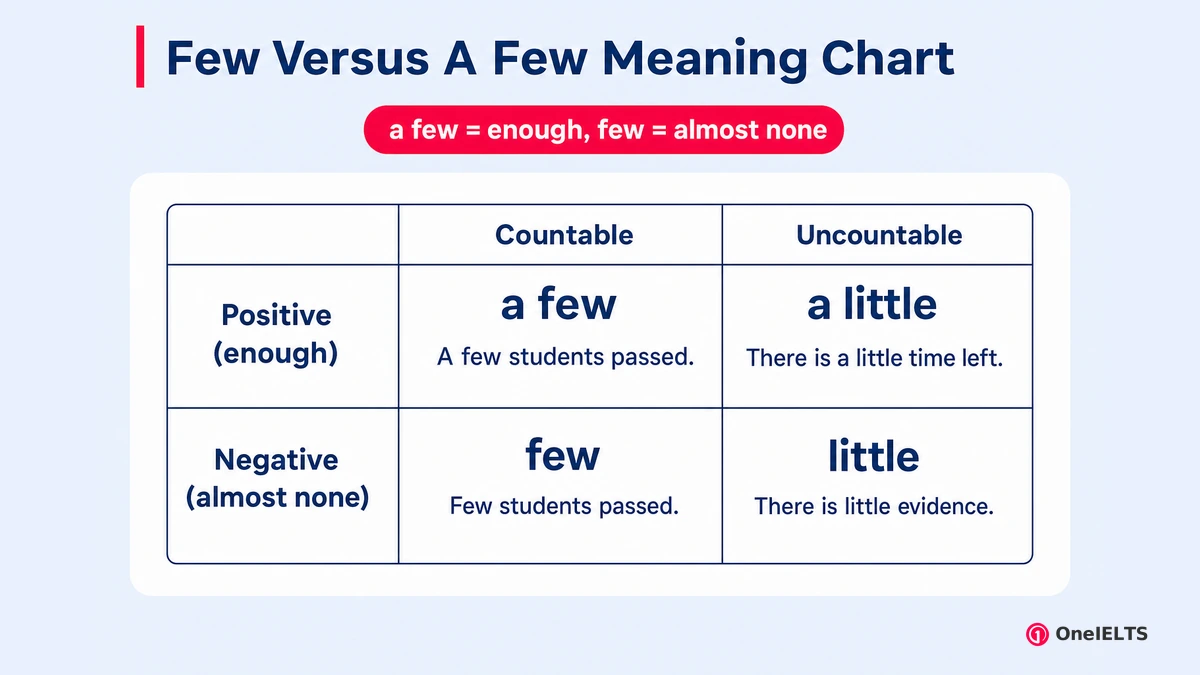
The article reverses the meaning. A few and a little mean a small amount that is enough, a positive meaning, while few and little without “a” mean almost none, a negative meaning. Few and a few take plural countable nouns, and little and a little take uncountable nouns. That single article flips the writer’s judgment, and each row pairs one form with its sense.
| Quantifier | Noun type | Meaning | Example |
|---|---|---|---|
| a few | countable | some, enough | A few students passed, so the class continued. |
| few | countable | almost none | Few students passed, so the course was changed. |
| a little | uncountable | some, enough | There is a little time left. |
| little | uncountable | almost none | There is little evidence for this claim. |
Quite a few means a fairly large number. Very few and very little add an intensifier that makes the negative stronger.
When Do You Use the Quantifiers Fewer and Less?
Use fewer with plural countable nouns (fewer cars) and less with uncountable nouns (less traffic). With numbers, a percentage, distances, money and time, less than is standard: less than 10%, less than five kilometers.
Less people is common in speech, but formal writing marks it as an error, so write fewer people.
Each comparative quantifier has a superlative quantifier partner, and five forms cover the set.
- More works with both noun types, as in more people and more energy.
- Most is the superlative of many and much, as in most households.
- Fewer and the fewest go with countable nouns: the fewest visitors came in March.
- Less and the least go with uncountable nouns: the least rainfall fell in July.
- Less than goes before figures and percentages, as in less than a quarter.
How Do You Use the Distributive Quantifiers Each, Every, All, Both, Either and Neither?
Yes, every is a distributive quantifier: it refers to all members of a group one by one. Each and every take a singular noun and a singular verb (Every student has a number). All takes a plural or uncountable noun, and both, either and neither refer to a group of two.
Half follows the same pattern and accepts both forms: half the students, half of the budget.
The six words split by the noun form they take.
- Each takes a singular noun and sees members separately: Each country has its own rules.
- Every takes a singular noun for the whole group: Every candidate gets a result.
- All takes a plural or uncountable noun: all schools, all information.
- Both takes a plural noun for two items together: Both charts show a rise.
- Either takes a singular noun for one of two: Either option works.
- Neither takes a singular noun for not one of two: Neither figure changed.
When Do You Need “Of” After a Quantifier?
Add “of” when the quantifier comes before another determiner or a pronoun (most of the students, some of my friends, none of them). Leave it out before a bare noun with a general meaning (most students, some friends).
Grammars call the “of” version a partitive structure, because it picks a part of a known group. An object pronoun such as them or us always needs it. Quantifier placement follows a fixed order: quantifier, then of, then the determiner or pronoun.
Six patterns show where “of” belongs, each with a right and a wrong version.
- Most + noun for a general group: Most people agree, not Most of people agree.
- Most of + determiner + noun for a specific group: Most of the people surveyed, not Most the people.
- No + noun, but none of + determiner or pronoun: none of the tickets, not none tickets.
- Some, any, many and few take of before the or a pronoun: many of them, not many them.
- All, both and half can drop of before the: all the students, never all of students.
- Every never takes of directly: write every one of the students, not every of the students.
How Does Subject-Verb Agreement Work With Quantifiers?
In subject-verb agreement, the verb usually agrees with the noun after the quantifier. A plural countable noun takes a plural verb (Many people are), an uncountable noun takes a singular verb (Much of the land is), and each, every, either and neither take a singular verb.
Task 1 tests these patterns hardest, because nearly every sentence reports a number, a percentage or a fraction.
Six rules settle the verb form.
- A number of + plural noun takes a plural verb: A number of students are absent.
- The number of + plural noun takes a singular verb: The number of students is rising.
- After a percentage + of, the verb follows the noun: 40% of the land is, 40% of residents are.
- Each, every, either and neither take a singular verb: Each of the graphs shows a rise.
- None of + plural noun takes a singular verb in formal writing; a plural verb is accepted in speech.
- Some, all and most + of take the noun’s number: Most of the money is, most of the cars are.
What Are the Common Mistakes With Quantifiers?
Most quantifier mistakes come from pairing a quantifier with the wrong noun type (much people, less cars). Two more sources are mixing up few and a few, and verb agreement after the number of and each.
The first mistake has a clear language transfer pattern behind it. Hindi “bahut” and Bengali “onek” each cover both much and many, so speakers of these languages often carry much onto countable nouns.
Use this list for error correction: each line gives the wrong form, the right form, then the rule.
- much people → many people, because people is a plural countable noun.
- less cars → fewer cars, because cars is a plural countable noun.
- a few information → a little information, because information is an uncountable noun.
- Few students came, it was great → A few students came: the meaning is positive.
- The number of tourists have increased → has increased, because the number is a singular head.
- every students → every student, because every always takes a singular noun.
- most of people → most people or most of the people, because of needs a determiner.
- There isn’t some milk → There isn’t any milk, because the sentence is negative.
How Can You Practice Quantifiers With Exercises?
Three exercise types build accuracy in order: choosing the quantifier, correcting errors in context, then data description. An answer key with a one-line rule follows the exercises, and the whole set prints as a single worksheet you can copy.
Work through the three exercises from first to last, since each one adds a step.
- Choose the correct quantifier (gap-fill exercise).
- How (much / many) students took the speaking test in March?
- The council spent too (much / many) money on the new stadium.
- (Few / A few) people came, so the meeting was canceled.
- There are (fewer / less) cars in the city center on Sundays.
- We still have (a little / little) time, so let’s check the answers.
- Are there (some / any) seats left for the evening session?
- Cities now produce (fewer / less) waste than they did in 2010.
- Correct the errors in this short paragraph (error correction).
- Much people now drive to work instead of taking the bus.
- The number of cars on city roads are now twice the 2010 figure.
- Officials hoped the new tram would mean less cars downtown.
- However, a few information about the tram reached local residents.
- Every drivers we asked said that parking costs had risen.
- Most of people still think the tram is too expensive.
- There isn’t some evidence that fares will fall next year.
- Describe the data table below in five sentences, one quantifier phrase each.
- Write one sentence about the bus figure using just under half.
- Describe the car figure with about a quarter and the right verb.
- Report the bicycle figure using a significant minority.
- Describe walking with a small minority and the percentage in brackets.
- Report the Other figure using hardly any and a singular verb.
- Check every verb against the noun that follows of.
The table for Exercise 3 shows how 200 students in a sample survey reach campus.
| Transport to campus | Share of students |
|---|---|
| Bus | 47% |
| Car | 26% |
| Bicycle | 18% |
| Walk | 8% |
| Other | 1% |
The answer key gives each answer with the rule from this page that decides it.
- Ex. 1, item 1: many, because students is a plural countable noun.
- Ex. 1, item 2: much, because money is uncountable and the sentence shows excess.
- Ex. 1, item 3: Few, because the meeting was canceled, so the meaning is negative.
- Ex. 1, item 4: fewer, because cars is countable and less needs uncountable nouns.
- Ex. 1, item 5: a little, because enough time is left, a positive meaning.
- Ex. 1, item 6: any, because the sentence is a question about availability.
- Ex. 1, item 7: less, because waste is uncountable, so fewer does not fit.
- Ex. 2, sentence 1: Many people, because people is countable and much needs uncountable nouns.
- Ex. 2, sentence 2: The number of cars is, because the head noun is singular.
- Ex. 2, sentence 3: fewer cars, because cars is a plural countable noun.
- Ex. 2, sentence 4: little information, because information is uncountable and the sense is negative.
- Ex. 2, sentence 5: Every driver, because every always takes a singular noun.
- Ex. 2, sentence 6: Most people, because of needs a determiner such as the.
- Ex. 2, sentence 7: any evidence, because the sentence is negative, so some does not fit.
- Ex. 3, model 1: Just under half of the students (47%) travel by bus.
- Ex. 3, model 2: About a quarter of the students (26%) come by car.
- Ex. 3, model 3: A significant minority of students (18%) cycle to campus.
- Ex. 3, model 4: A small minority of students (8%) walk to campus.
- Ex. 3, model 5: Hardly any of the group (1%) uses another method.
Once the key holds no surprises, apply the rules in full tasks with our IELTS Writing practice tests, where timed practice shows whether your accuracy holds under the clock.
How Do You Use Quantifiers in IELTS Writing Task 1 and Task 2?
Use precise quantity phrases in Task 1 and qualified quantifiers in Task 2, and check agreement after the number of, percentages and each in both tasks. In Academic IELTS Writing Task 1, quantifiers turn chart figures into readable data description: just under half of households, a small minority of users. In IELTS Writing Task 2, they set how strong each claim is, which is hedging in its plainest form (many young people, not all young people).
Quantifier slips rarely block meaning, so examiners count them against accuracy under Grammatical Range and Accuracy rather than against communication. Range matters as much, because Lexical Resource rewards variety, and a script that repeats a lot of in every sentence limits itself. Our IELTS grammar hub places quantifiers in a full grammar plan.
Which Quantifiers Describe Proportions in an IELTS Writing Task 1 Report?
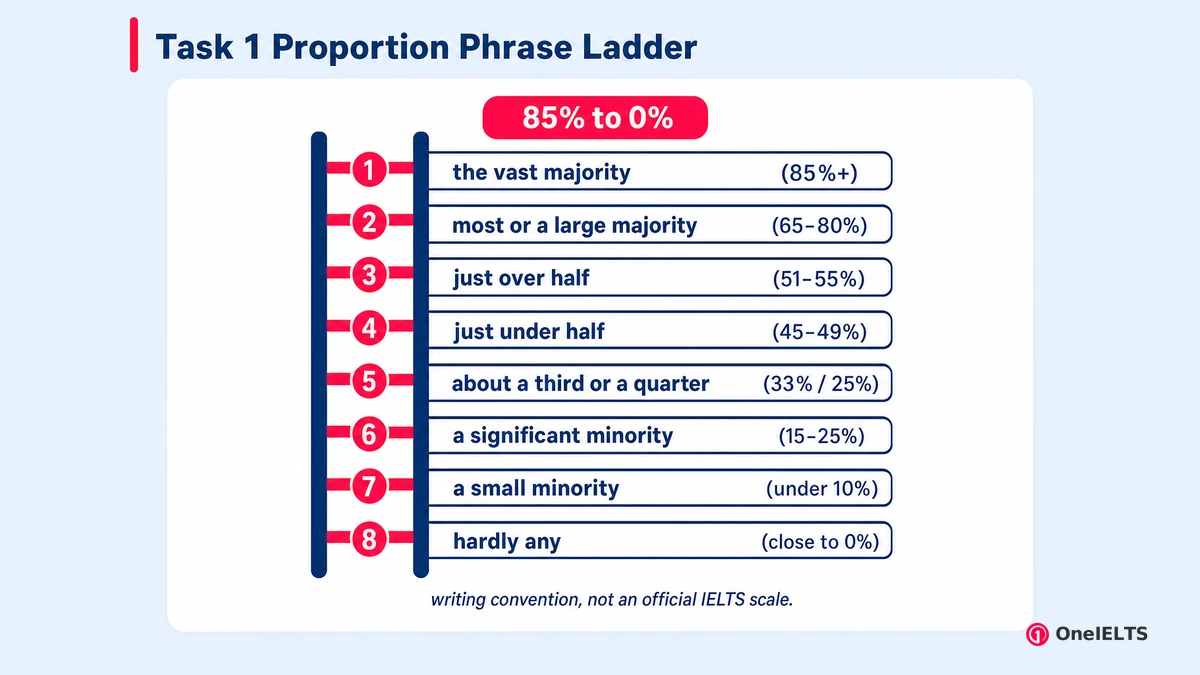
The quantifiers that describe proportions in an IELTS Writing Task 1 report form a ladder from almost all to almost none, and each step should match the figure in the chart. IELTS publishes no such scale, so these ranges follow a writing convention, and examiners check each phrase against the chart. Put the actual percentage in brackets after the phrase the first time: just under half (47%).
Read the ladder from the largest proportion down, matching chart data to one phrase per step.
- The vast majority: about 85% or more of the group.
- Most or a large majority: roughly 65 to 80%.
- Just over half: between 51 and 55%.
- Just under half: between 45 and 49%.
- About a third or a quarter: near 33% or 25%.
- A significant minority: about 15 to 25%.
- A small minority: under 10% of the group.
- Hardly any or almost none: close to 0%.
A worked check: if the chart shows 40%, “most students” misreports the figure in your Task 1 report, while “two in five students (40%)” reports it exactly. Pair the ladder with the trend words in our IELTS Writing Task 1 vocabulary list.
How Do Quantifiers Help You Avoid Overgeneralizing in an IELTS Task 2 Essay?
Quantifiers help you avoid overgeneralizing in an IELTS Task 2 essay by limiting each claim to the people or cases it is true of, so that ‘many students’ replaces ‘all students’. “All teenagers waste time online” becomes “Many teenagers waste time online.” “No one reads newspapers now” becomes “Few young people read newspapers now.”
An absolute statement invites one counterexample to break it. A qualified claim is easier to support with an example, and that hedging fixes overgeneralization while making your Task 2 essay stronger. Our guide on how to write an IELTS essay shows where those claims sit.
Which IELTS Writing Criteria Judge How You Use Quantifiers?
The IELTS Writing criteria that judge how you use quantifiers are Grammatical Range and Accuracy, Lexical Resource and, in Task 1, Task Achievement. Agreement and countability errors fall under Grammatical Range and Accuracy, where band 7 expects frequent error-free sentences. The range and precision of quantity phrases fall under Lexical Resource.
Writing most for 40% misreports the data, which Task Achievement treats as an accuracy problem. This paraphrases the May 2023 IELTS Writing band descriptors, checked on 7 October 2026.
Should You Check Whether a Noun Is Countable Before Choosing Quantifiers in IELTS Writing?
Yes, you should check whether a noun is countable before choosing quantifiers in IELTS Writing, because the noun type decides between many and much, fewer and less, and the number of and the amount of. Information, research, traffic, equipment and advice are each an uncountable noun, so much information and less traffic are right. The full noun countability test sits on our countable and uncountable nouns page.
Written by Fahimur Rahman, reviewed 7 October 2026.
Last verified: 7 October 2026