An IELTS examiner is a certified teacher who marks the Speaking and Writing tests against official band descriptors. Listening and Reading are scored from an answer key instead. The job is gated by your teaching credentials, not by your own IELTS result.
You need a degree, a recognised teaching qualification such as CELTA/DELTA, and real adult-teaching experience before recruitment begins. This guide covers what an examiner does, how they score the test, the requirements to qualify, how training works, the salary, and the step-by-step path to apply.
Last verified: 30 June 2026
What Does an IELTS Examiner Do?
An IELTS examiner assesses the Speaking and Writing tests using the official band descriptors, judging each candidate against published criteria rather than personal impression. Speaking assessment happens in a live face-to-face or video interview. Writing assessment covers both tasks against the same nine-band scale.
Every examiner is trained, standardised, and re-certified on a regular cycle. That standardisation is what keeps a band 7 in Delhi equal to a band 7 in London.
How Do IELTS Examiners Score the Test?
Certified examiners score only the Writing and Speaking papers. They apply the published band descriptors across the four criteria. Listening and Reading are marked against a fixed answer key.
In Writing those four criteria are task achievement, coherence and cohesion, lexical resource, and grammatical range. Speaking adds fluency and pronunciation. The test partners keep up examiner monitoring and re-certify markers at set intervals. This keeps scoring consistent across centres.
What Are the Requirements to Become an IELTS Examiner?
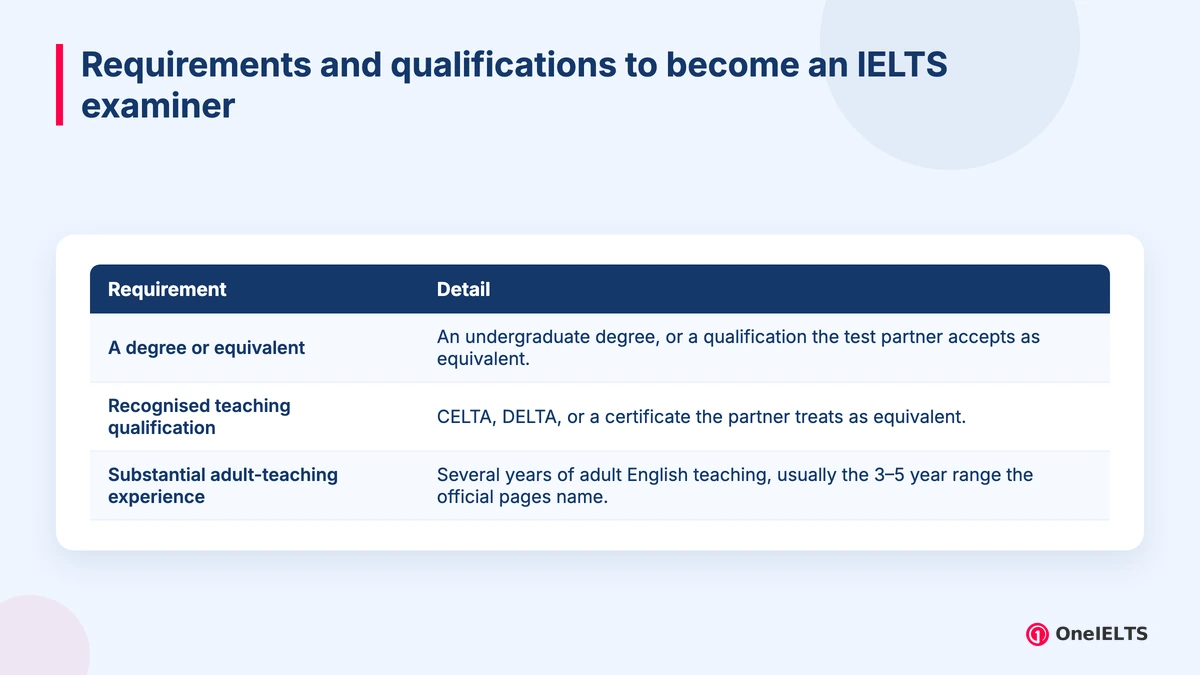
Three credentials decide whether you can apply, and each carries equal weight at the screening stage. The requirements every applicant must meet are set out here.
- A degree or equivalent. You hold an undergraduate degree, or a qualification the test partner accepts as equivalent, before you apply.
- A recognised teaching qualification (CELTA, DELTA or equivalent). You have completed CELTA, DELTA, or a certificate the partner treats as equivalent.
- Substantial adult English-teaching experience. You can show several years of adult teaching experience, usually the three-to-five-year range the official pages name.
How Are IELTS Examiners Trained?
The test partners run examiner training as a structured certification course, not a one-day briefing. New examiners complete a supervised training programme, mark sample scripts and Speaking recordings, and must hit the partner’s accuracy threshold before certification clears them.
After certification, standardisation tasks and ongoing monitoring continue all year. The British Council and IDP re-certify examiners on a fixed cycle, and they withdraw certification from anyone whose marking drifts.
How Much Does an IELTS Examiner Earn?
IELTS examiner pay is set per script or per session and varies by country and test partner, so a single global figure does not exist. Writing examiners are usually paid per script marked. Speaking examiners are paid per session or per candidate block.
The examiner salary in India differs from rates in the UK or Australia, and partners review them often. Confirm the current salary with your local British Council or IDP recruitment office before you count on a number.
Last verified: 30 June 2026
How Do You Become an IELTS Examiner?
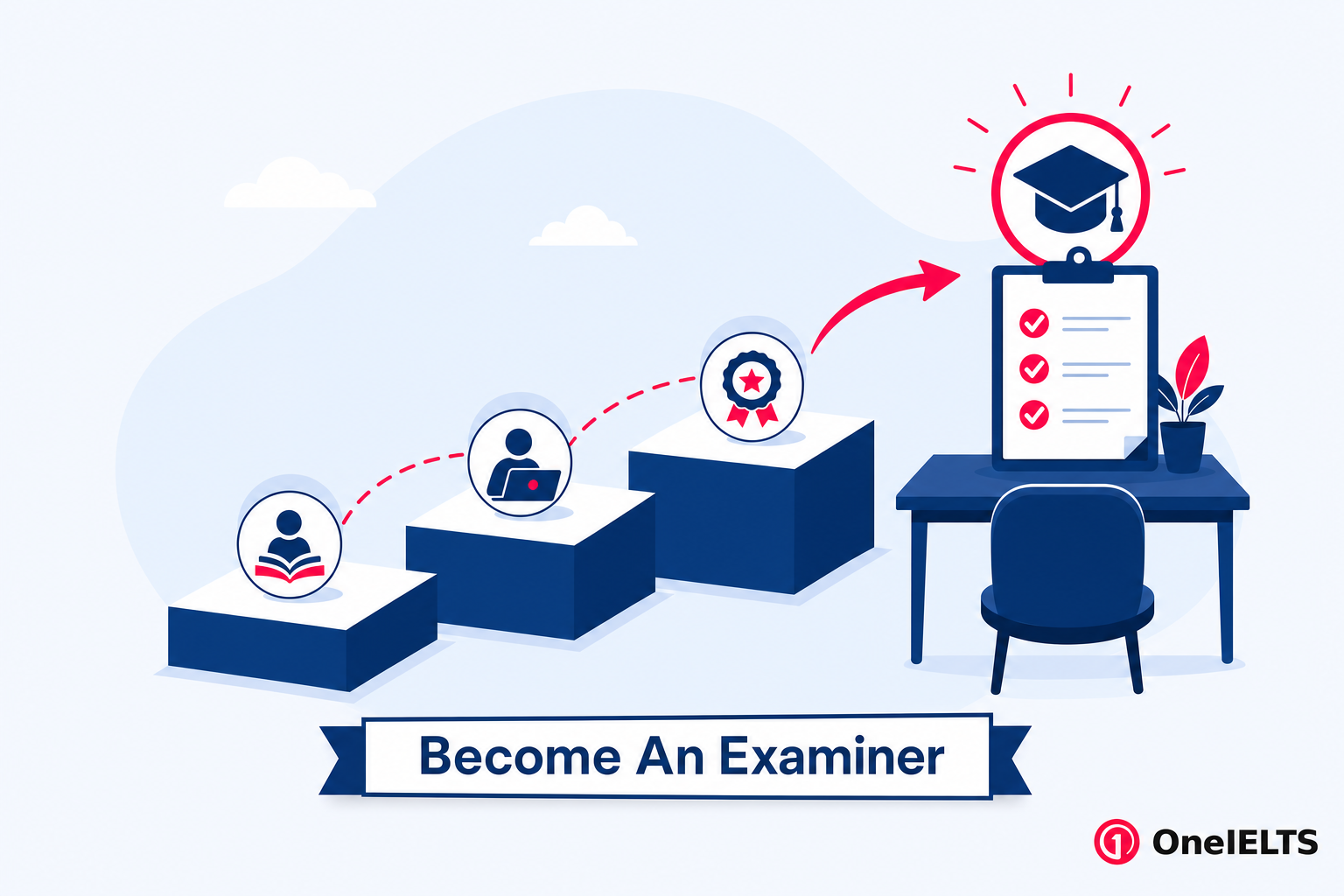
Becoming an IELTS examiner means applying through your local British Council / IDP centre, passing an interview, and completing the certification training course. You apply against a live recruitment need. You prove your degree, teaching qualification, and experience, then train before marking real tests. The steps to apply are listed in order below.
- Check the IELTS examiner vacancies at your nearest British Council or IDP test centre.
- Submit your application with evidence of your degree, teaching qualification, and adult-teaching experience.
- Attend the recruitment interview, where the centre confirms your credentials and English competence.
- Complete the examiner training course and pass the certification standard before you assess live candidates.
Do You Need to Take IELTS to Become an Examiner?
No, you do not need an IELTS score to become an examiner; your teaching credentials matter instead of any test result you hold. There is no IELTS score needed at any stage of recruitment. The centre screens your degree, your recognised teaching qualification, and your years of adult teaching, not a band on your own transcript.
English competence at native level is still expected. You judge candidates against the same scale set out in our IELTS band score guide. You prove that competence through your teaching background, not by sitting the exam.
Can You Become an IELTS Examiner Online?
Some examiner training and Speaking assessment can be done remotely, depending on the test partner and the centre’s setup. The British Council and IDP run video-delivered Speaking tests in many markets. A remote examining model lets a certified examiner assess candidates from a screen, and online training often runs the same way.
Availability varies by region. Remote work that is routine in one region may not yet exist in another, so your local centre confirms what each test partner offers where you live.
Practice for the Real IELTS Exam
Apply what you’ve learned with free, exam-style practice:
- Take a full IELTS mock test
- Practice by section: Listening, Reading, Writing, Speaking
- Structure your essays with IELTS Writing templates