If a disability or medical condition makes the standard test hard to access, IELTS lets you sit the same exam under modified conditions. IELTS special requirements are accessibility adjustments — extra time, braille, a scribe, or hearing support. They change how you take the test, never the band scale you are scored against.
You request them through your test centre on roughly 3 months notice, with recent medical evidence. This guide covers what these special arrangements are, the examples IELTS offers, how to request them, the medical evidence needed, the support for Dyslexia and ADHD, and whether any accommodation changes your score.
Last verified: 30 June 2026
What Are IELTS Special Requirements?
IELTS special requirements are adjustments to test conditions for candidates with disabilities or medical needs. The special arrangements cover physical disability, sensory difficulties, learning difficulties, and short-term medical needs such as a recent injury.
Every arrangement keeps the same test content and the same band scale. You answer the same questions. Your result is marked just like anyone else’s. The support removes an access barrier. It does not lower the bar.
What Examples of Special Arrangements Does IELTS Offer?
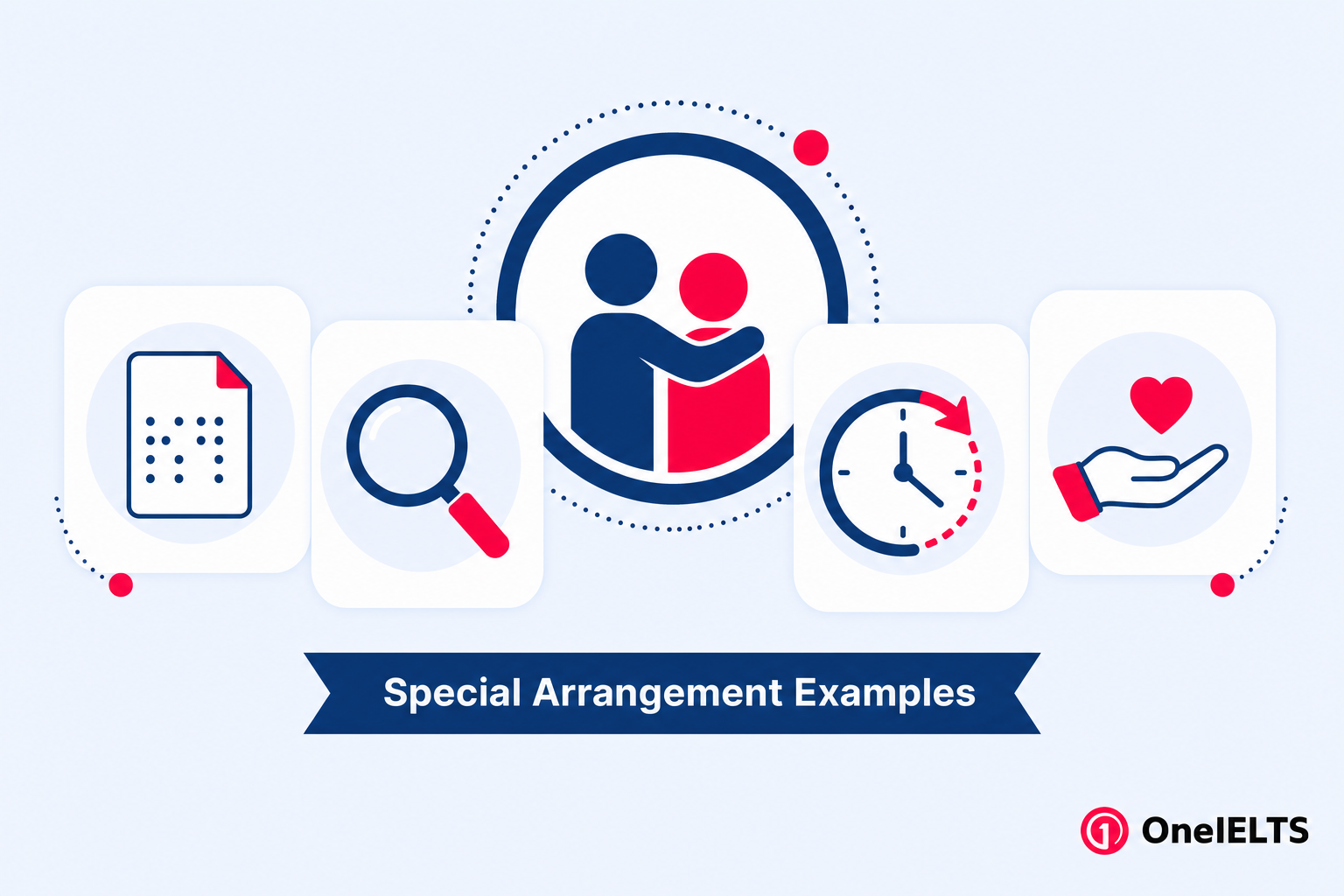
IELTS offers a set list of accommodations for the most common access needs. Each one changes the format or the room, not the questions.
- Extra time. IELTS grants around 25% more time per section when a condition slows your reading or writing.
- Braille or enlarged-print papers. Test centres make question papers in braille or large print for visual difficulties.
- A scribe or reader. A trained helper writes your dictated answers or reads the questions aloud to you.
- Hearing/amplification support. Hearing support covers amplification gear or a lip-reading version of the Listening test.
- Separate room. A separate room lets you take supervised breaks or use equipment away from other candidates.
How Do You Request IELTS Special Requirements?
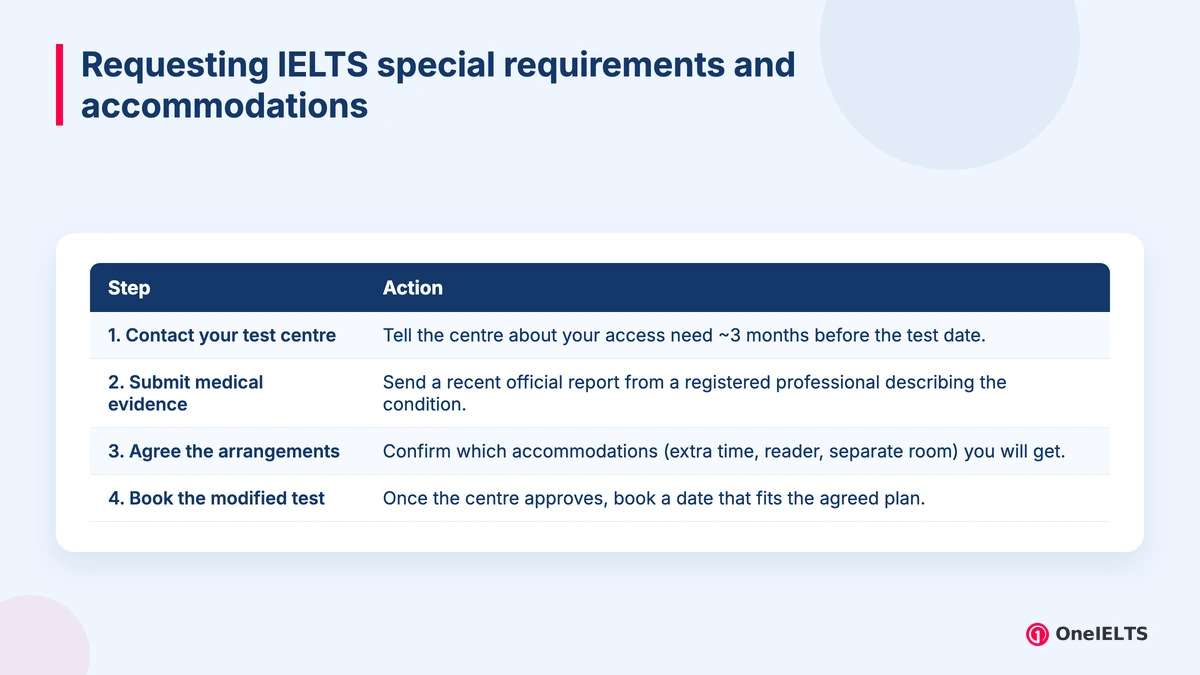
Requesting an accommodation starts well before you book. Modified papers and staffing take time to arrange. These four steps set out the process and the 3 months notice IELTS expects.
- Contact your test centre about 3 months ahead. Tell your test centre about your access need around three months before your test date.
- Submit recent medical evidence. Send official medical evidence that describes your condition and the support it needs, written by a registered professional.
- Agree the arrangements. Confirm with the centre which accommodations — extra time, a reader, a separate room — you will get.
- Book the modified test. Once the centre approves the support, book your modified test for a date that fits the agreed plan.
What Medical Evidence Does IELTS Require?
IELTS approves special arrangements only on official medical evidence written in English by a registered medical professional, issued within two years of the test date. The English-language report must come from a registered professional, such as a doctor or a qualified specialist.
It also has to be recent. The report must be issued within two years, not an older one. And the evidence must match the arrangement you ask for. A report for extra time has to explain why your condition needs it. A braille-paper request needs evidence of the visual difficulty behind it.
What Support Is There for Dyslexia and ADHD?
Learning difficulties such as Dyslexia and ADHD qualify for the same access support as any other documented condition, with the right evidence. IELTS grants extra time, supervised breaks within a section, and a reader or scribe when reading or handwriting is affected.
The evidence still has to be a recent report from a registered professional. It must link the learning difficulty to the support you ask for. None of this changes the band scale. The questions and the marking stay the same, and the support helps access only.
Do Special Requirements Change Your IELTS Score?
Special arrangements do not change the band scale or the score requirements. They change the conditions you sit the test under, not the standard you are measured against. You answer the same questions. Examiners apply the same nine-band scale that every other candidate meets.
Because the test itself is unchanged, your result carries equal recognition. Universities and immigration accept a score taken on the same band scale just like any other IELTS result. The arrangements give accessibility and no advantage. A candidate who used extra time or a scribe gains no edge.
Who Qualifies for IELTS Special Requirements?
Candidates with documented disabilities or medical conditions qualify for IELTS special arrangements. Eligibility rests on the documented disability or medical condition, not on the type of test you take.
You confirm eligibility with evidence: a recent report from a registered professional that describes the condition and the support it justifies. Conditions range from visual or hearing difficulties to learning difficulties. Candidates with visual impairment can read more in our IELTS for blind and visually impaired candidates guide.
How Far in Advance Should You Request Arrangements?
Request special arrangements about three months before your test date. That gives the centre time to check your evidence and set up the support.
Some modified materials need longer lead time than standard adjustments. Braille and large-print papers are made specially, so they sit at the three-month end. Staffing such as a reader or extra time can need around six weeks. Check the exact timing against your wider IELTS eligibility and booking requirements before you fix a date.
Practice for the Real IELTS Exam
Apply what you’ve learned with free, exam-style practice:
- Take a full IELTS mock test
- Practice by section: Listening, Reading, Writing, Speaking
- Structure your essays with IELTS Writing templates