Article slips are among the most frequent grammar errors examiners see in IELTS Writing and IELTS Speaking, and each one counts against Grammatical Range and Accuracy. The definite article points your reader to one specific noun you both can identify. This page covers its rules, the zero article, Task 1 phrases, typical Indian errors, examples, practice and band impact; “a” and “an” live on our articles page.
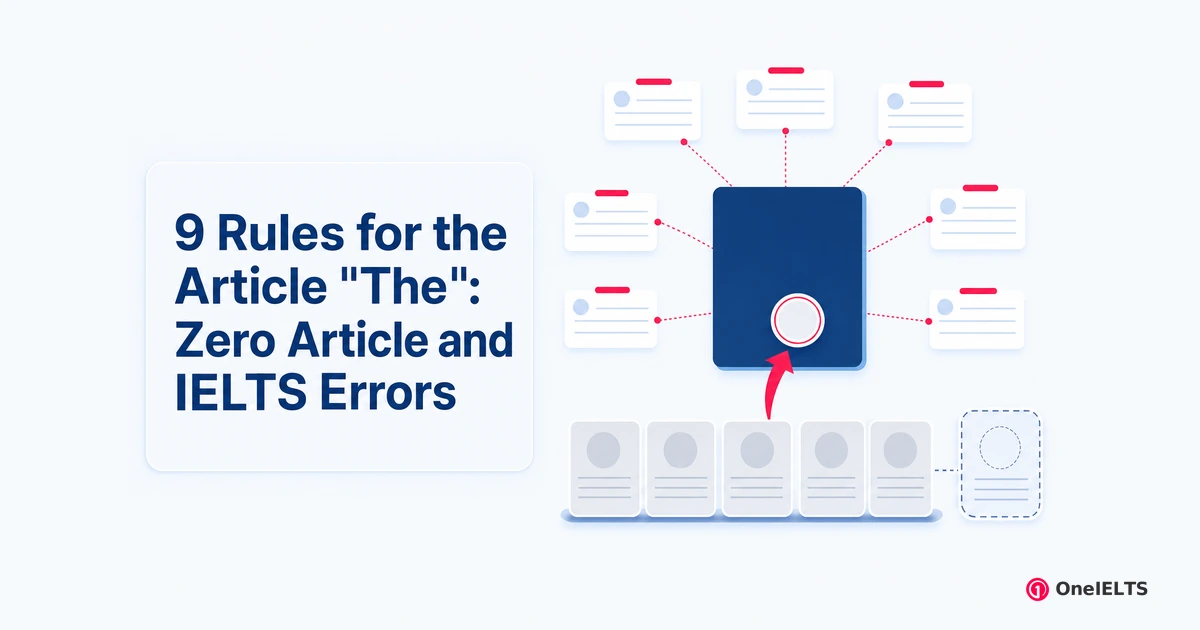
Nine situations call for “the”.
- Second mention: a noun already introduced takes “the”.
- Context shows which one: setting or phrase identifies it.
- Unique objects: only one exists in that setting.
- Superlatives and ordinal numbers: both single out one item.
- Oceans, rivers, mountain ranges and plural country names.
- Compass directions and regions: a direction used as noun.
- Musical instruments and inventions: an instrument, or whole class.
- Adjectives that name a group of people take “the”.
- Plural surnames: a family name meaning the whole family.
What Is the Definite Article “The”?
“The” is the definite article, the word you place before a singular, plural or uncountable noun to show the reader already knows which specific thing you mean. It marks a noun as specific and known. “A” and “an” mark a noun as one of many, and no article marks a noun used in a general sense.
Corpus counts rank “the” as the most frequent word in written English, and English has no other definite article. It fits all three noun types: the book, the books, the water. The indefinite article needs a singular countable noun, so “the” is the only article an uncountable noun can take.
Its pronunciation shifts with the next sound: /ðə/ before a consonant sound (the university) and /ðiː/ before a vowel sound (the environment). Speaking examiners hear that difference. Three tests sit under most of the nine rules: the noun was mentioned before, it’s one of a kind, or the context makes it clear.
1. Use “The” When You Mention a Noun a Second Time
A noun takes “the” from its second mention onward. You introduce it with “a”, “an” or no article, and every later reference uses “the” because the reader now knows which one you mean. Four patterns show this handover in everyday English and in IELTS answers.
- First mention with a/an, then “the”. I saw a dog outside. The dog was brown and clearly lost.
- First mention as a plural, then “the”. Some students failed in May. The students resat the test in June.
- Speaking Part 2 story pattern. I bought a phone last year, but the phone stopped working after a month.
- Task 2 example pattern. A recent survey asked parents about screen time, and the survey found most set limits.
Repeating “a survey” after you’ve introduced it in a Task 2 essay makes the examiner think a second survey has appeared. The previously mentioned noun has to switch to “the”.
2. Use “The” When the Context Shows Which Thing You Mean
Shared context lets you use “the” even on first mention, because the situation or the words after the noun make clear which one you mean. Context identifies a noun in three ways, one physical and two grammatical.
- Physical setting. Please close the door. In the test room, the examiner already knows which door you mean.
- An of-phrase after the noun. The importance of education and the cost of living each name one specific thing.
- A that/who clause after the noun. The students who took the test last month received their results first.
That last pattern is a relative clause, and it limits the noun to one group. The of-phrase matters most for IELTS. A Task 2 essay leans on “the role of”, “the impact of” and “the importance of”, and dropping “the” there is one of the most visible article errors examiners meet.
3. Use “The” With Unique Objects
Nouns that refer to the only one of their kind, in the world or in a shared setting, take “the”. These unique nouns recur across Task 2 topics, so they’re grouped here by the essay theme where you’ll meet them.
- Nature. The sun, the moon, the sky and the earth each exist once, so each takes “the”.
- Environment topics. The environment, the climate and the atmosphere refer to one shared system and keep “the”.
- Technology topics. The internet and the media name single networks, so write “the internet”, never “internet”.
- Society topics. The government, the police and the economy mean the one serving your country or city.
Candidates often miss one contrast. The environment and the internet almost always keep “the”, while nature, society and technology used in a general sense take no article.
4. Use “The” With Superlatives and Ordinal Numbers
Superlative adjectives and ordinal numbers single out one item, so they take “the”. The sequence words “same”, “only”, “next” and “last” follow the same logic. Each pattern comes with a line you could write in Writing Task 1 or Task 2.
- Superlatives. The highest figure belonged to Japan, and cycling was the least common option overall.
- Ordinal numbers. Sales rose sharply in the first year but then fell in the second quarter.
- Same and only. Both countries grew at the same rate, and Brazil was the only country to decline.
- Next and last in a sequence. Car ownership doubled over the last decade and could double again in the next.
The usual slip in report writing runs both ways. “Japan had highest rate” needs “the”, while “most of people” needs no article at all: “most people”.
5. Use “The” With Oceans, Rivers, Mountain Ranges and Plural Country Names
Some geographical names take “the”: oceans, seas, rivers, canals, deserts, mountain ranges, island groups, and plural country names or names containing Republic, Kingdom or States. Most single names don’t. The table sorts each place type by whether it needs the article.
| Place type | Takes “the”? | Example |
|---|---|---|
| Oceans and seas | Yes, always | the Indian Ocean, the Arabian Sea |
| Rivers and canals | Yes, always | the Ganges, the Suez Canal |
| Deserts and mountain ranges | Yes, always | the Thar Desert, the Himalayas |
| Plural or Republic/Kingdom/States countries | Yes, always | the UK, the USA, the Netherlands, the Maldives |
| Most countries and cities | No article | India, Canada, Delhi, London |
| Single mountains and lakes | No article | Mount Everest, Dal Lake |
The United Kingdom and the United States keep “the” because Kingdom and States sit in their full names. Task 1 tables and maps often compare countries, so “the UK” and “the USA” appear next to “India” and “Canada” in the same sentence.
6. Use “The” With Compass Directions and Regions
Compass directions used as nouns for regions take “the” (the north, the south-east), but used as adjectives before a name they don’t (North India, South Africa). Each pattern here is something you could say in Speaking Part 1.
- Region as a noun. I come from the north of India, about two hours from Chandigarh.
- Direction as an adjective. I grew up in South India, so my first language is Malayalam.
- Named regions. My uncle works in the Middle East, and my cousin studies in the West.
- Movement toward a direction. My town lies to the east of the river, close to the station.
The hometown question is where examiners hear this rule most, and “in north of India” is a frequent slip. Named regions such as the Middle East keep “the” in every position.
7. Use “The” With Musical Instruments and Inventions
You put “the” before musical instruments (play the guitar) and before a singular noun that stands for a whole class of inventions or species (the smartphone, the tiger). That second use is called generic reference. The uses below cover instruments, inventions and animal species.
- Instruments. She plays the violin every morning, and her younger brother plays the tabla at night.
- Inventions as a class. The smartphone has changed how we communicate with family living abroad.
- Animal species as a class. The tiger is an endangered species, and India runs reserves to protect it.
In a Task 2 essay, the class use of “the” is a formal, band-8 style choice. The plural without an article (“Smartphones have changed…”) is equally correct and safer for most candidates. “Play guitar” without “the” is common in American speech and isn’t penalized in Speaking.
8. Use “The” With an Adjective to Name a Group of People
“The” plus an adjective names everyone in a group (the elderly, the poor) and takes a plural verb. These group nouns turn up again and again in Task 2 prompts about welfare and inequality.
- The elderly. The elderly need affordable healthcare, so governments are funding more clinics in villages.
- The young. The young are usually quicker to adopt new technology than their own parents are.
- The poor and the rich. The gap between the poor and the rich has widened in most large cities.
- The unemployed. The unemployed need retraining programs that match the jobs local employers want to fill.
- The disabled. The disabled deserve step-free access to every public building and every railway station.
Avoid two errors: dropping “the” (“Elderly need care”) and adding a plural -s (“the elderlys”). When you mean individuals, “elderly people” works without “the”. The same pattern names nations, such as the British and the Japanese.
9. Use “The” With Plural Surnames
A family name made plural with “the” refers to the whole family (the Sharmas, the Patels), while a single person’s name takes no article. Plural surnames follow three patterns in speech.
- Whole family. The Sharmas live next door, and they host a big Diwali dinner every year.
- Single person, no article. Mr. Sharma teaches math at the local school and coaches the cricket team.
- Possessive family. We spent most evenings at the Patels’ house when I was about ten.
Other proper nouns for one person stay bare too. A Speaking Part 2 cue card about a neighbor, a family or a person you admire is where this rule appears naturally.
When Should You Not Use the Article “The”?
Leave out “the” when a plural or uncountable noun is used in a general sense, and before most names of people, cities, countries, single mountains and lakes. This absence is called the zero article. It covers general statements, abstract nouns and most proper nouns. Each case shows the wrong version first, then the right one.
- General plural nouns. Write “Cats like milk”, not “The cats like milk”, for cats in general.
- General uncountable and abstract nouns. Write “Education is important”, not “The education is important”, in a general claim.
- Most proper nouns. Write “I live in Paris” and “India is large”, never “the Paris”.
- Meals. Write “We have lunch at one o’clock”, not “We have the lunch at one”.
- Languages and academic subjects. Write “She speaks Tamil” and “He studies economics”, without “the” before either.
Meals, languages and academic subjects take “the” again when they’re specific: the lunch we had yesterday, the Tamil spoken in Chennai.
How Do You Choose Between “The” and No Article?
Ask whether you mean the noun in general or one specific, limited instance of it: general takes no article, specific takes “the”, and the same noun can take either. Two questions settle it. Is the noun plural or uncountable and meant in general? Use no article. Is it limited by context, an of-phrase or a clause? Use “the”.
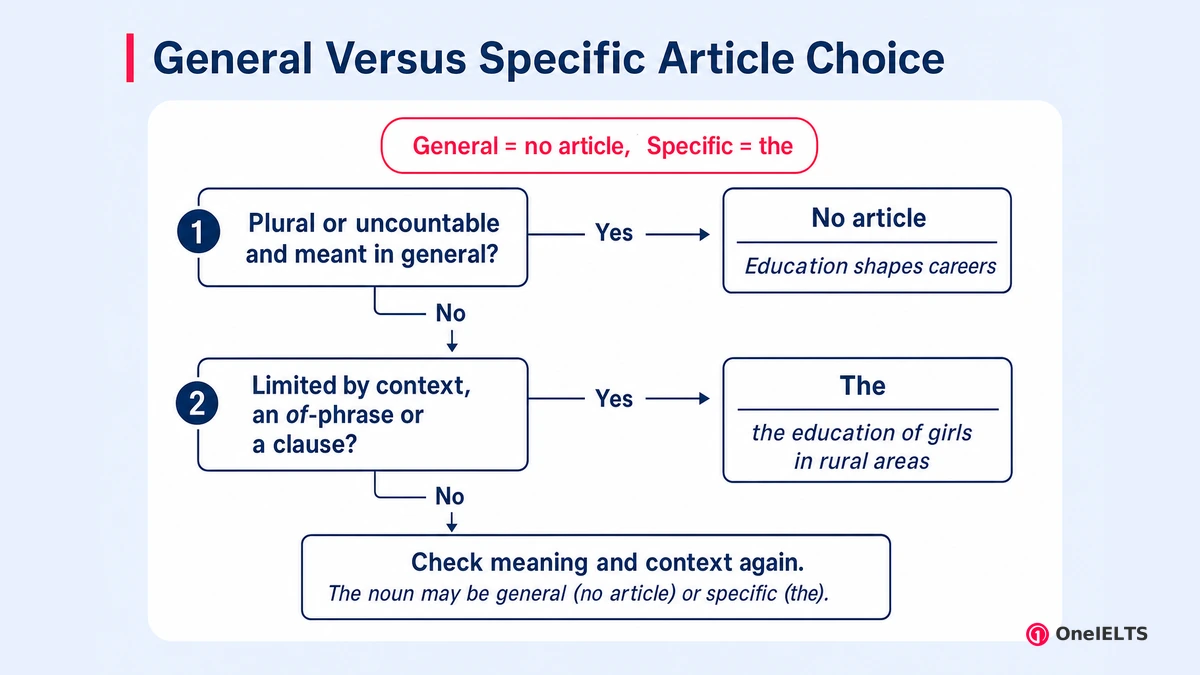
The general vs specific split shows most clearly with abstract nouns and uncountable nouns, so the table pairs six Task 2 nouns in both forms.
| Noun | General (no article) | Specific (the) |
|---|---|---|
| education | Education shapes careers in every country. | the education of girls in rural areas |
| society | Society benefits when more people volunteer. | the society we live in today |
| technology | Technology saves time at work and home. | the technology used in modern hospitals |
| crime | Crime is rising in many cities. | the crime rate in Delhi this year |
| people | People prefer online shopping for convenience. | the people living in my neighborhood |
| life | Life in big cities is expensive. | the daily life of a farmer |
The most common over-use in a Task 2 essay is an opener like “The technology has changed our lives” or “The education is the key to success”. Both mean technology and education in general, so both drop “the”.
Where Should You Use “The” in IELTS Writing Task 1 Reports?
In Writing Task 1, “the” goes before the visual itself, quantity phrases with “of”, superlatives, time periods and plural or Kingdom/States country names. That means the graph, the number of, the highest, over the period and the UK. Percentages and totals both take “the” when “of” follows them, as each model sentence shows.
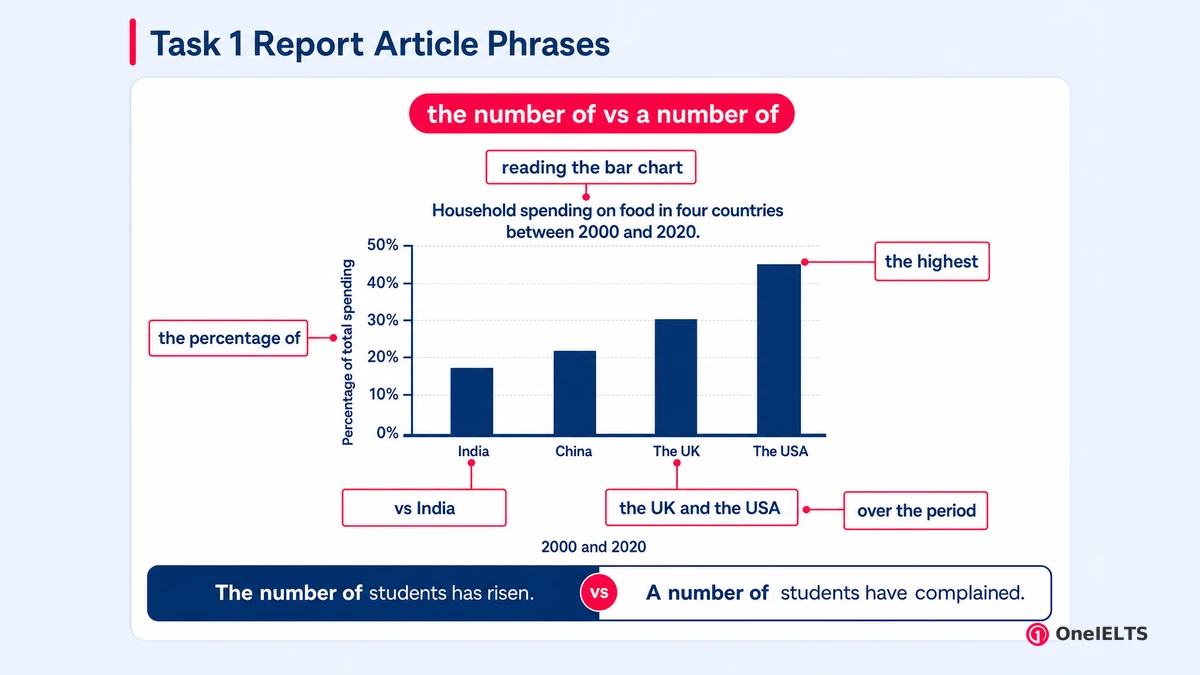
- The visual. The bar chart compares household spending on food in four countries between 2000 and 2020.
- Quantity + of. The proportion of commuters who cycled rose, while the percentage of drivers fell slightly.
- The number of vs a number of. The number of students has risen, but a number of students have complained.
- Superlatives and same. Rice had the highest share, and wheat stayed at the same level throughout.
- Time expressions. Over the period, sales doubled, peaking in the 1990s before falling the following decade.
- Country names. The UK and the USA spent more on health than India and China did.
Candidates confuse one pair most. “The number of students has risen” takes a singular verb because it names a figure. “A number of students have complained” takes a plural verb because it means several students, so these quantity phrases change the verb as well as the article.
What Are the Common Mistakes With “The” in IELTS Writing and Speaking?
Speakers of Hindi and most other Indian languages, which have no separate word for “the”, tend to drop it where English needs it and add it where English uses none. Typical drops are “highest rate”, “internet” and “north of India”. Typical additions are “the India”, “the cricket” and “The education is important”.
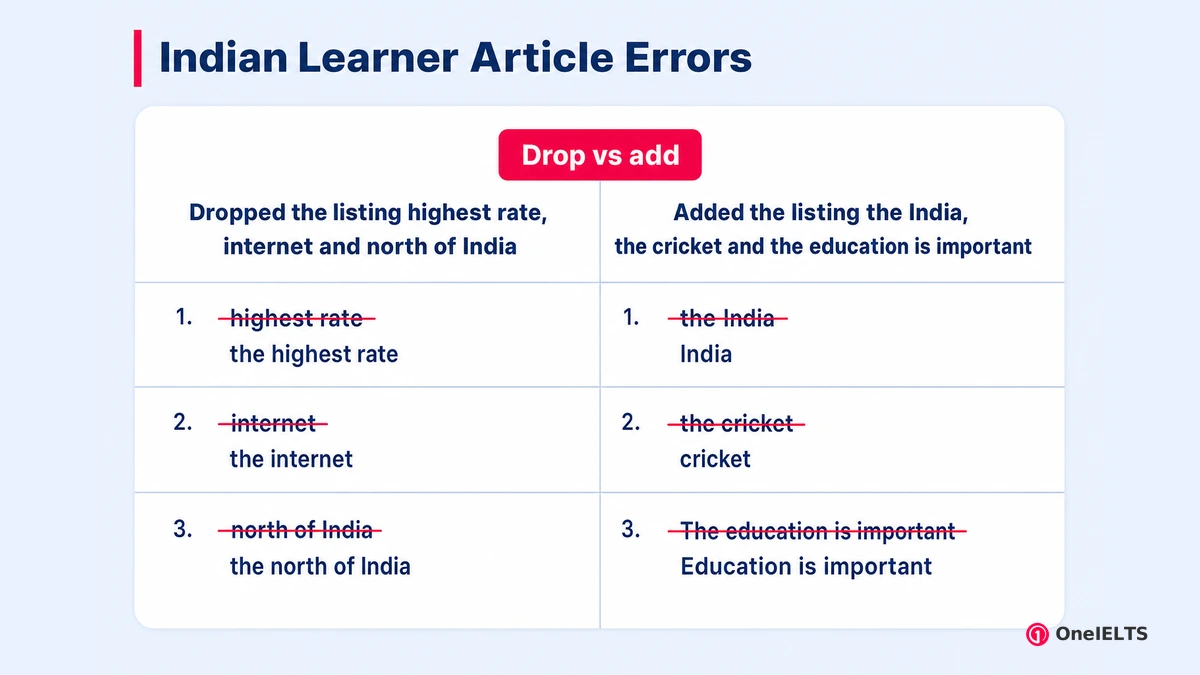
Hindi marks definiteness through context rather than through an article word, so the habit carries over into English. That’s first-language transfer. Google’s related searches for “use of article the in hindi” show how many learners think about the article through their first language.
Five article errors recur in IELTS Writing scripts, each shown wrong and then corrected.
- Missing “the” before a superlative. “Japan had highest rate” becomes “Japan had the highest rate”.
- “The” before a general abstract noun. “The education is important” becomes “Education is important”.
- “The” before a country name. “Prices rose in the India” becomes “Prices rose in India”.
- Missing “the” before an of-phrase. “Importance of exercise is clear” becomes “The importance of exercise is clear”.
- “Most of people” instead of “most people”. “Most of people agree” becomes “Most people agree”.
In IELTS Speaking the slips change shape, because sports, cities and subjects come up in Part 1 small talk.
- “The” before a sport or game. “I like playing the cricket” becomes “I like playing cricket”.
- “The” before a city. “I live in the Mumbai” becomes “I live in Mumbai”.
- “The” before a subject. “I am studying the engineering” becomes “I am studying engineering”.
- Missing “the” with a region. “I am from north of India” becomes “I am from the north of India”.
Watch for repetition more than single slips. A candidate who writes “the education” in the introduction usually writes it again in every body paragraph. Our list of Speaking mistakes covers the slips beyond articles.
What Are 10 Example Sentences Using the Article “The”?
Each of these ten example sentences carries its rule numbers in brackets, and seven sound like lines from IELTS Writing or IELTS Speaking answers.
- I read an article about pollution, and the article blamed traffic. (Rule 1)
- The cost of living in Mumbai has risen sharply. (Rule 2)
- The internet has transformed the way students learn. (Rule 3)
- The highest figure was recorded in the final year. (Rule 4)
- The UK and the USA spent more than India. (Rule 5)
- My hometown is in the north of Kerala. (Rule 6)
- The smartphone has changed how Indian families communicate. (Rule 7)
- Governments should do more to support the elderly. (Rule 8)
- The Iyers next door taught me to cook. (Rule 9)
- Education is the key to a better life. (zero article + Rule 2)
How Can You Practice Using the Article “The”?
A short routine works best: complete a gap-fill exercise, then reread one of your own Task 2 essays and check every noun phrase for its article. The second step builds self-correction, the habit that carries into the exam. Fill each blank with “the” or leave it empty for no article.
- ___ graph shows ___ number of tourists visiting Goa each year.
- My grandfather always told us that ___ honesty is ___ best policy.
- She plays ___ tabla every evening after finishing her homework.
- ___ Ganges flows east across India into ___ Bay of Bengal.
- I usually have ___ dinner at nine after my evening walk.
- ___ unemployed need retraining programs that match the jobs available locally.
- He moved from ___ Chennai to ___ USA for his master’s degree.
- This is ___ second time I have taken IELTS.
The answer key names the rule behind each answer.
- 1. The, the: the visual and an of-phrase (Rule 2).
- 2. No article, the: abstract noun (zero article), then superlative (Rule 4).
- 3. The: a musical instrument always takes it (Rule 7).
- 4. The, the: river and bay names (Rule 5).
- 5. No article: meals take the zero article.
- 6. The: adjective naming a group (Rule 8).
- 7. No article, the: city name, then the USA (Rule 5).
- 8. The: an ordinal number singles out one (Rule 4).
Then test your articles in a timed essay with IELTS Writing practice.
How Does Using “The” Correctly Affect Your IELTS Band Score?
Articles are judged under Grammatical Range and Accuracy, one of four equally weighted criteria in both Writing and Speaking. Frequent article errors stop sentences from being error-free, and that frequency separates band 6 from band 7 on this criterion.
Examiners don’t count article errors one by one; they judge how often your sentences are error-free. A single slip rarely changes a band, but a pattern repeated in every paragraph does. Article errors almost never block meaning, so they cost accuracy rather than communication.
The public Writing band descriptors, updated May 2023, say at band 7 that “error-free sentences are frequent”. At band 6 they read: “Errors in grammar and punctuation occur, but rarely impede communication.” Checked on 7 October 2026.
How Many Article Errors Can a Band 7 IELTS Essay Have?
The band descriptors set no fixed number of article errors for band 7; they ask that error-free sentences be frequent, so what counts is how many of your sentences are fully correct. Mostly clean sentences with a few article slips can still reach band 7 for Grammatical Range and Accuracy. A recurring “the” error drifts toward band 6. Speaking applies the same logic, and the IELTS Writing band descriptors give the full wording.
When Should You Use “A” or “An” Instead of “The”?
The indefinite articles “a” and “an” are used instead of “the” when a singular countable noun is mentioned for the first time or means any one of its kind. The vowel sound decides between them: an hour, a university. First mention takes “a”, then Rule 1 hands over to “the” (a survey, then the survey). Full rules sit in articles in English grammar.
Does “The” Go Before Countable or Uncountable Nouns?
Yes, “the” goes before both countable and uncountable nouns, singular, plural or uncountable, whenever the noun is specific, unlike “a/an”, which needs a singular countable noun. That creates a real choice in IELTS essays. An uncountable noun such as information or advice takes “the” or no article, but never “a”. See countable and uncountable nouns for the tricky ones.
How Can You Catch Article Errors When You Proofread an IELTS Essay?
The quickest way to catch article errors is a separate proofreading pass that checks only noun phrases. Run these four checks in order on your Task 2 script.
- Underline every noun and ask whether you mean it generally or specifically.
- Check that every superlative and every of-phrase carries “the” in front.
- Check each country name against the plural, Kingdom or States rule.
- Delete “the” before any abstract noun you are using in a general sense.
Two minutes at the end of Task 2 is enough for this self-correction pass. More final-read checks sit in IELTS Writing proofreading.
Written by Fahimur Rahman, reviewed 7 October 2026.
Last verified: 7 October 2026