The words a, an and the sit in front of a noun and tell your reader whether they already know which thing you mean. They’re among the most frequent errors in IELTS Writing and IELTS Speaking, marked under Grammatical Range and Accuracy. The definite article points to a known thing, the indefinite article introduces one singular countable noun, and the zero article leaves a general plural or uncountable noun bare.
Hindi and Bengali speakers tend to drop “a” (“I am student”) or add “the” (“The technology has changed the education”). This page covers types, meaning, the rules for a/an, the and no article, noun types, special cases, mistakes, examples, exercises and your IELTS score. “The” has its own full page.
What Are Articles in English Grammar?
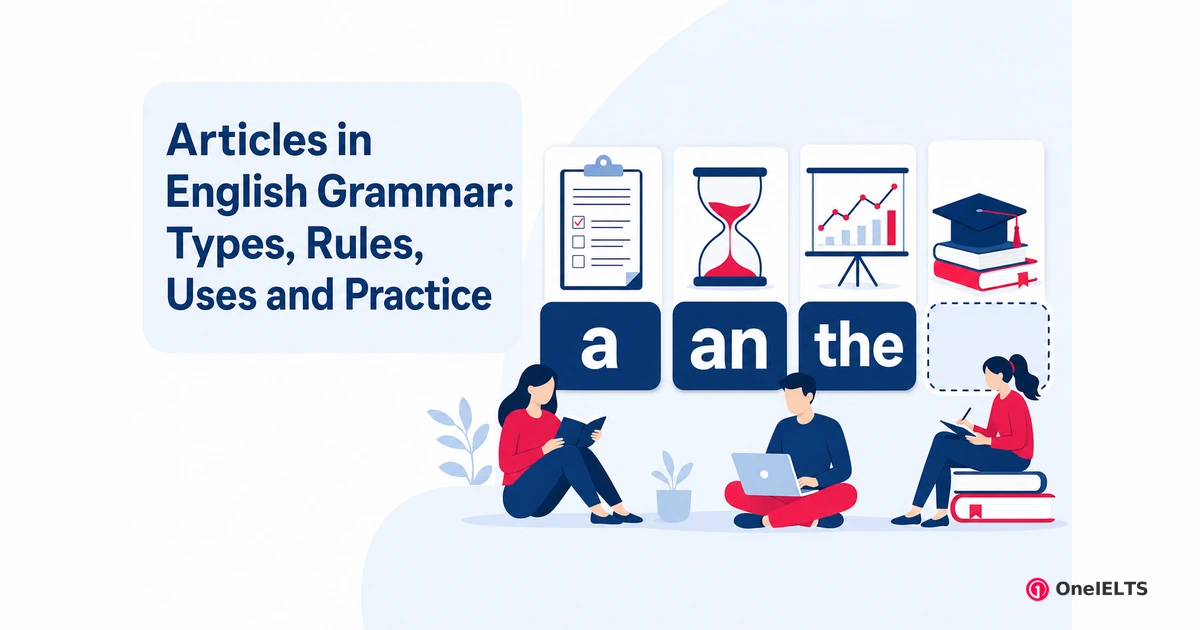
Articles are the determiners a, an and the, placed before a noun or before the adjective describing it to show whether you mean a specific noun or a general noun. English has three articles in two types, plus the zero article, which means using no article at all.
Each article opens a noun phrase, and a noun takes one determiner, never two, so “my the book” is wrong. The article also comes before any adjectives, which makes “a very old house” correct. English uses the three article forms to change meaning in IELTS sentences. “A graph shows…” could be any graph, while “The graph shows…” points to the one in the prompt.
What Are the Types of Articles in English Grammar?
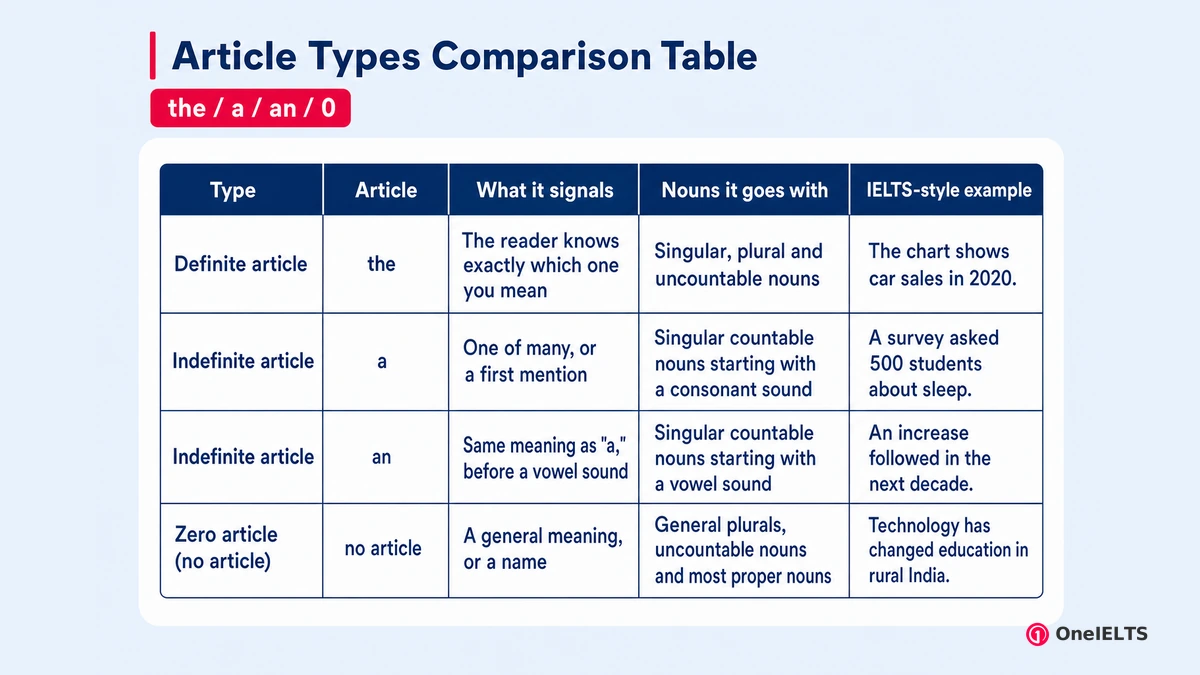
English has two types of article: the definite article “the” and the indefinite articles “a” and “an”, and grammars add the zero article for nouns that take none. The definite article sets up a specific reference. The indefinite article sets up a non-specific reference to one singular countable noun.
Each row below gives one clause per type, and the next three sections hold the rules.
| Type | Article | What it signals | Nouns it goes with | IELTS-style example |
|---|---|---|---|---|
| Definite article | the | The reader knows exactly which one you mean | Singular, plural and uncountable nouns | The chart shows car sales in 2020. |
| Indefinite article | a | One of many, or a first mention | Singular countable nouns starting with a consonant sound | A survey asked 500 students about sleep. |
| Indefinite article | an | Same meaning as “a,” before a vowel sound | Singular countable nouns starting with a vowel sound | An increase followed in the next decade. |
| Zero article | no article | A general meaning, or a name | General plurals, uncountable nouns and most proper nouns | Technology has changed education in rural India. |
Why Are Articles Important in English?
Articles carry meaning. They tell your reader whether a noun is new information or known information, one of many or the only one, and whether you’re making a general statement or a specific reference.
Each minimal pair here changes meaning with one word. “I saw a chart” introduces a chart, while “I saw the chart” means one we both know. “Cars pollute” is a general statement about all cars; “The cars pollute” means particular cars, perhaps the ones in a photo. “A president” is one of many, and “the president” is the one leading a country.
A missing article raises a flag quickly. It is one of the first signs that tells an examiner your English hasn’t reached native-like accuracy. The last section shows what that does to an IELTS band.
When Do You Use “A” or “An”?
Use “a” or “an” before a singular countable noun that is mentioned for the first time or is one of many. Choose “a” before a consonant sound and “an” before a vowel sound, because the sound decides, not the spelling. Seven rules decide the indefinite article, each shown with a sentence a candidate might write.
- First mention of a singular countable noun: a new noun takes “a,” as in “A survey asked 500 students.”
- One of many, not a particular one: “Can I borrow a pen?” means any pen will do.
- Jobs and roles: English needs the article with a profession, so write “She is an engineer,” never “She is engineer.”
- Rates and frequency: “a” or “an” means “per” in phrases such as “twice a week” and “80 km an hour.”
- Consonant sound takes “a”: “a university” and “a one-year course” both start with a consonant sound, /j/ or /w/.
- Vowel sound takes “an”: a silent h leaves a vowel sound, so write “an hour” and “an honest answer.”
- Abbreviations follow the letter sound: say each abbreviation aloud first, giving “an MBA,” “an IELTS score” and “a UN report.”
Never put “a” or “an” before a plural or uncountable noun, so “a waters” and “an advice” are both wrong. The two cases learners ask about most follow the sound rule: “a university” because it starts with a “you” sound, and “an MBA” because M is said “em.”
When Do You Use “The”?
Use “the” when the reader knows exactly which noun you mean: it was mentioned before, the context makes it clear, or there’s only one of it. The definite article works with singular, plural and uncountable nouns. Five core uses cover most sentences you’ll write in the test.
- Second mention: “A survey was carried out in 2019. The survey asked 2,000 adults about commuting.”
- Shared context: in a Task 1 prompt you write “the graph” or “the table,” because the examiner sees it too.
- Unique things: a unique noun takes “the” because only one exists, as in the sun, the internet, the environment.
- Superlatives and ordinals: a superlative or an ordinal number needs “the,” as in the highest figure and the first year.
- Fixed time and number phrases: quantity phrases keep “the,” as in the 1990s, the number of and the proportion of.
This section stays at overview level. Geographical names, families, instruments and “the” plus an adjective for groups are covered in the full rules for using the article “the”.
When Should You Use No Article?
Use no article, the zero article, when a plural or uncountable noun refers to things in general, and before most proper nouns such as people, cities, countries and languages. Five groups of nouns normally go bare.
- General plural nouns: a general plural noun takes no article, as in “Dogs like to run” and “Students need sleep.”
- General uncountable nouns: an uncountable noun used generally stays bare, as in “Water is vital” and “Education changes lives.”
- Most names of people, cities and countries: a proper noun usually needs nothing, as with Paris, Japan, India and Priya.
- Languages and academic subjects: “She speaks Hindi” and “He studies economics” both leave the noun without an article.
- Meals, sports and days: you have lunch, play cricket and meet on Monday, with “the” only for one specific meal.
In Task 2 essays, a general statement defaults to the zero article. Write “Technology has changed education” rather than “The technology has changed the education” in your essay. That extra “the” before general nouns is one of the most frequent article errors in Task 2 essays.
How Do Articles Work With Countable and Uncountable Nouns?
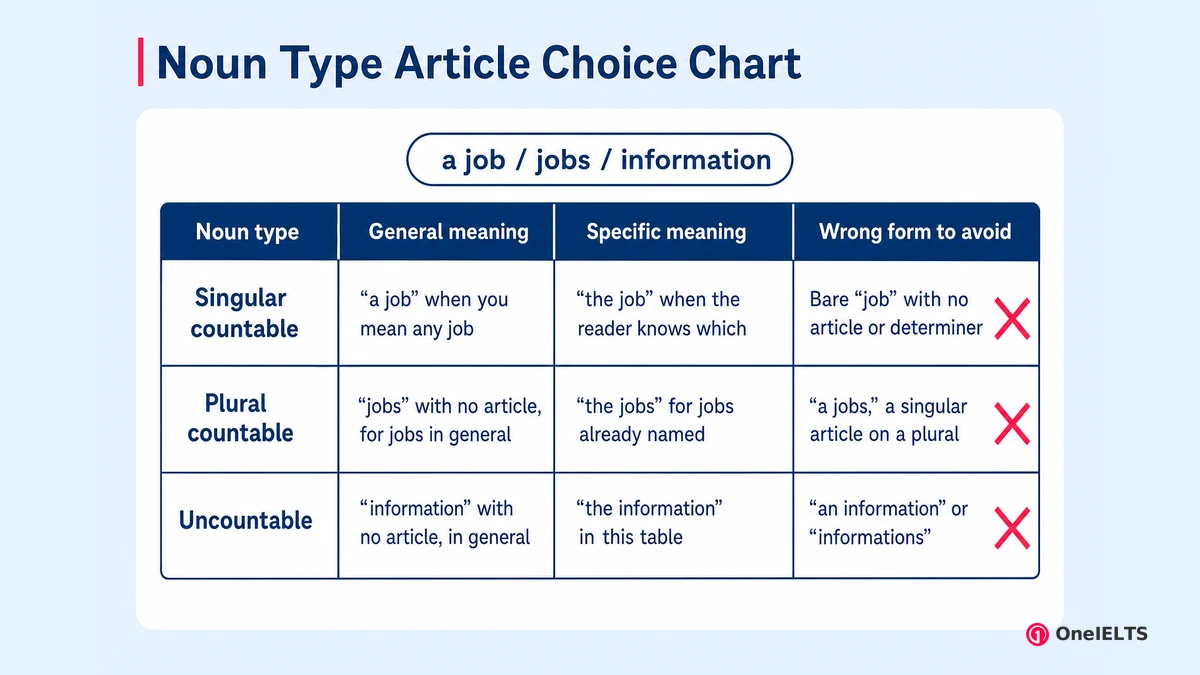
A singular countable noun always needs an article or another determiner. A plural countable noun and an uncountable noun take “the” when specific and no article when general, and neither one ever takes “a” or “an” in front. The table covers article choice only; noun classification lives on the page about countable and uncountable nouns.
| Noun type | General meaning | Specific meaning | Wrong form to avoid |
|---|---|---|---|
| Singular countable | “a job” when you mean any job | “the job” when the reader knows which | Bare “job” with no article or determiner |
| Plural countable | “jobs” with no article, for jobs in general | “the jobs” for jobs already named | “a jobs,” a singular article on a plural |
| Uncountable | “information” with no article, in general | “the information” in this table | “an information” or “informations” |
Seven uncountable nouns trip up Indian candidates: advice, information, research, equipment, furniture, evidence and accommodation. Use a partitive phrase like “a piece of advice,” or a countable swap like “a study” for “a research.”
What Are the Special Cases in Article Usage?
Some nouns take a fixed article, or none, whatever the specific-or-general test says. These are fixed expressions and named categories such as institutions, geographical names, musical instruments, nationalities and acronyms. Six cases cover most of them, each with a right form and a wrong one.
- Institutions used for their purpose: “go to school” for lessons, not “go to the school”; Americans say “in the hospital.”
- Geographical names: “the Ganges,” “the Himalayas” and “the United States,” but “India” and “Mount Everest,” never “the India.”
- Musical instruments and inventions: “play the guitar” and “the internet changed work”; avoid “Internet changed work” without an article.
- Languages vs nationalities: “English is hard” names the language; “the English” means the people; never “The English is hard.”
- Abbreviations and acronyms: letter-by-letter forms take “the” (the UN, the BBC), while NASA stays bare, never “the NASA.”
- Fixed expressions: “at night,” “by bus,” “in fact” and “on time” stay bare; “by the bus” sounds wrong here.
What Are the Common Mistakes With Articles?
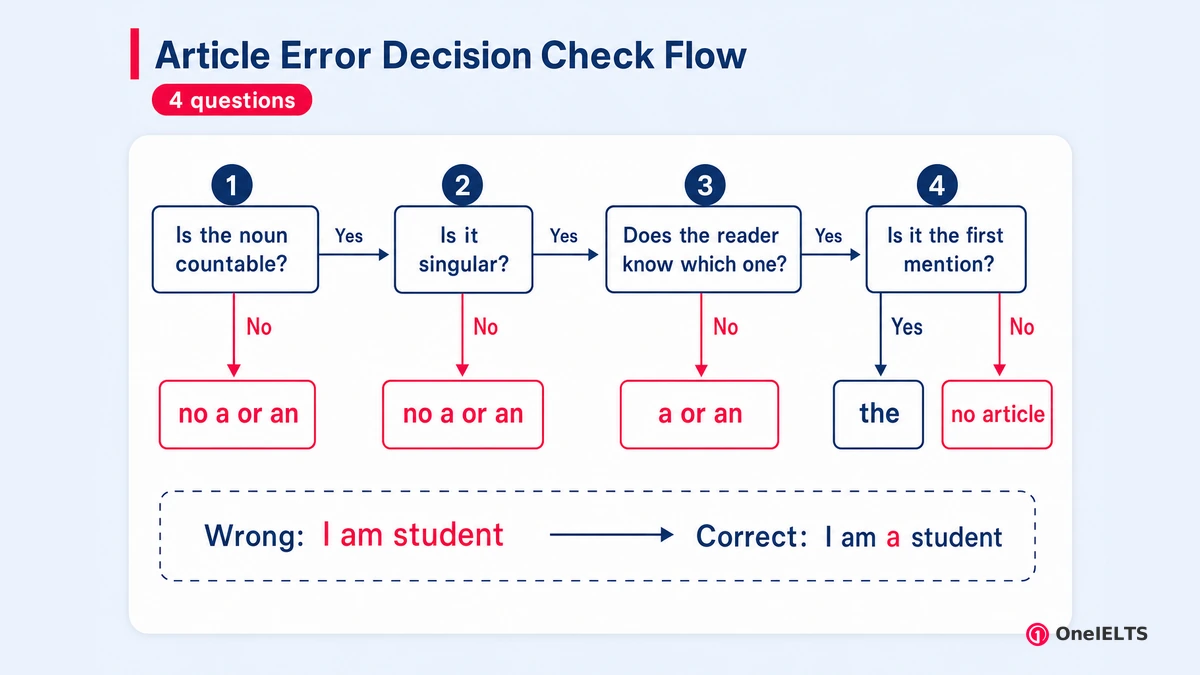
Most article mistakes fall into three groups: a missing article, an extra article and the wrong article. Speakers of Hindi, Bengali, Tamil, Urdu and other languages without an article system make the first two far more often than the third. That’s first-language transfer: Hindi has no word that works like “the,” so the slot stays empty or gets filled by habit.
Each mistake shows the wrong sentence first and the corrected version after it.
- Missing “a” before a singular countable noun: “I am student” becomes “I am a student.” It’s the commonest missing article.
- Extra “the” before a general noun: “The education is important” becomes “Education is important.” It’s the classic extra article.
- “A” or “an” with an uncountable noun: “She gave me an advice” becomes “She gave me some advice.”
- Spelling instead of sound: “an university” and “a hour” become “a university” and “an hour” once you listen.
- “The” missing before a superlative: “Japan had highest figure” becomes “Japan had the highest figure in 2020.”
- “The” with most country names: “I live in the India” becomes “I live in India,” though “the USA” keeps it.
A four-question decision check catches all six during proofreading.
- Is the noun countable? Uncountable nouns never take “a” or “an.”
- Is it singular? A singular countable noun needs an article or another determiner.
- Does the reader know which one? Then use “the.”
- Is it the first mention? Then use “a” or “an,” and use none for general plurals.
Run it on “The technology has changed the education” and question 3 fails twice, because neither noun is specific.
What Are 10 Examples of Articles in Sentences?
These ten example sentences cover every rule on this page. Each is the kind of Task 1 description or Task 2 argument IELTS candidates write and say, so read the rule in brackets, then cover it and name the rule yourself.
- The graph shows the number of tourists who visited Goa. (shared context; quantity phrases)
- There was a sharp rise in the 1990s. (first mention; decades)
- An hour a day is enough to improve. (vowel sound; rate)
- I want to become an engineer. (jobs and roles; vowel sound)
- Science has changed medicine. (general uncountable noun; zero article in a Task 2 argument)
- The Ganges flows through India. (river takes “the”; country takes no article)
- She plays the sitar. (musical instrument takes the definite article)
- A university in Pune offers a one-year course. (consonant sounds)
- This was the highest figure of the period. (superlative; shared time period)
- I need some advice about the test. (uncountable noun; specific noun)
How Can You Practice Articles With Exercises?
Three exercise types build article accuracy in order: choosing the article, correcting it, then producing it. An answer key with a one-line rule follows the exercises. Treat the three sets as a short worksheet and write every answer before you check.
- Gap-fill exercise with Task 1 sentences: write a, an, the or 0 for no article.
- (a) ___ graph shows sales of bicycles in three Indian cities between 2000 and 2020.
- (b) The table gives ___ information about water use in four countries.
- (c) There was ___ sharp fall in bicycle sales in 2015.
- (d) Delhi recorded ___ highest figure of all three cities in 2018.
- (e) Prices doubled over ___ eight-year period, from 2010 to 2018.
- Error correction in a short Task 2 paragraph: each sentence has one or two article errors.
- (a) The technology has changed the way people work in most cities.
- (b) Many people now work from home as freelancer for foreign companies.
- (c) This saves each worker a hour of travel every working day.
- (d) Doctors offer an advice about sitting for too long at home.
- (e) The India has seen biggest rise in remote work since 2020.
- Production for timed practice: write five sentences about any chart in ten minutes.
- (a) Use “the number of” to describe a total shown in the chart.
- (b) Use “a rise” to introduce a change for the first time.
- (c) Use “the highest” to name the top figure in the chart.
- (d) Use “the 2000s” to place a trend in a decade.
- (e) Write one general statement with no article before a general noun.
Answer key. Each line gives the answer and the rule that decides it.
- 1(a) The: the graph is shared context in the prompt.
- 1(b) 0: “information” is uncountable and general here.
- 1(c) a: “fall” is a first mention of a singular countable noun.
- 1(d) the: a superlative always takes the definite article.
- 1(e) an: “eight” starts with a vowel sound.
- 2(a) Technology: a general uncountable noun takes the zero article.
- 2(b) as freelancers: a singular countable noun can’t stand bare.
- 2(c) an hour: the h is silent, so a vowel sound follows.
- 2(d) advice: an uncountable noun never takes “a” or “an.”
- 2(e) India, the biggest: no article before most country names; superlatives need “the.”
- 3(a) “The number of students rose to 400 in 2010.”
- 3(b) “There was a rise of 15% in the first year.”
- 3(c) “Delhi had the highest figure throughout the whole period.”
- 3(d) “Sales fell steadily during the 2000s in all three cities.”
- 3(e) “Public transport reduces pollution in large cities.”
Once these feel automatic, apply them under time pressure in IELTS Writing practice tests.
How Do Articles Affect Your IELTS Grammar Score?
Occasional article slips are compatible with band 7, but frequent ones keep a script at band 6. IELTS Writing and IELTS Speaking are each marked on four criteria, and Grammatical Range and Accuracy carries 25% of that score. Examiners don’t count article errors one by one. They judge how often sentences are error-free and whether errors make the meaning harder to follow.
The band 7 Writing descriptor says “error-free sentences are frequent,” and band 8 says “the majority of sentences are error-free.” One missing “a” is enough to make a sentence fall short of error-free sentences. Article errors rarely block meaning, so they lower accuracy rather than communication. The decision check above is the fastest proofreading pass in the last three minutes of Writing. Descriptor wording checked on 7 October 2026 against the ielts.org public Writing band descriptors.
Do Common Article Mistakes Lower Your IELTS Band?
Yes, common article mistakes can lower your IELTS band, because they reduce the number of error-free sentences that Grammatical Range and Accuracy rewards. The effect is cumulative. One slip costs nothing, but a missing “a” or extra “the” in every second sentence holds a script at band 6 under the IELTS Writing band descriptors. Check the six mistakes listed above first.
When Is Using “The” Correct in IELTS Writing?
The uses of ‘the’ that come up most in IELTS Writing are the ones that describe charts and trends. Four of them, from quantity phrases and proportion phrases to superlatives, cover nearly every sentence in a Task 1 report.
- The graph, the table, the chart: the prompt’s visual is shared context, so use “the.”
- The number of, the proportion of, the percentage of: these keep “the” before every figure.
- The 1990s, the period, the following decade: a named time period takes “the” in trends.
- The highest, the lowest, the most significant: every superlative in your report needs “the.”
Every other rule, from rivers to “the” plus an adjective, sits on the page of article “the” rules.
Why Are Articles Important in IELTS Speaking?
The reason articles matter in IELTS Speaking is that Grammatical Range and Accuracy is marked in Speaking too, and dropped articles are easy for an examiner to hear.
Natural speech shrinks “a” to a schwa, /ə/, and “the” to the weak forms /ðə/ or /ði/ before vowel sounds. Drop them and you sound less fluent as well as less accurate. In Speaking Part 2, “I’d like to describe a teacher who…” needs that quick /ə/. The IELTS Speaking pronunciation guide covers weak forms.
Where Do Articles Fit in IELTS Grammar Preparation?
The place of articles in IELTS grammar preparation is the accuracy pass – after sentence structure and tenses, before final proofreading. Use the four-question decision check on every Task 1 and Task 2 answer you practice, and keep an error log that tags each article error as missing, extra or wrong. Articles are one item in the wider IELTS grammar plan, alongside tenses, complex sentences and punctuation.
Written by Fahimur Rahman, reviewed 7 October 2026.
Last verified: 7 October 2026