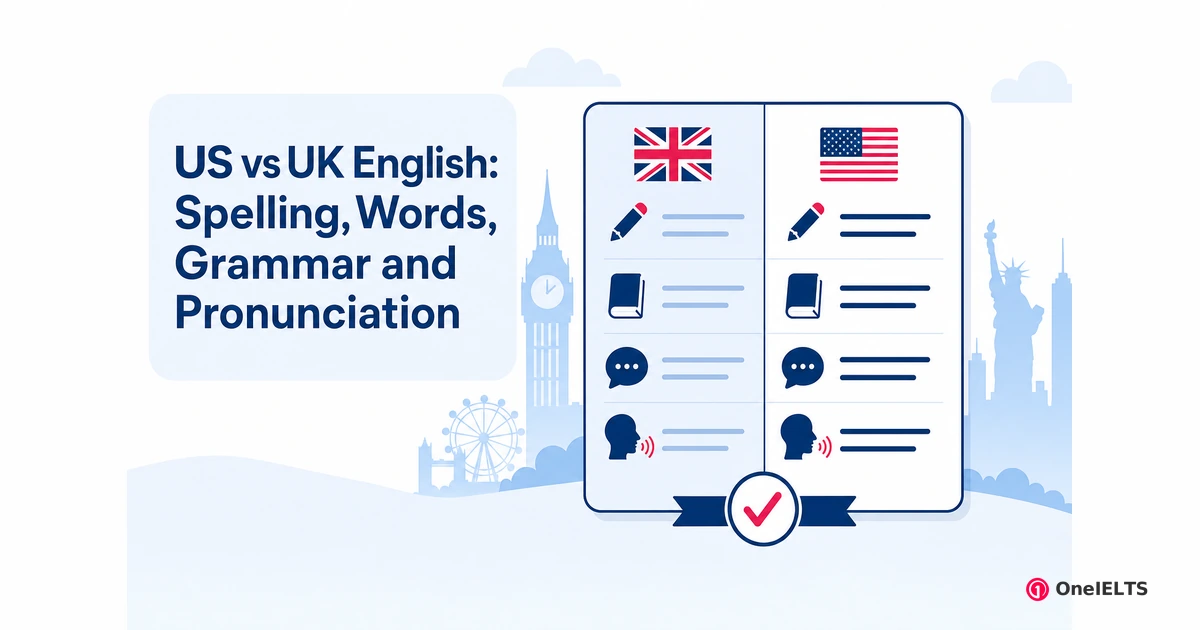
British English and American English share one grammar and one core vocabulary, then split on four things: spelling, vocabulary, a few grammar habits and pronunciation. This page compares those two varieties only. British vs Australian English and the American accent each have their own OneIELTS page.
You’ll find each variety defined first, then the differences at a glance and the four areas in turn. Punctuation, dates and numbers come next, then words that change meaning and whether American English is easier. The page ends with what it means for IELTS, which accepts both varieties: each difference is tied to the skill it touches, from spelling in Listening answers to accent in Speaking.
What Is British English?
British English is the standard form of English written and spoken in the United Kingdom. So if you’re asking whether British English is UK or US, it’s the UK; the US uses American English. Most Commonwealth countries follow British spelling conventions with local variation, and India’s school and university system is one of them. That’s why Indian candidates usually write “colour” and “organise” by default.
The Oxford English Dictionary is the reference dictionary for the variety. Received Pronunciation, the accent of older BBC broadcasts, is only one British accent among dozens, from Scouse to Glaswegian. British English is really a written standard English, not a single way of speaking.
What Is American English?
American English is the standard form of English used in the United States. It grew from the English that settlers brought from Britain in the 1600s and drifted apart after independence. Noah Webster’s 1828 dictionary deliberately simplified spellings such as “color” and “center” to give the new country its own standard.
Merriam-Webster, which grew out of Webster’s work, is the reference dictionary today. General American is the accent most learners hear in US films, series and online courses. American English also sets the defaults for global media and software, and most spell-checker tools ship set to en-US. That’s how many learners end up mixing the two without noticing.
What Are the Differences Between American and British English?
American and British English differ in four main areas: spelling, vocabulary, grammar and pronunciation, plus smaller conventions for punctuation, dates and numbers. A shift in date format, 22 May against May 22, sits in that last group. Six areas cover almost every contrast you’ll meet, each shown here with one example pair.
- Spelling: regular patterns, such as colour in Britain and color in America.
- Vocabulary: different words for one thing, such as flat and apartment.
- Grammar: small habits, such as “the team are” against “the team is”.
- Pronunciation: the non-rhotic British r against the rhotic American r.
- Punctuation, dates and numbers: conventions such as 22 May against May 22.
- Words that change meaning: shared words, such as pants and chips, with different meanings.
What Are the Spelling Differences Between American and British English?
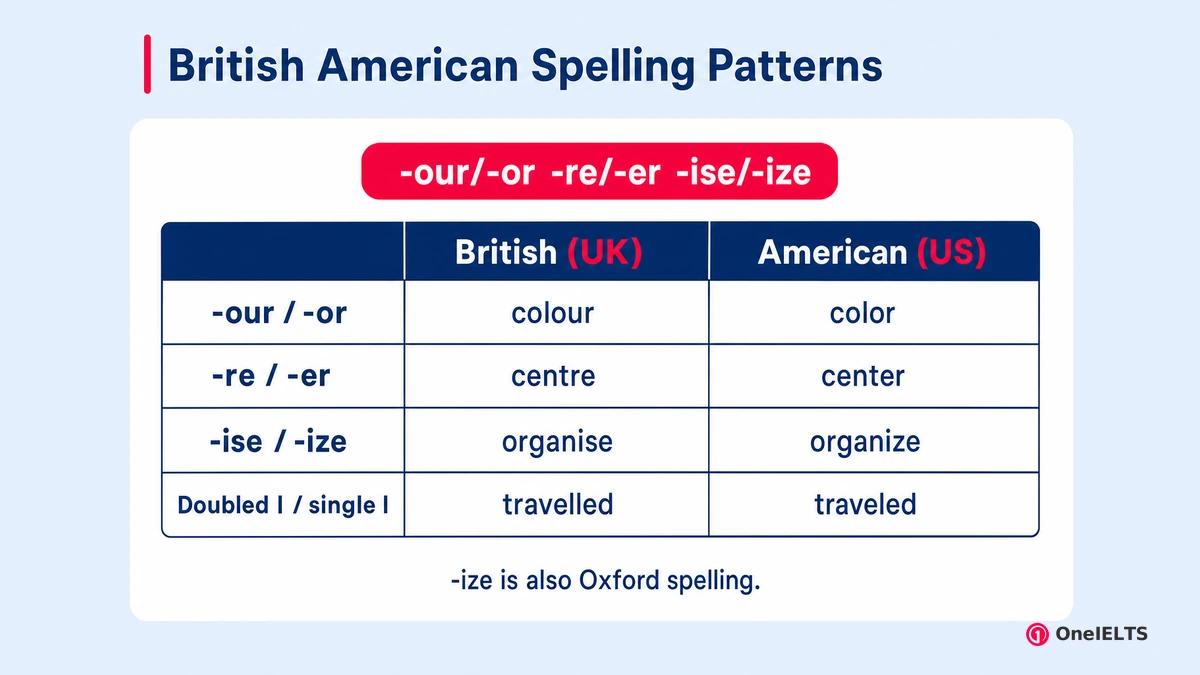
Most spelling differences follow a handful of regular patterns, so learning the pattern covers hundreds of words. The four biggest are -our and -or, -re and -er, -ise and -ize, and the doubled consonant in words like travelled. Nine patterns sit in the table, each with a British form, its American partner and more words that follow the same rule.
| Pattern | British spelling | American spelling | More examples |
|---|---|---|---|
| -our / -or | colour | color | flavour/flavor, honour/honor, neighbour/neighbor, humour/humor, labour/labor |
| -re / -er | centre | center | metre/meter, theatre/theater, fibre/fiber, litre/liter, calibre/caliber |
| -ise / -ize | organise | organize | realise/realize, recognise/recognize, apologise/apologize, criticise/criticize, summarise/summarize |
| -yse / -yze | analyse | analyze | paralyse/paralyze, catalyse/catalyze, breathalyse/breathalyze, plus all their verb forms |
| Doubled l / single l | travelled | traveled | cancelled/canceled, modelling/modeling, labelled/labeled, jeweller/jeweler, counsellor/counselor |
| -ce / -se nouns | licence, defence | license, defense | offence/offense, pretence/pretense, and the noun licence/license |
| -ogue / -og | catalogue | catalog | analogue/analog, and dialogue/dialog in computing contexts |
| ae and oe / e | paediatric | pediatric | anaemia/anemia, oestrogen/estrogen, manoeuvre/maneuver, encyclopaedia/encyclopedia, foetus/fetus |
| -mme / -m | programme | program | gramme/gram, and a computer program in both varieties |
An “-ize” ending doesn’t prove a text is American. Oxford spelling, used by Oxford University Press and many international bodies, writes “organize” and “realize” while keeping “colour” and “centre”.
The bigger trap is noun and verb pairs. British English writes “practice” for the noun and “practise” for the verb, and “licence” against “license”. American English uses “practice” and “license” for both. These pairs cause more “wrong” spellings in candidate essays than any other pattern.
What Are the Vocabulary Differences Between American and British English?
Many everyday things have one name in the UK and another in the US: flat and apartment, lift and elevator, chips and French fries. The table covers twenty-one common pairs, grouped by where you’d meet them.
| Theme | British English | American English |
|---|---|---|
| Home | flat, lift, garden | apartment, elevator, yard |
| Food | chips, crisps, biscuit, sweets | French fries, chips, cookie, candy |
| Transport | lorry, petrol, motorway, return ticket | truck, gas, highway, round-trip ticket |
| Clothes | trousers, jumper, trainers | pants, sweater, sneakers |
| Everyday | rubbish, mobile, holiday, queue | garbage, cell phone, vacation, line |
| Education | term, maths, timetable | semester, math, schedule |
Speakers on both sides understand most of this everyday vocabulary, so register and consistency decide how a word lands. Two pairs trip learners most often. Petrol and gas confuse because “gas” also means a vapor. Holiday and vacation confuse because a British bank holiday is a public day off for everyone.
What Are the Grammar Differences Between American and British English?
Grammar differences are few and small: collective nouns, the present perfect, got and gotten, and some prepositions. None of them makes a sentence wrong in the other variety. Seven habits account for nearly every contrast, each shown with a British and an American example.
- Collective nouns: British English often treats a group as plural, “the team are winning”, while American subject-verb agreement keeps it singular: “the team is winning”.
- Present perfect vs simple past: British speakers use the present perfect for recent actions, “I’ve just eaten”, where Americans often prefer the simple past: “I just ate”.
- Past participle of get: British English uses “got” as the past participle, “she’s got better”, while American English uses “gotten” for change: “she’s gotten better”.
- Have got vs have: British speakers ask “Have you got a pen?” about possession, and Americans more often ask “Do you have a pen?” Both are understood everywhere.
- Prepositions: British English says “at the weekend” and “different to”, while American English says “on the weekend” and “different from”, which British usage also accepts.
- Shall and will: British speakers still make offers with shall, as in “Shall we go?”, while Americans rarely use it and ask “Should we go?” instead.
- Subjunctive: British English usually adds should, “I suggest that he should go”, while American English keeps the bare subjunctive form: “I suggest that he go”.
How Is American Pronunciation Different From British Pronunciation?
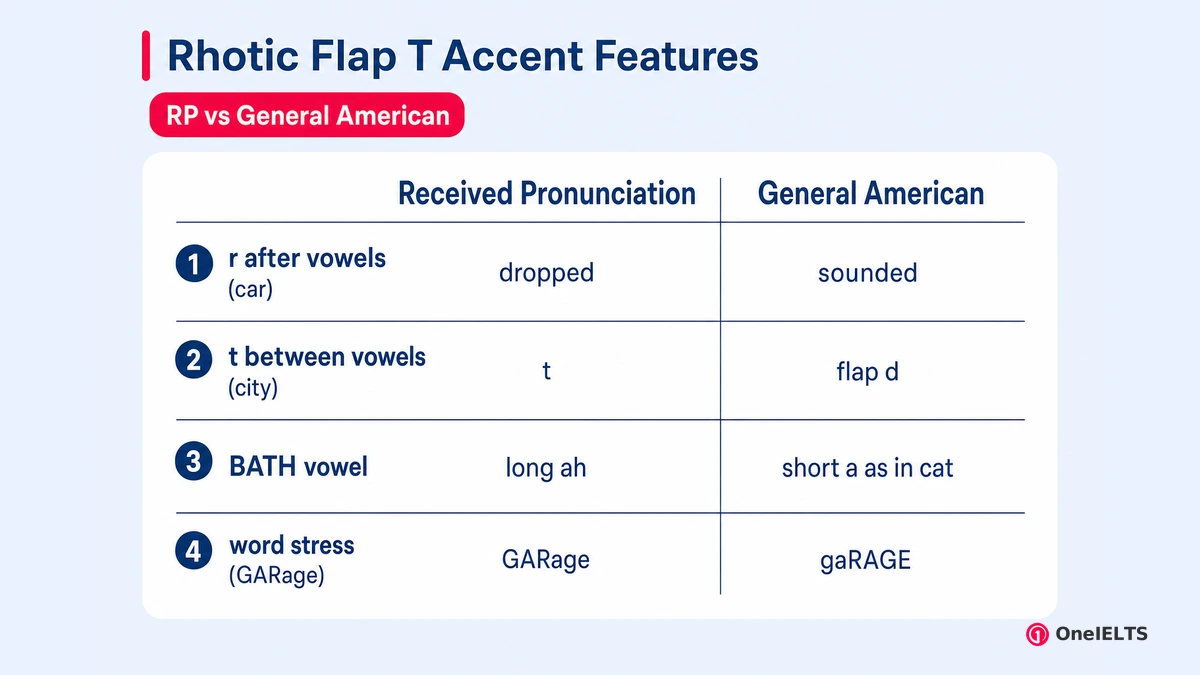
The clearest differences are the r after vowels, the American flapped t, and a few vowels and word stresses. General American sounds the r in “car”, standard British English drops it, and Americans say “city” with a soft, d-like t. Six features separate the two reference accents, each with one example word.
- Rhoticity: American English is a rhotic accent, so the r in “car” and “water” is sounded, while Received Pronunciation is a non-rhotic accent that drops it.
- T-flapping: between vowels, Americans turn t into a quick flap t, close to a light d, so “city” and “butter” sound like “ciddy” and “budder”.
- The BATH vowel: southern British speakers use a long “ah” in “bath”, “dance” and “can’t”, while General American uses the short vowel heard in “cat”.
- The LOT vowel: British speakers round their lips for the short o in “hot” and “stop”, while Americans use an open, unrounded “ah” sound instead.
- Word stress: British English says adVERtisement and GARage, while American English says adverTISEment and gaRAGE, so the word stress moves to another syllable entirely.
- Individual words: “schedule” starts with sh in Britain and sk in America, “tomato” takes “mah” or “may”, and Z is zed or zee.
Neither country has one accent. These are the features of the two standard reference accents, Received Pronunciation and General American. This section stays comparative, and techniques for producing an American accent live on their own page.
How Do Punctuation, Dates and Numbers Differ in American and British English?
British English usually writes the day before the month (22 May 2026) and uses single quotation marks. American English writes the month first (May 22, 2026), uses double quotation marks and puts a period after “Mr.”. Seven writing conventions differ, and the table sets each British form beside its American one.
| Convention | British English | American English |
|---|---|---|
| Date order | 22/05/2026, or 22 May | 05/22/2026, or May 22 |
| Quotation marks | ‘single’ first, “double” inside | “double” first, ‘single’ inside |
| Punctuation inside quotes | outside, unless part of the quote | inside the closing quotation mark |
| Titles | Mr, Dr, no period | Mr., Dr., with a period |
| Time | half past six, or 18:30 | six-thirty, or 6:30 p.m. |
| Numbers | one hundred and five | one hundred five |
| Money | £5.50, with a decimal point | $5.50, with a decimal point |
The date format matters in practice. “05/06” is 5 June to a reader used to day-month order and May 6 to one used to month-day order, so write the month as a word whenever the date counts. British timetables also use the 24-hour clock far more often. In titles and abbreviations, British style drops the period when the short form ends with the same letter as the full word, as “Dr” does with “Doctor”.
Which Words Mean Different Things in American and British English?
A small set of shared words carry a different meaning on each side: “pants” are underwear in the UK and trousers in the US. The first floor is one level up in Britain but the ground floor in America. These false friends differ from the vocabulary pairs above, because the word stays the same while the meaning changes. Eight cause most real misunderstandings.
- Pants: underwear in British English but trousers in American English, so “nice pants” can startle a British listener.
- Chips: thick fried potato strips in Britain, but thin packaged snacks in America, where British chips are fries.
- First floor: the level above the ground floor in Britain, but the street-level floor in America.
- Football: the round-ball game Americans call soccer in Britain, but the oval-ball game of American football in the US.
- Biscuit: a sweet, flat baked snack in Britain, but a soft, scone-like bread often served with gravy in America.
- Rubber: a pencil eraser in British classrooms, but informally a condom in America, so ask for an eraser there.
- Pavement: the raised walkway beside a road in Britain, but the hard road surface itself in America.
- Public school: an old, fee-paying private school in England, but any free, state-funded school in the United States.
The pair pavement and sidewalk shows the pattern clearly: a Londoner walks on the pavement, and a New Yorker walks on the sidewalk.
Is American English Easier Than British English?
No, neither variety is easier overall: American spelling is slightly simpler and its rhotic r is often easier to follow, but the grammar is almost identical. American English feels easier to many learners because of simplified spelling, such as “color” and “program”, and heavy media exposure through films and apps. British English feels easier to most Indian learners because Indian schooling teaches it by default and it matches what they already write.
For any language learner, the practical answer is simple: use the variety you already read and write most, and keep it with consistency.
Is American or British English Accepted in IELTS?
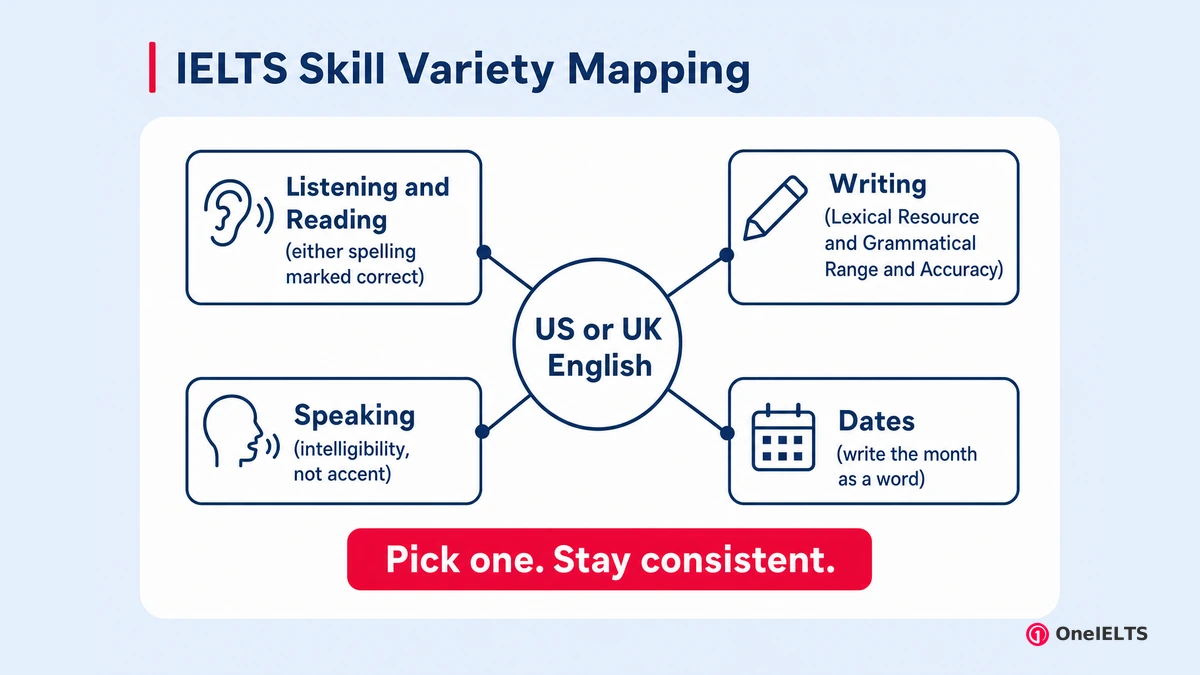
Yes, IELTS accepts both American and British English, in spelling, vocabulary and accent, as long as you use one variety consistently. The British Council says both spellings are “100% accepted and scored equally”, and IDP says both forms of vocabulary, spelling and grammar are accepted.
Each difference on this page lands in a specific skill. In IELTS Listening and IELTS Reading, either spelling is marked correct, while a misspelling isn’t. In IELTS Writing, spelling and word choice count under Lexical Resource, and grammar habits fall under Grammatical Range and Accuracy. In IELTS Speaking, the examiner assesses intelligibility, not accent. Our IELTS Listening spelling guide covers the answer-sheet rules in full.
The consistency rule is simple: pick one spelling system before test day and use it across the whole paper. Set your practice spell-checker to that variety too. For Listening form-completion dates, IDP lists both “24 April” and “April 24” as correct, but writing the month as a word keeps the answer clear in either variety.
Indian candidates usually default to British spelling from school, which is fine. The risk is switching mid-paper after months on American-English apps. IELTS publishes no fixed penalty for mixing varieties. Checked on 7 October 2026.
Can You Mix American and British Spelling in IELTS?
No, you should not: IELTS accepts both spellings, but mixing “color” and “organise” in one essay reads as inconsistent spelling control. The five spellings candidates most often mix are colour/color, organise/organize, centre/center, travelled/traveled and programme/program. The mix usually comes from tools: a candidate who writes “colour” by hand types “color” after weeks of practice on an en-US laptop.
A word spelled in neither variety, such as “recieve”, is simply a spelling mistake under Lexical Resource. Check spelling consistency in your last two minutes by scanning only the -our and -ise words. The common spelling mistakes in English guide lists the errors candidates repeat most.
Does American Vocabulary Lower Your IELTS Writing Score?
No, American words such as “apartment” or “vacation” do not lower your Writing band; examiners assess range and precision, not variety. Lexical Resource rewards accurate word choice, and “apartment” is as precise as “flat”. Slang from either side does more damage: “quid”, “bucks” or a casual “gotten” in formal register can hurt the tone of a Task 2 essay more than the variety ever would. Build topic words with our IELTS Writing vocabulary lists.
Do You Need a British or American Accent for IELTS Speaking?
No, the Speaking test does not reward any particular accent; the examiner scores how clearly and naturally you are understood. The British Council says you’re free to speak in any standard English accent, and the Pronunciation criterion measures intelligibility along with features such as stress and intonation.
A forced or inconsistent accent can lower that score, because a borrowed American r that comes and goes makes speech harder to follow. Keep your own accent and work on clarity. If you still want to learn an American accent, treat it as a long project.
How Is British English Different From Australian English?
The differences between British and Australian English are mostly vocabulary and accent; Australian English keeps British spelling, so “colour” and “organise” stay the same. The regional vocabulary and regional accent features are set out on our British vs Australian English page.
Written by Fahimur Rahman, reviewed 7 October 2026.
Last verified: 7 October 2026