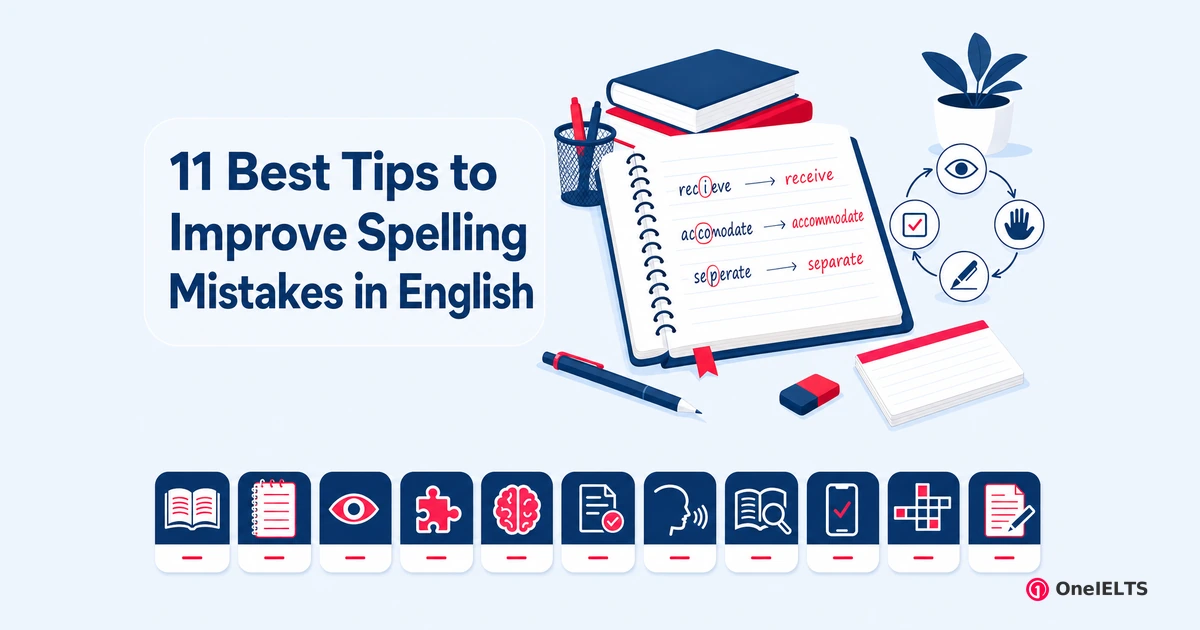
You fix spelling by repeating spelling habits weekly: a personal word list, Look-Cover-Write-Check, mnemonics and spelling rules. In IELTS, a misspelled Listening or Reading answer scores zero, Writing marks spelling under Lexical Resource, and computer-delivered IELTS counts typos as errors. Common misspellings and exam-day checks have their own pages. Eleven habits follow.
- Read regularly so wrong spellings start looking wrong.
- Keep a personal misspelled-words list of real errors.
- Use Look-Cover-Write-Check to test each word from memory.
- Break long words into chunks and spell each.
- Use mnemonics for the letters you keep forgetting.
- Learn the basic spelling rules and word families.
- Sound words out syllable by syllable before writing.
- Check word origins in a dictionary for oddities.
- Use practice tools and apps that schedule reviews.
- Play word games that demand exact letter recall.
- Write a little every day with autocorrect off.
What Causes Poor Spelling Skills in English?
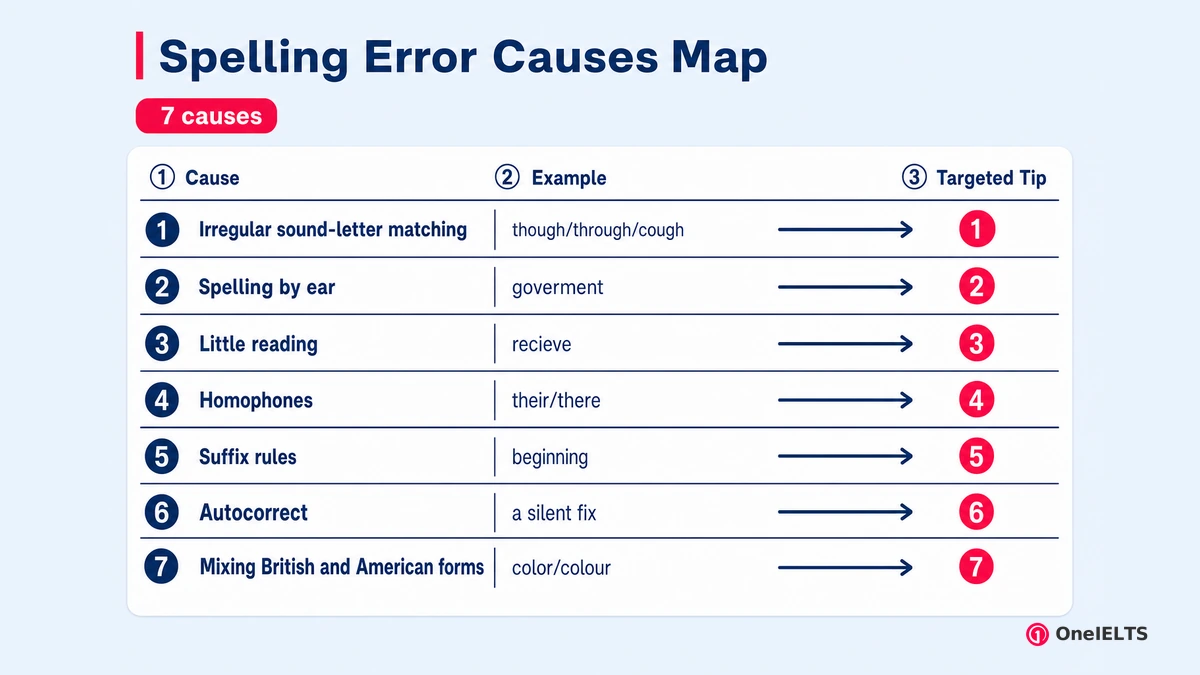
Most English spelling mistakes come from three causes: letters that don’t map one-to-one to sounds, spelling by ear from your own pronunciation, and seeing words in print too rarely. Each one produces a different kind of error.
English is harder to spell than a phonetic language such as Hindi or Bengali, where one letter usually stands for one sound. In English, the same sound can take five spellings, and some letters make no sound at all. Seven specific causes sit behind most of the mistakes learners make.
- Irregular sound-letter matching. Silent letters and “ough” words like though, through and cough defeat any guess from sound.
- Spelling by ear. Learners copy their regional pronunciation, so a dropped or merged sound becomes a missing letter.
- Little reading. Words learned mostly by hearing are rarely seen in print, so the eye never stores them.
- Homophones and near-homophones. Pairs such as their and there, or affect and effect, sound alike but mean different things.
- Uncertain suffix rules. Doubling the consonant or dropping the final e trips up words like beginning and writing.
- Heavy reliance on autocorrect. Software fixes the word silently, so you never notice or learn the correct spelling.
- Mixing British and American forms. Switching between color and colour inside one answer looks like uncontrolled spelling.
Each tip below targets one of these causes, so start with the cause that matches your own mistakes.
1. Read Regularly to Improve Your Spelling
Reading builds the visual memory that spelling depends on. Every time you see a word in print, your brain stores its letter patterns, and after enough exposures a wrong spelling simply looks wrong. That’s why heavy readers often can’t state a rule but still spot “recieve” at once.
For an IELTS learner, 15 to 20 minutes a day is enough. Read English newspapers, magazines and IELTS Reading passages, which use the same academic and general vocabulary the test draws on.
Make the reading active. In each article, underline two or three words you’d have spelled differently, then copy them into your personal list from tip 2.
2. Make a List of Words You Have Trouble Spelling
A personal spelling list records only the words you actually get wrong, in a notebook or a phone note. A generic list of hard words wastes time on words you already know, while your own difficult-to-spell list targets your real trouble spots. Some learners call it a spelling diary.
Five steps keep the list short, accurate and useful.
- Write each word correctly every time, and never copy the wrong version into the list.
- Mark the exact letters you got wrong in color, such as the second m in accommodation.
- Add homophone pairs you confuse side by side, like stationary and stationery, with a short meaning.
- Practice the whole list three times a week, testing yourself from memory rather than rereading.
- Remove a word only after you spell it correctly in three tests in a row.
3. Use the Look-Cover-Write-Check Method
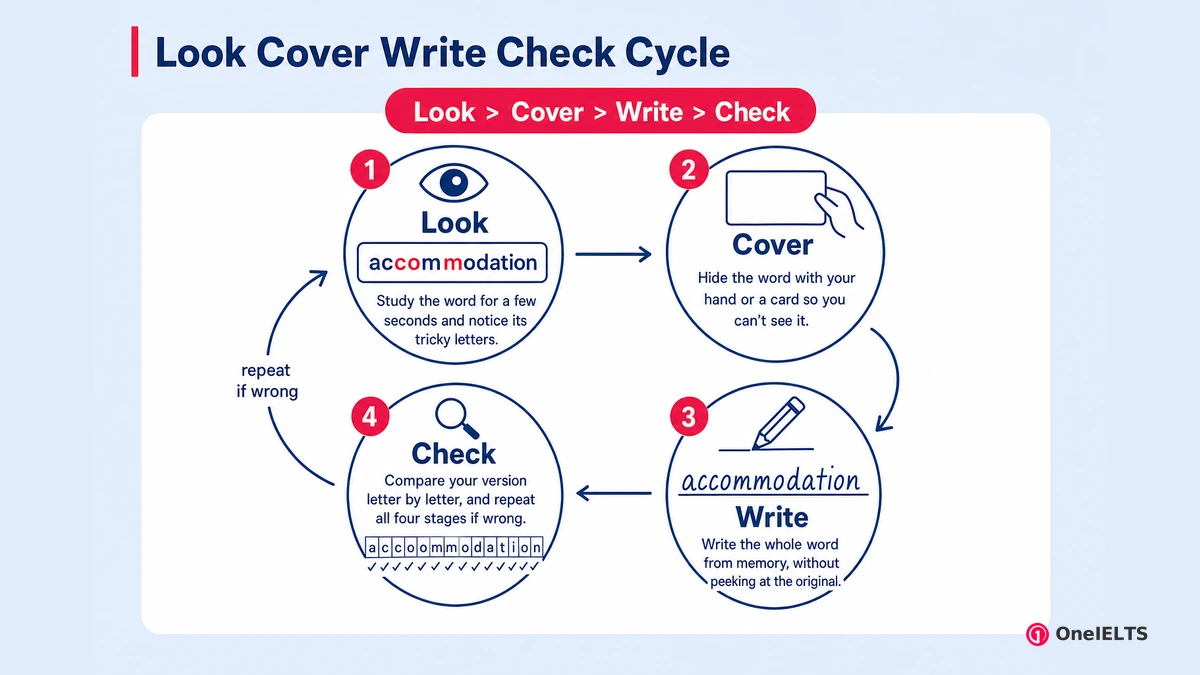
Look-Cover-Write-Check is a four-stage self-testing routine that moves a word from short-term to long-term memory. Writing the word from recall, not copying it, is what makes it stick.
The four stages run in a fixed order.
- Look. Study the word for a few seconds and notice its tricky letters.
- Cover. Hide the word with your hand or a card so you can’t see it.
- Write. Write the whole word from memory, without peeking at the original.
- Check. Compare your version letter by letter, and repeat all four stages if wrong.
Adults preparing for IELTS can run it on the personal list from tip 2 in five minutes a day.
4. Break Long Words Into Chunks
Chunking splits a long word into syllables or meaningful parts, so you spell each small part on its own. Four letters at a time are far easier to hold than thirteen.
IELTS topics use plenty of long words that reward this, such as en-vi-ron-ment, gov-ern-ment, ac-com-mo-da-tion and Wed-nes-day. Saying each chunk aloud as you write it fixes its letters in order.
Chunking also catches letters that vanish in fast speech. Most people say “enviroment” and “goverment” aloud, and the missing n then disappears on paper too. Spelling environment as four separate chunks forces the n back in, and the same trick keeps both m’s in accommodation.
5. Use Mnemonics for Tricky Words
Mnemonics are short memory tricks that tie the hard letters of a word to a phrase or a picture. Four types of memory trick cover most needs.
- Words within words. Spot a smaller word inside the hard one: separate has “a rat” in the middle.
- Acrostics. Turn each letter into a word: big elephants can always understand small elephants spells because.
- Rhymes and stories. Build a short rhyme or scene around the tricky part, like “i before e.”
- Alliteration. Repeat a starting sound to fix letters, such as “necessary has one collar, two sleeves.”
Mnemonics work best for the five to ten words you keep getting wrong, not for every word you learn.
6. Learn the Basic Spelling Rules
A handful of rules predict the spelling of thousands of English words, but every rule has exceptions you learn by sight. Five rules give the best return for the effort.
- I before E except after C. Write receive and believe this way, but learn exceptions like weird separately.
- Drop the silent e before a vowel suffix. Make becomes making, and hope becomes hoping, without the e.
- Double the final consonant after a short stressed vowel. Stop becomes stopped; consonant doubling also gives beginning.
- Change y to i before a suffix. Happy becomes happiness, and carry becomes carried in the past tense.
- Add -es after s, x, z, ch and sh. Box becomes boxes, and church becomes churches.
Longer sets of “12 spelling rules” add plural, -ful and -ly rules, so learn these five first.
Word families stretch each rule further. Learn prefixes, suffixes and related forms as one group: necessary, unnecessary and necessarily share a core, as do child, children and childhood. One known spelling then unlocks three or four more, and a single silent e or i before e decision carries across the family.
7. Sound It Out Syllable by Syllable
Sounding out means saying a word slowly, syllable by syllable, and then spelling it aloud letter by letter. This phonics drill recovers dropped syllables that casual speech swallows, as in Feb-ru-ary, lib-ra-ry and prob-ab-ly.
English isn’t fully phonetic, though, so sounding out only works alongside reading (tip 1) and the spelling rules (tip 6).
Learners whose first language merges sounds, such as v and w or short and long vowels, need a standard pronunciation to copy. Use the recorded dictionary pronunciation, not your own voice. Clearer pronunciation also helps your IELTS Speaking score.
8. Check Word Origins in a Good Dictionary
Etymology explains spellings that look random. Greek words use “ph” for the f sound, as in phenomenon; French words end in -que, as in technique; and Latin roots like aqua- keep their form in aquarium and aquatic. Once you know a word’s history, its letters stop looking arbitrary.
Use a learner’s dictionary such as Oxford, Cambridge or Merriam-Webster. Each shows word origins and marks the British or American form.
Build the habit into your personal list. When you add a word, note its origin in a few words, such as “Greek, ph = f.” Greek and Latin roots repeat across hundreds of academic words, so each note pays off again later.
9. Use Tools and Apps to Improve English Spelling
Practice tools speed up every habit above: they schedule your reviews, test your recall and give instant feedback. Five kinds of tool are worth a place in your routine.
- Spelling apps. Spelling practice apps quiz you on target words and track which ones you keep missing.
- Flashcard apps with spaced repetition. Anki or Quizlet flashcards bring each word back just before you’d forget it.
- Online dictionaries with audio. Cambridge or Merriam-Webster online lets you hear the word before you spell it.
- Dictation and listening practice. Dictation from short recordings trains you to turn heard words into correct letters.
- Spellchecker flags. Every red underline in practice writing marks a word that belongs on your personal list.
Retype each spellchecker correction yourself and add the word to your list, rather than letting autocorrect fix it.
10. Play Word Games to Practice Spelling
Word games add repetition without boredom, and they force exact letter recall because a single wrong letter breaks the answer. Five games suit adult learners.
- Crosswords. Crosswords make every letter count, since one wrong letter blocks the crossing words.
- Wordle-style daily puzzles. Five-letter word puzzles train you to test letter positions one at a time.
- Scrabble. Scrabble rewards correct spelling with points and punishes invented words with a challenge.
- Hangman with a study partner. Guessing letters in order builds awareness of common English letter patterns.
- Dictation challenges. A partner reads ten words aloud, and you score your spelling against the list.
11. Practice English Writing Daily
Ten minutes of daily writing, by handwriting or typing with autocorrect off, turns the words from tips 1 to 10 into active vocabulary. Recognizing a spelling and producing it unaided are different skills, and only writing trains the second.
Keep the routine simple. Write a short writing diary entry or a 100-word answer to an IELTS-style question, such as whether cities need more parks. Then check every doubtful word against the dictionary and add any errors to your personal list.
This is practice over weeks. The checks to run while you write an exam answer belong to a separate guide, so don’t turn this into a proofreading drill.
How Can You Improve Your Spelling for the IELTS Exam?
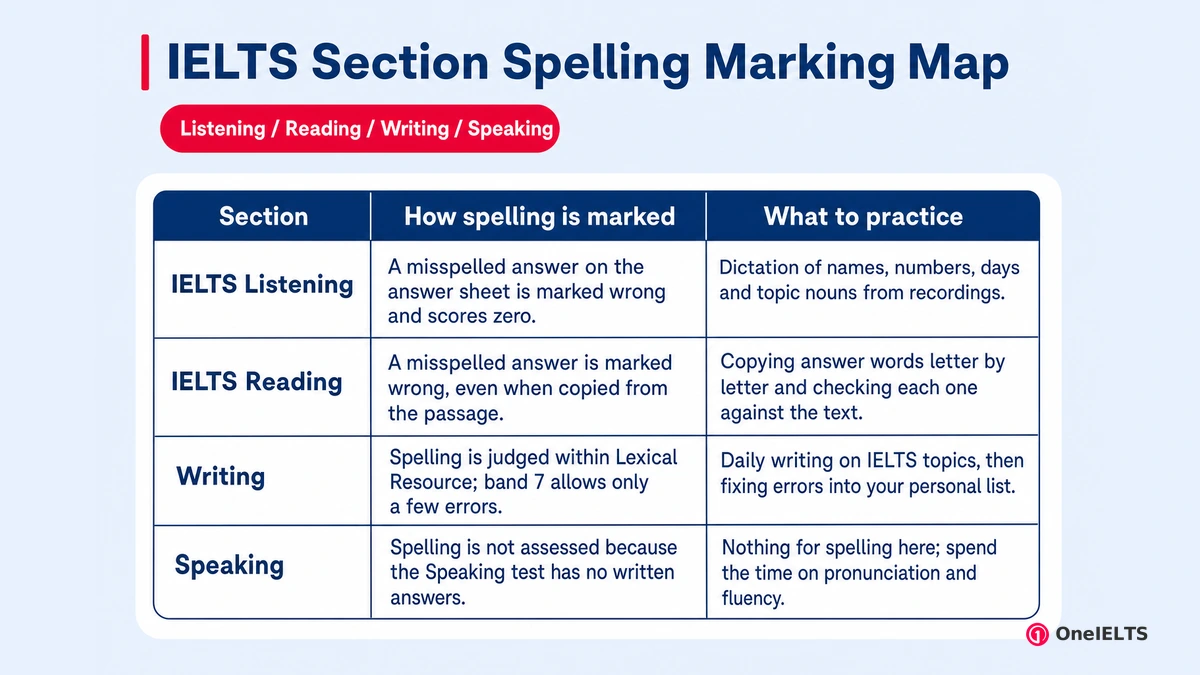
Practice the habits above on the words IELTS actually tests, meaning Listening answers, Reading answers and topic vocabulary for Writing, and practice without a spellchecker. IDP counts every typo on computer-delivered IELTS as a spelling mistake, so your own eye has to do the checking.
Spelling affects each section differently, and the practice should follow the marking. These scoring facts were checked on 7 October 2026 against IDP and the ielts.org Writing band descriptors.
| Section | How spelling is marked | What to practice |
|---|---|---|
| IELTS Listening | A misspelled answer on the answer sheet is marked wrong and scores zero. | Dictation of names, numbers, days and topic nouns from recordings. |
| IELTS Reading | A misspelled answer is marked wrong, even when copied from the passage. | Copying answer words letter by letter and checking each one against the text. |
| Writing | Spelling is judged within Lexical Resource; band 7 allows only a few errors. | Daily writing on IELTS topics, then fixing errors into your personal list. |
| Speaking | Spelling is not assessed because the Speaking test has no written answers. | Nothing for spelling here; spend the time on pronunciation and fluency. |
A four-week plan turns this into a routine. In weeks 1 and 2, take a mock test and build your personal list from every spelling error; in weeks 3 and 4, run Look-Cover-Write-Check on that list and retest. Listening practice is the quickest place to collect real spelling errors.
A common pattern in Listening practice: the word was heard correctly but spelled by ear, so “Febuary” or “goverment” costs the full mark.
Does IELTS Accept Both American and British Spelling?
Yes, IELTS accepts both American and British spelling, as long as each word is spelled correctly in one standard. The British Council says both are scored equally in Listening, Reading and Writing. American spelling or British spelling both work, and consistency is good practice rather than a condition: write color or colour, not both. The full -ize and -ise list sits in our US vs UK English spelling guide.
How Can Adults Improve Spelling Mistakes in English?
Adults improve spelling fastest with short, scheduled sessions, 15 minutes a day built around their own error list, rather than the games and phonics drills written for children. Adult learners also gain from linking spelling to a test date. Add one weekly review slot to your IELTS study plan and move every mock-test spelling error onto the list.
How Can You Learn Spelling Words Fast Before IELTS?
The fastest way to learn spelling words before IELTS is to practice the words that appear in Listening answers: names, numbers, days, months and topic nouns, with daily dictation. Days and months alone cause many lost marks. Work from a set of IELTS dictation words, then run Look-Cover-Write-Check on every word you miss.
What Are 20 Tricky Words to Spell in English?
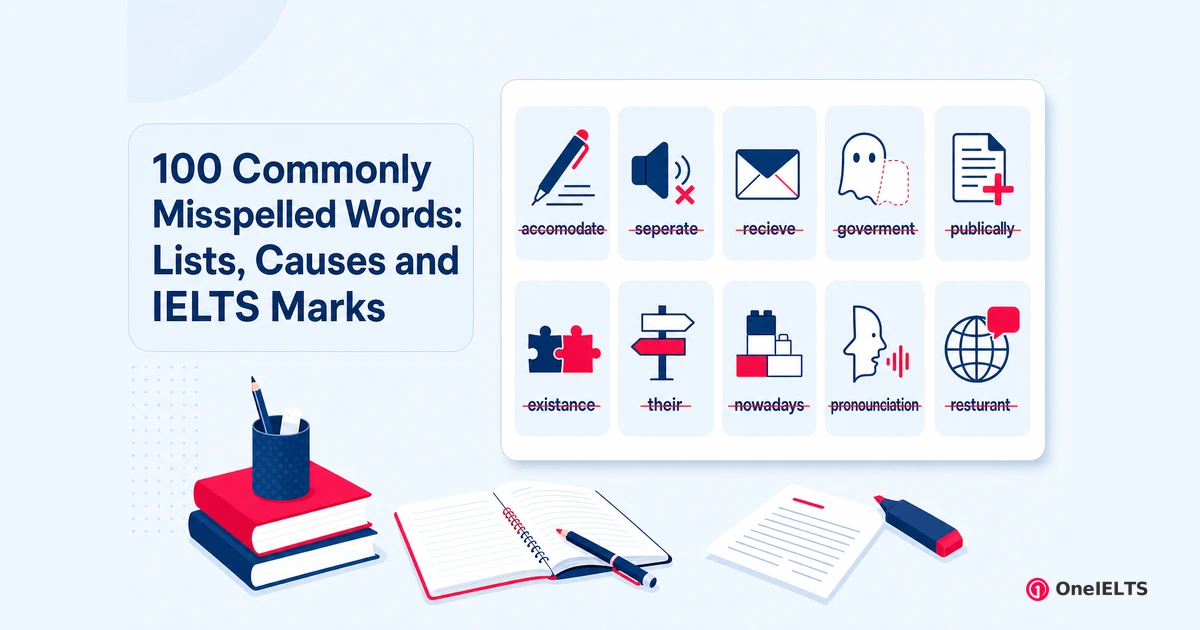
The tricky words most learners misspell include accommodation, necessary, separate, definitely and government. Each hides a double letter, a silent letter or an unstressed vowel. The full set of twenty, with the reason each one goes wrong, is in our guide to commonly misspelled words.
How Can You Avoid Spelling Mistakes While Writing the IELTS Exam?
You avoid spelling mistakes in the exam by leaving two or three minutes to reread each answer and by choosing words you can spell with confidence. Under exam conditions, rereading catches slips, and safe word choice replaces a risky long word with one you know. The step-by-step proofreading routine is in our guide on how to write English without spelling mistakes.
Written by Fahimur Rahman, reviewed 7 October 2026.
Last verified: 7 October 2026