Listening turns sound into meaning: you receive a spoken message, interpret it, remember it and respond, a listening process that plain hearing skips. Guides count anywhere from 4 to 12 types, but the same ten recur as foundation, purpose and engagement types. Techniques for better listening skills and communication have their own pages; the last section maps each type to the IELTS Listening test.
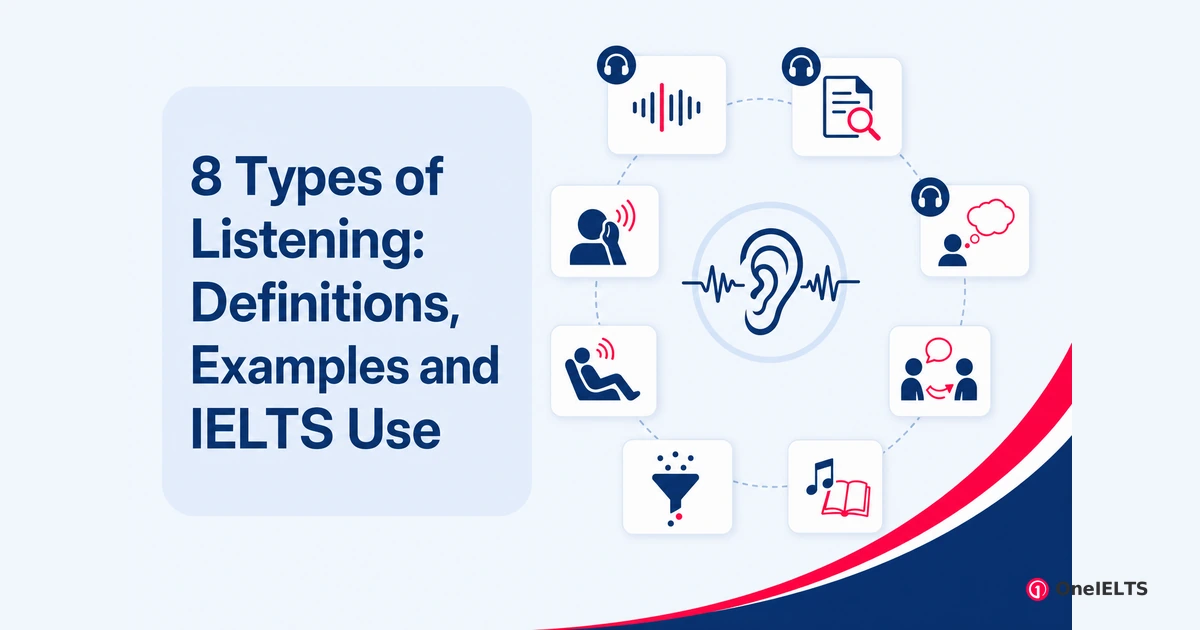
Eight headings cover the recurring types, each named with what it listens for.
- Discriminative listening: differences in sound, tone and accent.
- Informational and comprehensive listening: the message and its facts.
- Critical listening: judging the logic and evidence behind claims.
- Active and reflective listening: full attention, mirrored back to the speaker.
- Empathetic listening: the speaker’s feelings and point of view.
- Appreciative listening: enjoyment of music, stories and good speakers.
- Selective listening: only the parts that matter to you.
- Passive listening: hearing sound without engaging with the message.
What Is Listening?
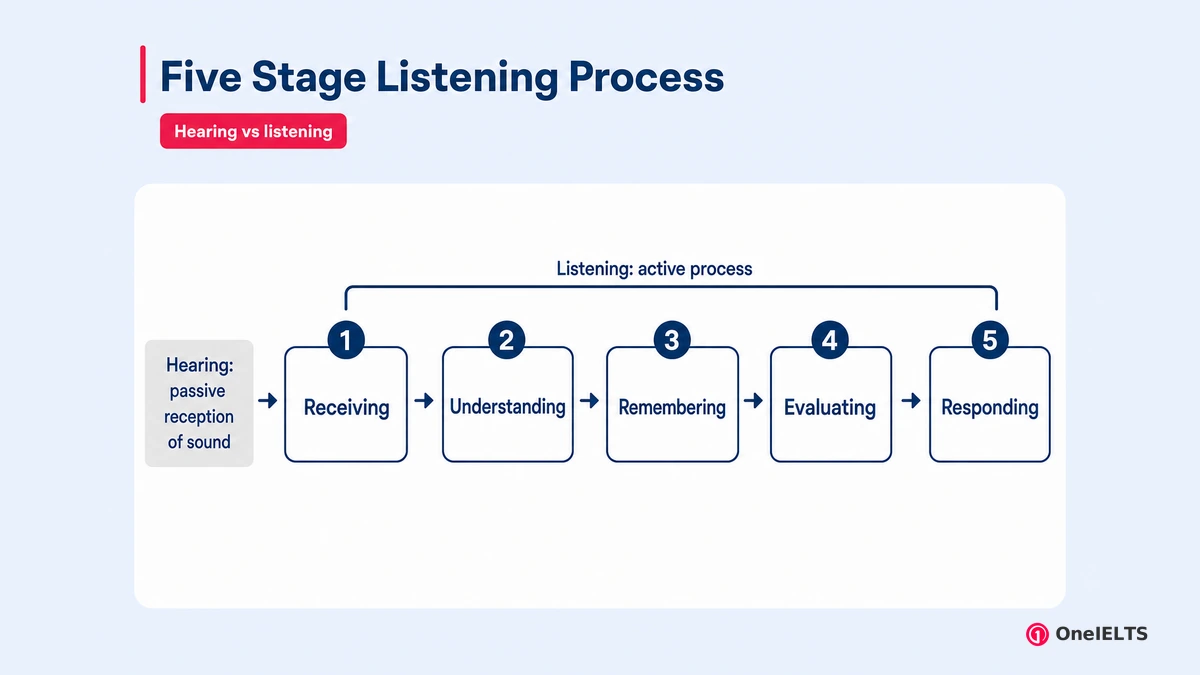
Listening is the active process of receiving a spoken message and its nonverbal cues, then interpreting, remembering and responding to it. Hearing is the passive physical reception of sound: you hear traffic, but you listen to directions. Most courses teach five stages of the listening process (receiving, understanding, remembering, evaluating and responding), and each type on this page leans on a different stage.
People use listening more than any other communication skill, yet schools rarely teach it. Misunderstandings at work and in study usually start with a listening failure rather than a speaking one. The types of listening that follow differ by what the listener is listening for.
How Many Types of Listening Are There?
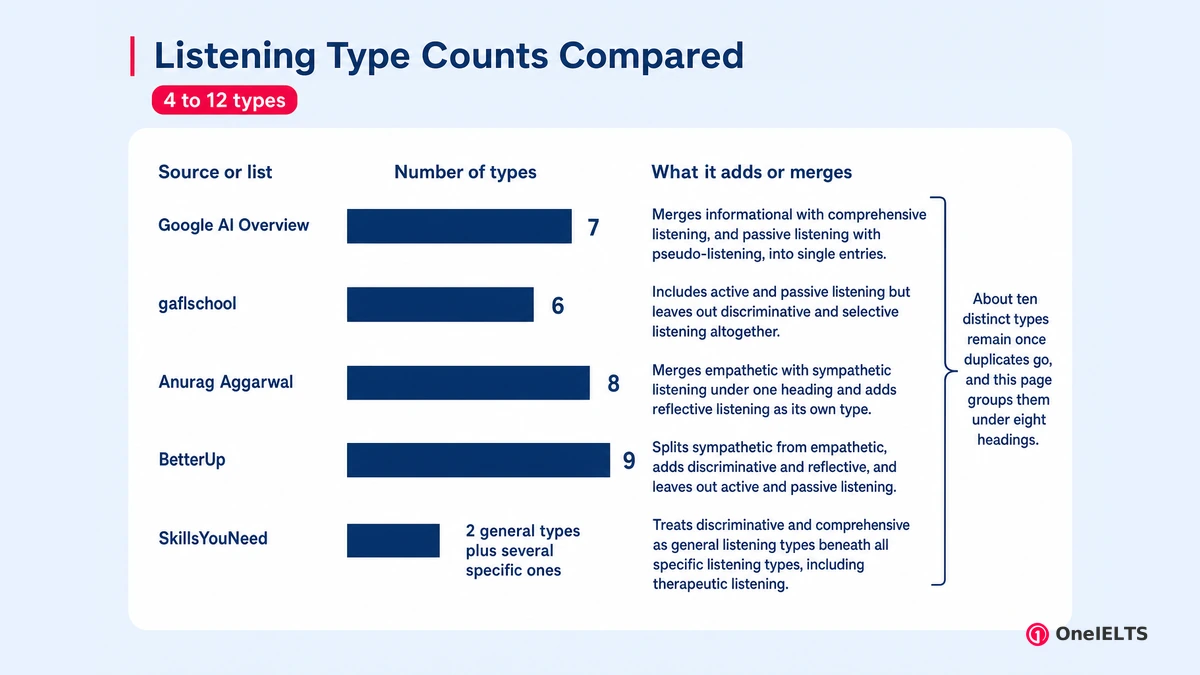
There’s no fixed number: published guides list between 4 and 12 types of listening, depending on whether they merge near-synonyms and count engagement levels such as active, selective and passive as types. About ten distinct types remain once duplicates go, and this page groups them under eight headings by pairing informational with comprehensive and active with reflective.
Five widely read lists, recounted from their own headings on 7 October 2026, show where the different totals come from.
| Source or list | Number of types | What it adds or merges |
|---|---|---|
| Google AI Overview | 7 | Merges informational with comprehensive listening, and passive listening with pseudo-listening, into single entries. |
| gaflschool | 6 | Includes active and passive listening but leaves out discriminative and selective listening altogether. |
| Anurag Aggarwal | 8 | Merges empathetic with sympathetic listening under one heading and adds reflective listening as its own type. |
| BetterUp | 9 | Splits sympathetic from empathetic, adds discriminative and reflective, and leaves out active and passive listening. |
| SkillsYouNeed | 2 general types plus several specific ones | Treats discriminative and comprehensive as general listening types beneath all specific listening types, including therapeutic listening. |
Searches for 4, 7, 8 or 12 types of listening draw on this same pool; each list simply sets its cut-off in a different place.
1. Discriminative Listening
Discriminative listening is the most basic type: telling sounds apart and picking up tone of voice, pitch, word stress, accent and nonverbal cues before any meaning is processed. It develops first, since an infant recognizes a parent’s voice long before it understands words. A second-language listener needs sound discrimination most, because sounds that don’t exist in the first language are hard to tell apart.
Each of these markers shows sound discrimination doing its job.
- What it listens for: differences in sound, tone, stress and accent, often before the words themselves register.
- Everyday example: hearing sarcasm in a flat “great”, or catching “thirteen” versus “thirty” in a phone number.
- What it supports: every other type of listening, since meaning always starts with sound reaching the ear.
2. Informational and Comprehensive Listening
The AI Overview and SkillsYouNeed treat this pair together. Comprehensive listening grasps the whole message: the main idea and how the points connect. Informational listening keeps the facts and figures, names and instructions from that message for later use.
What separates them is what each one adds. Comprehension is limited by vocabulary range and topic knowledge, so two people can hear the same lecture and understand different amounts. Informational listening adds memory and note-taking on top, because a fact you understood but didn’t keep is gone by the time you need it.
Four features split the pair, and each line names the half it belongs to.
- Comprehensive: listens for the main idea and how the parts of the message fit together.
- Informational: listens for facts, figures, names, dates and steps that you’ll need to use later.
- Everyday example (both): a lecture, a training session, a news bulletin or a set of driving directions.
- What limits it (both): vocabulary range, topic knowledge and memory, which cap how much of any message survives.
3. Critical Listening
Critical listening is listening for evaluation: judging whether a message is logical, accurate, backed by evidence and free of bias before you accept it. A critical listener asks who is speaking and why, what the evidence is, and whether a claim separates fact and opinion. It matters most when someone wants to persuade you, because persuasion works best on a listener who has stopped checking.
These features mark where critical listening goes beyond comprehension.
- What it listens for: claims, evidence, opinions and the persuasion techniques a speaker uses to win agreement.
- Everyday example: a sales pitch, a political speech or a debate where both sides cite numbers.
- What it protects against: accepting weak arguments, loaded statistics or misinformation simply because they sound confident.
4. Active and Reflective Listening
Active listening means giving the speaker your full attention and showing it: you understand, respond and remember through verbal feedback, nodding and clarifying questions. Carl Rogers and Richard Farson named it in their 1957 paper “Active Listening”. Reflective listening is its best-known technique. You mirror the message back by restating or paraphrasing what the speaker said and felt, so both sides can confirm it landed. Counseling, coaching and conflict resolution use it formally.
Three traits define the pair, and the last one separates it from every type above.
- What it listens for: the full message, words and feeling, then shows the speaker it was understood.
- Everyday example: “So you’re saying the deadline is the real problem?” after a colleague’s long complaint.
- What sets it apart: the listener responds as well as receives, so listening becomes a two-way exchange.
5. Empathetic Listening
Empathetic listening tunes into the speaker’s feelings and point of view as well as the words, so the speaker feels understood. Other lists split this ground three ways. Sympathetic listening means feeling for the speaker, and empathetic listening means understanding from the speaker’s perspective. Therapeutic listening is the trained form a counselor or doctor uses to help someone talk through a problem. Sympathy can pull the focus onto your own emotions, while empathy keeps it on theirs.
Here’s how empathetic listening looks inside a real conversation.
- What it listens for: emotions, concerns and the reason behind the words rather than the words alone.
- Everyday example: supporting a friend after bad news, or a counselor’s first session with a new client.
- What it avoids: judging, fixing or redirecting too early, before the speaker has finished explaining.
6. Appreciative Listening
Appreciative listening is listening for enjoyment or inspiration, where the reward is the experience itself: music, stories, a gifted speaker. What counts depends on personal taste, since one person’s favorite album is another’s background noise. It can also turn into informational listening once you start learning from what you enjoy. An English learner who replays podcasts for new phrases has crossed that line.
Taste shapes every line of this profile.
- What it listens for: pleasure, mood and style, the qualities that make a piece worth hearing twice.
- Everyday example: music, audiobooks, a stand-up set or a moving speech heard for its own sake.
- What drives it: personal taste and interest, so two listeners rarely enjoy the same recording equally.
7. Selective Listening
Selective listening means hearing only the parts of a message that match your interests or expectations and filtering out the rest. The cocktail party effect explains it: Colin Cherry’s 1953 experiments showed people can follow one voice among several, and later work found your own name still breaks through from the ignored voice.
In conversation, selective attention is a fault that feeds confirmation bias. Used on purpose, it picks one announcement out of a noisy station, and that directed form returns later on this page.
Both sides of selective listening show in its profile.
- What it listens for: only the parts that seem relevant or agreeable, while everything else fades out.
- Everyday example: hearing your flight number in a busy airport announcement while the rest blurs into noise.
- Its risk: missing key information and reinforcing bias, because you only keep what you expected to hear.
8. Passive Listening
Passive listening is hearing a message without engaging with it: no questions, no response and little retention. Its close relative, pseudo-listening, adds pretense, so the listener nods while thinking about something else. Background listening, such as music while you work, does no harm. Passive listening fails whenever a message requires understanding or action, which makes it the type that lacks depth.
Low attention and low engagement run through each feature.
- What it listens for: very little, since sound is received but never processed into meaning.
- Everyday example: a radio playing in the background, or nodding through a meeting you can’t recall later.
- Why it lacks depth: without attention, nothing is understood or remembered, so nothing can be acted on.
Which Types of Listening Does IELTS Listening Demand?
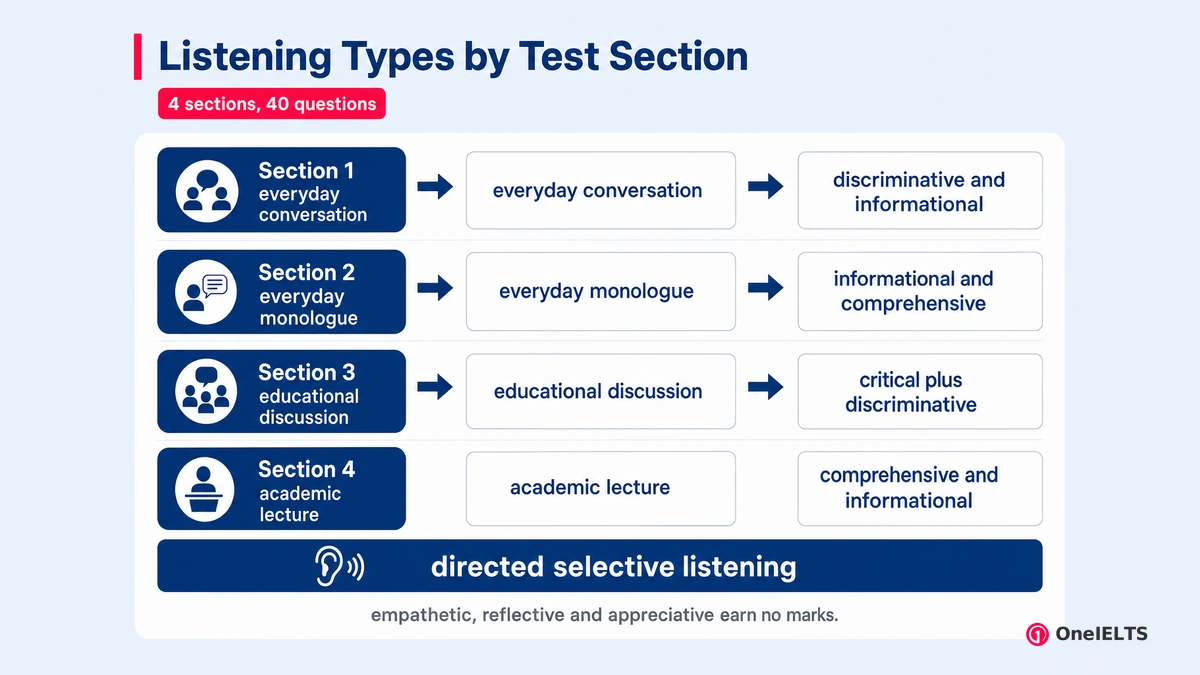
IELTS Listening tests four types directly: discriminative, informational, comprehensive and critical listening, and it requires a directed form of selective listening throughout. The share of each shifts from Section 1 to Section 4. Its four sections (IELTS calls them Parts 1 to 4) hold 40 questions in about 30 minutes, with each recording played once and native-speaker accents from Britain, Australia, New Zealand and North America.
Each section leans on a different mix of types, set out with the reason it needs them.
| Section | Setting and speakers | Listening types demanded | Why that type is needed |
|---|---|---|---|
| Section 1 (Part 1) | Everyday conversation between two speakers, such as booking travel or registering for a club or course. | Discriminative and informational listening, the two types that capture exact sounds and details. | Answers are spelled names, numbers, dates and addresses, where one misheard sound costs the mark. |
| Section 2 (Part 2) | Everyday monologue from one main speaker, such as a guide or a talk about local facilities. | Informational and comprehensive listening, holding the facts while following how the talk is organized. | You follow the order of a talk and the directional language that places rooms, routes and features. |
| Section 3 (Part 3) | Educational discussion between two main speakers, such as two students, perhaps guided by a tutor. | Critical listening, plus discriminative listening for telling the voices apart when speakers take turns. | Answers turn on opinions, agreement, disagreement and the moment a speaker changes their mind. |
| Section 4 (Part 4) | An academic lecture from one speaker on an educational subject, with no second voice to cue answers. | Comprehensive and informational listening, tracking the argument while catching the details each question targets. | Long, structured input is held together by signposting such as “firstly” and “turning now to”. |
Directed selective listening runs through all four sections. Active listening’s respond-and-clarify half can’t apply to a recording, and empathetic, reflective and appreciative listening earn no marks in this test. Test format checked on ielts.org on 7 October 2026.
Is Selective Listening a Weakness or an IELTS Skill?
Both: selective listening is a weakness when bias decides what you hear, and a core IELTS Listening skill when the question decides it. The directed form starts with a question preview: you pick out keywords and listen for those ideas, which usually arrive as a paraphrase or synonyms.
Distractors make undirected listening costly. A speaker says “Tuesday, no, sorry, Thursday”, and a listener who stops at the first match loses the mark. Our IELTS Listening tips cover the full pre-listening routine.
Which Types of Listening Help With Each Question Type?
Map labeling, form completion and the other formats each lean on one or two listening types. Our guide to IELTS Listening question types explains how each format works.
- Form, note, table and flow-chart completion: informational and discriminative listening, for exact details and correct spelling.
- Multiple choice and matching: critical listening, for rejecting distractors and spotting the paraphrased option that really matches.
- Map, plan and diagram labeling: comprehensive listening, for following directions and spatial language across a layout.
- Sentence and summary completion: comprehensive listening, for tracking meaning through paraphrase from the recording to the page.
Short-answer questions, the sixth format on ielts.org, rely on informational listening plus a strict word limit. ielts.org doesn’t list summary completion as a separate type; practice books use that label for a paragraph-length gap-fill.
Which Listening Skills Does Section 1 Test?
Section 1 tests discriminative and informational listening above all, because most of its answers are names, numbers, dates and addresses that turn on a single sound. Minimal pairs cost marks here: thirteen and thirty, fifteen and fifty, B, P and V, M and N, and “double S”. In form completion, one wrong letter in spelled names makes the answer wrong, so the spelling must be heard, not guessed. See IELTS Listening Section 1 for structure.
Is Active Listening Enough for IELTS Listening?
No, active listening builds the attention IELTS Listening needs, but its responding half (nodding, paraphrasing back, asking questions) has no place when a recording plays once. What carries over is sustained concentration and the habit of tracking meaning over single words. Commonly cited active listening skills include paying attention, withholding judgment, reflecting, clarifying, summarizing and sharing; our page on active listening covers them.
How Do You Practice the Listening Types the Test Demands?
Five drills each train one demanded type, while general habits live on our page of listening strategies.
- Discriminative: write down numbers and spelled names from audio, then check every one against the transcript.
- Informational: complete a form or table from a short recording, played once only, like a practice test.
- Comprehensive: write a two-sentence lecture summary after hearing a 5-minute talk without pausing it once.
- Critical: note each speaker’s opinion in a discussion and mark the point where it changes.
- Selective (directed): run a keyword preview of each question, then listen only for paraphrases of those words.
Run the five drills as timed practice with IELTS Listening practice.
Written by Hureen Begum, reviewed 7 October 2026.
Last verified: 7 October 2026