Both PTE Academic and IELTS prove your English to the same universities and visa offices, but they sit on different scales. A PTE to IELTS score conversion reads across an equivalence band rather than a fixed sum.
PTE runs 10-90 and IELTS runs 1-9, so the PTE 10-90 vs IELTS 1-9 gap is exactly why the only safe comparison is the official Pearson concordance, not arithmetic. This guide covers how the two scores compare, the full conversion chart, how to convert a result, whether PTE is easier, how each test is scored and marked, and which test to choose. Last verified: 30 June 2026.
How Do PTE and IELTS Scores Compare?
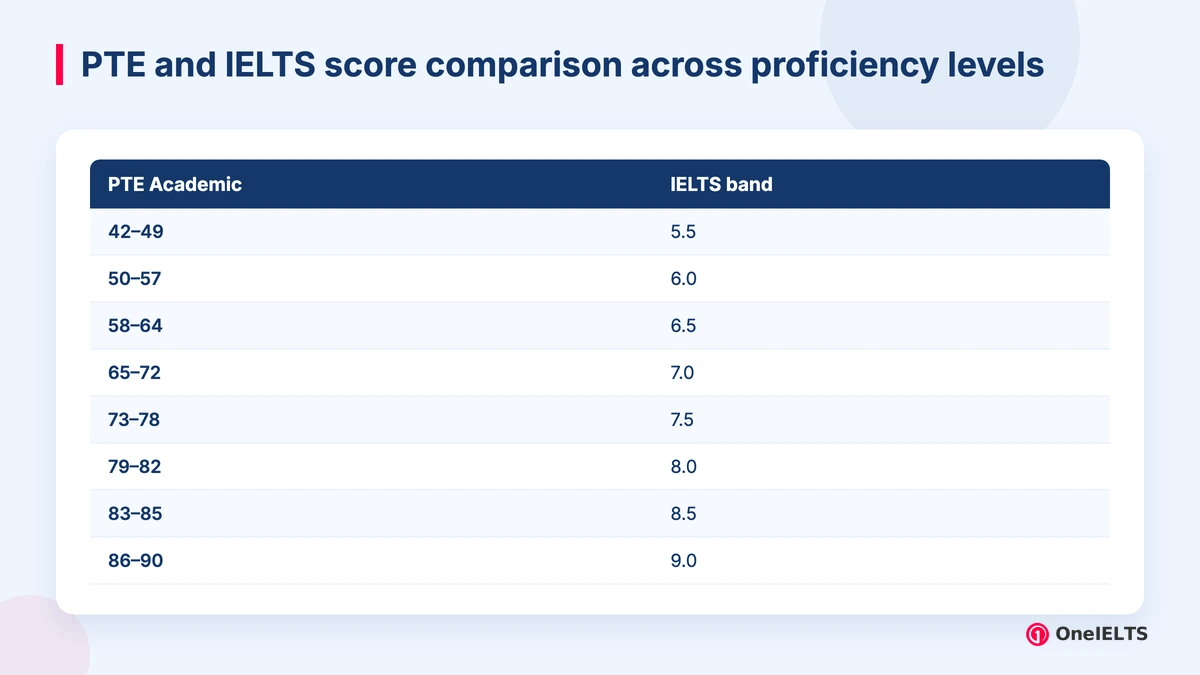
PTE Academic is scored 10 to 90 and IELTS 1 to 9, so the two compare only through an official equivalence band, not a direct formula. The scales were built for different reporting systems, which means a PTE 10 to 90 result and an IELTS band line up by research, not by sharing the same number.
Both tests assess the four skills of listening, reading, speaking and writing, and both are accepted for study and migration across the same destinations. Treat any cross-test number as a band match, since the equivalence band places nearby scores close together without making them identical.
What Is the PTE to IELTS Conversion Chart?
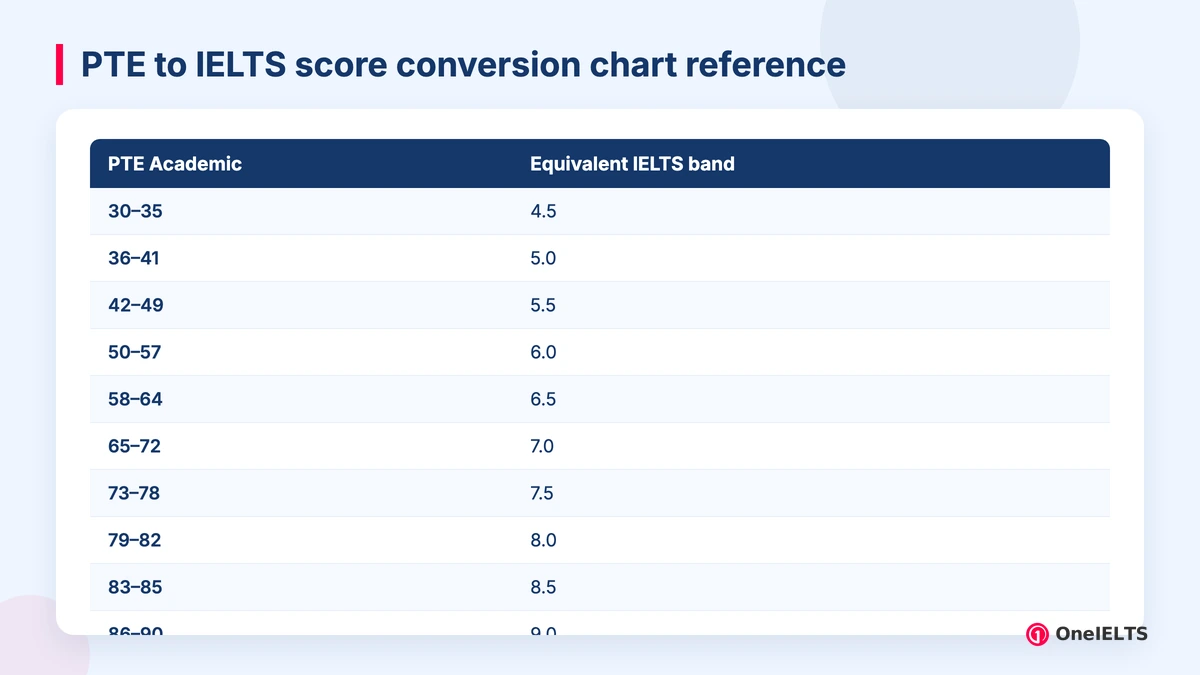
The table below maps each PTE Academic band range to its equivalent IELTS band using Pearson’s official mapping, the same band range that universities and visa offices apply. These figures come from the 2020 Pearson concordance study, so check the captured date before you rely on a borderline row.
| PTE Academic | Equivalent IELTS band |
|---|---|
| 30-35 | 4.5 |
| 36-41 | 5.0 |
| 42-49 | 5.5 |
| 50-57 | 6.0 |
| 58-64 | 6.5 |
| 65-72 | 7.0 |
| 73-78 | 7.5 |
| 79-82 | 8.0 |
| 83-85 | 8.5 |
| 86-90 | 9.0 |
By the Pearson concordance, PTE 65 ~ IELTS 7.0, because a PTE 65 sits at the bottom of the 65-72 range, while IELTS 6.5 corresponds to the 58-64 range just below it.
How Do You Convert a PTE Score to IELTS?
There is no formula that turns a PTE score into an IELTS band — you read the matching row on the official Pearson concordance instead. Find your PTE score within a band range, then read across to the IELTS value.
Pearson has already rounded each equivalent to the nearest half-band, so you never round it yourself. A PTE 60 falls in the 58-64 range and concords to IELTS 6.5, while a PTE 66 crosses into 65-72 and concords to IELTS 7.0. Whatever the chart says, the institution table you are applying to overrides it, because each university and visa route publishes its own accepted-score table.
Is PTE Easier Than IELTS?
Many candidates find PTE more comfortable because it is fully computer-based with AI scoring and no human interviewer, so the speaking section is recorded against a microphone rather than spoken to a person. That suits test-takers who freeze in conversation or prefer a fixed, predictable interface.
IELTS may suit those who are stronger in a face-to-face speaking test, where a live examiner follows a natural exchange and you can read the room. Neither is objectively easier; the gap is about which format matches how you perform under pressure.
How Is PTE Scored and Marked Compared to IELTS?
PTE is fully computer-marked on a 10-90 scale, with an AI engine scoring every section, including speaking and writing. IELTS marks Reading and Listening by an answer key, then sends Writing and Speaking to trained human examiners who score them on the 9-band scale.
That split in marking method is why the two tests need a concordance not formula approach. A machine-scored 10-90 result and a partly human-scored 1-9 result cannot be equated directly, only linked by research. The same PTE score can map slightly differently across skills, because PTE blends integrated tasks while IELTS tests each skill on its own.
Should You Take PTE or IELTS?
Choosing between PTE and IELTS comes down to what your destination accepts and which test format plays to your strengths, not to which one looks easier online. Work through the decision rules in order and stop at the first one that settles it for your case. The four checks that decide most applications are set out here.
- Confirm acceptance first. Check which test your target institution or visa route actually accepts and at what minimum score, since an acceptance check beats any conversion every time.
- Prefer PTE for speed and a screen. If you want a fully computer-based sitting with fast AI scoring and results in days, PTE AI scoring fits applicants on a tight admission or visa deadline.
- Prefer IELTS for reach. If you need the widest acceptance and want a human examiner, the IELTS human speaking interview is recognised by more institutions and immigration bodies worldwide.
- Match the format to your strengths. Pick the test whose tasks suit how you work, because format fit between integrated computer tasks and single-skill paper or screen tasks changes your score more than the brand.
Do Universities Accept PTE and IELTS Equally?
Most universities accept both, but acceptance and minimum scores vary, so always confirm the requirement on the course page before you book. With both accepted in principle, the real bar still varies by institution: a department may set its PTE floor a band higher or lower than the concordance suggests.
Some routes are visa-specific and accept only one test rather than both. What counts as a good IELTS score for one programme can sit below another’s bar, so the published minimum is the only number that binds you.
Which Score Do Universities Trust, PTE or IELTS?
Trust your institution’s own accepted-score table over any general conversion chart, because the admission requirement is the number the university will actually check. A chart is a guide not guarantee of acceptance: it can tell you a PTE 65 sits near IELTS 7.0, yet it cannot promise the university reads it that way.
When the concordance and the institution table disagree, the institution table wins. Confirm the figure against the official IELTS band score scale and the course requirement together.
Practice for the Real IELTS Exam
Apply what you’ve learned with free, exam-style practice:
- Take a full IELTS mock test
- Practice by section: Listening, Reading, Writing, Speaking
- Structure your essays with IELTS Writing templates